
BuddhistCatholicContemplativeEvangelicalGeneral ChristianHinduJewishLatter-day SaintMuslimNew VisionsProgressive Christian
Beliefs
- Buddhist
- Catholic
- Contemplative
- Evangelical
- General Christian
- Hindu
- Jewish
- Latter-day Saint
- More Voices
- Muslim
- New Visions
- Pagan
- Progressive Christian
Topics
- Religion News
- Food and Religion
- Sports and Religion
- Religious Art
- Religious Music and Entertainment
- Religious Events
- History and Religion
- Style and Religion
- Politics and Religion
- Women in Religion
- Recreation Outdoors and Religion
- Business Finance and Religion
- Careers Workplace and Religion
- Education and Religion
- Family Parenting and Religion
- Health Fitness and Religion
- Home and Religion
- Relationships and Religion
- Technology and Religion
- Travel and Religion
Columnists
- Buddhist Columnists
- Business Finance and Religion Columnists
- Careers Workplace and Religion Columnists
- Catholic Columnists
- Contemplative Columnists
- Education and Religion Columnists
- Evangelists Columnists
- Family Parenting and Religion Columnists
- General Christian Columnists
- Health Fitness and Religion Columnists
- Hindu Columnists
- History and Religion Columnists
- Home and Religion Columnists
- Jewish Columnists
- More Voices Columnists
- Latter Day Columnists
- Muslim Columnists
- New Visions Columnists
- Nonreligious Columnists
- Pagan Columnists
- Politics and Religion Columnists
- Progressive Columnists
- Recreation Outdoors and Religion Columnists
- Relationships and Religion Columnists
- Religion News Columnists
- Religious Art Columnists
- Religious Events Columnists
- Religious Music and Entertainment Columnists
- Sports and Religion Columnists
- Style and Religion Columnists
- Technology and Religion Columnists
- Travel and Religion Columnists
- Women in Religion Columnists
Resource Library
- 2026 Calendar
- Library of World Religions
- The 100 Most Holy Places on Earth
- Patheos Answers
- Podcasts
- Videos
- Faith Leaders Database
- Anglican Episcopalian
- Bahai
- Baptist
- Buddhism
- Christianity
- Confucianism
- Eastern Orthodoxy
- Hinduism
- Holiness and Pentecostal
- ISKCON
- Islam
- Judaism
- Lutheran
- Methodist
- The Church of Jesus Christ of Latter-day Saints
- New Age
- Paganism
- Presbytarian and Reformed
- Protestantism
- Religion Behind the Scenes
- Roman Catholic
- Scientology
- Shia Islam
- Sikhism
- Sufism
- Sunni Islam
- Taoism
- Zen
- See all religions
Research Tools
 Ad-Free & Subscriber Log-In Subscription Support
Ad-Free & Subscriber Log-In Subscription Support
Follow Patheos 

- Trending:
- Forgiveness
- |
- Marriage
- |
- Consciousness
- |
- Death Penalty
- |
- Election
- |
- Halloween
 Christian Piatt
- Home
- Progressive Christian
- What Makes a White, Middle-Class Man Kill?
What Makes a White, Middle-Class Man Kill?
Last updated on: July 20, 2012 at 6:46 pm by Christian Piatt
What Makes a White, Middle-Class Man Kill? 2012-07-20T18:46:46+00:00 Christian Piatt
Patheos Explore the world's faith through different perspectives on religion and spirituality! Patheos has the views of the prevalent religions and spiritualities of the world.
I, like many others, was shocked to hear this morning about the mass killing in Aurora, Colorado at a suburban movie theater at the hands of med student James Holmes. Having recently moved form Colorado to Oregon, it tapped into old feelings, recalling back when the Columbine High School killings took place. My wife, Amy, was a youth minister at the time, and one of the girls who had previously been a part of her group had helped the killers buy their guns.
Then there was the attack at New Life Church in Colorado Springs. And now this. It got me thinking about what all of the killers have in common, and for that matter, what they seem to have in common with many of the mass murderers at the focus of such tragic stories. I found this excerpt from David Lohr, a writer known for his interviews and write-ups about notorious criminals:
Typical mass murderers are usually conservative, middle-aged, white males from relatively stable, lower-to-middle-class backgrounds. These individuals usually aspire to more than they can achieve, and when they see their ambitions thwarted, they blame others for their failures. They feel exclusion and develop an irrational, and eventually, homicidal hatred of anyone they consider a hindrance to their own aspirations. Quite often, they choose to die in an eruption of violence directed at these perceived oppressors.
There are three common types of mass murderers: family annihilators, paramilitary enthusiasts, and disgruntled workers. Social areas of dysfunction, such as unemployment, loneliness, a family breakup, or an argument with a supervisor, can trigger their deadly rage.
Though much of what Lohr says makes sense, it still doesn’t explain, for me at least, why so many white, middle-class men seem to be the perpetrators of

these particular crimes. What’s more, I’ve found it difficult to track down any research seeking an answer to this question. It may be out there, but I’ve had a hard time finding it. We have all kinds of theories about inner city violence, gang murders and the like, but what about these “lone wolf” killers, many of whom have no prior record of criminal behavior at all?
But based on my own amateur research, here are some things that may contribute to this curious and disturbing pattern.
Propaganda: Often times, mass murderers have collections of literature from “hate groups” such as white supremacy organizations, separatist groups and other politically extreme networks. Though these groups are generally wary of ordering adherents to exact violence on others, the foundational hatred, militaristic aggression and ideological zealotry are a caustic admixture that can lead to such inevitably deadly outcomes.
Role Models: Consider the profiles of the most notorious mass killers in history – Hitler, Stalin, John Wayne Gacy, Lucky Luciano, Jim Jones, Charles Manson…all white men (European descent). In selecting role models, we tend to look for a bit of ourselves in the people we look up to. Granted, these are stomach-turning role models, but like it or not, some people do look at them as such. So in a sense, it’s a pattern because history has established precedent.
Isolation: It would be hard to plan a mass killing spree in a more communal living space; such planning requires a fair degree of isolation. Generally, people  from middle income families can afford to have their own apartment, or at least their own room that is closed off from others. And consider that suburban life is, in many ways, constructed upon the value of privacy while being surrounded by thousands of people. We can go from our home to our car in the garage to our office and back again without having much, if any, contact with anyone else. This kind of privacy can be fertile ground for unchecked aberrant behavior.
Access: Combine extreme isolation with being inculcated with extreme propaganda, a litany of murderous role models with a healthy disposable income and
lots of free time, and you have someone who can frequent gun shows, pawn shops and the like to collect supplies. These things are expensive, and to be able to buy up so much of it without raising any eyebrows, you have to have access to a good deal of disposable income. Plus, they don’t look “suspicious,” according to the profiles we maintain for what a terrorist is supposed to look like.
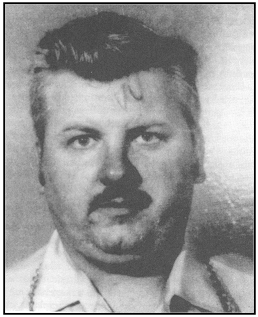 Shock and Awe: If someone is a paranoid narcissist with a victim mentality and a longing to be noticed, they’ll likely go to extremes to get the reaction from society they seek. And although there is this time-tested pattern of white males as mass killers, we still hold up the middle class white male as the archetype of normalcy in the United States, particularly in suburban culture. So for one who is intent on personal and societal destruction, blowing up such archetypes serves their end as well.
No Hope: In a way, it seems absurd to suggest that middle class suburban white men are more susceptible to hopelessness, despair and depression than others. But for those in an oppressive, violent environment, the source of distress is fairly evident. But if you live in an environment where you’re supposed to be happy and content about your life, and yet you’re not, who is to blame? Such internalized hatred can turn into internalized violence which, then, can be expressed outwardly.
So what is our collective responsibility in all of this? We are charged with recognizing and addressing the systemic and individual brokenness all around us. Who do you know that seems isolated, hopeless or in despair? Who among us is at risk of falling through the cracks, their pain and sickness going unnoticed until it’s too late?
This isn’t to say that anyone in these circumstances is at risk for such violent outbursts. Hardly. But aren’t the conditions themselves in which this type of personality germinates, and the pain that accompanies it, cause enough for attention, concern and action?
Previous Post

July 19, 2012
Gospel Coalition's Views on Gender, Sex Aren't "Complementary"
Next Post
July 21, 2012 Farewell, Chick Fil A
Browse Our Archives
Select a Category atonement belief bible Bill O'Reilly Buddhism CCM children christian piatt christianity Contemporary Christian Music current events derek flood Easter education Everyday Sunday faith faith and culture Frank Schaeffer great commission Haaz Sleiman Hobby Lobby Homebrewed Culture humor ISIS Jesus John Paul Lederach Killing Jesus LGBTQ marc driscoll Mission Year Music My Jesus Project Nat Geo parenting politics popular culture postChristian prison reform Ray rice religion republicans sacrifice sexuality theology Uncategorized video violence wild goose festival World Vision young adults
Select a Month December 2017 November 2017 October 2017 September 2017 August 2017 July 2017 June 2017 May 2017 April 2017 March 2017 February 2017 January 2017 November 2016 October 2016 September 2016 August 2016 July 2016 June 2016 May 2016 April 2016 March 2016 February 2016 January 2016 December 2015 November 2015 October 2015 September 2015 August 2015 July 2015 June 2015 May 2015 April 2015 March 2015 February 2015 January 2015 December 2014 November 2014 October 2014 September 2014 August 2014 July 2014 June 2014 May 2014 April 2014 March 2014 February 2014 January 2014 December 2013 November 2013 October 2013 September 2013 August 2013 July 2013 June 2013 May 2013 April 2013 March 2013 February 2013 January 2013 December 2012 November 2012 October 2012 September 2012 August 2012 July 2012 June 2012 May 2012 April 2012 March 2012 February 2012 January 2012 December 2011 November 2011 October 2011 September 2011 August 2011 July 2011 June 2011 May 2011 April 2011 March 2011 February 2011 January 2011 December 2010 November 2010 October 2010 September 2010 August 2010 July 2010 June 2010 May 2010 April 2010 March 2010 February 2010 January 2010 December 2009 November 2009 October 2009 September 2009 August 2009 July 2009 June 2009 May 2009 April 2009 March 2009 February 2009 January 2009 December 2008 November 2008 October 2008 September 2008 August 2008 July 2008 June 2008 May 2008 April 2008 March 2008 February 2008 January 2008 December 2007 November 2007 October 2007 September 2007 August 2007 July 2007 June 2007 May 2007 April 2007 March 2007 February 2007 January 2007 December 2006 November 2006 October 2006 September 2006 August 2006
Follow Us!
TAKE THE
Religious Wisdom Quiz
What does Romans say about the mind governed by the flesh versus the mind governed by the Spirit?
Select your answer to see how you score.
The flesh seeks itself, but the Spirit seeks God The flesh leads to sin, but the Spirit leads to righteousness The mind governed by the flesh is death, but the mind governed by the Spirit is life and peace The flesh is weak, but the Spirit is strong
Related posts from Christian Piatt

Are We There Yet? (Second Week in Advent...

Look, Shiny! (First Week of Advent Study)


This Episode is (Kinda) a Matter of Life...
TRENDING AT PATHEOS Progressive Christian

What Being a Modern-Day Apostle Means to Me
In my last column, I discussed the ins and outs of modern-day...

Did Ancient China Once Worship the God of...
Across human history, a common thread weaves through the origins of the...

Love Your Neighbor – Including Earth-Kin: Lev. 19,...
God’s command to love your neighbor means acting in an ethical and...

Lead a Church Study of “Jesus and Lao...
Guest writer Jack Thomas (The Irreverent Reverend) reflects on leading his church...

Pastoral Wisdom for Responding to Sermon Pushback
Getting sermon pushback on your social justice sermon? Learn practical, Proverbs-based strategies...

Principles for Understanding the Apostolic Ministry Today
Whenever people discover that my formal ministry title is "apostle," as in...
view all Progressive Christian blogs
Ad-Free & Subscriber Log-In Subscription Support
- About Us
- 2026 Calendar
- Videos
- Podcasts
- Library of World Religions
- Faith In Media Tracker
- Advertise With Us
- Write for Us
- Privacy Policy
- Terms of Service
- Do Not Sell My Data
- Contact Us
- Radiant Digital
- Manage Newsletter Subscriptions
- Unsubscribe From Notifications
- Sitemap
Copyright 2008-2026, Patheos. All rights reserved.
Subscription Support Ad-Free & Subscriber Log-In
Follow Patheos