
BuddhistCatholicContemplativeEvangelicalGeneral ChristianHinduJewishLatter-day SaintMuslimNew VisionsProgressive Christian
Beliefs
- Buddhist
- Catholic
- Contemplative
- Evangelical
- General Christian
- Hindu
- Jewish
- Latter-day Saint
- More Voices
- Muslim
- New Visions
- Pagan
- Progressive Christian
Topics
- Religion News
- Food and Religion
- Sports and Religion
- Religious Art
- Religious Music and Entertainment
- Religious Events
- History and Religion
- Style and Religion
- Politics and Religion
- Women in Religion
- Recreation Outdoors and Religion
- Business Finance and Religion
- Careers Workplace and Religion
- Education and Religion
- Family Parenting and Religion
- Health Fitness and Religion
- Home and Religion
- Relationships and Religion
- Technology and Religion
- Travel and Religion
Columnists
- Buddhist Columnists
- Business Finance and Religion Columnists
- Careers Workplace and Religion Columnists
- Catholic Columnists
- Contemplative Columnists
- Education and Religion Columnists
- Evangelists Columnists
- Family Parenting and Religion Columnists
- General Christian Columnists
- Health Fitness and Religion Columnists
- Hindu Columnists
- History and Religion Columnists
- Home and Religion Columnists
- Jewish Columnists
- More Voices Columnists
- Latter Day Columnists
- Muslim Columnists
- New Visions Columnists
- Nonreligious Columnists
- Pagan Columnists
- Politics and Religion Columnists
- Progressive Columnists
- Recreation Outdoors and Religion Columnists
- Relationships and Religion Columnists
- Religion News Columnists
- Religious Art Columnists
- Religious Events Columnists
- Religious Music and Entertainment Columnists
- Sports and Religion Columnists
- Style and Religion Columnists
- Technology and Religion Columnists
- Travel and Religion Columnists
- Women in Religion Columnists
Resource Library
- 2026 Calendar
- Library of World Religions
- The 100 Most Holy Places on Earth
- Patheos Answers
- Podcasts
- Videos
- Faith Leaders Database
- Anglican Episcopalian
- Bahai
- Baptist
- Buddhism
- Christianity
- Confucianism
- Eastern Orthodoxy
- Hinduism
- Holiness and Pentecostal
- ISKCON
- Islam
- Judaism
- Lutheran
- Methodist
- The Church of Jesus Christ of Latter-day Saints
- New Age
- Paganism
- Presbytarian and Reformed
- Protestantism
- Religion Behind the Scenes
- Roman Catholic
- Scientology
- Shia Islam
- Sikhism
- Sufism
- Sunni Islam
- Taoism
- Zen
- See all religions
Research Tools
 Ad-Free & Subscriber Log-In Subscription Support
Ad-Free & Subscriber Log-In Subscription Support
Follow Patheos 

- Trending:
- Forgiveness
- |
- Marriage
- |
- Consciousness
- |
- Death Penalty
- |
- Election
- |
- Halloween
 Christian Piatt
- Home
- Progressive Christian
- WWJB (What Would Jesus Brew)? Tapping Our Franciscan Roots
WWJB (What Would Jesus Brew)? Tapping Our Franciscan Roots
Last updated on: June 19, 2012 at 5:58 pm by Christian Piatt
WWJB (What Would Jesus Brew)? Tapping Our Franciscan Roots 2012-06-19T17:58:33+00:00 Christian Piatt
Patheos Explore the world's faith through different perspectives on religion and spirituality! Patheos has the views of the prevalent religions and spiritualities of the world.
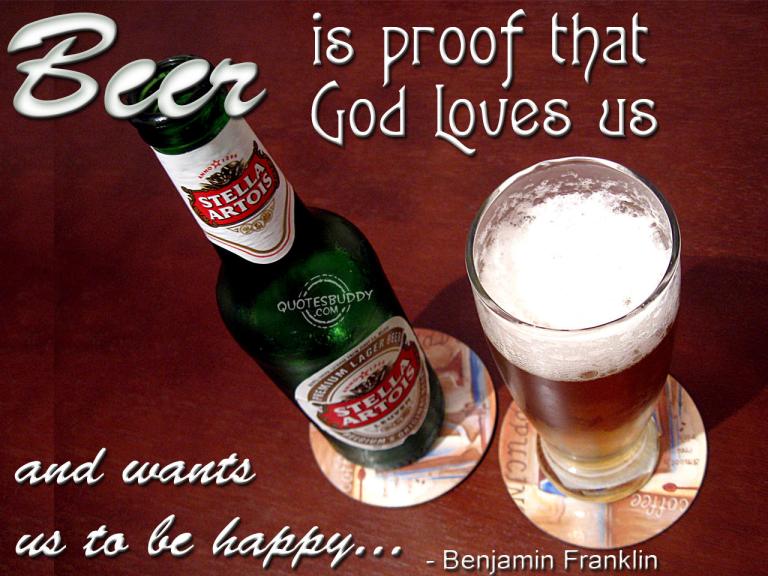 There’s a well-known saying, often attributed to Ben Franklin, about God and beer. I’ve even seen it on T-shirts and the like, but it turns out it’s mis-quoted. The one I see and hear is generally some derivation of, “beer is evidence that God loves us and wants us to be happy.” However, on further, tireless research, I discovered this blurb from a letter penned by Franklin in Paris around 1779:
We hear of the conversion of water into wine at the marriage in Cana as of a miracle. But this conversion is, through the goodness of God, made every day before our eyes. Behold the rain which descends from heaven upon our vineyards; there it enters the roots of the vines, to be changed into wine; a constant proof that God loves us, and loves to see us happy. The miracle in question was only performed to hasten the operation, under circumstances of present necessity, which required it.
Though I always found the mis-quoted version clever, as well as an intellectual justification for drinking, I actually like the real quote much better. Franklin, pointing to the story of Jesus turning water into wine, acknowledges the miracle of the processes of nature itself, taking natural sugars and recombining them into an (ahem) intoxicating elixir that has been a staple of global culture for millennia.
And then the religious folks came along and tried to ruin the fun for everyone. Having grown up Baptist, I heard some of my fellow faithful proclaim the evils of demon alcohol, though their warnings seemed to do little to stem folks’ drinking, aside from pushing them to do it more privately. Then I met some Anglican and Jewish friends who appreciated the fruit of the vine around the dinner table. I was shocked – and more than a little intrigued – when I saw kids under the age of twenty-one taking part in the ritual wine drinking as part of a Jewish Seder meal, and I was in awe when I realized some churches used real wine in their worship services.
So which is it? Is alcohol the lynchpin of the decline of civilization, or is it a sacrament, not only to be enjoyed, but to be held up as a gift from the Almighty?
Well, yes.
There’s been a surge of interest in so-called “theology on tap” or “pub theology” events among faith leaders in recent years. I’ve even done a few myself. The idea is consistent with the missional church model, intent on blurring the lines between the sacred and secular, blending the two together in a way that, hopefully, brings a little bit more richness and relevance to both. It helps foster a more relaxed peer environment, while also implicitly telling passersby, “hey, we religious folk aren’t all morally superior stuffed shirts; we’re pretty much like you.”
Is there a downside? Yes. In Colorado, we had a core family leave the church after a pub theology night, followed by wine served at our own “Goy” Seder meal during Passover. The husband was recently in recovery for alcoholism and he felt his sobriety was being threatened by the presence of alcohol in what he felt should have been a safe space for him at church.
I also remember an awkward moment at one of the pub nights when a guy from church whom I considered do be a practicing alcoholic threw back an uncomfortable number of pints while we discussed that nights Bible passage.
Both of these present reasonable arguments against having any kind of drinking associated with church. I get that. But there’s also something to be said both for reaching out into the “real world” with our faith (seems something Jesus did quite frequently), while also distinguishing ourselves from the sort of puritanical prohibitionism often associated with Christianity.
The message many pick up from what they know of the Christian faith is that it’s a practice of subtraction, not addition. We’re going to get you to part with your time, your money and all of the fun things you enjoy in life. Somewhere along the way, we got remarkably off point with our “branding,” failing to show folks how a connection to a faith community and religious practices can actually enrich a life, whether it is void of meaning or already relatively rich.
 Does alcohol make our faith better? That might be a tough one to argue, but in as much as it’s a powerful presence not only in our contemporary culture, but throughout the spectrum of recorded history, it’s a part of who we are as a people. But it seems to me that placing our focus on drinking in particular misses the larger sicknesses among us. Consider how we treat food, even in our churches. Consider the time, money and energy we invest into self-aggrandizing monuments to self that we claim are for the glory of God, or the special attention or deference we afford that family who writes the bigger checks on Sunday. Or our addiction to information, our obsession with ego, or our obsession with sex.
Actually, churches have a field day condemning that last one; they just generally lack any skills to talk about how to deal with sexuality in a healthier way. And the same could be said about our approach to alcohol. Easier simply to apply a plenary blessing or condemnation to the object of our attention than to deal with our complex relationship with it. Easier to “just say no” than do delve into whether our drinking (or spending, or sex, eating, etc) is a stumbling block that creates further distance between us, God and our loved ones.
There will always be detractors, no matter what. Jesus was called a drunkard for imbibing in public. The power that things like alcohol, money or sex have over some people scares the hell out of them, and I understand that. But to think that closing our eyes and holding the object of desire at arms-length will purge us of such “demons” is naive. Yes, Jesus drank; he also took his demons head-on. From what I see in scripture, he never used drinking to avoid his problems or fears.
So is it Biblical to drink? Did God give us the mysterious elixir as a gesture of love? Sounds like a good topic for a future pub theology night to me.
Previous Post

June 18, 2012
Mad Men, Catholics and a "Moral Revolution"
Next Post
June 20, 2012 Love Greater Than Our Differences: My Interview on ChurchNext
Browse Our Archives
Select a Category atonement belief bible Bill O'Reilly Buddhism CCM children christian piatt christianity Contemporary Christian Music current events derek flood Easter education Everyday Sunday faith faith and culture Frank Schaeffer great commission Haaz Sleiman Hobby Lobby Homebrewed Culture humor ISIS Jesus John Paul Lederach Killing Jesus LGBTQ marc driscoll Mission Year Music My Jesus Project Nat Geo parenting politics popular culture postChristian prison reform Ray rice religion republicans sacrifice sexuality theology Uncategorized video violence wild goose festival World Vision young adults
Select a Month December 2017 November 2017 October 2017 September 2017 August 2017 July 2017 June 2017 May 2017 April 2017 March 2017 February 2017 January 2017 November 2016 October 2016 September 2016 August 2016 July 2016 June 2016 May 2016 April 2016 March 2016 February 2016 January 2016 December 2015 November 2015 October 2015 September 2015 August 2015 July 2015 June 2015 May 2015 April 2015 March 2015 February 2015 January 2015 December 2014 November 2014 October 2014 September 2014 August 2014 July 2014 June 2014 May 2014 April 2014 March 2014 February 2014 January 2014 December 2013 November 2013 October 2013 September 2013 August 2013 July 2013 June 2013 May 2013 April 2013 March 2013 February 2013 January 2013 December 2012 November 2012 October 2012 September 2012 August 2012 July 2012 June 2012 May 2012 April 2012 March 2012 February 2012 January 2012 December 2011 November 2011 October 2011 September 2011 August 2011 July 2011 June 2011 May 2011 April 2011 March 2011 February 2011 January 2011 December 2010 November 2010 October 2010 September 2010 August 2010 July 2010 June 2010 May 2010 April 2010 March 2010 February 2010 January 2010 December 2009 November 2009 October 2009 September 2009 August 2009 July 2009 June 2009 May 2009 April 2009 March 2009 February 2009 January 2009 December 2008 November 2008 October 2008 September 2008 August 2008 July 2008 June 2008 May 2008 April 2008 March 2008 February 2008 January 2008 December 2007 November 2007 October 2007 September 2007 August 2007 July 2007 June 2007 May 2007 April 2007 March 2007 February 2007 January 2007 December 2006 November 2006 October 2006 September 2006 August 2006
Follow Us!
TAKE THE
Religious Wisdom Quiz
How did Jesus die?
Select your answer to see how you score.
Crucifixion Spearing Stoning Hanging
Related posts from Christian Piatt

More Than Jezebel (Third Week Advent Devotional)

Are We There Yet? (Second Week in Advent...

Look, Shiny! (First Week of Advent Study)

TRENDING AT PATHEOS Progressive Christian

What Being a Modern-Day Apostle Means to Me
In my last column, I discussed the ins and outs of modern-day...

Did Ancient China Once Worship the God of...
Across human history, a common thread weaves through the origins of the...

Love Your Neighbor – Including Earth-Kin: Lev. 19,...
God’s command to love your neighbor means acting in an ethical and...

Lead a Church Study of “Jesus and Lao...
Guest writer Jack Thomas (The Irreverent Reverend) reflects on leading his church...

Pastoral Wisdom for Responding to Sermon Pushback
Getting sermon pushback on your social justice sermon? Learn practical, Proverbs-based strategies...

Principles for Understanding the Apostolic Ministry Today
Whenever people discover that my formal ministry title is "apostle," as in...
view all Progressive Christian blogs
Ad-Free & Subscriber Log-In Subscription Support
- About Us
- 2026 Calendar
- Videos
- Podcasts
- Library of World Religions
- Faith In Media Tracker
- Advertise With Us
- Write for Us
- Privacy Policy
- Terms of Service
- Do Not Sell My Data
- Contact Us
- Radiant Digital
- Manage Newsletter Subscriptions
- Unsubscribe From Notifications
- Sitemap
Copyright 2008-2026, Patheos. All rights reserved.
Subscription Support Ad-Free & Subscriber Log-In
Follow Patheos