
BuddhistCatholicContemplativeEvangelicalGeneral ChristianHinduJewishLatter-day SaintMuslimNew VisionsProgressive Christian
Beliefs
- Buddhist
- Catholic
- Contemplative
- Evangelical
- General Christian
- Hindu
- Jewish
- Latter-day Saint
- More Voices
- Muslim
- New Visions
- Pagan
- Progressive Christian
Topics
- Religion News
- Food and Religion
- Sports and Religion
- Religious Art
- Religious Music and Entertainment
- Religious Events
- History and Religion
- Style and Religion
- Politics and Religion
- Women in Religion
- Recreation Outdoors and Religion
- Business Finance and Religion
- Careers Workplace and Religion
- Education and Religion
- Family Parenting and Religion
- Health Fitness and Religion
- Home and Religion
- Relationships and Religion
- Technology and Religion
- Travel and Religion
Columnists
- Buddhist Columnists
- Business Finance and Religion Columnists
- Careers Workplace and Religion Columnists
- Catholic Columnists
- Contemplative Columnists
- Education and Religion Columnists
- Evangelists Columnists
- Family Parenting and Religion Columnists
- General Christian Columnists
- Health Fitness and Religion Columnists
- Hindu Columnists
- History and Religion Columnists
- Home and Religion Columnists
- Jewish Columnists
- More Voices Columnists
- Latter Day Columnists
- Muslim Columnists
- New Visions Columnists
- Nonreligious Columnists
- Pagan Columnists
- Politics and Religion Columnists
- Progressive Columnists
- Recreation Outdoors and Religion Columnists
- Relationships and Religion Columnists
- Religion News Columnists
- Religious Art Columnists
- Religious Events Columnists
- Religious Music and Entertainment Columnists
- Sports and Religion Columnists
- Style and Religion Columnists
- Technology and Religion Columnists
- Travel and Religion Columnists
- Women in Religion Columnists
Resource Library
- 2026 Calendar
- Library of World Religions
- The 100 Most Holy Places on Earth
- Patheos Answers
- Podcasts
- Videos
- Faith Leaders Database
- Anglican Episcopalian
- Bahai
- Baptist
- Buddhism
- Christianity
- Confucianism
- Eastern Orthodoxy
- Hinduism
- Holiness and Pentecostal
- ISKCON
- Islam
- Judaism
- Lutheran
- Methodist
- The Church of Jesus Christ of Latter-day Saints
- New Age
- Paganism
- Presbytarian and Reformed
- Protestantism
- Religion Behind the Scenes
- Roman Catholic
- Scientology
- Shia Islam
- Sikhism
- Sufism
- Sunni Islam
- Taoism
- Zen
- See all religions
Research Tools
 Ad-Free & Subscriber Log-In Subscription Support
Ad-Free & Subscriber Log-In Subscription Support
Follow Patheos 

- Trending:
- Forgiveness
- |
- Marriage
- |
- Consciousness
- |
- Death Penalty
- |
- Election
- |
- Halloween
 Christian Piatt
- Home
- Progressive Christian
- Blue Like Jazz: I Was Donald Miller
Blue Like Jazz: I Was Donald Miller
Last updated on: March 22, 2012 at 3:22 pm by Christian Piatt
Blue Like Jazz: I Was Donald Miller 2012-03-22T15:22:02+00:00 Christian Piatt
Patheos Explore the world's faith through different perspectives on religion and spirituality! Patheos has the views of the prevalent religions and spiritualities of the world.
 I was Donald Miller.
Once upon a time, a lot of us were. Some of us still are.
I, too, grew up in the church. Then it hurt me. So I walked away — injured, disillusioned, and pissed off.
I, too, went away to college and left my faith behind me, with no intention of ever looking back.
I, too, met an beautiful young woman who showed me a different side of what life as a follower of Jesus could be.
And though my journey has been nothing as remarkable as Miller’s, it’s no less improbable.
As the old song goes, I once was lost, but…well, you know.
My journey took an even more unlikely turn this week when I had opportunity to sit down with 40-year-old Miller, whose Blue Like Jazz memoir has sold more than 1.5 million copies (and counting) since its publication in 2003, to talk about the book, his faith journey and the new film of the same name, which is set to hit 100 screens in 25 cities nationwide on April 13.
Joining us in the conversation Monday in Colorado Springs were Steve Taylor — the renowned rock musician and producer/director of the 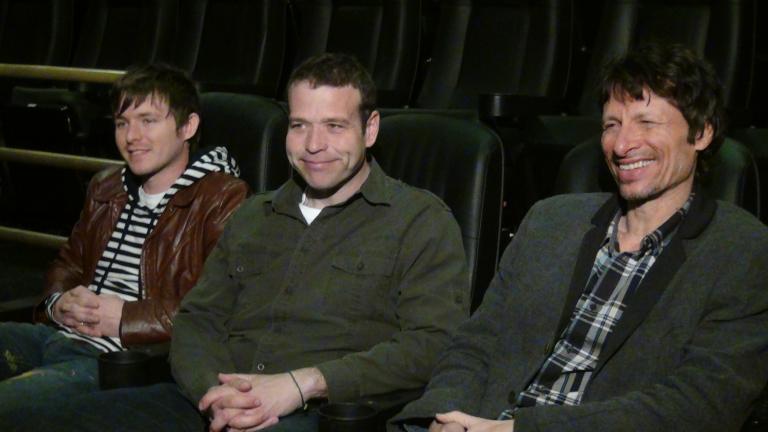 film — and Marshall Allman, the fresh-faced actor who plays “Don” in the film. Allman, 27, has appeared most recently in the HBO series True Blood and in Prison Break on Fox.
“There was a time,” Taylor, 54, says, “when I couldn’t imagine my life without this film getting made, which isn’t a good place to live for a Christian.”
But it was this same consuming passion that drove both him and Miller to persevere when failure seemed certain and the project was all but DOA
In fact, Miller announced as much on his blog when the project fell $250,000 short of their fundraising goal, with less than a month left to secure the needed funds. That’s when an idealistic pair of young men from Nashville approached Taylor and Miller with the idea of creating a Kickstarter campaign to “crowdsource” funding from fans who couldn’t simply let the movie idea die.
The result? More than $300,000 in pledges poured in the weeks following the launch of the Kickstarter campaign. Taylor promised to contact each supporter personally, though he hadn’t anticipated the final list would grow to include more than 3,000 names.
“It took months,” Taylor says, “but I feel like I’ve made several thousand new friends in the process.”
Each donor also received an Associate Producer title, and is listed in the final credits of the film. “We broke two records, I think,” Taylor says, smiling. “Not only was this the biggest fundraiser for a movie in the history of the Kickstarter website, we also win the award for most associate producers ever credited in a major motion picture.
“Right now I am soaking in unearned grace,” he says about the entire experience seeing the film go from concept to reality, “and I do not take it for granted.”
In our conversation, the four of us talked about unearned grace (of which each of them has much), our collective understanding of the nature of God (of which we all agreed we have very little) and about the insanity of making a Hollywood film on an indie budget.
How do you navigate such a David vs Goliath conundrum?
 “You hire Steve Taylor to direct your film and he loses his mind,” Miller says.
Many of the creative forces behind the film, including Miller himself, accepted little or no money to get the movie made. That combined with the miraculous grassroots fundraising and a battalion of volunteer promoters in dozens of major cities, mean that this “little-story-that-could” will reach many thousands — if not millions — of viewers who long to hear that they are not alone in their tumultuous, doubt-riddled, hardly-perfect journey of faith.
Will we ever get it right? It’s of little consequence to Miller.
“There are people who struggle with not being understood; God is not one of them,” he says. “(God) isn’t crying himself to sleep at night, saying, ‘They just don’t get me.’”
“I think I’ve let go of some control,” Miller continues. “I actually find a lot of comfort in the fact that (God) is bigger than anything I could possibly understand or get my mind wrapped around. And that makes me think things are going to be OK.”
So how do you take a book of ruminations, anecdotes and reflections, about a faith based on something that is largely incomprehensible and indescribable? Much like in jazz, you improvise.
“When you adapt a book for film,” Miller explains, “you have to change the structure of the story. You have to consolidate characters, because reality doesn’t play well on film.”
For example, though the characters of Don and Penny remain largely faithful to real life (give or take some biographical details), there are new characters, such as “The Pope,” that don’t appear in the book at all.
Though Reed College does have a tradition of the student body electing one student to be the satirical religious figurehead for the school each year, the Pope in the movie “represents the entirety of the student body for us … all of the characteristics of the average ‘Reedie,’” Miller says.
The ersatz pontiff is one of the many points of friction for Don’s character in Blue Like Jazz. They are catalysts and opponents, propelling  him as he strives to discover who he is and what he believes, independent of the religion of his childhood.
There are a few moments in the film where it’s clear the creative aspirations of the filmmakers exceeded their modest budget.
For example, there is an animated travel montage of Don as a rabbit making his cross-country trek to Portland. Toy Story it’s not. But in some sense the contrived imagery adds to the dissonance between reality and fiction — a leitmotif the filmmakers employ from beginning to end.
In total, the story works — and not just because the characters are believable, the music is great, and the message is sincere and relevant.
The story works because it’s a story many of us understand.
I have been Donald Miller. Maybe you have, too. Chances are you’ve loved a Donald Miller, had him break your heart, or seen him wrestle angels (or demons) and perhaps emerge a changed man — different, seasoned, healed.
Or not.
Love or hate it, we can’t honestly argue with someone else’s story. It is his story, his memory and experiences, even when it seems like they could be ours.
We may choose to embrace a it as part of our own or dismiss it as irrelevant. But how we interact with a story neither enhances nor diminishes it.
People feel strongly about Miller and his story, and they will have strong feelings about his movie.
Feel about it how you will. It’s a story that needed to be told.
For my video interview with Donald Miller, Steve Taylor and Marshall Allman, CLICK HERE.
For my webcast interview with Steve Taylor and Marshall Allman from South by Southwest, CLICK HERE.
Previous Post

March 21, 2012
Dear Ann Coulter: Stop Making Sense
Browse Our Archives
Select a Category atonement belief bible Bill O'Reilly Buddhism CCM children christian piatt christianity Contemporary Christian Music current events derek flood Easter education Everyday Sunday faith faith and culture Frank Schaeffer great commission Haaz Sleiman Hobby Lobby Homebrewed Culture humor ISIS Jesus John Paul Lederach Killing Jesus LGBTQ marc driscoll Mission Year Music My Jesus Project Nat Geo parenting politics popular culture postChristian prison reform Ray rice religion republicans sacrifice sexuality theology Uncategorized video violence wild goose festival World Vision young adults
Select a Month December 2017 November 2017 October 2017 September 2017 August 2017 July 2017 June 2017 May 2017 April 2017 March 2017 February 2017 January 2017 November 2016 October 2016 September 2016 August 2016 July 2016 June 2016 May 2016 April 2016 March 2016 February 2016 January 2016 December 2015 November 2015 October 2015 September 2015 August 2015 July 2015 June 2015 May 2015 April 2015 March 2015 February 2015 January 2015 December 2014 November 2014 October 2014 September 2014 August 2014 July 2014 June 2014 May 2014 April 2014 March 2014 February 2014 January 2014 December 2013 November 2013 October 2013 September 2013 August 2013 July 2013 June 2013 May 2013 April 2013 March 2013 February 2013 January 2013 December 2012 November 2012 October 2012 September 2012 August 2012 July 2012 June 2012 May 2012 April 2012 March 2012 February 2012 January 2012 December 2011 November 2011 October 2011 September 2011 August 2011 July 2011 June 2011 May 2011 April 2011 March 2011 February 2011 January 2011 December 2010 November 2010 October 2010 September 2010 August 2010 July 2010 June 2010 May 2010 April 2010 March 2010 February 2010 January 2010 December 2009 November 2009 October 2009 September 2009 August 2009 July 2009 June 2009 May 2009 April 2009 March 2009 February 2009 January 2009 December 2008 November 2008 October 2008 September 2008 August 2008 July 2008 June 2008 May 2008 April 2008 March 2008 February 2008 January 2008 December 2007 November 2007 October 2007 September 2007 August 2007 July 2007 June 2007 May 2007 April 2007 March 2007 February 2007 January 2007 December 2006 November 2006 October 2006 September 2006 August 2006
Follow Us!
TAKE THE
Religious Wisdom Quiz
Who was King Saul's father?
Select your answer to see how you score.
Kish Methuselah Rehoboam Job
Related posts from Christian Piatt

More Than Jezebel (Third Week Advent Devotional)

Are We There Yet? (Second Week in Advent...

Look, Shiny! (First Week of Advent Study)

TRENDING AT PATHEOS Progressive Christian

Why Christians Have a Sacred Duty to Vote:...
The Bible offers strong support for the sacred duty to vote. Here...

What Being a Modern-Day Apostle Means to Me
In my last column, I discussed the ins and outs of modern-day...

Did Ancient China Once Worship the God of...
Across human history, a common thread weaves through the origins of the...

Love Your Neighbor – Including Earth-Kin: Lev. 19,...
God’s command to love your neighbor means acting in an ethical and...

Lead a Church Study of “Jesus and Lao...
Guest writer Jack Thomas (The Irreverent Reverend) reflects on leading his church...

Principles for Understanding the Apostolic Ministry Today
Whenever people discover that my formal ministry title is "apostle," as in...
view all Progressive Christian blogs
Ad-Free & Subscriber Log-In Subscription Support
- About Us
- 2026 Calendar
- Videos
- Podcasts
- Library of World Religions
- Faith In Media Tracker
- Advertise With Us
- Write for Us
- Privacy Policy
- Terms of Service
- Do Not Sell My Data
- Contact Us
- Radiant Digital
- Manage Newsletter Subscriptions
- Unsubscribe From Notifications
- Sitemap
Copyright 2008-2026, Patheos. All rights reserved.
Subscription Support Ad-Free & Subscriber Log-In
Follow Patheos