
BuddhistCatholicContemplativeEvangelicalGeneral ChristianHinduJewishLatter-day SaintMuslimNew VisionsProgressive Christian
Beliefs
- Buddhist
- Catholic
- Contemplative
- Evangelical
- General Christian
- Hindu
- Jewish
- Latter-day Saint
- More Voices
- Muslim
- New Visions
- Pagan
- Progressive Christian
Topics
- Religion News
- Food and Religion
- Sports and Religion
- Religious Art
- Religious Music and Entertainment
- Religious Events
- History and Religion
- Style and Religion
- Politics and Religion
- Women in Religion
- Recreation Outdoors and Religion
- Business Finance and Religion
- Careers Workplace and Religion
- Education and Religion
- Family Parenting and Religion
- Health Fitness and Religion
- Home and Religion
- Relationships and Religion
- Technology and Religion
- Travel and Religion
Columnists
- Buddhist Columnists
- Business Finance and Religion Columnists
- Careers Workplace and Religion Columnists
- Catholic Columnists
- Contemplative Columnists
- Education and Religion Columnists
- Evangelists Columnists
- Family Parenting and Religion Columnists
- General Christian Columnists
- Health Fitness and Religion Columnists
- Hindu Columnists
- History and Religion Columnists
- Home and Religion Columnists
- Jewish Columnists
- More Voices Columnists
- Latter Day Columnists
- Muslim Columnists
- New Visions Columnists
- Nonreligious Columnists
- Pagan Columnists
- Politics and Religion Columnists
- Progressive Columnists
- Recreation Outdoors and Religion Columnists
- Relationships and Religion Columnists
- Religion News Columnists
- Religious Art Columnists
- Religious Events Columnists
- Religious Music and Entertainment Columnists
- Sports and Religion Columnists
- Style and Religion Columnists
- Technology and Religion Columnists
- Travel and Religion Columnists
- Women in Religion Columnists
Resource Library
- 2026 Calendar
- Library of World Religions
- The 100 Most Holy Places on Earth
- Patheos Answers
- Podcasts
- Videos
- Faith Leaders Database
- Anglican Episcopalian
- Bahai
- Baptist
- Buddhism
- Christianity
- Confucianism
- Eastern Orthodoxy
- Hinduism
- Holiness and Pentecostal
- ISKCON
- Islam
- Judaism
- Lutheran
- Methodist
- The Church of Jesus Christ of Latter-day Saints
- New Age
- Paganism
- Presbytarian and Reformed
- Protestantism
- Religion Behind the Scenes
- Roman Catholic
- Scientology
- Shia Islam
- Sikhism
- Sufism
- Sunni Islam
- Taoism
- Zen
- See all religions
Research Tools
 Ad-Free & Subscriber Log-In Subscription Support
Ad-Free & Subscriber Log-In Subscription Support
Follow Patheos 

- Trending:
- Forgiveness
- |
- Marriage
- |
- Consciousness
- |
- Death Penalty
- |
- Election
- |
- Halloween
 Christian Democracy
- Home
- Catholic
- Politics and Religion
- What’s Wrong With Socialism? (Part 6)
What’s Wrong With Socialism? (Part 6)
Last updated on: October 7, 2018 at 7:13 pm by Jack Quirk
What’s Wrong With Socialism? (Part 6) 2018-10-07T19:13:21-05:00 Jack Quirk
Patheos Explore the world's faith through different perspectives on religion and spirituality! Patheos has the views of the prevalent religions and spiritualities of the world.
In setting forth his objections to Socialism in Quadragesimo anno [1], Pope Pius XI touched upon another political economic idea that was gaining currency in his day, but was not at that time being called “Socialism.” It ought to be considered in this series, however, because it would be recognized as a form of Socialism today.
There was extant then, as now, the misanthropic doctrine that “all accumulation of capital falls by an absolutely insuperable economic law to the rich, and that by the same law the workers are given over and bound to perpetual want, to the scantiest of livelihoods.” (Ibid, no. 54) This idea has always had to be backed up with force, so the notion that such a state of affairs is as natural as plants growing is patently ludicrous to the minimally observant eye.
 But there have been those who have argued for “the equally fictitious moral principle that all products and profits, save only enough to repair and renew capital, belong by very right to the workers. This error, much more specious than that of certain of the Socialists who hold that whatever serves to produce goods ought to be transferred to the State, or, as they say ‘socialized,’ is consequently all the more dangerous and the more apt to deceive the unwary.” (Ibid, no. 55)
This, too, would work an injustice, because the truth is that neither “’capital can do without labor, nor labor without capital,’” and “it is wholly false to ascribe to property alone or to labor alone whatever has been obtained through the combined effort of both, and it is wholly unjust for either, denying the efficacy of the other, to arrogate to itself whatever has been produced.” (Ibid, no. 53)
It is not capital ownership, as such, that produces injustice, but the failure to recognize and reward the labor contribution to production. And while it is undeniable that a lop-sided income distribution is a problem in the United States, the remedy is to fix the distribution, not dispossess one class for the supposed benefit of the other.
“…the riches that economic-social developments constantly increase ought to be so distributed among individual persons and classes that the common advantage of all…will be safeguarded; in other words, that the common good of all society will be kept inviolate. By this law of social justice, one class is forbidden to exclude the other from sharing in the benefits. Hence the class of the wealthy violates this law no less, when, as if free from care on account of its wealth, it thinks it the right order of things for it to get everything and the worker nothing, than does the non-owning working class when, angered deeply at outraged justice and too ready to assert wrongly the one right it is conscious of, it demands for itself everything as if produced by its own hands, and attacks and seeks to abolish, therefore, all property and returns or incomes, of whatever kind they are or whatever the function they perform in human society, that have not been obtained by labor, and for no other reason save that they are of such a nature.” (Ibid, no. 57)
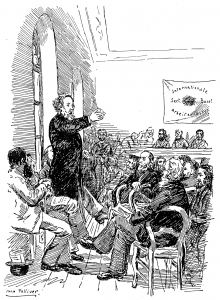 Those who argue passionately for the abolition of ownership on the part of anyone but workers seem to ignore four salient points. The first is that money, with which capital is purchased, is, unless it derives from rent or interest, ultimately attributable to labor. One acquires money either through his own labor, or through the labor of a benefactor such as an ancestor. Money, then, is an abstraction of the value of labor services rendered. And while it may be cogently pointed out that there is an absurdity in a system where capital is purchased with the abstraction of labor but not the labor itself, the reverse would be equally true. Indeed, an economic system of that kind would diminish the purchasing power of money, the reward of labor, to the detriment of labor, because no one would be allowed to purchase capital with his money. The same inherent injustice that classic Socialism, which puts all capital ownership in the hands of the State, brings upon the world would be realized, albeit without State confiscation.
The second concern is that without investment, there would be no investment. This means that the State would have to come up with a method to replace it, and it is easy to see how that process would become a method of political preferment. The response here might be that investment by those engaging in work for a business enterprise would be allowed, but this would require a fair measure of intrusiveness as regulators engaged in in satisfying themselves that investors weren’t being given meaningless job titles in order to skirt requirements. How hard would it be for the chief investor to have himself voted “president” of the company? Moreover, it is to be anticipated that the workers themselves would become co-conspirators in such an effort, since the need for capital infusion will often outweigh the need for regulatory niceties.
Third, an abolition of passive income would fall heavily on retirees. Most people who advocate this idea wouldn’t openly favor taking away workers’ pensions. But pensions would collapse if it became illegal for any but workers in an enterprise to own any shares in it. How would pension funds invest in such a regime?
Finally, some businesses require heavy capitalization. The machine tool industry comes to mind. A single CNC lathe can cost in the neighborhood of $15,000.00 to $20,000.00. Or there is the construction industry, where an excavator will cost between $100,000.00 and $500,000.00. Since banks won’t be allowed to invest under the worker-ownership-only regime, financing will be difficult to come by, and only the well-off will be able to practice a trade in such industries. Perhaps the government can do the financing, but then we’ll see workers laboring under oppressive debt, worse than that currently experienced by those paying off their college degrees now. Someone may object that these will be collective enterprises, but only one person can operate such equipment at a time. If we want to keep the other members of the collective busy, we’ll need a lot more equipment.
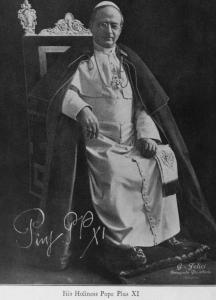 Now none of this is to say that worker ownership is a bad thing, or that it wouldn’t be a good thing. Indeed, Pope Pius XI recommended it, saying,
“First of all, those who declare that a contract of hiring and being hired is unjust of its own nature, and hence a partnership-contract must take its place, are certainly in error and gravely misrepresent Our Predecessor whose Encyclical not only accepts working for wages or salaries but deals at some length with it regulation in accordance with the rules of justice.
“We consider it more advisable, however, in the present condition of human society that, so far as is possible, the work-contract be somewhat modified by a partnership-contract, as is already being done in various ways and with no small advantage to workers and owners. Workers and other employees thus become sharers in ownership or management or participate in some fashion in the profits received.” (Ibid, nos. 64-65)
Following Pius XI, employee ownership and profit-sharing are not only permissible but advisable. But prohibiting anyone but workers from having an ownership stake in business enterprises would deprive businesses of needed financing, which would ultimately hurt working people. Too much of a good idea is too much.
The icon of St. Joseph the Worker is by Daniel Nichols.
Please go like Christian Democracy on Facebook here. Join the discussion on Catholic social teaching here.
Previous Post

September 29, 2018
Truth or Politics
Next Post

October 24, 2018 The Catholic Vote
Browse Our Archives
Select a Category Abortion Affordable Care Act Arbitration Agreements Catholic Social Teaching Christian Democracy climate change Communism Consistent life Constitutional Rights Discrimination distributism Employment Contracts First Amendment Free Exercise Clause Freedom of Speech Government Immigration Ireland Israel Jerusalem Labor Magisterium Middle East Monarchism Neoliberalism Palestine Palestinian State Political parties Pope Pro-Life Movement Religious Discrimination Religious Freedom RIght to Life right-to-work Ruth Bader Ginsburg Same Sex Marriage socialism subsidiarity Supreme Court syndicates Uncategorized United States United States Constitution Universal health care Unjust law Western Society
Select a Month June 2019 May 2019 April 2019 March 2019 February 2019 January 2019 December 2018 November 2018 October 2018 September 2018 August 2018 July 2018 June 2018 May 2018 April 2018
Follow Us!
TAKE THE
Religious Wisdom Quiz
True or False: John is the only Gospel that records Jesus washing the disciples' feet.
Select your answer to see how you score.
FALSE TRUE
Related posts from Christian Democracy



Bernie Sanders Tacks Distributist

TRENDING AT PATHEOS Catholic

Rejecting Doom: Christian Hope And Human Action
Christianity is a religion of hope. We are to have hope and...

It’s What Comes From Within Which Matters
One of the most difficult things for us to understand is why...

Why I Choose the Eucharist Over the Sermon
Choose the Eucharist, Not the Sermon What are we supposed to get...

5 Design Elements Found in Spiritually Rooted Homes
Putting Spirituality Into Home Decor Our homes are more than our living...

Credo: A Story of God Told with the...
About 10 years ago, I began to imagine a personal "Credo" that...

The Anatomy of Divine Revelation in Catholic Thought
The claim that God has made Himself known to human beings is...
view all Catholic blogs
Ad-Free & Subscriber Log-In Subscription Support
- About Us
- 2026 Calendar
- Videos
- Podcasts
- Library of World Religions
- Faith In Media Tracker
- Advertise With Us
- Write for Us
- Privacy Policy
- Terms of Service
- Do Not Sell My Data
- Contact Us
- Radiant Digital
- Manage Newsletter Subscriptions
- Unsubscribe From Notifications
- Sitemap
Copyright 2008-2026, Patheos. All rights reserved.
Subscription Support Ad-Free & Subscriber Log-In
Follow Patheos