
BuddhistCatholicContemplativeEvangelicalGeneral ChristianHinduJewishLatter-day SaintMuslimNew VisionsProgressive Christian
Beliefs
- Buddhist
- Catholic
- Contemplative
- Evangelical
- General Christian
- Hindu
- Jewish
- Latter-day Saint
- More Voices
- Muslim
- New Visions
- Pagan
- Progressive Christian
Topics
- Religion News
- Food and Religion
- Sports and Religion
- Religious Art
- Religious Music and Entertainment
- Religious Events
- History and Religion
- Style and Religion
- Politics and Religion
- Women in Religion
- Recreation Outdoors and Religion
- Business Finance and Religion
- Careers Workplace and Religion
- Education and Religion
- Family Parenting and Religion
- Health Fitness and Religion
- Home and Religion
- Relationships and Religion
- Technology and Religion
- Travel and Religion
Columnists
- Buddhist Columnists
- Business Finance and Religion Columnists
- Careers Workplace and Religion Columnists
- Catholic Columnists
- Contemplative Columnists
- Education and Religion Columnists
- Evangelists Columnists
- Family Parenting and Religion Columnists
- General Christian Columnists
- Health Fitness and Religion Columnists
- Hindu Columnists
- History and Religion Columnists
- Home and Religion Columnists
- Jewish Columnists
- More Voices Columnists
- Latter Day Columnists
- Muslim Columnists
- New Visions Columnists
- Nonreligious Columnists
- Pagan Columnists
- Politics and Religion Columnists
- Progressive Columnists
- Recreation Outdoors and Religion Columnists
- Relationships and Religion Columnists
- Religion News Columnists
- Religious Art Columnists
- Religious Events Columnists
- Religious Music and Entertainment Columnists
- Sports and Religion Columnists
- Style and Religion Columnists
- Technology and Religion Columnists
- Travel and Religion Columnists
- Women in Religion Columnists
Resource Library
- 2026 Calendar
- Library of World Religions
- The 100 Most Holy Places on Earth
- Patheos Answers
- Podcasts
- Videos
- Faith Leaders Database
- Anglican Episcopalian
- Bahai
- Baptist
- Buddhism
- Christianity
- Confucianism
- Eastern Orthodoxy
- Hinduism
- Holiness and Pentecostal
- ISKCON
- Islam
- Judaism
- Lutheran
- Methodist
- The Church of Jesus Christ of Latter-day Saints
- New Age
- Paganism
- Presbytarian and Reformed
- Protestantism
- Religion Behind the Scenes
- Roman Catholic
- Scientology
- Shia Islam
- Sikhism
- Sufism
- Sunni Islam
- Taoism
- Zen
- See all religions
Research Tools
 Ad-Free & Subscriber Log-In Subscription Support
Ad-Free & Subscriber Log-In Subscription Support
Follow Patheos 

- Trending:
- Forgiveness
- |
- Marriage
- |
- Consciousness
- |
- Death Penalty
- |
- Election
- |
- Halloween
 Christian Democracy
- Home
- Catholic
- Politics and Religion
- What’s Wrong with Socialism? (Part 5)
What’s Wrong with Socialism? (Part 5)
Last updated on: September 14, 2018 at 10:19 pm by Jack Quirk
What’s Wrong with Socialism? (Part 5) 2018-09-14T22:19:32-05:00 Jack Quirk
Patheos Explore the world's faith through different perspectives on religion and spirituality! Patheos has the views of the prevalent religions and spiritualities of the world.
In the last offering in this series [1], your humble servant related how by 1931 Socialism had become divided into two main camps. One was Communism, and Pope Pius XI both observed and predicted its atrocities in his encyclical Quadragesimo anno. [2] The other version, which had “kept the name Socialism,” the pope recognized as “surely more moderate,” saying this about it:
“It not only professes the rejection of violence but modifies and tempers to some degree, if it does not reject entirely, the class struggle and the abolition of private ownership. One might say that, terrified by its own principles and by the conclusions drawn therefrom by Communism, Socialism inclines toward and in a certain measure approaches the truths which Christian tradition has always held sacred; for it cannot be denied that its demands at times come very near those that Christian reformers of society justly insist upon.
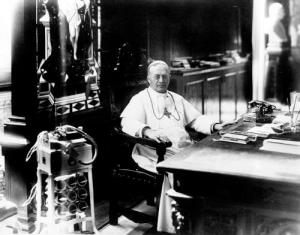 “For if the class struggle abstains from enmities and mutual hatred, it gradually changes into an honest discussion of differences founded on a desire for justice, and if this is not that blessed social peace which we all seek, it can and ought to be the point of departure from which to move forward to the mutual cooperation of the Industries and Professions. So also the war declared on private ownership, more and more abated, is being so restricted that now, finally, not the possession itself of the means of production is attacked but rather a kind of sovereignty over society which ownership has, contrary to all right, seized and usurped. For such sovereignty belongs in reality not to owners but to the public authority. If the foregoing happens, it can come even to the point that imperceptibly these ideas of the more moderate socialism will no longer differ from the desires and demands of those who are striving to remold human society on the basis of Christian principles. For certain kinds of property, it is rightly contended, ought to be reserved to the State since they carry with them a dominating power so great that cannot without danger to the general welfare be entrusted to private individuals.
“Such just demands and desire have nothing in them now which is inconsistent with Christian truth, and much less are they special to Socialism. Those who work solely toward such ends have, therefore, no reason to become socialists.” (Quadragesimo anno, §113-115)
So if all one is seeking is to abolish the political power of capital ownership, rather than capital ownership itself, this isn’t contrary to Catholic doctrine. On the contrary, it is in complete accord with it. But it wasn’t every non-communist socialist who had abandoned the quest. As Pius XI pointed out,
“Yet let no one think that all the socialist groups or factions that are not communist have, without exception, recovered their senses to this extent either in fact or in name. For the most part they do not reject the class struggle or the abolition of ownership, but only in some degree modify them.” (Ibid, §116)
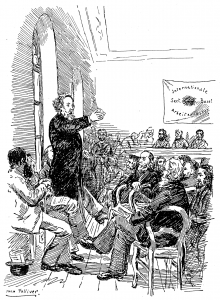 Still, the question remained: what if socialists gave up on the idea of abolishing private property in the means of production? Would Socialism then be suitable for Catholics to embrace? There was one problem. The Holy Father put it this way:
“For, according to Christian teaching, man, endowed with a social nature, is placed on this earth so that by leading a life in society and under an authority ordained of God he may fully cultivate and develop all his faculties unto the praise and glory of his Creator; and that by faithfully fulfilling the duties of his craft or other calling he may obtain for himself temporal and at the same time eternal happiness. Socialism, on the other hand, wholly ignoring and indifferent to this sublime end of both man and society, affirms that human association has been instituted for the sake of material advantage alone.
“Because of the fact that goods are produced more efficiently by a suitable division of labor than by the scattered efforts of individuals, socialists infer that economic activity, only the material ends of which enter into their thinking, ought of necessity to be carried on socially. Because of this necessity, they hold that men are obliged, with respect to the producing of goods, to surrender and subject themselves entirely to society. Indeed, possession of the greatest possible supply of things that serve the advantages of this life is considered of such great importance that the higher goods of man, liberty not excepted, must take a secondary place and even be sacrificed to the demands of the most efficient production of goods. This damage to human dignity, undergone in the ‘socialized’ process of production, will be easily offset, they say, by the abundance of socially produced goods which will pour out in profusion to individuals to be used freely at their pleasure for comforts and cultural development. Society, therefore, as Socialism conceives it, can on the one hand neither exist nor be thought of without an obviously excessive use of force; on the other hand, it fosters a liberty no less false, since there is no place in it for true social authority, which rests not on temporal and material advantages but descends from God alone, the Creator and last end of all things.” (Ibid, §§118-119)
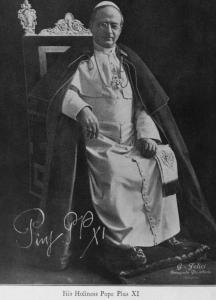 The Socialism that Pius XI observed, while on the surface renouncing the violence of Communism, envisioned a society that could only materialize through a prodigious use of force. Simply put, human labor would be directed in the supposed interests of society as a whole, by those who had attained the political power to so direct it. People would become subject to what was, in essence, forced labor. And this loss of liberty would be justified in terms of the only good that Socialists were capable of imagining: material wealth. Such a false (and deceitful) god could never be imported into Catholicism.
Human beings are much more than producers of goods, but that was all that the Socialism that Pius XI was describing could see about them. Clearly, such a Socialism would be no improvement upon Capitalism at all. Although Capitalism reduces labor to a commodity, this Socialism would make draft animals of humans.
This has been the problem with Socialism. In order for it to work, you have to force everyone to participate. And then it isn’t altogether clear that Socialism working is a desirable outcome.
The icon of St. Joseph the Worker is by Daniel Nichols.
Please go like Christian Democracy on Facebook here. Join the discussion on Catholic social teaching here.
Previous Post
September 2, 2018
If He Did It
Next Post

September 29, 2018 Truth or Politics
Browse Our Archives
Select a Category Abortion Affordable Care Act Arbitration Agreements Catholic Social Teaching Christian Democracy climate change Communism Consistent life Constitutional Rights Discrimination distributism Employment Contracts First Amendment Free Exercise Clause Freedom of Speech Government Immigration Ireland Israel Jerusalem Labor Magisterium Middle East Monarchism Neoliberalism Palestine Palestinian State Political parties Pope Pro-Life Movement Religious Discrimination Religious Freedom RIght to Life right-to-work Ruth Bader Ginsburg Same Sex Marriage socialism subsidiarity Supreme Court syndicates Uncategorized United States United States Constitution Universal health care Unjust law Western Society
Select a Month June 2019 May 2019 April 2019 March 2019 February 2019 January 2019 December 2018 November 2018 October 2018 September 2018 August 2018 July 2018 June 2018 May 2018 April 2018
Follow Us!
TAKE THE
Religious Wisdom Quiz
Who prayed in the lions' den every day?
Select your answer to see how you score.
Solomon Daniel David Paul
Related posts from Christian Democracy


Bernie Sanders Tacks Distributist

TRENDING AT PATHEOS Catholic

The Parable Of The Sower And The Word...
One of Christ’s most famous parables is that of the sower who...

Rejecting Doom: Christian Hope And Human Action
Christianity is a religion of hope. We are to have hope and...

Why I Choose the Eucharist Over the Sermon
Choose the Eucharist, Not the Sermon What are we supposed to get...

5 Design Elements Found in Spiritually Rooted Homes
Putting Spirituality Into Home Decor Our homes are more than our living...

Credo: A Story of God Told with the...
About 10 years ago, I began to imagine a personal "Credo" that...

The Anatomy of Divine Revelation in Catholic Thought
The claim that God has made Himself known to human beings is...
view all Catholic blogs
Ad-Free & Subscriber Log-In Subscription Support
- About Us
- 2026 Calendar
- Videos
- Podcasts
- Library of World Religions
- Faith In Media Tracker
- Advertise With Us
- Write for Us
- Privacy Policy
- Terms of Service
- Do Not Sell My Data
- Contact Us
- Radiant Digital
- Manage Newsletter Subscriptions
- Unsubscribe From Notifications
- Sitemap
Copyright 2008-2026, Patheos. All rights reserved.
Subscription Support Ad-Free & Subscriber Log-In
Follow Patheos