
BuddhistCatholicContemplativeEvangelicalGeneral ChristianHinduJewishLatter-day SaintMuslimNew VisionsProgressive Christian
Beliefs
- Buddhist
- Catholic
- Contemplative
- Evangelical
- General Christian
- Hindu
- Jewish
- Latter-day Saint
- More Voices
- Muslim
- New Visions
- Pagan
- Progressive Christian
Topics
- Religion News
- Food and Religion
- Sports and Religion
- Religious Art
- Religious Music and Entertainment
- Religious Events
- History and Religion
- Style and Religion
- Politics and Religion
- Women in Religion
- Recreation Outdoors and Religion
- Business Finance and Religion
- Careers Workplace and Religion
- Education and Religion
- Family Parenting and Religion
- Health Fitness and Religion
- Home and Religion
- Relationships and Religion
- Technology and Religion
- Travel and Religion
Columnists
- Buddhist Columnists
- Business Finance and Religion Columnists
- Careers Workplace and Religion Columnists
- Catholic Columnists
- Contemplative Columnists
- Education and Religion Columnists
- Evangelists Columnists
- Family Parenting and Religion Columnists
- General Christian Columnists
- Health Fitness and Religion Columnists
- Hindu Columnists
- History and Religion Columnists
- Home and Religion Columnists
- Jewish Columnists
- More Voices Columnists
- Latter Day Columnists
- Muslim Columnists
- New Visions Columnists
- Nonreligious Columnists
- Pagan Columnists
- Politics and Religion Columnists
- Progressive Columnists
- Recreation Outdoors and Religion Columnists
- Relationships and Religion Columnists
- Religion News Columnists
- Religious Art Columnists
- Religious Events Columnists
- Religious Music and Entertainment Columnists
- Sports and Religion Columnists
- Style and Religion Columnists
- Technology and Religion Columnists
- Travel and Religion Columnists
- Women in Religion Columnists
Resource Library
- 2026 Calendar
- Library of World Religions
- The 100 Most Holy Places on Earth
- Patheos Answers
- Podcasts
- Videos
- Faith Leaders Database
- Anglican Episcopalian
- Bahai
- Baptist
- Buddhism
- Christianity
- Confucianism
- Eastern Orthodoxy
- Hinduism
- Holiness and Pentecostal
- ISKCON
- Islam
- Judaism
- Lutheran
- Methodist
- The Church of Jesus Christ of Latter-day Saints
- New Age
- Paganism
- Presbytarian and Reformed
- Protestantism
- Religion Behind the Scenes
- Roman Catholic
- Scientology
- Shia Islam
- Sikhism
- Sufism
- Sunni Islam
- Taoism
- Zen
- See all religions
Research Tools
 Ad-Free & Subscriber Log-In Subscription Support
Ad-Free & Subscriber Log-In Subscription Support
Follow Patheos 

- Trending:
- Forgiveness
- |
- Marriage
- |
- Consciousness
- |
- Death Penalty
- |
- Election
- |
- Halloween
 Christian Democracy
- Home
- Catholic
- Politics and Religion
- Right-To-Work, Janus, and Catholic Social Teaching
Right-To-Work, Janus, and Catholic Social Teaching
Last updated on: July 12, 2018 at 12:41 pm by Jack Quirk
Right-To-Work, Janus, and Catholic Social Teaching 2018-07-12T12:41:31-05:00 Jack Quirk
Patheos Explore the world's faith through different perspectives on religion and spirituality! Patheos has the views of the prevalent religions and spiritualities of the world.
In my recent post, Hurting Labor Unions is Wrong [1], your humble servant endeavored to demonstrate that the holding of the U.S. Supreme Court in Janus v. State, County, and Municipal Employees [2], that requiring non-union members to pay an “agency fee” to cover the cost of representation in collective bargaining violates the First Amendment, was in conflict with Catholic social teaching.
Now it has been observed that the Janus case has essentially imposed a “right-to-work” regime on all government employment. “Right-to-work” otherwise comes in the form of state legislation, prohibiting businesses and labor unions from entering into contracts whereby all employees are required to become union members. Thus union membership cannot be made a condition of employment in right-to-work states.
 It is ironic that legislation of this kind tends to be supported by those with libertarian leanings, since it is really a restriction on private contract terms. Those who would argue that employment terms should consist of whatever employers and individual employees agree to will often be advocates of right-to-work laws, which dictate what may not be in an employer’s contract with a union. Of course, it is beyond a reasonable doubt that the real intent behind right-to-work legislation is to weaken labor unions, so it should not be surprising that such a shameless contradiction would be so brazenly engaged in. Politics, sad to say, is not about philosophy and reason, but control of resources.
As it turns out, Catholic social teaching has something to say on the subject.
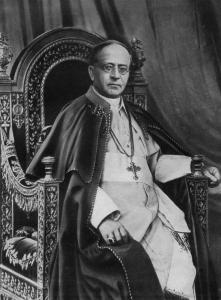
In his encyclical, Quadragesimo anno, Pope Pius XI described a solution to the conflict between labor and capital that avoids the extremes of unregulated capitalism and socialism, which he described this way:
“The civil authority itself constitutes the syndicate as a juridical personality in such a manner as to confer on it simultaneously a certain monopoly-privilege, since only such a syndicate, when thus approved, can maintain the rights (according to the type of syndicate) of workers or employers, and since it alone can arrange for the placement of labor and conclude so-termed labor agreements. Anyone is free to join a syndicate or not, and only within these limits can this kind of syndicate be called free; for syndical dues and special assessments are exacted of absolutely all members of every specified calling or profession, whether they are workers or employers; likewise all are bound by the labor agreements made by the legally recognized syndicate. Nevertheless, it has been officially stated that this legally recognized syndicate does not prevent the existence, without legal status, however, of other associations made up of persons following the same calling.
 “The associations, or corporations, are composed of delegates from the two syndicates (that is, of workers and employers) respectively of the same industry or profession and, as true and proper organs and institutions of the State, they direct the syndicates and coordinate their activities in matters of common interest toward one and the same end.
“Strikes and lock-outs are forbidden; if the parties cannot settle their dispute, public authority intervenes.” (Id, §§92-94) [3]
The idea is that there will be two syndicates for each industry: one for the employers, and one for the employees. The syndicates of an industry send delegates to an industry association, which tries to coordinate activities and resolve disputes. The government steps in when disputes cannot be resolved. The one feature that is critical to the present discussion is that while one is free to join his proper syndicate or not, he is still required to pay dues to the syndicate representing him.
Under a right-to-work regime, by contrast, the employee who chooses not to join a union also frees himself of the obligation to pay dues. In Janus, the plaintiff complained that he was required to pay an agency fee, not even full dues, to cover the cost of his being represented in collective bargaining, and he prevailed on free speech grounds.
Right-to-work legislation cannot be squared with what Pius XI promoted in Quadragesimo anno, and, therefore, neither can Janus. Whatever virtues one might claim for such arrangements, there is simply no support for it in Catholic social teaching. And those of us who are Catholic ought to be interested in that.
The icon of St. Joseph the Worker is by Daniel Nichols.
Listen to Christian Democracy on live internet radio on Tuesdays at 10:30 p.m. Eastern time at WCAT Radio here, or listen to the podcast here on the Christian Democracy Patheos blog.
Please go like Christian Democracy on Facebook here. Join the discussion on Catholic social teaching here.
Previous Post

July 11, 2018
Christian Democracy Radio with Prominent Distributist John Medaille
Next Post

July 14, 2018 Public Sector Unions in Catholic Social Teaching
Browse Our Archives
Select a Category Abortion Affordable Care Act Arbitration Agreements Catholic Social Teaching Christian Democracy climate change Communism Consistent life Constitutional Rights Discrimination distributism Employment Contracts First Amendment Free Exercise Clause Freedom of Speech Government Immigration Ireland Israel Jerusalem Labor Magisterium Middle East Monarchism Neoliberalism Palestine Palestinian State Political parties Pope Pro-Life Movement Religious Discrimination Religious Freedom RIght to Life right-to-work Ruth Bader Ginsburg Same Sex Marriage socialism subsidiarity Supreme Court syndicates Uncategorized United States United States Constitution Universal health care Unjust law Western Society
Select a Month June 2019 May 2019 April 2019 March 2019 February 2019 January 2019 December 2018 November 2018 October 2018 September 2018 August 2018 July 2018 June 2018 May 2018 April 2018
Follow Us!
TAKE THE
Religious Wisdom Quiz
What is the shortest chapter in the Bible?
Select your answer to see how you score.
John 3 Psalm 117 Psalm 119 Proverbs 31
Related posts from Christian Democracy


Bernie Sanders Tacks Distributist


TRENDING AT PATHEOS Catholic

Rejecting Doom: Christian Hope And Human Action
Christianity is a religion of hope. We are to have hope and...

It’s What Comes From Within Which Matters
One of the most difficult things for us to understand is why...

Why I Choose the Eucharist Over the Sermon
Choose the Eucharist, Not the Sermon What are we supposed to get...

5 Design Elements Found in Spiritually Rooted Homes
Putting Spirituality Into Home Decor Our homes are more than our living...

Credo: A Story of God Told with the...
About 10 years ago, I began to imagine a personal "Credo" that...

The Anatomy of Divine Revelation in Catholic Thought
The claim that God has made Himself known to human beings is...
view all Catholic blogs
Ad-Free & Subscriber Log-In Subscription Support
- About Us
- 2026 Calendar
- Videos
- Podcasts
- Library of World Religions
- Faith In Media Tracker
- Advertise With Us
- Write for Us
- Privacy Policy
- Terms of Service
- Do Not Sell My Data
- Contact Us
- Radiant Digital
- Manage Newsletter Subscriptions
- Unsubscribe From Notifications
- Sitemap
Copyright 2008-2026, Patheos. All rights reserved.
Subscription Support Ad-Free & Subscriber Log-In
Follow Patheos