
BuddhistCatholicContemplativeEvangelicalGeneral ChristianHinduJewishLatter-day SaintMuslimNew VisionsProgressive Christian
Beliefs
- Buddhist
- Catholic
- Contemplative
- Evangelical
- General Christian
- Hindu
- Jewish
- Latter-day Saint
- More Voices
- Muslim
- New Visions
- Pagan
- Progressive Christian
Topics
- Religion News
- Food and Religion
- Sports and Religion
- Religious Art
- Religious Music and Entertainment
- Religious Events
- History and Religion
- Style and Religion
- Politics and Religion
- Women in Religion
- Recreation Outdoors and Religion
- Business Finance and Religion
- Careers Workplace and Religion
- Education and Religion
- Family Parenting and Religion
- Health Fitness and Religion
- Home and Religion
- Relationships and Religion
- Technology and Religion
- Travel and Religion
Columnists
- Buddhist Columnists
- Business Finance and Religion Columnists
- Careers Workplace and Religion Columnists
- Catholic Columnists
- Contemplative Columnists
- Education and Religion Columnists
- Evangelists Columnists
- Family Parenting and Religion Columnists
- General Christian Columnists
- Health Fitness and Religion Columnists
- Hindu Columnists
- History and Religion Columnists
- Home and Religion Columnists
- Jewish Columnists
- More Voices Columnists
- Latter Day Columnists
- Muslim Columnists
- New Visions Columnists
- Nonreligious Columnists
- Pagan Columnists
- Politics and Religion Columnists
- Progressive Columnists
- Recreation Outdoors and Religion Columnists
- Relationships and Religion Columnists
- Religion News Columnists
- Religious Art Columnists
- Religious Events Columnists
- Religious Music and Entertainment Columnists
- Sports and Religion Columnists
- Style and Religion Columnists
- Technology and Religion Columnists
- Travel and Religion Columnists
- Women in Religion Columnists
Resource Library
- 2026 Calendar
- Library of World Religions
- The 100 Most Holy Places on Earth
- Patheos Answers
- Podcasts
- Videos
- Faith Leaders Database
- Anglican Episcopalian
- Bahai
- Baptist
- Buddhism
- Christianity
- Confucianism
- Eastern Orthodoxy
- Hinduism
- Holiness and Pentecostal
- ISKCON
- Islam
- Judaism
- Lutheran
- Methodist
- The Church of Jesus Christ of Latter-day Saints
- New Age
- Paganism
- Presbytarian and Reformed
- Protestantism
- Religion Behind the Scenes
- Roman Catholic
- Scientology
- Shia Islam
- Sikhism
- Sufism
- Sunni Islam
- Taoism
- Zen
- See all religions
Research Tools
 Ad-Free & Subscriber Log-In Subscription Support
Ad-Free & Subscriber Log-In Subscription Support
Follow Patheos 

- Trending:
- Forgiveness
- |
- Marriage
- |
- Consciousness
- |
- Death Penalty
- |
- Election
- |
- Halloween
 Christian Democracy
- Home
- Catholic
- Politics and Religion
- The U.S. Is Not a Catholic Country
The U.S. Is Not a Catholic Country
Last updated on: June 29, 2018 at 1:02 pm by Jack Quirk
The U.S. Is Not a Catholic Country 2018-06-29T13:02:46-05:00 Jack Quirk
Patheos Explore the world's faith through different perspectives on religion and spirituality! Patheos has the views of the prevalent religions and spiritualities of the world.
Applying ourselves to the study of Catholic social doctrine, it is not long before we discover that the “Magisterium recognizes the fundamental role played by labour unions, whose existence is connected with the right to form associations or unions to defend the vital interests of workers employed in the various professions.” (Compendium of the Social Doctrine of the Church (CSDC), §305) [1] We are reminded that unions “’grew up from the struggle of the workers — workers in general but especially the industrial workers — to protect their just rights vis-à-vis the entrepreneurs and the owners of the means of production’.” (Ibid.)
The Church does not see labor unions as a destructive force, but recognizes that such “organizations, while pursuing their specific purpose with regard to the common good, are a positive influence for social order and solidarity, and are therefore an indispensable element of social life.” (Ibid.) “Properly speaking, unions are promoters of the struggle for social justice, for the rights of workers in their particular professions: ‘This struggle should be seen as a normal endeavour “for ‘the just good … not a struggle “against” others’”’.” (Id, §306) Moreover,
 “Beyond their function of defending and vindicating, unions have the duty of acting as representatives working for ‘the proper arrangement of economic life’ and of educating the social consciences of workers so that they will feel that they have an active role, according to their proper capacities and aptitudes, in the whole task of economic and social development and in the attainment of the universal common good. Unions and other forms of labour associations are to work in cooperation with other social entities and are to take an interest in the management of public matters. Union organizations have the duty to exercise influence in the political arena, making it duly sensitive to labour problems and helping it to work so that workers’ rights are respected.” (Id, §307)
On June 27th, the United States Supreme Court rendered what might be considered a body blow to the ability of public labor unions to perform these functions. In the case of Janus v. State, County, and Municipal Employees [2], the Court held that public employees who choose not to be a member of the union that represents them cannot be compelled to pay an “agency fee” to support the costs of collective bargaining.
The union contended that “that agency fees are needed to prevent nonmembers from enjoying the benefits of union representation without shouldering the costs.” (Id, at p. 13) But Janus argued “that he is not a free rider on a bus headed for a destination that he wishes to reach but is more like a person shanghaied for an unwanted voyage.” (Ibid.) The Court accepted that logic, and struck down the agency fee arrangement on Free Speech grounds.
Even though there was a previous Supreme Court case that upheld agency fees [3], which the Court overruled in this case, the outcome of the Janus case cannot be said to be without a basis in U.S. constitutional law. In American jurisprudence, free speech is paramount.
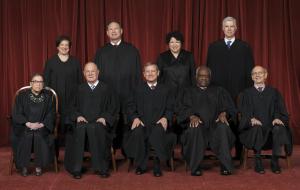 This doesn’t mean that there is something wrong with Catholic social teaching, of course. But it does mean that, from time to time, there are going to be conflicts between Catholic doctrine and even the highest law in the United States. That is something we’re going to have to be honest about if we’re going to properly understand the relationship between the two.
The closest thing to a bill of rights in the magisterial documents of the Church is found in Saint Pope John Paul II’s encyclical, Centesimus annus:
“Following the collapse of Communist totalitarianism and of many other totalitarian and ‘national security’ regimes, today we are witnessing a predominance, not without signs of opposition, of the democratic ideal, together with lively attention to and concern for human rights. But for this very reason it is necessary for peoples in the process of reforming their systems to give democracy an authentic and solid foundation through the explicit recognition of those rights. Among the most important of these rights, mention must be made of the right to life, an integral part of which is the right of the child to develop in the mother’s womb from the moment of conception; the right to live in a united family and in a moral environment conducive to the growth of the child’s personality; the right to develop one’s intelligence and freedom in seeking and knowing the truth; the right to share in the work which makes wise use of the earth’s material resources, and to derive from that work the means to support oneself and one’s dependents; and the right freely to establish a family, to have and to rear children through the responsible exercise of one’s sexuality. In a certain sense, the source and synthesis of these rights is religious freedom, understood as the right to live in the truth of one’s faith and in conformity with one’s transcendent dignity as a person.” (Id, §47) [4]
For John Paul II, the most important freedom is religious freedom, and he doesn’t mention the freedom of speech in this listing of the “most important” rights. The right to seek and know the truth is mentioned, but that, in itself, doesn’t touch on the expression of opinion.
 On the other hand, he does mention the right to employment, and the right to compensation sufficient for the support of a family. This right doesn’t appear anywhere in our Constitution in so many words. Your humble servant would argue that it is a right contained in the right to life, but there is no case law supporting that idea.
Meanwhile freedom of religion takes a decidedly secondary place in American constitutional law, notwithstanding its primary presence in the wording of the First Amendment. In American law, freedom of religion falls before laws of general applicability, even if such laws put someone in the position of violating the precepts of his religion. That’s why issues that, from a Catholic perspective, appear as Freedom of Religion issues are best addressed in American courts as Free Speech matters.
From the standpoint of Catholic teaching, requiring an agency fee from someone who doesn’t want to join the union appears as a fair resolution, to keep him from becoming a free rider on efforts made on his behalf. That is because Catholic teaching tells us that union representation is a positive good accomplished by an association that is objectively a “positive influence for social order and solidarity,” and “an indispensable element of social life.” The U.S. Constitution doesn’t recognize that.
In seeking the influence of Catholic social teaching in society, it is important to remember where we stand in relation to that society. The United States is not a Catholic country. But it is to be hoped and prayed for that enough people will become persuaded of the value of Catholic social doctrine so that what it teaches us can find implementation through the nation’s legitimate democratic processes.
The icon of St. Joseph the Worker is by Daniel Nichols.
Listen to Christian Democracy on live internet radio on Tuesdays at 10:30 p.m. Eastern time at WCAT Radio here, or listen to the podcast here on the Christian Democracy Patheos blog.
Please go like Christian Democracy on Facebook here. Join the discussion on Catholic social teaching here.
Previous Post

June 28, 2018
The Second Broadcast of Christian Democracy's Radio Version
Next Post
June 30, 2018 After Roe v. Wade Is Overturned
Browse Our Archives
Select a Category Abortion Affordable Care Act Arbitration Agreements Catholic Social Teaching Christian Democracy climate change Communism Consistent life Constitutional Rights Discrimination distributism Employment Contracts First Amendment Free Exercise Clause Freedom of Speech Government Immigration Ireland Israel Jerusalem Labor Magisterium Middle East Monarchism Neoliberalism Palestine Palestinian State Political parties Pope Pro-Life Movement Religious Discrimination Religious Freedom RIght to Life right-to-work Ruth Bader Ginsburg Same Sex Marriage socialism subsidiarity Supreme Court syndicates Uncategorized United States United States Constitution Universal health care Unjust law Western Society
Select a Month June 2019 May 2019 April 2019 March 2019 February 2019 January 2019 December 2018 November 2018 October 2018 September 2018 August 2018 July 2018 June 2018 May 2018 April 2018
Follow Us!
TAKE THE
Religious Wisdom Quiz
According to Romans, how does faith come?
Select your answer to see how you score.
By hearing the word From the Holy Spirit By reading Scripture Through prayer
Related posts from Christian Democracy
Bernie Sanders Tacks Distributist

TRENDING AT PATHEOS Catholic

The Parable Of The Sower And The Word...
One of Christ’s most famous parables is that of the sower who...

Rejecting Doom: Christian Hope And Human Action
Christianity is a religion of hope. We are to have hope and...

Why I Choose the Eucharist Over the Sermon
Choose the Eucharist, Not the Sermon What are we supposed to get...

5 Design Elements Found in Spiritually Rooted Homes
Putting Spirituality Into Home Decor Our homes are more than our living...

Credo: A Story of God Told with the...
About 10 years ago, I began to imagine a personal "Credo" that...

The Anatomy of Divine Revelation in Catholic Thought
The claim that God has made Himself known to human beings is...
view all Catholic blogs
Ad-Free & Subscriber Log-In Subscription Support
- About Us
- 2026 Calendar
- Videos
- Podcasts
- Library of World Religions
- Faith In Media Tracker
- Advertise With Us
- Write for Us
- Privacy Policy
- Terms of Service
- Do Not Sell My Data
- Contact Us
- Radiant Digital
- Manage Newsletter Subscriptions
- Unsubscribe From Notifications
- Sitemap
Copyright 2008-2026, Patheos. All rights reserved.
Subscription Support Ad-Free & Subscriber Log-In
Follow Patheos