
BuddhistCatholicContemplativeEvangelicalGeneral ChristianHinduJewishLatter-day SaintMuslimNew VisionsProgressive Christian
Beliefs
- Buddhist
- Catholic
- Contemplative
- Evangelical
- General Christian
- Hindu
- Jewish
- Latter-day Saint
- More Voices
- Muslim
- New Visions
- Pagan
- Progressive Christian
Topics
- Religion News
- Food and Religion
- Sports and Religion
- Religious Art
- Religious Music and Entertainment
- Religious Events
- History and Religion
- Style and Religion
- Politics and Religion
- Women in Religion
- Recreation Outdoors and Religion
- Business Finance and Religion
- Careers Workplace and Religion
- Education and Religion
- Family Parenting and Religion
- Health Fitness and Religion
- Home and Religion
- Relationships and Religion
- Technology and Religion
- Travel and Religion
Columnists
- Buddhist Columnists
- Business Finance and Religion Columnists
- Careers Workplace and Religion Columnists
- Catholic Columnists
- Contemplative Columnists
- Education and Religion Columnists
- Evangelists Columnists
- Family Parenting and Religion Columnists
- General Christian Columnists
- Health Fitness and Religion Columnists
- Hindu Columnists
- History and Religion Columnists
- Home and Religion Columnists
- Jewish Columnists
- More Voices Columnists
- Latter Day Columnists
- Muslim Columnists
- New Visions Columnists
- Nonreligious Columnists
- Pagan Columnists
- Politics and Religion Columnists
- Progressive Columnists
- Recreation Outdoors and Religion Columnists
- Relationships and Religion Columnists
- Religion News Columnists
- Religious Art Columnists
- Religious Events Columnists
- Religious Music and Entertainment Columnists
- Sports and Religion Columnists
- Style and Religion Columnists
- Technology and Religion Columnists
- Travel and Religion Columnists
- Women in Religion Columnists
Resource Library
- 2026 Calendar
- Library of World Religions
- The 100 Most Holy Places on Earth
- Patheos Answers
- Podcasts
- Videos
- Faith Leaders Database
- Anglican Episcopalian
- Bahai
- Baptist
- Buddhism
- Christianity
- Confucianism
- Eastern Orthodoxy
- Hinduism
- Holiness and Pentecostal
- ISKCON
- Islam
- Judaism
- Lutheran
- Methodist
- The Church of Jesus Christ of Latter-day Saints
- New Age
- Paganism
- Presbytarian and Reformed
- Protestantism
- Religion Behind the Scenes
- Roman Catholic
- Scientology
- Shia Islam
- Sikhism
- Sufism
- Sunni Islam
- Taoism
- Zen
- See all religions
Research Tools
 Ad-Free & Subscriber Log-In Subscription Support
Ad-Free & Subscriber Log-In Subscription Support
Follow Patheos 

- Trending:
- Forgiveness
- |
- Marriage
- |
- Consciousness
- |
- Death Penalty
- |
- Election
- |
- Halloween
 Christian Democracy
- Home
- Catholic
- Politics and Religion
- What Wage Is a Living Wage?
What Wage Is a Living Wage?
Last updated on: May 16, 2018 at 10:19 am by Jack Quirk
What Wage Is a Living Wage? 2018-05-16T10:19:33-05:00 Jack Quirk
Patheos Explore the world's faith through different perspectives on religion and spirituality! Patheos has the views of the prevalent religions and spiritualities of the world.
In a previous offering in these pages [1] your humble servant did his level best to explain that leaving wages to market forces is not in accord with Catholic social teaching. As Pope Leo XIII explained in his landmark encyclical, Rerum novarum,
“Let the working man and the employer make free agreements, and in particular let them agree freely as to the wages; nevertheless, there underlies a dictate of natural justice more imperious and ancient than any bargain between man and man, namely, that wages ought not to be insufficient to support a frugal and well-behaved wage-earner. If through necessity or fear of a worse evil the workman accept harder conditions because an employer or contractor will afford him no better, he is made the victim of force and injustice.” (Rerum novarum, §45) [2]
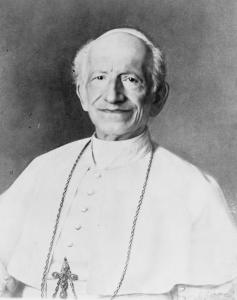 Now as strange as it may seem, there are those who take issue with this idea, all the more so when it is brought to their attention that the Pope’s idea of a wage sufficient “to support a frugal and well-behaved wage-earner” involved compensation that was enough “to enable him comfortably to support himself, his wife, and his children….” (Ibid, §46) Some jobs, it is said, are really for schoolkids, who, since they are living with their parents in the suburbs, and will be spending the money on compact discs, do not need so much.
Those who are blessed enough to avoid fast food never see the number of full-on adults that work in those places. Moreover, there seems to be some who are unaware that sometimes people live with their parents because they have taken on the care of their mother or father. Such is the anesthetization of those who don’t get out very often.
But there is another, more serious objection that bears some discussion, and it is put in the form of a question: How are we to determine what a just wage is? More specifically, how does government decide what the proper minimum wage is? A living, family wage will be different in various parts of the country. How does the government establish a just wage that applies everywhere?
The answer is: it doesn’t. Pope Leo XIII said that in “these and similar questions, however – such as, for example, the hours of labor in different trades, the sanitary precautions to be observed in factories and workshops, etc. – in order to supersede undue interference on the part of the State, especially as circumstances, times, and localities differ so widely, it is advisable that recourse be had to societies or boards such as We shall mention presently, or to some other mode of safeguarding the interests of the wage-earners; the State being appealed to, should circumstances require, for its sanction and protection.” (Ibid, §45)
 The “societies or boards” the Pontiff was referring to were labor unions. “Such unions,” he said, should be suited to the requirements of this our age – an age of wider education, of different habits, and of far more numerous requirements in daily life. It is gratifying to know that there are actually in existence not a few associations of this nature, consisting either of workmen alone, or of workmen and employers together, but it were greatly to be desired that they should become more numerous and more efficient.”
In keeping with the principle of subsidiarity, what wages are just should be worked out between employers and employees themselves, but with the employees afforded through unions a bargaining power equal to that of their employers. Representation by a union provides a notable benefit when it comes to compensation. Wages and benefits for union workers are consistently higher than that of their non-union counterparts. [3] “Among full-time wage and salary workers, union members had median usual weekly earnings of $1,041 in 2017, while those who were not union members had median weekly earnings of $829.” [4]
Unfortunately, the percentage of wage or salary employees in the United States who are members of unions stands at only 10.7 percent. Along with Pope Leo XIII, we should want this number to increase significantly. Indeed, we could rid ourselves of the scourge of poverty wages if every employee was able to benefit from union representation.
The icon of St. Joseph the Worker is by Daniel Nichols.
Please go like Christian Democracy on Facebook here. Join the discussion on Catholic social teaching here.
Previous Post

May 11, 2018
Catholic Social Teaching on the Rack
Next Post

May 18, 2018 Jerusalem for All
Browse Our Archives
Select a Category Abortion Affordable Care Act Arbitration Agreements Catholic Social Teaching Christian Democracy climate change Communism Consistent life Constitutional Rights Discrimination distributism Employment Contracts First Amendment Free Exercise Clause Freedom of Speech Government Immigration Ireland Israel Jerusalem Labor Magisterium Middle East Monarchism Neoliberalism Palestine Palestinian State Political parties Pope Pro-Life Movement Religious Discrimination Religious Freedom RIght to Life right-to-work Ruth Bader Ginsburg Same Sex Marriage socialism subsidiarity Supreme Court syndicates Uncategorized United States United States Constitution Universal health care Unjust law Western Society
Select a Month June 2019 May 2019 April 2019 March 2019 February 2019 January 2019 December 2018 November 2018 October 2018 September 2018 August 2018 July 2018 June 2018 May 2018 April 2018
Follow Us!
TAKE THE
Religious Wisdom Quiz
True or False: In Mark, Jesus healed a man with a withered hand on the Sabbath, which angered the Pharisees.
Select your answer to see how you score.
FALSE TRUE
Related posts from Christian Democracy

Bernie Sanders Tacks Distributist


What's Wrong with Socialism? (Part 5)
TRENDING AT PATHEOS Catholic

Rejecting Doom: Christian Hope And Human Action
Christianity is a religion of hope. We are to have hope and...

It’s What Comes From Within Which Matters
One of the most difficult things for us to understand is why...

Why I Choose the Eucharist Over the Sermon
Choose the Eucharist, Not the Sermon What are we supposed to get...

5 Design Elements Found in Spiritually Rooted Homes
Putting Spirituality Into Home Decor Our homes are more than our living...

Credo: A Story of God Told with the...
About 10 years ago, I began to imagine a personal "Credo" that...

The Anatomy of Divine Revelation in Catholic Thought
The claim that God has made Himself known to human beings is...
view all Catholic blogs
Ad-Free & Subscriber Log-In Subscription Support
- About Us
- 2026 Calendar
- Videos
- Podcasts
- Library of World Religions
- Faith In Media Tracker
- Advertise With Us
- Write for Us
- Privacy Policy
- Terms of Service
- Do Not Sell My Data
- Contact Us
- Radiant Digital
- Manage Newsletter Subscriptions
- Unsubscribe From Notifications
- Sitemap
Copyright 2008-2026, Patheos. All rights reserved.
Subscription Support Ad-Free & Subscriber Log-In
Follow Patheos