
BuddhistCatholicContemplativeEvangelicalGeneral ChristianHinduJewishLatter-day SaintMuslimNew VisionsProgressive Christian
Beliefs
- Buddhist
- Catholic
- Contemplative
- Evangelical
- General Christian
- Hindu
- Jewish
- Latter-day Saint
- More Voices
- Muslim
- New Visions
- Pagan
- Progressive Christian
Topics
- Religion News
- Food and Religion
- Sports and Religion
- Religious Art
- Religious Music and Entertainment
- Religious Events
- History and Religion
- Style and Religion
- Politics and Religion
- Women in Religion
- Recreation Outdoors and Religion
- Business Finance and Religion
- Careers Workplace and Religion
- Education and Religion
- Family Parenting and Religion
- Health Fitness and Religion
- Home and Religion
- Relationships and Religion
- Technology and Religion
- Travel and Religion
Columnists
- Buddhist Columnists
- Business Finance and Religion Columnists
- Careers Workplace and Religion Columnists
- Catholic Columnists
- Contemplative Columnists
- Education and Religion Columnists
- Evangelists Columnists
- Family Parenting and Religion Columnists
- General Christian Columnists
- Health Fitness and Religion Columnists
- Hindu Columnists
- History and Religion Columnists
- Home and Religion Columnists
- Jewish Columnists
- More Voices Columnists
- Latter Day Columnists
- Muslim Columnists
- New Visions Columnists
- Nonreligious Columnists
- Pagan Columnists
- Politics and Religion Columnists
- Progressive Columnists
- Recreation Outdoors and Religion Columnists
- Relationships and Religion Columnists
- Religion News Columnists
- Religious Art Columnists
- Religious Events Columnists
- Religious Music and Entertainment Columnists
- Sports and Religion Columnists
- Style and Religion Columnists
- Technology and Religion Columnists
- Travel and Religion Columnists
- Women in Religion Columnists
Resource Library
- 2026 Calendar
- Library of World Religions
- The 100 Most Holy Places on Earth
- Patheos Answers
- Podcasts
- Videos
- Faith Leaders Database
- Anglican Episcopalian
- Bahai
- Baptist
- Buddhism
- Christianity
- Confucianism
- Eastern Orthodoxy
- Hinduism
- Holiness and Pentecostal
- ISKCON
- Islam
- Judaism
- Lutheran
- Methodist
- The Church of Jesus Christ of Latter-day Saints
- New Age
- Paganism
- Presbytarian and Reformed
- Protestantism
- Religion Behind the Scenes
- Roman Catholic
- Scientology
- Shia Islam
- Sikhism
- Sufism
- Sunni Islam
- Taoism
- Zen
- See all religions
Research Tools
 Ad-Free & Subscriber Log-In Subscription Support
Ad-Free & Subscriber Log-In Subscription Support
Follow Patheos 

- Trending:
- Forgiveness
- |
- Marriage
- |
- Consciousness
- |
- Death Penalty
- |
- Election
- |
- Halloween
 Christian Democracy
- Home
- Catholic
- Politics and Religion
- Anti-Social Darwinism
Anti-Social Darwinism
Last updated on: May 5, 2018 at 12:19 pm by Jack Quirk
Anti-Social Darwinism 2018-05-05T12:19:11-05:00 Jack Quirk
Patheos Explore the world's faith through different perspectives on religion and spirituality! Patheos has the views of the prevalent religions and spiritualities of the world.
Contemporary debates between evolution and Creationism miss the point entirely. The real issue is not one of what happened, but its implications. Alas, there are Christians today, even some Catholics, who go about trying to claim that biological evolution, particularly of humans, never took place. Such have consigned themselves to an attempt to falsify mountains of contrary scientific evidence, and that to no perceivable end. Indeed, evolutionary “theory has been put to practical use in several areas…,” [1] which would be a strange outcome if it lacked veracity.
But the theory has been known to have pernicious effects when detached from its biological moorings. While the theory of evolution has been of great benefit to the field of medicine in understanding the human organism, the misapplication of the theory has had dire consequences. We saw the results of such a misapplication in the United States during the 19th century.
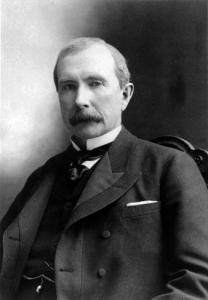 “The life of a 19th-century American industrial worker was far from easy. Even in good times wages were low, hours long and working conditions hazardous. Little of the wealth which the growth of the nation had generated went to its workers. The situation was worse for women and children, who made up a high percentage of the work force in some industries and often received but a fraction of the wages a man could earn. Periodic economic crises swept the nation, further eroding industrial wages and producing high levels of unemployment….
“The laissez-faire capitalism, which dominated the second half of the 19th century and fostered huge concentrations of wealth and power, was backed by a judiciary which time and again ruled against those who challenged the system. In this, they were merely following the prevailing philosophy of the times. As John D. Rockefeller is reported to have said: ‘the growth of a large business is merely a survival of the fittest.’ This ‘Social Darwinism,’ as it was known, had many proponents who argued that any attempt to regulate business was tantamount to impeding the natural evolution of the species.
“Yet the costs of this indifference to the victims of capital were high. For millions, living and working conditions were poor, and the hope of escaping from a lifetime of poverty slight. As late as the year 1900, the United States had the highest job-related fatality rate of any industrialized nation in the world. Most industrial workers still worked a 10-hour day (12 hours in the steel industry), yet earned from 20 to 40 percent less than the minimum deemed necessary for a decent life. The situation was only worse for children, whose numbers in the work force doubled between 1870 and 1900.” [2]
But these conditions did not obtain only in the United States. In 1891, Pope Leo XIII took inventory of the conditions of working people throughout the Western World, and observed “enormous fortunes of some few individuals, and the utter poverty of the masses….” (Rerum Novarum, §1) [3] He saw that working people had “been surrendered, isolated and helpless, to the hardheartedness of employers and the greed of unchecked competition,” and that “the hiring of labor and the conduct of trade” had become “concentrated in the hands of comparatively few,” with the result “that a small number of very rich men” had “been able to lay upon the teeming masses of the laboring poor a yoke little better than that of slavery itself.” (Ibid, §3)
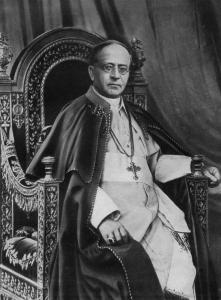 Forty years later, Pope Pius XI reflected on the conditions that Pope Leo XIII observed, and remarked on the philosophical underpinnings that gave support to them.
“For toward the close of the nineteenth century, the new kind of economic life that had arisen and the new developments of industry had gone to the point in most countries that human society was clearly becoming divided more and more into two classes. One class, very small in number, was enjoying almost all the advantages which modern inventions so abundantly provided; the other, embracing the huge multitude of working people, oppressed by wretched poverty, was vainly seeking escape from the straits wherein it stood.
“Quite agreeable, of course, was this state of things to those who thought it in their abundant riches the result of inevitable economic laws and accordingly, as if it were for charity to veil the violation of justice which lawmakers not only tolerated but at times sanctioned, wanted the whole care of supporting the poor committed to charity alone. The workers, on the other hand, crushed by their hard lot, were barely enduring it and were refusing longer to bend their necks beneath so galling a yoke; and some of them, carried away by the heat of evil counsel, were seeking the overturn of everything, while others, whom Christian training restrained from such evil designs, stood firm in the judgment that much in this had to be wholly and speedily changed.” (Quadragesimo anno, §§3-4) [4]
The fallacious nature of the thinking behind this Social Darwinism, if it was at all hidden, was hiding in plain sight. It was an outlandish claim that newly created economic conditions, caused by rapid technological changes, were somehow written permanently in nature. Moreover, the productive property, the means of production, through which such egregious exploitation was accomplished, was supported by laws which protected the ownership of that property. Either laws were themselves part of the natural order or they were not. If they were, then laws protecting the interests of working people would have been part of the natural order as much as those protecting the ownership of the means of production. If not, then the proponents of Social Darwinism would have had to concede that they were maintaining their advantages through brute force.
But if an economic order is maintained simply through force, there is no morality to appeal to. One cannot consistently maintain that there is “right” in protecting ownership and “wrong” in protecting the interests of workers if force is the final arbiter. Notions of “right” and “wrong” become mental surplusage, conveying only conditions that are more clearly described by other words. At the end of the day, Social Darwinists were merely claiming that exploiters should have been permitted to exploit because they were capable of doing so, leaving unexplained why such conditions should have been considered preferable.
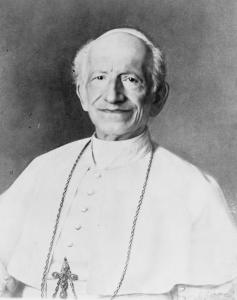 We have Social Darwinists today, though most of them wouldn’t dare call themselves that. Nowadays they present themselves as proponents of “free enterprise.” But there is no “free enterprise.” A truly unregulated economy would permit armed invasion of places of business and plundering the inventory. Therefore, we should not be bashful about asserting, along with Pope Leo XIII,
“Wages, as we are told, are regulated by free consent, and therefore the employer, when he pays what was agreed upon, has done his part and seemingly is not called upon to do anything beyond. The only way, it is said, in which injustice might occur would be if the master refused to pay the whole of the wages, or if the workman should not complete the work undertaken; in such cases the public authority should intervene, to see that each obtains his due, but not under any other circumstances.
“To this kind of argument a fair-minded man will not easily or entirely assent; it is not complete, for there are important considerations which it leaves out of account altogether…. The preservation of life is the bounden duty of one and all, and to be wanting therein is a crime. It necessarily follows that each one has a natural right to procure what is required in order to live, and the poor can procure that in no other way than by what they can earn through their work.
“Let the working man and the employer make free agreements, and in particular let them agree freely as to the wages; nevertheless, there underlies a dictate of natural justice more imperious and ancient than any bargain between man and man, namely, that wages ought not to be insufficient to support a frugal and well-behaved wage-earner. If through necessity or fear of a worse evil the workman accept harder conditions because an employer or contractor will afford him no better, he is made the victim of force and injustice. (Rerum Novarum, §§43-45)
This is Catholic social teaching. So let us Catholics not allow ourselves to be buffaloed into believing that Social Darwinism, by whatever name it is called, or with whatever words it is described, can ever be consistent with the teachings of our religion.
The icon of St. Joseph the Worker is by Daniel Nichols.
Please go like Christian Democracy on Facebook here. Join the discussion on Catholic social teaching here.
Previous Post

May 2, 2018
Of Alfie Evans, Subsidiarity, and Universal Health Care
Next Post
May 9, 2018 Withdrawal
Browse Our Archives
Select a Category Abortion Affordable Care Act Arbitration Agreements Catholic Social Teaching Christian Democracy climate change Communism Consistent life Constitutional Rights Discrimination distributism Employment Contracts First Amendment Free Exercise Clause Freedom of Speech Government Immigration Ireland Israel Jerusalem Labor Magisterium Middle East Monarchism Neoliberalism Palestine Palestinian State Political parties Pope Pro-Life Movement Religious Discrimination Religious Freedom RIght to Life right-to-work Ruth Bader Ginsburg Same Sex Marriage socialism subsidiarity Supreme Court syndicates Uncategorized United States United States Constitution Universal health care Unjust law Western Society
Select a Month June 2019 May 2019 April 2019 March 2019 February 2019 January 2019 December 2018 November 2018 October 2018 September 2018 August 2018 July 2018 June 2018 May 2018 April 2018
Follow Us!
TAKE THE
Religious Wisdom Quiz
What does "Emmanuel" mean?
Select your answer to see how you score.
God is Peace God is Judge God is Righteous God with Us
Related posts from Christian Democracy



Bernie Sanders Tacks Distributist
TRENDING AT PATHEOS Catholic

Creation, Preservation, and Teleology in Catholic Theology
As I write this, it is very early Monday morning. Like millions...

The Parable Of The Sower And The Word...
One of Christ’s most famous parables is that of the sower who...

Rejecting Doom: Christian Hope And Human Action
Christianity is a religion of hope. We are to have hope and...

Why I Choose the Eucharist Over the Sermon
Choose the Eucharist, Not the Sermon What are we supposed to get...

5 Design Elements Found in Spiritually Rooted Homes
Putting Spirituality Into Home Decor Our homes are more than our living...

Credo: A Story of God Told with the...
About 10 years ago, I began to imagine a personal "Credo" that...
view all Catholic blogs
Ad-Free & Subscriber Log-In Subscription Support
- About Us
- 2026 Calendar
- Videos
- Podcasts
- Library of World Religions
- Faith In Media Tracker
- Advertise With Us
- Write for Us
- Privacy Policy
- Terms of Service
- Do Not Sell My Data
- Contact Us
- Radiant Digital
- Manage Newsletter Subscriptions
- Unsubscribe From Notifications
- Sitemap
Copyright 2008-2026, Patheos. All rights reserved.
Subscription Support Ad-Free & Subscriber Log-In
Follow Patheos