
BuddhistCatholicContemplativeEvangelicalGeneral ChristianHinduJewishLatter-day SaintMuslimNew VisionsProgressive Christian
Beliefs
- Buddhist
- Catholic
- Contemplative
- Evangelical
- General Christian
- Hindu
- Jewish
- Latter-day Saint
- More Voices
- Muslim
- New Visions
- Pagan
- Progressive Christian
Topics
- Religion News
- Food and Religion
- Sports and Religion
- Religious Art
- Religious Music and Entertainment
- Religious Events
- History and Religion
- Style and Religion
- Politics and Religion
- Women in Religion
- Recreation Outdoors and Religion
- Business Finance and Religion
- Careers Workplace and Religion
- Education and Religion
- Family Parenting and Religion
- Health Fitness and Religion
- Home and Religion
- Relationships and Religion
- Technology and Religion
- Travel and Religion
Columnists
- Buddhist Columnists
- Business Finance and Religion Columnists
- Careers Workplace and Religion Columnists
- Catholic Columnists
- Contemplative Columnists
- Education and Religion Columnists
- Evangelists Columnists
- Family Parenting and Religion Columnists
- General Christian Columnists
- Health Fitness and Religion Columnists
- Hindu Columnists
- History and Religion Columnists
- Home and Religion Columnists
- Jewish Columnists
- More Voices Columnists
- Latter Day Columnists
- Muslim Columnists
- New Visions Columnists
- Nonreligious Columnists
- Pagan Columnists
- Politics and Religion Columnists
- Progressive Columnists
- Recreation Outdoors and Religion Columnists
- Relationships and Religion Columnists
- Religion News Columnists
- Religious Art Columnists
- Religious Events Columnists
- Religious Music and Entertainment Columnists
- Sports and Religion Columnists
- Style and Religion Columnists
- Technology and Religion Columnists
- Travel and Religion Columnists
- Women in Religion Columnists
Resource Library
- 2026 Calendar
- Library of World Religions
- The 100 Most Holy Places on Earth
- Patheos Answers
- Podcasts
- Videos
- Faith Leaders Database
- Anglican Episcopalian
- Bahai
- Baptist
- Buddhism
- Christianity
- Confucianism
- Eastern Orthodoxy
- Hinduism
- Holiness and Pentecostal
- ISKCON
- Islam
- Judaism
- Lutheran
- Methodist
- The Church of Jesus Christ of Latter-day Saints
- New Age
- Paganism
- Presbytarian and Reformed
- Protestantism
- Religion Behind the Scenes
- Roman Catholic
- Scientology
- Shia Islam
- Sikhism
- Sufism
- Sunni Islam
- Taoism
- Zen
- See all religions
Research Tools
 Ad-Free & Subscriber Log-In Subscription Support
Ad-Free & Subscriber Log-In Subscription Support
Follow Patheos 

- Trending:
- Forgiveness
- |
- Marriage
- |
- Consciousness
- |
- Death Penalty
- |
- Election
- |
- Halloween
 Christian Democracy
- Home
- Catholic
- Politics and Religion
- Of Jailing Striking Teachers and Other Considerations
Of Jailing Striking Teachers and Other Considerations
Last updated on: April 25, 2018 at 3:21 am by Jack Quirk
Of Jailing Striking Teachers and Other Considerations 2018-04-25T03:21:06-05:00 Jack Quirk
Patheos Explore the world's faith through different perspectives on religion and spirituality! Patheos has the views of the prevalent religions and spiritualities of the world.
The Denver Post reports that two “Republican state lawmakers have introduced a bill seeking to prohibit Colorado teachers from striking and make it so they would face firing, fines or even jail time if they do so anyway.” [1] This wouldn’t be the only example of a law like this. In North Carolina, all public employees are prohibited from striking [2], and those who do are guilty of a misdemeanor. [3]
While the “measure’s chances of becoming law are minuscule,” if it somehow did pass it could put the United States in violation of the International Labour Organization’s Abolition of Forced Labour Convention, 1957 [4], which the U.S. ratified on September 25, 1991. [5] The Convention specifically prohibits imposing forced labor “as a punishment for having participated in strikes.” The Convention would thus be violated every time a striker was sentenced to community service, which is ordinarily considered by convicted criminal defendants to be preferable to actual jail time.
But it is in fashion these days for Americans to be derisive of the requirements of international law, so that sort of forewarning is likely to meet up with a fair number of deaf ears. It will be of interest to some, however, what Catholic social teaching has to say on the subject; and the promulgation of same being the stated mission of this blog, let us proceed to examine the proposed legislation in that light.
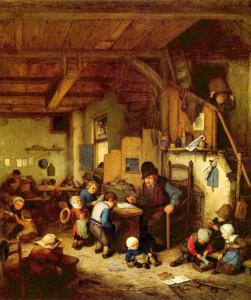 The Catechism tells us that recourse “to a strike is morally legitimate when it cannot be avoided, or at least when it is necessary to obtain a proportionate benefit. It becomes morally unacceptable when accompanied by violence, or when objectives are included that are not directly linked to working conditions or are contrary to the common good.” (Catechism of the Catholic Church (CCC), §2435) [6]
Since the adversaries of the Colorado teachers will be quick to assert that any teacher strike is contrary to the common good, that is a subject that should be considered. As it turns out, the Catechism lays out with specificity what the common good consists of, telling us that it “consists of three essential elements:” [7] (CCC, §1906)
The first is “respect for the person as such.” (CCC, §1907) This means, among other things, that society “should permit each of its members to fulfill his vocation.” Obviously, a balancing of interests is required here. There is the interest of the teachers in fulfilling their vocation as teachers in a manner that is not burdensome. Depriving them of effective bargaining power as to their compensation could easily compel them to seek a different kind of employment. On the other hand, there are the interests of the students in developing their vocations. Teacher strikes undoubtedly interfere with their learning, and cannot be credibly said to be harmless as to their personal development.
But the students also have an interest in ensuring that teachers are adequately compensated. Low pay for teachers hinders the attraction of talent to that profession, and if school boards are empowered to engage in one-sided negotiations with teachers, that is going to place a downward pressure on teacher pay. And the negotiations will be essentially one-sided if the teachers have no remedy, such as a strike, for intransigence on the part of those with whom they are negotiating. Moreover, it will do the students no good at all to be taught by people who are demoralized, and, perhaps, seeking a way to leave the teaching profession. On balance, then, it appears that the interests of both teachers and students are best served if teachers are permitted to strike for better pay or working conditions.
 The second element requires that every person have access to what “what is needed to lead a truly human life:” to include education. (CCC, §1908) Now it is true that students are being deprived of an education so long as a teacher strike lasts. But education also has to be effective if it is going to provide a true benefit. The aforementioned teacher demoralization and narrowing of the teacher talent pool that will arise from stripping teachers of meaningful bargaining power would inevitably have an inimical impact on the effectiveness of public education.
“Finally, the common good requires peace, that is, the stability and security of a just order.” (CCC, §1909) But this cannot be properly understood only as peace between citizens. There also must be peace between people and their government. If a strike can be morally legitimate, and the other factors for assessing the public good weigh in its favor, it cannot serve the cause of peace for a strike to be suppressed by government force. But that is exactly what the proposed legislation in Colorado calls for.
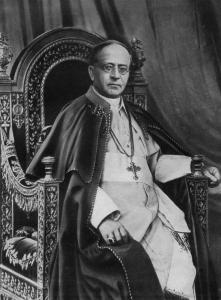
From these considerations it is apparent that the common good is best served by allowing teachers to strike when necessary. Of course, society would doubtlessly be better served if such strikes were made unnecessary. But it would require some reforms, which could be applied, with necessary adaptations, to all circumstances where labor-management disputes now take place. Pope Pius XI made a suggestion on how this might be accomplished in his encyclical, Quadragesimo anno. [8]
His suggestion was, basically, that employers and workers in a given industry would form separate associations. The associations would bargain with each other, and, if disputes could not be resolved, the government would step in to resolve it. (Quadragesimo anno, §§91-95) Now the pope only intended a suggestion here, so we need not be chary of making adaptations. In doing so, we should head off at the pass the calumny that the Holy Father was endorsing fascism by his proposal, since there is nothing of nationalism or authoritarianism in it, and is completely workable within a democracy.
But history has demonstrated a seemingly chronic problem with liberal democracy as it is practiced in the United States, that governments are susceptible to representing only the wealthiest interests, leaving us with an effective oligarchy notwithstanding our republican political form. This hardly means that we should switch to a monarchy or even a more authoritarian system, but it does indicate that we cannot expect American governments to be neutral arbiters between employers and workers. Moreover, in the case of public school teachers, government would be a party in any dispute, and so could not also be a judge.
Neutral arbitration, however, can be accomplished, and it is already widely used in the United States to resolve labor disputes, particularly where government employees are involved. One sound method of selecting arbitrators is that each side will select one, and these two will agree on a third. The decision of the arbitrators is legally binding on both sides.
This method has obvious advantages over strikes or lockouts, and it would be advantageous if was practiced everywhere that labor-management disputes can arise. It is, therefore, reasonable to suggest that it become public policy throughout the nation. It certainly would be a better solution than threatening to jail one side of a dispute for exercising the only remedy available to it.
The icon of St. Joseph the Worker is by Daniel Nichols.
Previous Post

April 19, 2018
St. Thomas Aquinas and the Attack on Syria
Next Post
April 26, 2018 The State Usurps the Family: The Case of Alfie Evans
Browse Our Archives
Select a Category Abortion Affordable Care Act Arbitration Agreements Catholic Social Teaching Christian Democracy climate change Communism Consistent life Constitutional Rights Discrimination distributism Employment Contracts First Amendment Free Exercise Clause Freedom of Speech Government Immigration Ireland Israel Jerusalem Labor Magisterium Middle East Monarchism Neoliberalism Palestine Palestinian State Political parties Pope Pro-Life Movement Religious Discrimination Religious Freedom RIght to Life right-to-work Ruth Bader Ginsburg Same Sex Marriage socialism subsidiarity Supreme Court syndicates Uncategorized United States United States Constitution Universal health care Unjust law Western Society
Select a Month June 2019 May 2019 April 2019 March 2019 February 2019 January 2019 December 2018 November 2018 October 2018 September 2018 August 2018 July 2018 June 2018 May 2018 April 2018
Follow Us!
TAKE THE
Religious Wisdom Quiz
Which Christian tradition is known for ornate mosaics and icons in their churches?
Select your answer to see how you score.
Presbyterian Adventist Baptist Orthodox
Related posts from Christian Democracy

Bernie Sanders Tacks Distributist
TRENDING AT PATHEOS Catholic

Rejecting Doom: Christian Hope And Human Action
Christianity is a religion of hope. We are to have hope and...

It’s What Comes From Within Which Matters
One of the most difficult things for us to understand is why...

Why I Choose the Eucharist Over the Sermon
Choose the Eucharist, Not the Sermon What are we supposed to get...

5 Design Elements Found in Spiritually Rooted Homes
Putting Spirituality Into Home Decor Our homes are more than our living...

Credo: A Story of God Told with the...
About 10 years ago, I began to imagine a personal "Credo" that...

The Anatomy of Divine Revelation in Catholic Thought
The claim that God has made Himself known to human beings is...
view all Catholic blogs
Ad-Free & Subscriber Log-In Subscription Support
- About Us
- 2026 Calendar
- Videos
- Podcasts
- Library of World Religions
- Faith In Media Tracker
- Advertise With Us
- Write for Us
- Privacy Policy
- Terms of Service
- Do Not Sell My Data
- Contact Us
- Radiant Digital
- Manage Newsletter Subscriptions
- Unsubscribe From Notifications
- Sitemap
Copyright 2008-2026, Patheos. All rights reserved.
Subscription Support Ad-Free & Subscriber Log-In
Follow Patheos