
BuddhistCatholicContemplativeEvangelicalGeneral ChristianHinduJewishLatter-day SaintMuslimNew VisionsProgressive Christian
Beliefs
- Buddhist
- Catholic
- Contemplative
- Evangelical
- General Christian
- Hindu
- Jewish
- Latter-day Saint
- More Voices
- Muslim
- New Visions
- Pagan
- Progressive Christian
Topics
- Religion News
- Food and Religion
- Sports and Religion
- Religious Art
- Religious Music and Entertainment
- Religious Events
- History and Religion
- Style and Religion
- Politics and Religion
- Women in Religion
- Recreation Outdoors and Religion
- Business Finance and Religion
- Careers Workplace and Religion
- Education and Religion
- Family Parenting and Religion
- Health Fitness and Religion
- Home and Religion
- Relationships and Religion
- Technology and Religion
- Travel and Religion
Columnists
- Buddhist Columnists
- Business Finance and Religion Columnists
- Careers Workplace and Religion Columnists
- Catholic Columnists
- Contemplative Columnists
- Education and Religion Columnists
- Evangelists Columnists
- Family Parenting and Religion Columnists
- General Christian Columnists
- Health Fitness and Religion Columnists
- Hindu Columnists
- History and Religion Columnists
- Home and Religion Columnists
- Jewish Columnists
- More Voices Columnists
- Latter Day Columnists
- Muslim Columnists
- New Visions Columnists
- Nonreligious Columnists
- Pagan Columnists
- Politics and Religion Columnists
- Progressive Columnists
- Recreation Outdoors and Religion Columnists
- Relationships and Religion Columnists
- Religion News Columnists
- Religious Art Columnists
- Religious Events Columnists
- Religious Music and Entertainment Columnists
- Sports and Religion Columnists
- Style and Religion Columnists
- Technology and Religion Columnists
- Travel and Religion Columnists
- Women in Religion Columnists
Resource Library
- 2026 Calendar
- Library of World Religions
- The 100 Most Holy Places on Earth
- Patheos Answers
- Podcasts
- Videos
- Faith Leaders Database
- Anglican Episcopalian
- Bahai
- Baptist
- Buddhism
- Christianity
- Confucianism
- Eastern Orthodoxy
- Hinduism
- Holiness and Pentecostal
- ISKCON
- Islam
- Judaism
- Lutheran
- Methodist
- The Church of Jesus Christ of Latter-day Saints
- New Age
- Paganism
- Presbytarian and Reformed
- Protestantism
- Religion Behind the Scenes
- Roman Catholic
- Scientology
- Shia Islam
- Sikhism
- Sufism
- Sunni Islam
- Taoism
- Zen
- See all religions
Research Tools
 Ad-Free & Subscriber Log-In Subscription Support
Ad-Free & Subscriber Log-In Subscription Support
Follow Patheos 

- Trending:
- Forgiveness
- |
- Marriage
- |
- Consciousness
- |
- Death Penalty
- |
- Election
- |
- Halloween
 Christian Democracy
- Home
- Catholic
- Politics and Religion
- Looking for Wiggle Room on Labor Rights
Looking for Wiggle Room on Labor Rights
Last updated on: April 9, 2018 at 4:21 am by Jack Quirk
Looking for Wiggle Room on Labor Rights 2018-04-09T04:21:25-05:00 Jack Quirk
Patheos Explore the world's faith through different perspectives on religion and spirituality! Patheos has the views of the prevalent religions and spiritualities of the world.
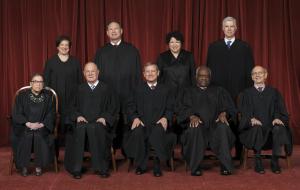
 The United States Conference of Catholic Bishops (USCCB) filed an amicus brief [1] in Mark Janus v. American Federation of State, County, and Municipal Employees, Council 31, a Supreme Court Case in which oral arguments were heard on the 26th of February. The USCCB is not a party to the case, but the Supreme Court permits non-parties to file briefs under certain circumstances. [2]
Mark Janus is asking the Court to invalidate public sector “agency shop” arrangements under the First Amendment, which would require the Court to overrule a previous case. [3] Under “agency shop” arrangements, employees in a bargaining unit covered by a union, but who choose not to join the union, are required to pay the union a fee that covers the costs of collective bargaining on their behalf. But these fees may not be used for political or ideological activity. [4] This permits employees to abstain from funding such things as political candidates or expressions with which the do not agree, but still requires them to pay for the collective bargaining from which they receive a benefit. The arrangement protects the employees’ First Amendment right not to participate in speech with which they disagree, while not permitting them to receive the service of collective bargaining for free.
But Mr. Janus’s position is that requiring him to pay any fee to a union of which he disapproves violates his constitutional rights. In other words, he wants all public employment to be, essentially, covered by a right-to-work law, where he makes no contribution whatsoever to the union, but still receives any benefit from what the union negotiates. In its brief, the USCCB states its opposition to what Mr. Janus is seeking this way:
“The Catholic bishops of the United States have long and consistently supported the right of workers to organize for purposes of collective bargaining. Because this right is substantially weakened by so-called ‘right-to-work’ laws, many bishops—in their dioceses, through their state conferences, and through their national conference—have opposed or cast doubt on such laws, and no U.S. bishop has expressed support for them.
“Petitioner invites this Court to constitutionalize the ‘right-to-work’ position—instantly, without exception, for all fifty states, almost irreversibly—in the public sector.”
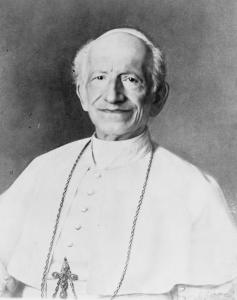
The bishops are quite obviously correct in supporting the right of working people to organize and collectively bargain. This has been the consistent position of the Catholic Church since Pope Leo XIII’s encyclical, Rerum Novarum. [5] And the “Magisterium recognizes the fundamental role played by labour unions, whose existence is connected with the right to form associations or unions to defend the vital interests of workers employed in the various professions.” (Compendium of the Social Doctrine of the Church (CSDC), Sec. 305) [6] As the Second Vatican Council decreed, “Among the basic rights of the human person is to be numbered the right of freely founding unions for working people.” (Guadium et spes, Sec. 68) [7]
Now it would be odd indeed if the Magisterium was indifferent to the weakening of something that it so vigorously supports. And requiring unions to permit free riders on their efforts would most certainly weaken them.
It will be objected that, nowadays, unions support political candidates who champion legalized abortion, and that puts them beyond any legitimate Catholic support, and that, therefore, a working person should be free to disassociate himself completely. But agency shop arrangements do allow for working people to disassociate themselves from a union. Unions lose money when employees avail themselves of the arrangement. Agency shop arrangements simply deny any privilege to receive a service for free, which is itself an injustice.
 While labor unions should certainly stick to advocating for the working people they represent, and not venture out into other issues, union “organizations have the duty to exercise influence in the political arena, making it duly sensitive to labour problems and helping it to work so that workers’ rights are respected.” (CSDC, Sec. 307) But it is unreasonable to demand that unions be able to control what factions have taken up residence in any political party. Unions will support the candidates that favor their cause, and they cannot be expected to forfeit any policy influence they have because of the vicissitudes of party alignments.
The Janus case involves public employment, and there are some sardonic voices afoot that would like to make the point that the Magisterial sources that support unions never specifically mention public employee unions. Therefore, they conclude, in an act of special pleading for the ages, that the Catholic position on the right of workers to organize, might not apply to public employees. These would argue that the bishops are misapplying Catholic doctrine in opposing Mr. Janus’s efforts.
It is easy to see, however, that this argument from silence could be applied to anything that has never been specifically mentioned. If there is no specific Magisterial reference to bakers, could that mean that bakers might have no right to organize? The Church has time and again spoken out against abortion, but would a possible exception exist if there was found no specific reference to abortion in Greenland? Such manifestations of desperation have no merit.
The outcome of the Janus case is not yet known. The Supreme Court has not issued an opinion. But there can be no serious doubt that the American bishops have correctly interpreted Magisterial teaching in this matter.
—Jack Quirk
The icon of St. Joseph the Worker is by Daniel Nichols.
Previous Post
June 22, 2019
Free the Detainees
Next Post

April 12, 2018 When the Salt Loses Its Taste
Browse Our Archives
Select a Category Abortion Affordable Care Act Arbitration Agreements Catholic Social Teaching Christian Democracy climate change Communism Consistent life Constitutional Rights Discrimination distributism Employment Contracts First Amendment Free Exercise Clause Freedom of Speech Government Immigration Ireland Israel Jerusalem Labor Magisterium Middle East Monarchism Neoliberalism Palestine Palestinian State Political parties Pope Pro-Life Movement Religious Discrimination Religious Freedom RIght to Life right-to-work Ruth Bader Ginsburg Same Sex Marriage socialism subsidiarity Supreme Court syndicates Uncategorized United States United States Constitution Universal health care Unjust law Western Society
Select a Month June 2019 May 2019 April 2019 March 2019 February 2019 January 2019 December 2018 November 2018 October 2018 September 2018 August 2018 July 2018 June 2018 May 2018 April 2018
Follow Us!
TAKE THE
Religious Wisdom Quiz
How many days was Jesus in the tomb before His resurrection?
Select your answer to see how you score.
Three Nine Forty Seven
Related posts from Christian Democracy



Bernie Sanders Tacks Distributist
TRENDING AT PATHEOS Catholic

Creation, Preservation, and Teleology in Catholic Theology
As I write this, it is very early Monday morning. Like millions...

The Parable Of The Sower And The Word...
One of Christ’s most famous parables is that of the sower who...

Rejecting Doom: Christian Hope And Human Action
Christianity is a religion of hope. We are to have hope and...

Why I Choose the Eucharist Over the Sermon
Choose the Eucharist, Not the Sermon What are we supposed to get...

5 Design Elements Found in Spiritually Rooted Homes
Putting Spirituality Into Home Decor Our homes are more than our living...

Credo: A Story of God Told with the...
About 10 years ago, I began to imagine a personal "Credo" that...
view all Catholic blogs
Ad-Free & Subscriber Log-In Subscription Support
- About Us
- 2026 Calendar
- Videos
- Podcasts
- Library of World Religions
- Faith In Media Tracker
- Advertise With Us
- Write for Us
- Privacy Policy
- Terms of Service
- Do Not Sell My Data
- Contact Us
- Radiant Digital
- Manage Newsletter Subscriptions
- Unsubscribe From Notifications
- Sitemap
Copyright 2008-2026, Patheos. All rights reserved.
Subscription Support Ad-Free & Subscriber Log-In
Follow Patheos