
BuddhistCatholicContemplativeEvangelicalGeneral ChristianHinduJewishLatter-day SaintMuslimNew VisionsProgressive Christian
Beliefs
- Buddhist
- Catholic
- Contemplative
- Evangelical
- General Christian
- Hindu
- Jewish
- Latter-day Saint
- More Voices
- Muslim
- New Visions
- Pagan
- Progressive Christian
Topics
- Religion News
- Food and Religion
- Sports and Religion
- Religious Art
- Religious Music and Entertainment
- Religious Events
- History and Religion
- Style and Religion
- Politics and Religion
- Women in Religion
- Recreation Outdoors and Religion
- Business Finance and Religion
- Careers Workplace and Religion
- Education and Religion
- Family Parenting and Religion
- Health Fitness and Religion
- Home and Religion
- Relationships and Religion
- Technology and Religion
- Travel and Religion
Columnists
- Buddhist Columnists
- Business Finance and Religion Columnists
- Careers Workplace and Religion Columnists
- Catholic Columnists
- Contemplative Columnists
- Education and Religion Columnists
- Evangelists Columnists
- Family Parenting and Religion Columnists
- General Christian Columnists
- Health Fitness and Religion Columnists
- Hindu Columnists
- History and Religion Columnists
- Home and Religion Columnists
- Jewish Columnists
- More Voices Columnists
- Latter Day Columnists
- Muslim Columnists
- New Visions Columnists
- Nonreligious Columnists
- Pagan Columnists
- Politics and Religion Columnists
- Progressive Columnists
- Recreation Outdoors and Religion Columnists
- Relationships and Religion Columnists
- Religion News Columnists
- Religious Art Columnists
- Religious Events Columnists
- Religious Music and Entertainment Columnists
- Sports and Religion Columnists
- Style and Religion Columnists
- Technology and Religion Columnists
- Travel and Religion Columnists
- Women in Religion Columnists
Resource Library
- 2026 Calendar
- Library of World Religions
- The 100 Most Holy Places on Earth
- Patheos Answers
- Podcasts
- Videos
- Faith Leaders Database
- Anglican Episcopalian
- Bahai
- Baptist
- Buddhism
- Christianity
- Confucianism
- Eastern Orthodoxy
- Hinduism
- Holiness and Pentecostal
- ISKCON
- Islam
- Judaism
- Lutheran
- Methodist
- The Church of Jesus Christ of Latter-day Saints
- New Age
- Paganism
- Presbytarian and Reformed
- Protestantism
- Religion Behind the Scenes
- Roman Catholic
- Scientology
- Shia Islam
- Sikhism
- Sufism
- Sunni Islam
- Taoism
- Zen
- See all religions
Research Tools
 Ad-Free & Subscriber Log-In Subscription Support
Ad-Free & Subscriber Log-In Subscription Support
Follow Patheos 

- Trending:
- Forgiveness
- |
- Marriage
- |
- Consciousness
- |
- Death Penalty
- |
- Election
- |
- Halloween
 Christian Crier
- Home
- Evangelical
- How To Be The Salt Of The Earth
How To Be The Salt Of The Earth
Last updated on: September 10, 2018 at 4:30 am by Jack Wellman
How To Be The Salt Of The Earth 2018-09-04T14:06:58-05:00 Jack Wellman
Patheos Explore the world's faith through different perspectives on religion and spirituality! Patheos has the views of the prevalent religions and spiritualities of the world.
What did Jesus mean by telling the disciples that they are the salt of the earth? What does that mean?
The Essential Mineral
Salt is a necessary mineral and so important that it was used as a currency in ancient times, and it’s where we get our word “salary” from, but for thousands of years, salt’s been used as a preservative, preventing spoilage in foods, particularly meat. Biologically, humans cannot life without salt. Jesus said salt is good (Mark 9:50), but He said that for more than a physical reason. He, as the Creator of life, must know that salt is essential to human life. Paul says our speech is to be seasoned as salt (Col 4:6), so why all these Scriptures about salt? And what does it mean to have salt in our speech? Is this tied to our behavior? We know that salt is important as a preservative, and was even offered in some of the Old Testament sacrifices. If we have this (sweet) speech among believers and the unsaved, then we are more likely to have peace with one another (Mark 9:50). Our salt can enhance the flavor of any conversation or serving opportunity. Salt can be any of these three E’s. I call them the 3 “E-migos:” Encouragement (to give courage), Edification (building others up) and Exhorting (to adjure, urge, or call upon). This does not mean cramming our beliefs down people’s throat. Too much salt ruins the flavor. It’s like someone left the cap loose on the salt shaker, and all the salt dumps out and ruins the food, however, just enough salt can make things more palatable. You can lead a horse to water, but you can’t make him drink…but, you can feed him salty peanuts.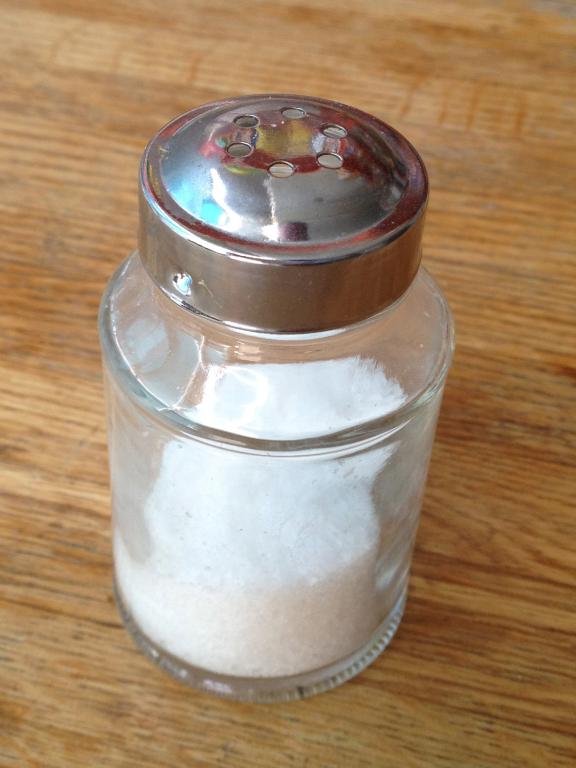
A Sanitizer
Salt enhances flavor, and it acts as a preservative, but it also acts as a cleanser or sanitizer, and in our family, gargling with warm salt water has cured many a sore throat over the years, but salt has also been used as a cleanser as well. A guy at work always used salt and crushed ice to clean the coffee pot stains, and even when someone had left the coffee pot on overnight, the combination of crushed ice and salt made it easier to clean the coffee pot. Today, most coffee makers will automatically shut down if left unattended, but you’ll find sodium chloride in many medicines, and during wartimes, it was used as a wound sterilizer and germ killer. Salt is good…unless you use too much. Then, it ruins everything it touches. One example of salty speech was when one of our church members was gone for a couple of weeks. When they came the following Sunday, one man said, “Well, where you have you been?” Instead, it would have been better to ask, “How are you? We missed you last week. Are things okay?” One seems a bit judgmental while the other is salted with the sweet speech of concern for their well-being. One leaves a bitter taste in the mouth; the other is comforting.
Human Survival
Salt is vital for many purposes, but it’s essential to our own physical survival, however, if regular salt loses its flavor, then it becomes worthless and it’s simply thrown away (Matt 5:13). If it’s left in the open air and exposed to the elements, the moisture ruins it. Salt like that is good for nothing, but pure salt has great value in this world, but I believe most of all, it have value in our speech and in our life. God may use our salty speech to bring people to Christ or to show the love of Christ by which they can know who His disciples are (John 13:34-35). In that way, He will preserve them for all eternity, becoming incorruptible someday (1 Cor 15), and He is able to keep them forever. Jesus says, “All that the Father gives me will come to me, and whoever comes to me I will never cast out” (John 6:37), so “that I should lose nothing of all that he has given me, but raise it up on the last day” (John 6:39). That means, “No man can pluck them out of my hand, nor…out of my Father’s hand” (John 10:28-29). You cannot be any more preserved than to be preserved by God Himself.
Worth their Salt
You’ve probably heard the saying, “he ain’t worth his salt.” That saying is based upon the salary he or she drew for the day, and whether he or she really worked hard that day, thereby earning it or being deserving of it. Some Roman soldiers were paid partly in salt, so to be worth your salt means you are earning your wages or deserving of what you receive. That means there is worth in what you do, but when it comes to salvation, worth has nothing to do with it…unless you’re talking about Jesus Christ’s worth! One precious drop of His blood is the most valuable thing in the universe, because under it the sinner’s plunged and is raised in victory. The important thing is that our worth is not why we got saved. It was only a matter of God’s free gift of grace. Our works had nothing to do with it, just as our human worth didn’t warrant our salvation. It was simply an act of love on God’s part (Eph 1:4, 2:8-9).
Seasoned with Salt
 Jesus spoke about being the salt of the earth, and doing so for a dead and decaying world. He said, “Salt is good, but if the salt has lost its saltiness, how will you make it salty again? Have salt in yourselves, and be at peace with one another” (Mark 9:50). This means that if we have saltiness in ourselves, it will show up in our words, and that saltiness can make us “be at peace with one another,” and that’s a worthy goal, isn’t it? The Apostle Paul said to “Let your speech always be gracious, seasoned with salt, so that you may know how you ought to answer each person” (Col 4:6), so our words to others, being “seasoned with salt,” will consist of knowing “how [we] ought to answer each person” when asked about the hope that is in us. Our response should always be with gentleness and respect (1 Pet 3:15), and in this way, we can “be at peace with one another,” perhaps even unbelievers.
Conclusion
Sometimes our words betray what’s in our heart. For example, when we begin to debate or argue with unbelievers, we can get worked up about things, and our language may be anything but salty. On the other hand, too much salt ruins the conversation. It’s like trying to enjoy a good meal. Using a little bit of salt is perfect, but too much salt ruins it, so there must be a balance. Too much can make it unpalatable, but too little can make it bland. Jesus said, “You are the salt of the earth, but if salt has lost its taste, how shall its saltiness be restored? It is no longer good for anything except to be thrown out and trampled under people’s feet” (Matt 5:13). Just like salt that’s left open and exposed to the world, we can lose our saltiness. If that happens, it’s not good for anything but to throw away, however, that’s not what salt was intended for. It was meant for our survival, but it was also mean to make our speech a sweet, savory.
Article by Jack Wellman
Jack Wellman is Pastor of the Mulvane Brethren Church in Mulvane Kansas. Jack is a writer at Christian Quotes and also the Senior Writer at What Christians Want To Know whose mission is to equip, encourage, and energize Christians and to address questions about the believer’s daily walk with God and the Bible. You can follow Jack on Google Plus or check out his book Teaching Children the Gospel available on Amazon.
Previous Post

September 7, 2018
Things We Cannot Compromise On
Next Post
September 12, 2018 Is There A Point Of No Return?
Browse Our Archives
Select a Category Bible Answers Bible Definitions Bible Story Bible Study Bible Verses Christian Books Christian Entertainment Christian Fathers Christian Mothers Christian Quotes Devotional Famous Christians Music News Parables Prayers Quotes Sunday School Lesson Uncategorized Youth Sermons
Select a Month October 2019 September 2019 August 2019 July 2019 June 2019 May 2019 April 2019 March 2019 February 2019 January 2019 December 2018 November 2018 October 2018 September 2018 August 2018 July 2018 June 2018 May 2018 April 2018 March 2018 February 2018 January 2018 December 2017 November 2017 October 2017 September 2017 August 2017 July 2017 June 2017 May 2017 April 2017 March 2017 February 2017 January 2017 December 2016 November 2016 October 2016 September 2016 August 2016 July 2016 June 2016 May 2016 March 2016 February 2016 January 2016 December 2015 November 2015 October 2015 September 2015 August 2015 July 2015 June 2015 May 2015 April 2015 March 2015 February 2015 January 2015 December 2014 November 2014 October 2014 September 2014 August 2014 July 2014 June 2014 May 2014 April 2014 March 2014 February 2014 January 2014 December 2013 November 2013 October 2013 September 2013 August 2013 July 2013 June 2013 May 2013 April 2013 March 2013
Follow Us!
TAKE THE
Religious Wisdom Quiz
In what city was Paul shipwrecked?
Select your answer to see how you score.
Malta Crete Rhodes Cyprus
Related posts from Christian Crier

What Does The Bible Say About Our Thoughts?

Top 13 Bible Verses About Virtue

Do Colors Have Special Meaning In The Bible?

The Greatest Father In History
TRENDING AT PATHEOS Evangelical

How the author of the world's best hymn...
I've been working with John Newton for a while now. This makes...

Long before this Lectio Divina, Psalm 130 - the song - started...

What About the Trees? Another Living Parable
After I finished writing the last article about falling leaves as a...

Why Classical Education Is a Conversation, Not a...
Come and Read: Joy in Classical Education When I was a little...

Falling Leaves: A Living Parable on Letting Go
I’ve spent the vast majority of my life in the southeast corner...

Cornell University has received a great deal of negative publicity and intense...
view all Evangelical blogs
Ad-Free & Subscriber Log-In Subscription Support
- About Us
- 2026 Calendar
- Videos
- Podcasts
- Library of World Religions
- Faith In Media Tracker
- Advertise With Us
- Write for Us
- Privacy Policy
- Terms of Service
- Do Not Sell My Data
- Contact Us
- Radiant Digital
- Manage Newsletter Subscriptions
- Unsubscribe From Notifications
- Sitemap
Copyright 2008-2026, Patheos. All rights reserved.
Subscription Support Ad-Free & Subscriber Log-In
Follow Patheos