
BuddhistCatholicContemplativeEvangelicalGeneral ChristianHinduJewishLatter-day SaintMuslimNew VisionsProgressive Christian
Beliefs
- Buddhist
- Catholic
- Contemplative
- Evangelical
- General Christian
- Hindu
- Jewish
- Latter-day Saint
- More Voices
- Muslim
- New Visions
- Pagan
- Progressive Christian
Topics
- Religion News
- Food and Religion
- Sports and Religion
- Religious Art
- Religious Music and Entertainment
- Religious Events
- History and Religion
- Style and Religion
- Politics and Religion
- Women in Religion
- Recreation Outdoors and Religion
- Business Finance and Religion
- Careers Workplace and Religion
- Education and Religion
- Family Parenting and Religion
- Health Fitness and Religion
- Home and Religion
- Relationships and Religion
- Technology and Religion
- Travel and Religion
Columnists
- Buddhist Columnists
- Business Finance and Religion Columnists
- Careers Workplace and Religion Columnists
- Catholic Columnists
- Contemplative Columnists
- Education and Religion Columnists
- Evangelists Columnists
- Family Parenting and Religion Columnists
- General Christian Columnists
- Health Fitness and Religion Columnists
- Hindu Columnists
- History and Religion Columnists
- Home and Religion Columnists
- Jewish Columnists
- More Voices Columnists
- Latter Day Columnists
- Muslim Columnists
- New Visions Columnists
- Nonreligious Columnists
- Pagan Columnists
- Politics and Religion Columnists
- Progressive Columnists
- Recreation Outdoors and Religion Columnists
- Relationships and Religion Columnists
- Religion News Columnists
- Religious Art Columnists
- Religious Events Columnists
- Religious Music and Entertainment Columnists
- Sports and Religion Columnists
- Style and Religion Columnists
- Technology and Religion Columnists
- Travel and Religion Columnists
- Women in Religion Columnists
Resource Library
- 2026 Calendar
- Library of World Religions
- The 100 Most Holy Places on Earth
- Patheos Answers
- Podcasts
- Videos
- Faith Leaders Database
- Anglican Episcopalian
- Bahai
- Baptist
- Buddhism
- Christianity
- Confucianism
- Eastern Orthodoxy
- Hinduism
- Holiness and Pentecostal
- ISKCON
- Islam
- Judaism
- Lutheran
- Methodist
- The Church of Jesus Christ of Latter-day Saints
- New Age
- Paganism
- Presbytarian and Reformed
- Protestantism
- Religion Behind the Scenes
- Roman Catholic
- Scientology
- Shia Islam
- Sikhism
- Sufism
- Sunni Islam
- Taoism
- Zen
- See all religions
Research Tools
 Ad-Free & Subscriber Log-In Subscription Support
Ad-Free & Subscriber Log-In Subscription Support
Follow Patheos 

- Trending:
- Forgiveness
- |
- Marriage
- |
- Consciousness
- |
- Death Penalty
- |
- Election
- |
- Halloween
 Christian Crier
- Home
- Evangelical
- The Duality Of Biblical Prophecy
The Duality Of Biblical Prophecy
Last updated on: April 20, 2018 at 5:00 am by Jack Wellman
The Duality Of Biblical Prophecy 2018-04-17T16:33:53-05:00 Jack Wellman
Patheos Explore the world's faith through different perspectives on religion and spirituality! Patheos has the views of the prevalent religions and spiritualities of the world.
The Bible has former and latter’s, and an Old Testament and New Testament, but there are more dualities in the Bible than you may realize.
The Captivity of Sin
After King Solomon’s reign, the nation of Israel split into two different nations. One was known as the Northern Kingdom and was referred to as Israel, so when Israel is mentioned in Bible prophecy, it refers to the Northern Kingdom, which consisted of ten of the tribes of Israel. The Southern Kingdom became known as Judah (or the Jews) and was comprised of Judah, Benjamin, and Levi. The Northern Kingdom, or the ten of the tribes of Israel, dwelt in Samaria, while the Southern Kingdom remained in control of Jerusalem and the southern half of Israel, so ten of the tribes of Israel were in the Northern Kingdom, while Judah, Benjamin, and Levi remained in Judah, so some Old Testament prophecies refer to Israel, and some to Israel’s sister, Judah (Jer 3:6-10). The striking thing is the prophecies are very similar concerning their coming judgments. Some of the prophets wrote about the coming judgment of Israel, while others wrote specifically to Judah, but in both cases, the nations were judged and sent into captivity for idolatry. Even though the nations were taken captive at different times, the reasons for God’s judgment were the same, and so was the judgment (captivity). The point is, if God judged His own people for their sins, then why would He not do the same to others? That’s why I believe that many of the Old Testament prophecies are applicable to the nations today. They may not be falling in front of a stone image to worship it, but whatever is above God is an idol nonetheless, so unless they repent and trust in Christ, their judgments will be similar. It may not be a physical captivity, but as Jesus said, “everyone who practices sin is a slave to sin” (John 8:34), so they really are captives…captive to sin. The Apostle Paul asked, “Do you not know that if you present yourselves to anyone as obedient slaves, you are slaves of the one whom you obey, either of sin, which leads to death, or of obedience, which leads to righteousness” (Rom 6:16)?
Now and Then
Today, there is no shortage of people who are self-proclaimed prophets of God, and it is just as it was in Jeremiah’s day where many of these claim to speak for God, but in biblical times, if you spoke for God, it was considered Scripture, so just as in Jeremiah’s day, we would do well to “not listen to the words of the prophets who prophesy to you, filling you with vain hopes. They speak visions of their own minds, not from the mouth of the Lord” (Jer 23:16). God tauntingly says to these false prophets, “who among them has stood in the council of the LORD to see and to hear his word, or who has paid attention to his word and listened” (Jer 23:18), saying, “I did not send the prophets, yet they ran; I did not speak to them, yet they prophesied” (Jer 23:21), so “who among them has stood in the council of God?” I believe that number is zero! Even in the New Testament, Paul prophesied that “the time is coming when people will not endure sound teaching, but having itching ears they will accumulate for themselves teachers to suit their own passions, and will turn away from listening to the truth and wander off into myths” (2 Tim 4:3-4). All we can do is stick “To the teaching and to the testimony! If they will not speak according to this word, it is because they have no dawn” (Isaiah 8:20), or light from God.
Former and Latter
When Jesus sat on the Mount of Olives and prophesied what was to come, much of it was fulfilled in 70 AD when the Roman Army, under Titus, destroyed Jerusalem, killing over a million Jews. You can also find similar prophecies in the Old Testament that have direct application to our day. Jesus said that before the temple is destroyed, and of course that would naturally mean Jerusalem, He warned that “many will come in my name, saying, ‘I am the Christ,’ and they will lead many astray. And you will hear of wars and rumors of wars. See that you are not alarmed, for this must take place, but the end is not yet. For nation will rise against nation, and kingdom against kingdom, and there will be famines and earthquakes in various places. All these are but the beginning of the birth pains” (Matt 24:5-8). Today, we see nations rising up against other nations, sometimes meeting in the middle (i.e. Syria), and we are seeing an increase in famine and earthquakes (in Oklahoma, Arkansas, Texas) in places where they used to be rare. And just as Jesus said it would be leading up to Jerusalem’s destruction, “lawlessness will be increased, the love of many will grow cold” (Matt 24:12).
Dualities
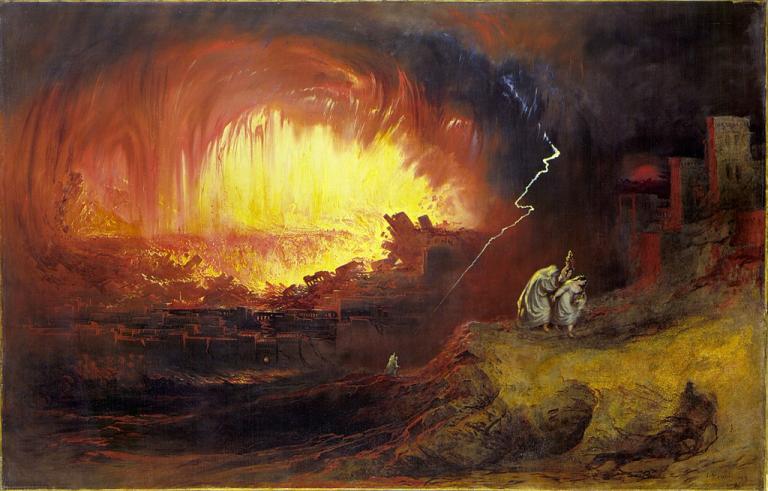 When the Roman Empire fell, some historians noted that it fell for the same reasons many other nations fell, including Sodom and Gomorrah, and even Israel and Judah. When Ezekiel was prophesying to the inhabitants of Jerusalem, he noted similarities between Judah and Sodom and Gomorrah, writing, “Behold, this was the guilt of your sister Sodom: she and her daughters had pride, excess of food, and prosperous ease, but did not aid the poor and needy. They were haughty and did an abomination before me. So I removed them, when I saw it” (Ezk 16:49-50). Today, the disparity between the rich and the poor is widening. There is no indication that famines will decrease, the poor will get richer, or the hungry will be fed better. God will judge any nation what Sodom and Gomorrah did, including His own chosen one. The Apostle Peter wrote, “For it is time for judgment to begin at the household of God; and if it begins with us, what will be the outcome for those who do not obey the gospel of God” (1 Pet 4:17). Obviously, the outcome will be horrendous.
Conclusion
There is a duality in the Bible too. There is the Old Covenant and the New Covenant, there is the Old Testament and the New Testament, and there is a day of salvation (today), and a day when God will judge the world (Dan 12:2-3; Matt 25:31-36; Acts 17:31; 1 Cor 6:2; Rev 20:12-15). For some, that judgment will come after death (Heb 9:27), so it’s exceedingly better to trust in Christ today. If you haven’t already done so, come to Him. If you do, He’s your Savior, but if you reject Him, He will be your Judge tomorrow. Grace and mercy are still available to all who come to Him…but if you delay, then you may have to pay for your own sins. It is infinitely better to have Christ pay for your sins than to pay for them yourself. With one way (John 14:6), your saved by grace (John 19:30; Eph 2:8-9), but without “the way,” you’ll pay forever.
Article by Jack Wellman
Jack Wellman is Pastor of the Mulvane Brethren Church in Mulvane Kansas. Jack is a writer at Christian Quotes and also the Senior Writer at What Christians Want To Know whose mission is to equip, encourage, and energize Christians and to address questions about the believer’s daily walk with God and the Bible. You can follow Jack on Google Plus or check out his book Teaching Children the Gospel available on Amazon.
Previous Post

April 18, 2018
What Caused Lucifer Or Satan’s Fall?
Next Post
April 23, 2018 What It Means To Lay Aside Every Weight And Sin
Browse Our Archives
Select a Category Bible Answers Bible Definitions Bible Story Bible Study Bible Verses Christian Books Christian Entertainment Christian Fathers Christian Mothers Christian Quotes Devotional Famous Christians Music News Parables Prayers Quotes Sunday School Lesson Uncategorized Youth Sermons
Select a Month October 2019 September 2019 August 2019 July 2019 June 2019 May 2019 April 2019 March 2019 February 2019 January 2019 December 2018 November 2018 October 2018 September 2018 August 2018 July 2018 June 2018 May 2018 April 2018 March 2018 February 2018 January 2018 December 2017 November 2017 October 2017 September 2017 August 2017 July 2017 June 2017 May 2017 April 2017 March 2017 February 2017 January 2017 December 2016 November 2016 October 2016 September 2016 August 2016 July 2016 June 2016 May 2016 March 2016 February 2016 January 2016 December 2015 November 2015 October 2015 September 2015 August 2015 July 2015 June 2015 May 2015 April 2015 March 2015 February 2015 January 2015 December 2014 November 2014 October 2014 September 2014 August 2014 July 2014 June 2014 May 2014 April 2014 March 2014 February 2014 January 2014 December 2013 November 2013 October 2013 September 2013 August 2013 July 2013 June 2013 May 2013 April 2013 March 2013
Follow Us!
TAKE THE
Religious Wisdom Quiz
Which letter emphasizes faith without works is dead?
Select your answer to see how you score.
1 Peter Titus Hebrews James
Related posts from Christian Crier

How God Is Reaching Muslims By Dreams


Seeing The Gospel In Biblical Accounts

Getting The Most Out Of Your Bible Reading
TRENDING AT PATHEOS Evangelical

How the author of the world's best hymn...
I've been working with John Newton for a while now. This makes...

Long before this Lectio Divina, Psalm 130 - the song - started...

What About the Trees? Another Living Parable
After I finished writing the last article about falling leaves as a...

Why Classical Education Is a Conversation, Not a...
Come and Read: Joy in Classical Education When I was a little...

Falling Leaves: A Living Parable on Letting Go
I’ve spent the vast majority of my life in the southeast corner...

Cornell University has received a great deal of negative publicity and intense...
view all Evangelical blogs
Ad-Free & Subscriber Log-In Subscription Support
- About Us
- 2026 Calendar
- Videos
- Podcasts
- Library of World Religions
- Faith In Media Tracker
- Advertise With Us
- Write for Us
- Privacy Policy
- Terms of Service
- Do Not Sell My Data
- Contact Us
- Radiant Digital
- Manage Newsletter Subscriptions
- Unsubscribe From Notifications
- Sitemap
Copyright 2008-2026, Patheos. All rights reserved.
Subscription Support Ad-Free & Subscriber Log-In
Follow Patheos