
BuddhistCatholicContemplativeEvangelicalGeneral ChristianHinduJewishLatter-day SaintMuslimNew VisionsProgressive Christian
Beliefs
- Buddhist
- Catholic
- Contemplative
- Evangelical
- General Christian
- Hindu
- Jewish
- Latter-day Saint
- More Voices
- Muslim
- New Visions
- Pagan
- Progressive Christian
Topics
- Religion News
- Food and Religion
- Sports and Religion
- Religious Art
- Religious Music and Entertainment
- Religious Events
- History and Religion
- Style and Religion
- Politics and Religion
- Women in Religion
- Recreation Outdoors and Religion
- Business Finance and Religion
- Careers Workplace and Religion
- Education and Religion
- Family Parenting and Religion
- Health Fitness and Religion
- Home and Religion
- Relationships and Religion
- Technology and Religion
- Travel and Religion
Columnists
- Buddhist Columnists
- Business Finance and Religion Columnists
- Careers Workplace and Religion Columnists
- Catholic Columnists
- Contemplative Columnists
- Education and Religion Columnists
- Evangelists Columnists
- Family Parenting and Religion Columnists
- General Christian Columnists
- Health Fitness and Religion Columnists
- Hindu Columnists
- History and Religion Columnists
- Home and Religion Columnists
- Jewish Columnists
- More Voices Columnists
- Latter Day Columnists
- Muslim Columnists
- New Visions Columnists
- Nonreligious Columnists
- Pagan Columnists
- Politics and Religion Columnists
- Progressive Columnists
- Recreation Outdoors and Religion Columnists
- Relationships and Religion Columnists
- Religion News Columnists
- Religious Art Columnists
- Religious Events Columnists
- Religious Music and Entertainment Columnists
- Sports and Religion Columnists
- Style and Religion Columnists
- Technology and Religion Columnists
- Travel and Religion Columnists
- Women in Religion Columnists
Resource Library
- 2026 Calendar
- Library of World Religions
- The 100 Most Holy Places on Earth
- Patheos Answers
- Podcasts
- Videos
- Faith Leaders Database
- Anglican Episcopalian
- Bahai
- Baptist
- Buddhism
- Christianity
- Confucianism
- Eastern Orthodoxy
- Hinduism
- Holiness and Pentecostal
- ISKCON
- Islam
- Judaism
- Lutheran
- Methodist
- The Church of Jesus Christ of Latter-day Saints
- New Age
- Paganism
- Presbytarian and Reformed
- Protestantism
- Religion Behind the Scenes
- Roman Catholic
- Scientology
- Shia Islam
- Sikhism
- Sufism
- Sunni Islam
- Taoism
- Zen
- See all religions
Research Tools
 Ad-Free & Subscriber Log-In Subscription Support
Ad-Free & Subscriber Log-In Subscription Support
Follow Patheos 

- Trending:
- Forgiveness
- |
- Marriage
- |
- Consciousness
- |
- Death Penalty
- |
- Election
- |
- Halloween
 Christian Crier
- Home
- Evangelical
- What Was Rodin Thinking, Man?
What Was Rodin Thinking, Man?
Last updated on: January 31, 2018 at 5:00 am by Jack Wellman
What Was Rodin Thinking, Man? 2018-01-24T16:10:47-06:00 Jack Wellman
Patheos Explore the world's faith through different perspectives on religion and spirituality! Patheos has the views of the prevalent religions and spiritualities of the world.
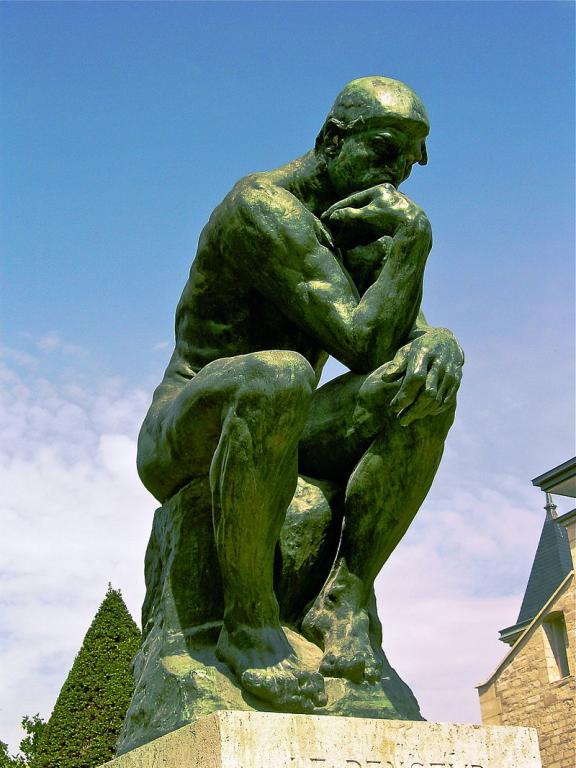
The Thinker by Auguste Rodin is thinking about something much different that we might believe. What was Rodin thinking when creating the so-called “Thinking man?”
Philosophy
Auguste Rodin’s “Thinking Man” is not really a work that was supposed to be about human philosophy but rather Rodin’s Thinking Man is contemplating something…and something that’s not very good. Rodin’s Thinking Man is not thinking, “I think, therefore I am,” but what I am thinking is not good because of what I see. The Thinker is a bronze statue or sculpture showing a life-sized figure sitting on a stone pedestal with his head resting on his fist. Apparently, he’s deep in thought over something he’s seeing, so it’s an image misappropriated to philosophy, because in actuality, The Thinker is thinking about the fate of human souls apart from God. Rodin based his work on The Divine Comedy of Dante, and the “Thinker” was intended to be sitting near the entrance of, while looking directly at, the gates of hell, so the “thinker” was originally intended to represent Dante at the gates of hell, pondering the eternal state of those who are in the lake of fire.
The Thinker
Conceived in 1880 to be the crowning element for Dante’s, The Gates of Hell, the Thinker was originally called The Poet and was intended to be Dante himself, leaning forward, and looking down at the various levels of hell, watching tortured bodies squirm in agony. Eventually, The Thinker became an independent work, separate from the Gates of Hell, so what was the Thinker thinking about? Was it human philosophy? Was he thinking, “I can think, so that means I must exist?” No, The Thinker may have been thinking about humanities rejection of God and their ultimate fate. Of course, not all have rejected God, so The Thinker is not thinking about any kind of human philosophy, but rather it’s a man thinking about and viewing all those lost souls in hell, where all hope is abandoned. It’s as if Rodin is The Thinker himself, and he is thinking of all those lost souls in time. It’s almost a “What if” for us, like “What if I had mentioned Christ to grandpa before he died? Would he have been saved? Why was I silent about Christ when so many of my friends and family and co-workers passed into an eternity separated from God, and having no hope for change? Rodin thought of the figure in broader, more universal terms than just thinking. The Thinker is depicted as a man in sober meditation battling with a powerful internal struggle, and resting in a highly unique pose with his hand to his chin, his right elbow on his left knee, and in a crouching position…almost as if he’s straining to see something. This position allows the statue to survey the work with a contemplative feel…and it’s not a good feeling about all those who have died outside of faith in Christ.
The Wrath of God
Jesus told us to “not fear those who kill the body but cannot kill the soul. Rather fear him who can destroy both soul and body in hell” (Matt 10:28), and the author of Hebrews writes that it’s “a fearful thing to fall into the hands of the living God” (Heb 10:31), “Therefore, knowing the fear of the Lord, we persuade others” (2 Cor 5:11a). Jude may have thought about the state of a person’s heart when sharing Christ because he said we should “have mercy on those who doubt; save others by snatching them out of the fire; to others show mercy with fear, hating even the garment stained by the flesh” (Jude 1:22-23). Showing God’s mercy works for those who have doubts or are convicted of their sin, but others may need to hear about God’s wrath before God’s mercy becomes relevant. When God’s Spirit convicts them of their sin, like it did us who believe, it makes them run to Christ for forgiveness and mercy. When they repent and put their trust in Christ, God doesn’t give us a spirit of fear, but a Spirit of power and love (2 Tim 1:7). This takes all our worries away concerning the wrath of God (John 3:36a). Jude understood that sometimes it takes , “snatching them out of the fire,” by showing them that they have every reason to fear God if they reject Jesus Christ, while at other times, like if they are already broken, they need to be pointed toward God’s mercy in Christ. It still puzzles me why people get so apoplectic about Jesus being the only way to God but not acknowledging that at least there is “a way” (John 14:6).
The Fear of God
Fear can be a good thing and it can be a bad thing. Irrational fear can subject a person to unnecessary mental torment, where they’re always expecting the worst. Fear can easily become debilitating, making work difficult, if not impossible, and destabilizing family relationships, however, fear can also keep us alive. It was fear that kept us as young boys from falling off of large bluffs in Arkansas where we scaled cliffs that were somewhat dangerous. The fear kept us from taking unnecessary risks and made think about our next step. Fear tightened our grips on the rock, and the fear of falling made sure that we’d find firm footing along the way. The fear of death keeps us from taking risks that could kill us, so not all fear is destructive. It even keeps a few cats, dogs, and squirrels alive around here, but here’s where the fear is really good. The fear of God is the very beginning and consummation of wisdom because the wisest thing we could ever do is trust in Christ. In this way, the fear of God is a good thing because it brings eternal life. The Bible says that the fear of God is the very beginning of wisdom (Prov 1:7, 9:10). Most misunderstand what this fear is. It’s not a fear of being struck down by God or a fear of unending punishment, but more like a driver on a freeway. The driver fears getting a ticket, so guess what happens? He slows down, or at least, drives the speed limit. It’s not that he or she fears police themselves, but they fear the blue lights, because they fear the price that a speeding ticket is going to bring in fines, court costs, insurance rates, so that type of fear is productive and keeps us from harm. Or at least it keeps our insurance rates lower, but fearing God means reverencing God, obeying God, listening to God’s Word, and fearing the consequences when we break God’s law. Believers never have to worry about a fear of being cast into hell, but they should fear (or respect) God taking them behind the woodshed. God disciplines every child He loves (Heb 12:6), and “the LORD reproves him whom he loves, as a father the son in whom he delights” (Prov 3:12).
Conclusion
We have already read what Jesus said to fear…and that is falling into the hands of God for all who have rejected His Son, Jesus Christ. Jesus said whoever rejects Him, has the wrath of God abiding on them (John 3:36b), but Christ followers have no need to fear, “For God has not destined us for wrath, but to obtain salvation through our Lord Jesus Christ” (1 Thess 5:9). Besides, “God gave us a spirit not of fear but of power and love and self-control” (2 Tim 1:7), so perhaps The Thinker, if he could speak, would tell those who have not yet believed, to repent and trust in Christ, and they will be saved (John 3:16-17). Auguste Rodin might not have been thinking this, but have you ever asked yourself, “Why do people reject God and scorn Jesus Christ so much…and why are so many so hateful about God’s wrath when God has provided a way of escape?” Complaining about God’s wrath is like complaining about the huge gash on the Titanic, and while it’s sinking, everyone’s railing at the crew, all the while, ignoring the lifeboats. For humanity, Jesus is the only way of escape, but instead of railing against this as being narrow-minded because there is only one way, we should rejoice that there is at least “a way.” And, even though I believe this, it’s not my opinion because Jesus’ statement about Himself is that He is the one and only way to be saved (John 14:6). You can scorn the Titanic crew for getting them into this mess and go down with the ship, or you can escape to the only way that you can be saved, and just as the Apostle Peter said, “there is salvation in no one else, for there is no other name under heaven given among men by which we must be saved” (Acts 4:12). It might be narrow and the only way, but at least it is a way! A way is better than no way. Believers have no reason to fear God’s wrath because God’s wrath was placed on Jesus Christ for those who trusted in Him. For those who reject Him, they have every real reason to fear.
Article by Jack Wellman
Jack Wellman is Pastor of the Mulvane Brethren Church in Mulvane Kansas. Jack is a writer at Christian Quotes and also the Senior Writer at What Christians Want To Know whose mission is to equip, encourage, and energize Christians and to address questions about the believer’s daily walk with God and the Bible. You can follow Jack on Google Plus or check out his book Teaching Children the Gospel available on Amazon.
Previous Post

January 29, 2018
Giving Hope To The Homeless
Next Post
February 2, 2018 To Little Children Belong The Kingdom
Browse Our Archives
Select a Category Bible Answers Bible Definitions Bible Story Bible Study Bible Verses Christian Books Christian Entertainment Christian Fathers Christian Mothers Christian Quotes Devotional Famous Christians Music News Parables Prayers Quotes Sunday School Lesson Uncategorized Youth Sermons
Select a Month October 2019 September 2019 August 2019 July 2019 June 2019 May 2019 April 2019 March 2019 February 2019 January 2019 December 2018 November 2018 October 2018 September 2018 August 2018 July 2018 June 2018 May 2018 April 2018 March 2018 February 2018 January 2018 December 2017 November 2017 October 2017 September 2017 August 2017 July 2017 June 2017 May 2017 April 2017 March 2017 February 2017 January 2017 December 2016 November 2016 October 2016 September 2016 August 2016 July 2016 June 2016 May 2016 March 2016 February 2016 January 2016 December 2015 November 2015 October 2015 September 2015 August 2015 July 2015 June 2015 May 2015 April 2015 March 2015 February 2015 January 2015 December 2014 November 2014 October 2014 September 2014 August 2014 July 2014 June 2014 May 2014 April 2014 March 2014 February 2014 January 2014 December 2013 November 2013 October 2013 September 2013 August 2013 July 2013 June 2013 May 2013 April 2013 March 2013
Follow Us!
TAKE THE
Religious Wisdom Quiz
Which book of the Bible contains the phrase "Vanity of vanities"?
Select your answer to see how you score.
Proverbs Psalms Job Ecclesiastes
Related posts from Christian Crier
The Apostle Paul’s Last Will And Testament

How Handel’s Messiah Handles Theology
The Book Of Jonah: The Reluctant Prophet
TRENDING AT PATHEOS Evangelical

How the author of the world's best hymn...
I've been working with John Newton for a while now. This makes...

Long before this Lectio Divina, Psalm 130 - the song - started...

What About the Trees? Another Living Parable
After I finished writing the last article about falling leaves as a...

Why Classical Education Is a Conversation, Not a...
Come and Read: Joy in Classical Education When I was a little...

Falling Leaves: A Living Parable on Letting Go
I’ve spent the vast majority of my life in the southeast corner...

Cornell University has received a great deal of negative publicity and intense...
view all Evangelical blogs
Ad-Free & Subscriber Log-In Subscription Support
- About Us
- 2026 Calendar
- Videos
- Podcasts
- Library of World Religions
- Faith In Media Tracker
- Advertise With Us
- Write for Us
- Privacy Policy
- Terms of Service
- Do Not Sell My Data
- Contact Us
- Radiant Digital
- Manage Newsletter Subscriptions
- Unsubscribe From Notifications
- Sitemap
Copyright 2008-2026, Patheos. All rights reserved.
Subscription Support Ad-Free & Subscriber Log-In
Follow Patheos