
BuddhistCatholicContemplativeEvangelicalGeneral ChristianHinduJewishLatter-day SaintMuslimNew VisionsProgressive Christian
Beliefs
- Buddhist
- Catholic
- Contemplative
- Evangelical
- General Christian
- Hindu
- Jewish
- Latter-day Saint
- More Voices
- Muslim
- New Visions
- Pagan
- Progressive Christian
Topics
- Religion News
- Food and Religion
- Sports and Religion
- Religious Art
- Religious Music and Entertainment
- Religious Events
- History and Religion
- Style and Religion
- Politics and Religion
- Women in Religion
- Recreation Outdoors and Religion
- Business Finance and Religion
- Careers Workplace and Religion
- Education and Religion
- Family Parenting and Religion
- Health Fitness and Religion
- Home and Religion
- Relationships and Religion
- Technology and Religion
- Travel and Religion
Columnists
- Buddhist Columnists
- Business Finance and Religion Columnists
- Careers Workplace and Religion Columnists
- Catholic Columnists
- Contemplative Columnists
- Education and Religion Columnists
- Evangelists Columnists
- Family Parenting and Religion Columnists
- General Christian Columnists
- Health Fitness and Religion Columnists
- Hindu Columnists
- History and Religion Columnists
- Home and Religion Columnists
- Jewish Columnists
- More Voices Columnists
- Latter Day Columnists
- Muslim Columnists
- New Visions Columnists
- Nonreligious Columnists
- Pagan Columnists
- Politics and Religion Columnists
- Progressive Columnists
- Recreation Outdoors and Religion Columnists
- Relationships and Religion Columnists
- Religion News Columnists
- Religious Art Columnists
- Religious Events Columnists
- Religious Music and Entertainment Columnists
- Sports and Religion Columnists
- Style and Religion Columnists
- Technology and Religion Columnists
- Travel and Religion Columnists
- Women in Religion Columnists
Resource Library
- 2026 Calendar
- Library of World Religions
- The 100 Most Holy Places on Earth
- Patheos Answers
- Podcasts
- Videos
- Faith Leaders Database
- Anglican Episcopalian
- Bahai
- Baptist
- Buddhism
- Christianity
- Confucianism
- Eastern Orthodoxy
- Hinduism
- Holiness and Pentecostal
- ISKCON
- Islam
- Judaism
- Lutheran
- Methodist
- The Church of Jesus Christ of Latter-day Saints
- New Age
- Paganism
- Presbytarian and Reformed
- Protestantism
- Religion Behind the Scenes
- Roman Catholic
- Scientology
- Shia Islam
- Sikhism
- Sufism
- Sunni Islam
- Taoism
- Zen
- See all religions
Research Tools
 Ad-Free & Subscriber Log-In Subscription Support
Ad-Free & Subscriber Log-In Subscription Support
Follow Patheos 

- Trending:
- Forgiveness
- |
- Marriage
- |
- Consciousness
- |
- Death Penalty
- |
- Election
- |
- Halloween
 Christian Crier
- Home
- Evangelical
- Why Did Jesus Have To Cleanse The Temple?
Why Did Jesus Have To Cleanse The Temple?
Last updated on: July 21, 2017 at 9:00 am by Jack Wellman
Why Did Jesus Have To Cleanse The Temple? 2017-07-15T11:14:12-05:00 Jack Wellman
Patheos Explore the world's faith through different perspectives on religion and spirituality! Patheos has the views of the prevalent religions and spiritualities of the world.
Jesus cleansed the Temple twice, but why did He do it? What was the purpose?
Jesus Cleanses the Temple
When Jesus saw all of the money changers taking advantage of those coming to exchange their currency to pay their Temple taxes and to buy animals for sacrifice for the Passover, Jesus quoted Jeremiah when He said, “Has this house, which is called by my name, become a den of robbers in your eyes? Behold, I myself have seen it, declares the LORD” (Jer 7:11). Jeremiah was saying this in the context of rebuking the nation of Israel, who wrote, “if you truly amend your ways and your deeds, if you truly execute justice one with another, if you do not oppress the sojourner, the fatherless, or the widow, or shed innocent blood in this place, and if you do not go after other gods to your own harm, then I will let you dwell in this place, in the land that I gave of old to your fathers forever” (Jer 7:5-7), so Jeremiah tells them that “this house, which is called by my name, become a den of robbers in your eyes? Behold, I myself have seen it, declares the Lord,” and in fact the Lord did see it; then and in Jesus’ day, so when Jesus went into “the temple he found those who were selling oxen and sheep and pigeons, and the money-changers sitting there. And making a whip of cords, he drove them all out of the temple, with the sheep and oxen. And he poured out the coins of the money-changers and overturned their tables. And he told those who sold the pigeons, “Take these things away; do not make my Father’s house a house of trade” (John 2:13-16). To be clear, Jesus never whipped one person or one animal. He only used the whip to drive out the livestock, but never used the whip on any man or beast (Matt 21:12). He did overturn the money changers tables, but you can certainly understand why.
The Courtyard
Most biblical scholars understand that Jesus cleansing the Temple was no small accomplishment. For one thing, it was a huge operation. The part of the temple that Jesus cleansed was called the courtyard and was as far as the Gentiles could go, but the courtyard was filled to the brim with all sorts of livestock and birds which were all sold or exchanged for the sacrifices at the Temple, and this was not just a small farmer’s market. When Passover came, Jerusalem swelled to nearly half a million travelers who came to Jerusalem to make their Passover sacrifice. Josephus computed the number of Jews present in Jerusalem at Passover to be no fewer 3,000,000, and those Jews would need a lot of animals to sacrifice; whether a lamb or a bird, whichever the family could afford, so the number of lambs alone would be about a quarter of a million lambs if there were one lamb per family of 10 or so, but conservative estimates may be closer to about 300,000, at least in Jesus’ day. Still, that’s a lot of animals and in a relatively small area, and then there were the money changers who may have numbered in the thousands.
A Den of Thieves
The Jerusalem Temple sat on top of the Temple Mount, which covered about thirty-five acres, so there was sufficient space for hundreds of money changers, and since it was impossible for some of the Jews coming to Jerusalem to bring their own animals to be sacrificed, they had to buy some once they entered Jerusalem, but the problem was they were being taken advantage of, or really, exploited. One example was when they came to pay the obligatory temple tax, they often had to exchange Roman coinage into the acceptable currency. When the Pilgrims came, often from long distances, the money changers forced the Pilgrims into paying exorbitant exchange rates for their currency, so both the money changers and sellers (of livestock) were exploiting the poor, and overcharging even the poorest man’s offering (Lev 5:7). This is why Jesus cleansed the temple. He was angry at their taking advantage of the Jews. The Temple was full of thieves and greedy merchants, and sadly, the very ones responsible for all this merchandising were the priests, and they were putting their blessing on it by allowing it, because by allowing it, they were condoning it.
Still Cleaning the Temple
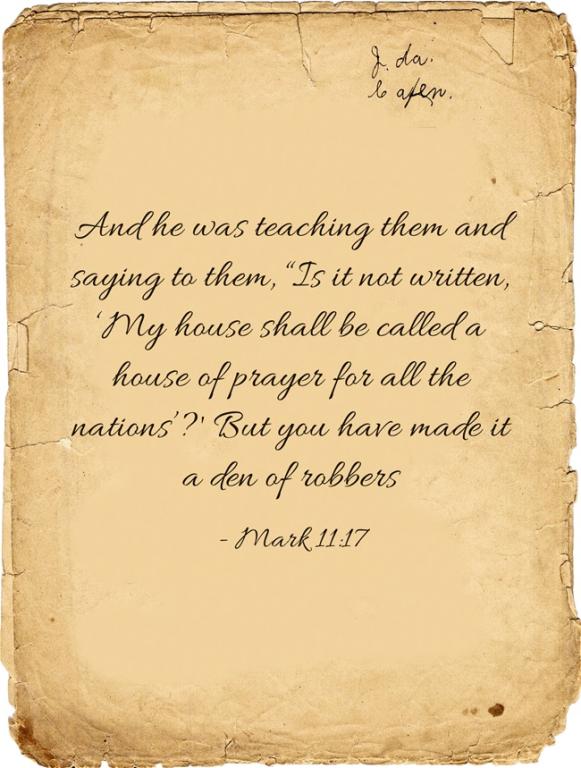
Jesus is coming again to cleanse the earth of sin but first of all, will deal with those who refuse to repent and trust in Christ (Rev 20:12-15). The Scriptures tell us Jesus cleansed the temple twice, once shortly after His ministry began (John 2:13-17), and another time, late in His ministry, during the Passover week (Matt 21:12), but today, Jesus is still cleansing the temple, but not the one you generally think of. Jesus was so angry at these robbers, so He “would not allow anyone to carry anything through the temple. And he was teaching them and saying to them, “Is it not written, ‘My house shall be called a house of prayer for all the nations’? But you have made it a den of robbers” (Mark 11:16-17). Today, the temple is our bodies, and for believers, the temple is no longer necessary because the Holy Spirit dwells in and lives in every believer. It is just as the Apostle Paul wrote; our “bodies are the temple of the Holy Spirit” (1st Cor 6:19), so even though Jesus might not have to make a whip out of cords, He does have to discipline us in love.
Conclusion
It is no coincidence that Jesus died at the exact moment that the Passover lamb was slain…at 3:00 PM. That’s when Jesus gave up His spirit and returned to the Father, and although Jesus never died, His physical body did, but Jesus cannot die since He is God. His death was a physical death of His body, but not the death of His Person, because He is God. God cannot die, and speaking of death, Jesus said, “I am the resurrection and the life. Whoever believes in me, though he die, yet shall he live, and everyone who lives and believes in me shall never die. Do you believe this” (John 11:25-26)? I hope you do believe that.
Article by Jack Wellman
Jack Wellman is Pastor of the Mulvane Brethren Church in Mulvane Kansas. Jack is host of Spiritual Fitness and also the Senior Writer at What Christians Want To Know whose mission is to equip, encourage, and energize Christians and to address questions about the believer’s daily walk with God and the Bible. You can follow Jack on Google Plus or check out his book Teaching Children the Gospel available on Amazon.
Previous Post

July 19, 2017
How To Keep Satan Off Your Back
Next Post
July 24, 2017 Why Jesus Says He Is The Only Way To Heaven
Browse Our Archives
Select a Category Bible Answers Bible Definitions Bible Story Bible Study Bible Verses Christian Books Christian Entertainment Christian Fathers Christian Mothers Christian Quotes Devotional Famous Christians Music News Parables Prayers Quotes Sunday School Lesson Uncategorized Youth Sermons
Select a Month October 2019 September 2019 August 2019 July 2019 June 2019 May 2019 April 2019 March 2019 February 2019 January 2019 December 2018 November 2018 October 2018 September 2018 August 2018 July 2018 June 2018 May 2018 April 2018 March 2018 February 2018 January 2018 December 2017 November 2017 October 2017 September 2017 August 2017 July 2017 June 2017 May 2017 April 2017 March 2017 February 2017 January 2017 December 2016 November 2016 October 2016 September 2016 August 2016 July 2016 June 2016 May 2016 March 2016 February 2016 January 2016 December 2015 November 2015 October 2015 September 2015 August 2015 July 2015 June 2015 May 2015 April 2015 March 2015 February 2015 January 2015 December 2014 November 2014 October 2014 September 2014 August 2014 July 2014 June 2014 May 2014 April 2014 March 2014 February 2014 January 2014 December 2013 November 2013 October 2013 September 2013 August 2013 July 2013 June 2013 May 2013 April 2013 March 2013
Follow Us!
TAKE THE
Religious Wisdom Quiz
How many men did Joshua initially send to Ai?
Select your answer to see how you score.
4,000 5,000 2,000 3,000
Related posts from Christian Crier

What Does The Bible Say About Our Thoughts?

Do Colors Have Special Meaning In The Bible?

The Glass – Half Empty Or Half Full?

TRENDING AT PATHEOS Evangelical

The REST of Your Life: A Creative Wrestles...
This week I had a conversation with a good friend from church....

How the author of the world's best hymn...
I've been working with John Newton for a while now. This makes...

Long before this Lectio Divina, Psalm 130 - the song - started...

What About the Trees? Another Living Parable
After I finished writing the last article about falling leaves as a...

Why Classical Education Is a Conversation, Not a...
Come and Read: Joy in Classical Education When I was a little...

Cornell University has received a great deal of negative publicity and intense...
view all Evangelical blogs
Ad-Free & Subscriber Log-In Subscription Support
- About Us
- 2026 Calendar
- Videos
- Podcasts
- Library of World Religions
- Faith In Media Tracker
- Advertise With Us
- Write for Us
- Privacy Policy
- Terms of Service
- Do Not Sell My Data
- Contact Us
- Radiant Digital
- Manage Newsletter Subscriptions
- Unsubscribe From Notifications
- Sitemap
Copyright 2008-2026, Patheos. All rights reserved.
Subscription Support Ad-Free & Subscriber Log-In
Follow Patheos