
BuddhistCatholicContemplativeEvangelicalGeneral ChristianHinduJewishLatter-day SaintMuslimNew VisionsProgressive Christian
Beliefs
- Buddhist
- Catholic
- Contemplative
- Evangelical
- General Christian
- Hindu
- Jewish
- Latter-day Saint
- More Voices
- Muslim
- New Visions
- Pagan
- Progressive Christian
Topics
- Religion News
- Food and Religion
- Sports and Religion
- Religious Art
- Religious Music and Entertainment
- Religious Events
- History and Religion
- Style and Religion
- Politics and Religion
- Women in Religion
- Recreation Outdoors and Religion
- Business Finance and Religion
- Careers Workplace and Religion
- Education and Religion
- Family Parenting and Religion
- Health Fitness and Religion
- Home and Religion
- Relationships and Religion
- Technology and Religion
- Travel and Religion
Columnists
- Buddhist Columnists
- Business Finance and Religion Columnists
- Careers Workplace and Religion Columnists
- Catholic Columnists
- Contemplative Columnists
- Education and Religion Columnists
- Evangelists Columnists
- Family Parenting and Religion Columnists
- General Christian Columnists
- Health Fitness and Religion Columnists
- Hindu Columnists
- History and Religion Columnists
- Home and Religion Columnists
- Jewish Columnists
- More Voices Columnists
- Latter Day Columnists
- Muslim Columnists
- New Visions Columnists
- Nonreligious Columnists
- Pagan Columnists
- Politics and Religion Columnists
- Progressive Columnists
- Recreation Outdoors and Religion Columnists
- Relationships and Religion Columnists
- Religion News Columnists
- Religious Art Columnists
- Religious Events Columnists
- Religious Music and Entertainment Columnists
- Sports and Religion Columnists
- Style and Religion Columnists
- Technology and Religion Columnists
- Travel and Religion Columnists
- Women in Religion Columnists
Resource Library
- 2026 Calendar
- Library of World Religions
- The 100 Most Holy Places on Earth
- Patheos Answers
- Podcasts
- Videos
- Faith Leaders Database
- Anglican Episcopalian
- Bahai
- Baptist
- Buddhism
- Christianity
- Confucianism
- Eastern Orthodoxy
- Hinduism
- Holiness and Pentecostal
- ISKCON
- Islam
- Judaism
- Lutheran
- Methodist
- The Church of Jesus Christ of Latter-day Saints
- New Age
- Paganism
- Presbytarian and Reformed
- Protestantism
- Religion Behind the Scenes
- Roman Catholic
- Scientology
- Shia Islam
- Sikhism
- Sufism
- Sunni Islam
- Taoism
- Zen
- See all religions
Research Tools
 Ad-Free & Subscriber Log-In Subscription Support
Ad-Free & Subscriber Log-In Subscription Support
Follow Patheos 

- Trending:
- Forgiveness
- |
- Marriage
- |
- Consciousness
- |
- Death Penalty
- |
- Election
- |
- Halloween
 Christian Crier
- Home
- Evangelical
- What Are Warning Signs Of Falling Into Apostasy?
What Are Warning Signs Of Falling Into Apostasy?
Last updated on: June 28, 2017 at 9:22 am by Jack Wellman
What Are Warning Signs Of Falling Into Apostasy? 2017-06-28T09:22:32-05:00 Jack Wellman
Patheos Explore the world's faith through different perspectives on religion and spirituality! Patheos has the views of the prevalent religions and spiritualities of the world.
How can you avoid falling into apostasy? What are some of the warning signs you or others might be falling for doctrinal error or heresy?
What is Apostasy?
When we read about apostasy, it’s typically about a group or a believer falling away from the truth, particularly from the essentials of the faith, like the divinity of Christ, the sinless nature and life of Christ, and the fact that we’re saved by grace and not of works. It is a renunciation or abandonment of the faith once delivered to the church (Jude 1:3). It can also be abandoning one’s own principles, morals, and values, but either way, apostasy is like a falling back or falling away from something; in this case, the truth (John 14:6). The Greek’s used the word apostasy (apostanai) to mean, “to stand apart from,” or “to desert” something or someone, so apostasy is voluntarily abandoning or standing in defiance of something that was once believed and practiced as true. It’s a rejection of what they knew, and in fact, a renunciation of what was formerly held. Whoever has believed the Bible and then chosen to disbelieve it or whoever doesn’t believe, which is also a free, volitional choice, is an apostate of the truth. Apostasy is not always bad. Some people have left a group when they discovered they were teaching errors, so in that case, it’s best to separate themselves, but when it’s a falling away, or as the Old Testament calls it in the Hebrew (mĕshuwbah), “a turning back,” or “backsliding.” The implications of being an apostate can have catastrophic, eternal consequences, particularly if it’s un-repented of.
Discernment and the Word
I believe those who have the greatest discernment are those who spend the greatest amounts of time in the Word of God. When you know enough of the truth, you can more easily recognize error when you hear it or read it. If you don’t know what the objective truth is, which is found in the Bible, then you are much less likely to know if something is true or not. For example, Christians know they cannot be saved by religious ceremonies or works (Gal 3; Eph 2:8-9), so when you hear someone say something like you must be baptized in our church, it’s like they’re saying, “Baptism + Jesus = Salvation.” I cannot count the number of times when someone wrote or talked about their experience, and in a way that seems to overshadow Scripture. It usually begins with, “My experience is” or “from what I’ve experienced,” and then just fill in the blank. Human experience might be helpful for some things, but it’s never a substitute for the truth. Rather than hearing what they believe based upon chapter and verse, it might be, “This is what happened to me,” therefore, their conclusion is, this must be true. In effect, it’s “My experience proves this to be true,” but what a slippery slope that is! The best weapon we have against heresy and apostasy is to know the truth well enough that when you read or hear something, you know it doesn’t square with Scripture. Experience is fine for many things, but its sinking sand when you try to build your eternity on it. Jesus says, “Everyone then who hears these words of mine and does them will be like a wise man who built his house on the rock. And the rain fell, and the floods came, and the winds blew and beat on that house, but it did not fall, because it had been founded on the rock” (Matt 7:24-25), however, “everyone who hears these words of mine and does not do them will be like a foolish man who built his house on the sand” (Matt 7:26). Building one’s belief system upon one’s own personal human experience is building a house on sinking sand and not the solid rock of Scripture.
Not if, but When
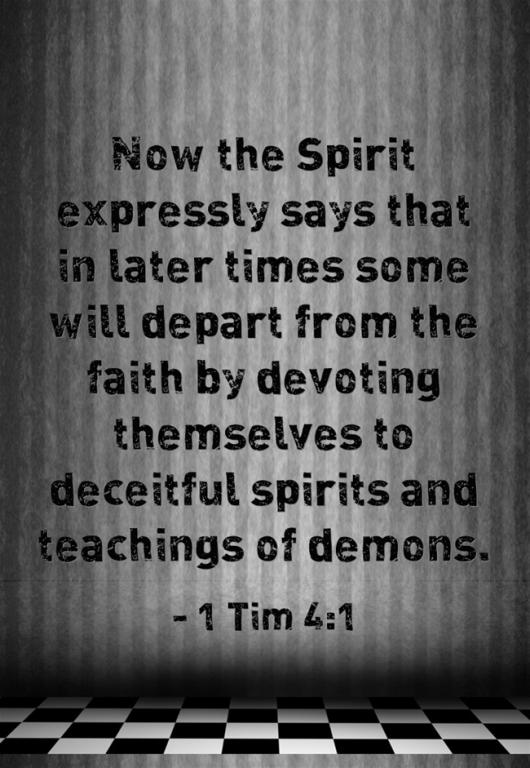
The Apostle Paul spoke with certainly about a time of apostasy. He writes that “the Spirit expressly says that in later times some will depart from the faith by devoting themselves to deceitful spirits and teachings of demons” (1st Tim 4:1). This departure from the faith was the reason Jude wrote his book. He knew it was necessary to contend for the faith that was once delivered (Jude 1:3), meaning it was a past, one-time event (Heb 1:1-2). The tense in the Greek doesn’t allow for it to mean it’s still happening or is yet to be delivered. By the way, the faith that was once delivered didn’t depend upon human experience to validate whether it was true or not. Human experience has no effect on the truth, but the truth directly effects the human’s experience (John 3:16; 2nd Cor 5:17-21). It is never the other way around. When Paul was writing about the coming of the Lord (2nd Thess 2:1), he reminded the church at Thessalonica that “the mystery of lawlessness is already at work. Only he who now restrains it will do so until he is out of the way” (2nd Thess 2:7), and it will be condemnation for those “who did not believe the truth but had pleasure in unrighteousness” (2nd Thess 2:12). This is why James places so much emphasis on helping our brothers and sisters, writing, “My brothers, if anyone among you wanders from the truth and someone brings him back, let him know that whoever brings back a sinner from his wandering will save his soul from death and will cover a multitude of sins” (James 5:19-20).
Conclusion
Some of the signs of falling into apostasy are that you start believing in human experience over what the Bible says. Your Bible reading drops off, which means you’ll be less likely to spot error. Your prayer life will all but dry up. You’ll be focusing on the peripherals (Gal 3) instead of the essentials (Rom 10:9-13; Acts 4:12). You worry less about what the Bible says and listen more to what people have experienced. We must recognize that a half-truth is really a whole lie. A little bit of error mixed with truth renders it all useless. In fact, the truth, even with a touch of error, is more dangerous than easily recognizable falsehoods. If there was a pure bottle of spring water and someone said, “It only contains 0.001% poison,” I doubt you’d drink it, even though it looked good. To protect yourself from apostasy, stay in the Word, study the Word, have the Spirit help you in the Word, and the Word will be familiar enough to you that you’ll know when something doesn’t smell right.
Article by Jack Wellman
Jack Wellman is Pastor of the Mulvane Brethren Church in Mulvane Kansas. Jack is host of Spiritual Fitness and also the Senior Writer at What Christians Want To Know whose mission is to equip, encourage, and energize Christians and to address questions about the believer’s daily walk with God and the Bible. You can follow Jack on Google Plus or check out his book Teaching Children the Gospel available on Amazon.
Previous Post

June 21, 2017
The Book Of Jonah: The Reluctant Prophet
Next Post
June 26, 2017 Why Persecution Is A Good Thing
Browse Our Archives
Select a Category Bible Answers Bible Definitions Bible Story Bible Study Bible Verses Christian Books Christian Entertainment Christian Fathers Christian Mothers Christian Quotes Devotional Famous Christians Music News Parables Prayers Quotes Sunday School Lesson Uncategorized Youth Sermons
Select a Month October 2019 September 2019 August 2019 July 2019 June 2019 May 2019 April 2019 March 2019 February 2019 January 2019 December 2018 November 2018 October 2018 September 2018 August 2018 July 2018 June 2018 May 2018 April 2018 March 2018 February 2018 January 2018 December 2017 November 2017 October 2017 September 2017 August 2017 July 2017 June 2017 May 2017 April 2017 March 2017 February 2017 January 2017 December 2016 November 2016 October 2016 September 2016 August 2016 July 2016 June 2016 May 2016 March 2016 February 2016 January 2016 December 2015 November 2015 October 2015 September 2015 August 2015 July 2015 June 2015 May 2015 April 2015 March 2015 February 2015 January 2015 December 2014 November 2014 October 2014 September 2014 August 2014 July 2014 June 2014 May 2014 April 2014 March 2014 February 2014 January 2014 December 2013 November 2013 October 2013 September 2013 August 2013 July 2013 June 2013 May 2013 April 2013 March 2013
Follow Us!
TAKE THE
Religious Wisdom Quiz
Who was sold into slavery by his brothers?
Select your answer to see how you score.
David Solomon Moses Joseph
Related posts from Christian Crier

What Does The Bible Say About Our Thoughts?

Top 13 Bible Verses About Virtue

Do Colors Have Special Meaning In The Bible?

The Greatest Father In History
TRENDING AT PATHEOS Evangelical

The REST of Your Life: A Creative Wrestles...
This week I had a conversation with a good friend from church....

How the author of the world's best hymn...
I've been working with John Newton for a while now. This makes...

Long before this Lectio Divina, Psalm 130 - the song - started...

What About the Trees? Another Living Parable
After I finished writing the last article about falling leaves as a...

Why Classical Education Is a Conversation, Not a...
Come and Read: Joy in Classical Education When I was a little...

Cornell University has received a great deal of negative publicity and intense...
view all Evangelical blogs
Ad-Free & Subscriber Log-In Subscription Support
- About Us
- 2026 Calendar
- Videos
- Podcasts
- Library of World Religions
- Faith In Media Tracker
- Advertise With Us
- Write for Us
- Privacy Policy
- Terms of Service
- Do Not Sell My Data
- Contact Us
- Radiant Digital
- Manage Newsletter Subscriptions
- Unsubscribe From Notifications
- Sitemap
Copyright 2008-2026, Patheos. All rights reserved.
Subscription Support Ad-Free & Subscriber Log-In
Follow Patheos