
BuddhistCatholicContemplativeEvangelicalGeneral ChristianHinduJewishLatter-day SaintMuslimNew VisionsProgressive Christian
Beliefs
- Buddhist
- Catholic
- Contemplative
- Evangelical
- General Christian
- Hindu
- Jewish
- Latter-day Saint
- More Voices
- Muslim
- New Visions
- Pagan
- Progressive Christian
Topics
- Religion News
- Food and Religion
- Sports and Religion
- Religious Art
- Religious Music and Entertainment
- Religious Events
- History and Religion
- Style and Religion
- Politics and Religion
- Women in Religion
- Recreation Outdoors and Religion
- Business Finance and Religion
- Careers Workplace and Religion
- Education and Religion
- Family Parenting and Religion
- Health Fitness and Religion
- Home and Religion
- Relationships and Religion
- Technology and Religion
- Travel and Religion
Columnists
- Buddhist Columnists
- Business Finance and Religion Columnists
- Careers Workplace and Religion Columnists
- Catholic Columnists
- Contemplative Columnists
- Education and Religion Columnists
- Evangelists Columnists
- Family Parenting and Religion Columnists
- General Christian Columnists
- Health Fitness and Religion Columnists
- Hindu Columnists
- History and Religion Columnists
- Home and Religion Columnists
- Jewish Columnists
- More Voices Columnists
- Latter Day Columnists
- Muslim Columnists
- New Visions Columnists
- Nonreligious Columnists
- Pagan Columnists
- Politics and Religion Columnists
- Progressive Columnists
- Recreation Outdoors and Religion Columnists
- Relationships and Religion Columnists
- Religion News Columnists
- Religious Art Columnists
- Religious Events Columnists
- Religious Music and Entertainment Columnists
- Sports and Religion Columnists
- Style and Religion Columnists
- Technology and Religion Columnists
- Travel and Religion Columnists
- Women in Religion Columnists
Resource Library
- 2026 Calendar
- Library of World Religions
- The 100 Most Holy Places on Earth
- Patheos Answers
- Podcasts
- Videos
- Faith Leaders Database
- Anglican Episcopalian
- Bahai
- Baptist
- Buddhism
- Christianity
- Confucianism
- Eastern Orthodoxy
- Hinduism
- Holiness and Pentecostal
- ISKCON
- Islam
- Judaism
- Lutheran
- Methodist
- The Church of Jesus Christ of Latter-day Saints
- New Age
- Paganism
- Presbytarian and Reformed
- Protestantism
- Religion Behind the Scenes
- Roman Catholic
- Scientology
- Shia Islam
- Sikhism
- Sufism
- Sunni Islam
- Taoism
- Zen
- See all religions
Research Tools
 Ad-Free & Subscriber Log-In Subscription Support
Ad-Free & Subscriber Log-In Subscription Support
Follow Patheos 

- Trending:
- Forgiveness
- |
- Marriage
- |
- Consciousness
- |
- Death Penalty
- |
- Election
- |
- Halloween
 Christian Crier
- Home
- Evangelical
- The Book Of Jonah: The Reluctant Prophet
The Book Of Jonah: The Reluctant Prophet
Last updated on: June 21, 2017 at 9:00 am by Jack Wellman
The Book Of Jonah: The Reluctant Prophet 2017-06-19T11:39:40-05:00 Jack Wellman
Patheos Explore the world's faith through different perspectives on religion and spirituality! Patheos has the views of the prevalent religions and spiritualities of the world.
The Book of Jonah shows us how we can’t run from the will of God any more than we can run from God Himself.
Jonah’s Calling
Jonah, whose very name means called, was called by God to witness to the great city-state of Nineveh, but that’s the last thing Jonah wanted to do because Nineveh was a longtime enemy of the Jews, so it’s not surprising that when God called Jonah to witness to Nineveh, he tried to escape on a ship headed for Tarshish, which was the opposite direction of where God wanted him to go. That’s when God sent or literally, “hurled” a great storm at the ship so that it appeared the ship would be destroyed (Jonah 1:4). The men were desperate and began throwing their goods overboard to prevent the ship from sinking, but the storm only grew worse, so Jonah’s disobedience caused the men to lose much of their merchandize (Jonah 1:5), and in similar fashion, Christians can hurt others, including non-believers, by their disobedience to God. When the crew cast lots to find out who was responsible, the lot fell on Jonah, but the men already knew that Jonah had “fled from the presence of the Lord”, because he told them, so “the men were exceedingly afraid” (Jonah 1:10) of Jonah’s God.
Jonah and the Great Fish
Jonah told the men on the ship that he was the reason for the storm and that if they tossed him overboard, they would be saved, but ending Jonah’s life was the last thing the ship’s crew wanted to do, perhaps because they knew about his God and feared throwing him into the sea, so the men started rowing harder to save the ship, but it was to no avail (Jonah 1:13). Finally, they took Jonah up and “cast him forth into the sea, and the sea ceased from her raging” (Jonah 1:15), so then the men on the ship understood Who the One, True God was and so it’s not surprising that “the men feared the LORD exceedingly, and offered a sacrifice to the LORD, and made vows” (Jonah 1:16). Even through Jonah’s terrible witness for God, this still caused the unbelievers to know Who the real God was. Jonah basically wanted to die since they if they had thrown him into the sea, he knew he wouldn’t survive, but the point is, Jonah would rather die than obey God’s will and witness to Nineveh, but “the LORD had prepared a great fish to swallow up Jonah” (John 1:17), so that not only would he not drown, he would be delivered to a place where he could go to directly to Nineveh.
Jonah’s Second Calling
Jesus spoke about His being in the grave for three days and nights, saying “just as Jonah was three days and three nights in the belly of the great fish, so will the Son of Man be three days and three nights in the heart of the earth” (Mat 12:4), so Jonah was “cut off” from the land of the living (Jonah 2:6), just as Jesus was, but then Jonah “remembered the Lord; and [his] prayer came to [God]” (Jonah 2:7) and “the LORD spoke to the fish and it vomited out Jonah upon the dry land” (Jonah 2:10), and at a place where he go to Nineveh. That’s when “the word of the LORD came to Jonah the second time” in commanding him to preach to Nineveh. Jonah did as he was told and warned, “Yet forty days, and Nineveh shall be overthrown” (Jonah 3:4), and to Jonah’s consternation, “the people of Nineveh believed God, and proclaimed a fast, and put on sackcloth, from the greatest of them even to the least of them” (Jonah 3:5). When even the king humbled himself before others (John 3:7), “God saw their works, that they turned from their evil way” (John 3:10) and spared that great city and all their occupants.
Jonah’s Unjust Anger
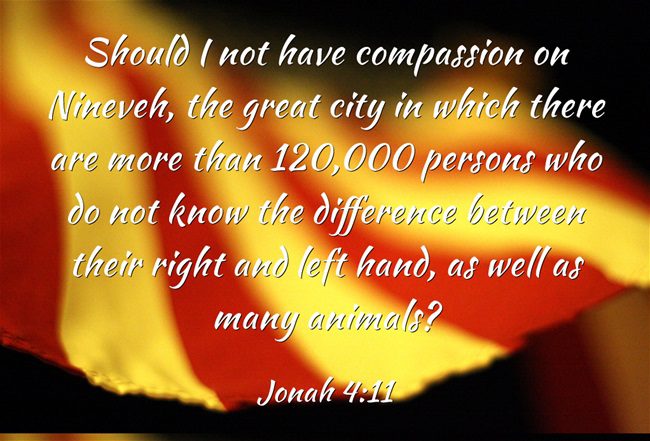
After Jonah had seen the great city-state of Nineveh repent, he was greatly angered, and told God, that he knew God was “a gracious God, and merciful, slow to anger, and of great kindness” (Jonah 4:2), so Jonah, instead of celebrating that Nineveh had repented and was saved, told God to take my “life from me, for it is better for me to die than to live” (Jonah 4:3). Jonah would rather die than to see his enemies saved. Then Jonah sat and waited to see if the city would be destroyed (Jonah 4:5) and God caused a great gourd to grow over him for shade from the hot sun, and Jonah rejoiced over this gourd, but the next morning, the gourd died and Jonah was angry about the gourd, meaning he lost his comforting shade. Jonah was angrier that one gourd died than the thousands of souls in Nineveh that would have perished. In other words, Jonah thought more of himself and his own comfort than he did the thousands of people in Nineveh, so God asked Jonah, “should I not spare Nineveh, that great city, wherein are more than 120,000 persons that cannot discern between their right hand and their left” (John 4:11), meaning there were that many infants and young children who couldn’t possibly have known how to repent (“cannot discern between their right hand and their left”), so God’s great mercy on a great city which didn’t deserve it, is symbolic of God’s great mercy for us, who similarly didn’t deserve it. The Apostle Paul makes this clear in writing, “For while we were still weak, at the right time Christ died for the ungodly. For one will scarcely die for a righteous person—though perhaps for a good person one would dare even to die—but God shows his love for us in that while we were still sinners, Christ died for us” (Rom 5:6-8), and even “while we were enemies we were reconciled to God by the death of his Son, much more, now that we are reconciled, shall we be saved by his life” (Rom5:10).
Conclusion
Instead of thinking, “How could Jonah be like that?” let’s ask ourselves, how are we like Jonah and reluctant to witness to those we might think could never be saved or those who have persecuted us? Who in their right mind would have witnessed to Saul, who before he became Paul, was obsessed with destroying the church? I doubt anyone thought that Saul would have ever been saved, but God can change the human heart (Prov 21:1; 2nd Cor 5:17) and made a Saul into a Paul. The point is, God’s desire that Nineveh repented shows that He doesn’t desire anyone to perish apart from faith in God. The Apostle Peter shows that God doesn’t just want to save the Jews but all people from all nations, writing, “The Lord is not slow to fulfill his promise as some count slowness, but is patient toward you, not wishing that any should perish, but that all should reach repentance” (2nd Pet 3:9), and “all” can only mean one thing in this context; whoever believes in Him, Jew, Greek, male, female, slave or free, will be saved.
Article by Jack Wellman
Jack Wellman is Pastor of the Mulvane Brethren Church in Mulvane Kansas. Jack is host of Spiritual Fitness and also the Senior Writer at What Christians Want To Know whose mission is to equip, encourage, and energize Christians and to address questions about the believer’s daily walk with God and the Bible. You can follow Jack on Google Plus or check out his book Teaching Children the Gospel available on Amazon.
Previous Post

June 19, 2017
Three Things Believers Should Know
Next Post
June 23, 2017 What Are Warning Signs Of Falling Into Apostasy?
Browse Our Archives
Select a Category Bible Answers Bible Definitions Bible Story Bible Study Bible Verses Christian Books Christian Entertainment Christian Fathers Christian Mothers Christian Quotes Devotional Famous Christians Music News Parables Prayers Quotes Sunday School Lesson Uncategorized Youth Sermons
Select a Month October 2019 September 2019 August 2019 July 2019 June 2019 May 2019 April 2019 March 2019 February 2019 January 2019 December 2018 November 2018 October 2018 September 2018 August 2018 July 2018 June 2018 May 2018 April 2018 March 2018 February 2018 January 2018 December 2017 November 2017 October 2017 September 2017 August 2017 July 2017 June 2017 May 2017 April 2017 March 2017 February 2017 January 2017 December 2016 November 2016 October 2016 September 2016 August 2016 July 2016 June 2016 May 2016 March 2016 February 2016 January 2016 December 2015 November 2015 October 2015 September 2015 August 2015 July 2015 June 2015 May 2015 April 2015 March 2015 February 2015 January 2015 December 2014 November 2014 October 2014 September 2014 August 2014 July 2014 June 2014 May 2014 April 2014 March 2014 February 2014 January 2014 December 2013 November 2013 October 2013 September 2013 August 2013 July 2013 June 2013 May 2013 April 2013 March 2013
Follow Us!
TAKE THE
Religious Wisdom Quiz
How many men did Gideon initially gather?
Select your answer to see how you score.
20,000 15,000 10,000 32,000
Related posts from Christian Crier

What Does The Bible Say About Our Thoughts?

Do Colors Have Special Meaning In The Bible?

The Glass – Half Empty Or Half Full?

TRENDING AT PATHEOS Evangelical

How the author of the world's best hymn...
I've been working with John Newton for a while now. This makes...

Long before this Lectio Divina, Psalm 130 - the song - started...

What About the Trees? Another Living Parable
After I finished writing the last article about falling leaves as a...

Why Classical Education Is a Conversation, Not a...
Come and Read: Joy in Classical Education When I was a little...

Falling Leaves: A Living Parable on Letting Go
I’ve spent the vast majority of my life in the southeast corner...

Cornell University has received a great deal of negative publicity and intense...
view all Evangelical blogs
Ad-Free & Subscriber Log-In Subscription Support
- About Us
- 2026 Calendar
- Videos
- Podcasts
- Library of World Religions
- Faith In Media Tracker
- Advertise With Us
- Write for Us
- Privacy Policy
- Terms of Service
- Do Not Sell My Data
- Contact Us
- Radiant Digital
- Manage Newsletter Subscriptions
- Unsubscribe From Notifications
- Sitemap
Copyright 2008-2026, Patheos. All rights reserved.
Subscription Support Ad-Free & Subscriber Log-In
Follow Patheos