
BuddhistCatholicContemplativeEvangelicalGeneral ChristianHinduJewishLatter-day SaintMuslimNew VisionsProgressive Christian
Beliefs
- Buddhist
- Catholic
- Contemplative
- Evangelical
- General Christian
- Hindu
- Jewish
- Latter-day Saint
- More Voices
- Muslim
- New Visions
- Pagan
- Progressive Christian
Topics
- Religion News
- Food and Religion
- Sports and Religion
- Religious Art
- Religious Music and Entertainment
- Religious Events
- History and Religion
- Style and Religion
- Politics and Religion
- Women in Religion
- Recreation Outdoors and Religion
- Business Finance and Religion
- Careers Workplace and Religion
- Education and Religion
- Family Parenting and Religion
- Health Fitness and Religion
- Home and Religion
- Relationships and Religion
- Technology and Religion
- Travel and Religion
Columnists
- Buddhist Columnists
- Business Finance and Religion Columnists
- Careers Workplace and Religion Columnists
- Catholic Columnists
- Contemplative Columnists
- Education and Religion Columnists
- Evangelists Columnists
- Family Parenting and Religion Columnists
- General Christian Columnists
- Health Fitness and Religion Columnists
- Hindu Columnists
- History and Religion Columnists
- Home and Religion Columnists
- Jewish Columnists
- More Voices Columnists
- Latter Day Columnists
- Muslim Columnists
- New Visions Columnists
- Nonreligious Columnists
- Pagan Columnists
- Politics and Religion Columnists
- Progressive Columnists
- Recreation Outdoors and Religion Columnists
- Relationships and Religion Columnists
- Religion News Columnists
- Religious Art Columnists
- Religious Events Columnists
- Religious Music and Entertainment Columnists
- Sports and Religion Columnists
- Style and Religion Columnists
- Technology and Religion Columnists
- Travel and Religion Columnists
- Women in Religion Columnists
Resource Library
- 2026 Calendar
- Library of World Religions
- The 100 Most Holy Places on Earth
- Patheos Answers
- Podcasts
- Videos
- Faith Leaders Database
- Anglican Episcopalian
- Bahai
- Baptist
- Buddhism
- Christianity
- Confucianism
- Eastern Orthodoxy
- Hinduism
- Holiness and Pentecostal
- ISKCON
- Islam
- Judaism
- Lutheran
- Methodist
- The Church of Jesus Christ of Latter-day Saints
- New Age
- Paganism
- Presbytarian and Reformed
- Protestantism
- Religion Behind the Scenes
- Roman Catholic
- Scientology
- Shia Islam
- Sikhism
- Sufism
- Sunni Islam
- Taoism
- Zen
- See all religions
Research Tools
 Ad-Free & Subscriber Log-In Subscription Support
Ad-Free & Subscriber Log-In Subscription Support
Follow Patheos 

- Trending:
- Forgiveness
- |
- Marriage
- |
- Consciousness
- |
- Death Penalty
- |
- Election
- |
- Halloween
 Christian Crier
- Home
- Evangelical
- Why Couldn’t God Just Forgive Sins Without Jesus’ Death?
Why Couldn’t God Just Forgive Sins Without Jesus’ Death?
Last updated on: May 15, 2017 at 5:00 am by Jack Wellman
Why Couldn’t God Just Forgive Sins Without Jesus’ Death? 2017-05-08T12:10:39-05:00 Jack Wellman
Patheos Explore the world's faith through different perspectives on religion and spirituality! Patheos has the views of the prevalent religions and spiritualities of the world.
Why did Jesus have to suffer and die to remove our sins? Couldn’t God just have forgiven us?
Courts of Law
Imagine a judge coming into the courtroom and the criminal standing before the judge and he or she has just been caught robbing a bank. Would it be kind or good of the judge to just let the criminal go and not have the victim receive satisfaction? Why not just forgive them and give them another chance? If he is a good judge, won’t he or she just let them go? Can’t the judge just forgive them? You can plainly see how that wouldn’t work at all. This rendering of injustice would only make others want to do the same thing. If they see that the judge let them go, then others would simply do the same thing in the hopes that they too would be freed if they were caught, so why couldn’t God just forgive our sins without having Jesus suffer and die? Perhaps now you can see why God just couldn’t sweep out sins under the carpet. If there is no penalty for committing a crime, then crime would be rampant and systemic throughout our society. Penalties act as deterrents to crime because if there is no penalty for breaking the law then lawlessness will prevail.
Lawbreakers
Every single human that has ever lived has sinned and broken God’s laws. Only Jesus was sinless but He was both God and Man, so there are no exceptions as we are all lawbreakers. Of course I include myself just as the Apostle Paul included himself and wrote, “I know that nothing good dwells in me, that is, in my flesh. For I have the desire to do what is right, but not the ability to carry it out. For I do not do the good I want, but the evil I do not want is what I keep on doing” (Rom 7:18-19). Isn’t that a description of you and me? I want to do what is right, but often I do what is wrong and then I try to avoid doing the wrong thing and then do it anyway. That’s why Paul wrote, “I do not do what I want, but I do the very thing I hate” (Rom 7:15). After a time, Paul sees his helplessness before God and cries out, “Wretched man that I am! Who will deliver me from this body of death” (Rom 7:24)? He answers his own question by writing, “Thanks be to God through Jesus Christ our Lord! So then, I myself serve the law of God with my mind, but with my flesh I serve the law of sin” (Rom 7:25). Paul, like the rest of Christians, was in a battle of the mind and the flesh. He desired to obey God but his human nature kicked in and he sinned, like all of us (Rom 3:23). The Bible says that no one is good…not even one of us (Rom 3:10). In fact, the Bible says all of us “have turned aside; together they have become worthless; no one does good, not even one” (Rom 3:12). All of us have earned the wages of death (Rom 6:23a), but God is gracious and offers us eternal life, but only through Jesus Christ (Rom 6:23b; Acts 4:12). We’ll never be good enough to be acceptable to God, so this leaves us in a state where the wrath of God abides on us, particularly if we don’t believe in Jesus Christ (John 3:36).
Pleading Guilty
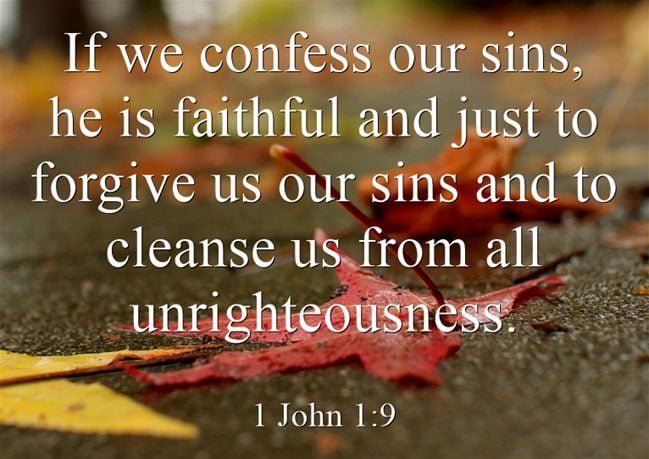
I remember years ago hearing about a situation where a king faced 5 convicted criminals who were pleading their case before him. One man said, “Oh king, I was setup and I didn’t do it….please see that I am not guilty and that my own friends betrayed me.” Another man said, “I was in the wrong place at the wrong time and was innocent. I never did what I was accused of. Someone else did it and not me.” The other two men gave similar stories, but when the king came to one man, his head was bent low and he cried out as he wept, “I am guilty. I have sinned against my God and against you, my king. I deserve my punishment. I have no excuses. I am guilty and deserve to be here.” Upon hearing this, the king said, “Get that man out of here…he doesn’t belong here,” so they freed him. Not sure if it was a true story or not, but the point is clear. If we confess our sins, we are agreeing with God about our sinfulness. Besides, He already knows about it anyway, so why not confess them? God will deal with those who refuse to acknowledge their sins and have not repented (Rev 20:12-15), so why not admit your sins (as I have) and repent and trust in Christ (as I have)? If you don’t admit you’re a sinner, it’s a sad state, because Jesus came to die for sinners. The Apostle John wrote, “If we confess our sins, he is faithful and just to forgive us our sins and to cleanse us from all unrighteousness” (1st John 1:9), however, if we say we have no sin, John says that we are calling God a liar and the truth is not in us (1st John 1:8), so “If we say we have not sinned, we make him a liar, and his word is not in us” (1st John 1:10). Jesus didn’t die for those who trust in their own righteousness. He came to justify sinners and not have sinners justify themselves (which they can’t anyway).
Conclusion
The Bible says, through King Solomon, “Whoever trusts in his own mind is a fool, but he who walks in wisdom will be delivered” (Prov 28:26). Jesus once spoke to those who trusted in themselves and what they thought was their own righteousness. He told a parable “to some who trusted in themselves that they were righteous, and treated others with contempt” (Luke 18:9), and this parable was a sharp contrast between someone who appeared religious and holy (Luke 18:10-12) and someone who “beat his breast and said, ‘God, have mercy on me, a sinner” (Luke 19:13). I wouldn’t trust the best five minutes of my life to be considered righteous. Jesus had to give His life as a ransom for the many who would trust in Him (Mark 10:45) because they didn’t have the righteousness of God that is required to enter the kingdom, and without the shedding of Jesus’ blood, there would be no forgiveness of sins. What if someone murdered your family and ask the judge for mercy? Would the judge just say, “It’s okay…I forgive you” and then let him or her free? Of course not. That would be a travesty of justice, so God cannot forgive our sins without Jesus’ atoning death on our behalf, but we must repent and believe, otherwise we still have God’s wrath abiding on us (John 3:36b).
Article by Jack Wellman
Jack Wellman is Pastor of the Mulvane Brethren Church in Mulvane Kansas. Jack is host of Spiritual Fitness and also the Senior Writer at What Christians Want To Know whose mission is to equip, encourage, and energize Christians and to address questions about the believer’s daily walk with God and the Bible. You can follow Jack on Google Plus or check out his book Teaching Children the Gospel available on Amazon.
Previous Post

May 12, 2017
Why Doesn’t God Heal Everyone?
Next Post
May 17, 2017 How Can Christians Be Holy As God Commands Them?
Browse Our Archives
Select a Category Bible Answers Bible Definitions Bible Story Bible Study Bible Verses Christian Books Christian Entertainment Christian Fathers Christian Mothers Christian Quotes Devotional Famous Christians Music News Parables Prayers Quotes Sunday School Lesson Uncategorized Youth Sermons
Select a Month October 2019 September 2019 August 2019 July 2019 June 2019 May 2019 April 2019 March 2019 February 2019 January 2019 December 2018 November 2018 October 2018 September 2018 August 2018 July 2018 June 2018 May 2018 April 2018 March 2018 February 2018 January 2018 December 2017 November 2017 October 2017 September 2017 August 2017 July 2017 June 2017 May 2017 April 2017 March 2017 February 2017 January 2017 December 2016 November 2016 October 2016 September 2016 August 2016 July 2016 June 2016 May 2016 March 2016 February 2016 January 2016 December 2015 November 2015 October 2015 September 2015 August 2015 July 2015 June 2015 May 2015 April 2015 March 2015 February 2015 January 2015 December 2014 November 2014 October 2014 September 2014 August 2014 July 2014 June 2014 May 2014 April 2014 March 2014 February 2014 January 2014 December 2013 November 2013 October 2013 September 2013 August 2013 July 2013 June 2013 May 2013 April 2013 March 2013
Follow Us!
TAKE THE
Religious Wisdom Quiz
What did Isaiah tell Hezekiah to use as a remedy for his illness?
Select your answer to see how you score.
Wine A poultice of figs Olive oil River water
Related posts from Christian Crier

What Does The Bible Say About Our Thoughts?

Do Colors Have Special Meaning In The Bible?

The Glass – Half Empty Or Half Full?

TRENDING AT PATHEOS Evangelical

How the author of the world's best hymn...
I've been working with John Newton for a while now. This makes...

Long before this Lectio Divina, Psalm 130 - the song - started...

What About the Trees? Another Living Parable
After I finished writing the last article about falling leaves as a...

Why Classical Education Is a Conversation, Not a...
Come and Read: Joy in Classical Education When I was a little...

Falling Leaves: A Living Parable on Letting Go
I’ve spent the vast majority of my life in the southeast corner...

Cornell University has received a great deal of negative publicity and intense...
view all Evangelical blogs
Ad-Free & Subscriber Log-In Subscription Support
- About Us
- 2026 Calendar
- Videos
- Podcasts
- Library of World Religions
- Faith In Media Tracker
- Advertise With Us
- Write for Us
- Privacy Policy
- Terms of Service
- Do Not Sell My Data
- Contact Us
- Radiant Digital
- Manage Newsletter Subscriptions
- Unsubscribe From Notifications
- Sitemap
Copyright 2008-2026, Patheos. All rights reserved.
Subscription Support Ad-Free & Subscriber Log-In
Follow Patheos