
BuddhistCatholicContemplativeEvangelicalGeneral ChristianHinduJewishLatter-day SaintMuslimNew VisionsProgressive Christian
Beliefs
- Buddhist
- Catholic
- Contemplative
- Evangelical
- General Christian
- Hindu
- Jewish
- Latter-day Saint
- More Voices
- Muslim
- New Visions
- Pagan
- Progressive Christian
Topics
- Religion News
- Food and Religion
- Sports and Religion
- Religious Art
- Religious Music and Entertainment
- Religious Events
- History and Religion
- Style and Religion
- Politics and Religion
- Women in Religion
- Recreation Outdoors and Religion
- Business Finance and Religion
- Careers Workplace and Religion
- Education and Religion
- Family Parenting and Religion
- Health Fitness and Religion
- Home and Religion
- Relationships and Religion
- Technology and Religion
- Travel and Religion
Columnists
- Buddhist Columnists
- Business Finance and Religion Columnists
- Careers Workplace and Religion Columnists
- Catholic Columnists
- Contemplative Columnists
- Education and Religion Columnists
- Evangelists Columnists
- Family Parenting and Religion Columnists
- General Christian Columnists
- Health Fitness and Religion Columnists
- Hindu Columnists
- History and Religion Columnists
- Home and Religion Columnists
- Jewish Columnists
- More Voices Columnists
- Latter Day Columnists
- Muslim Columnists
- New Visions Columnists
- Nonreligious Columnists
- Pagan Columnists
- Politics and Religion Columnists
- Progressive Columnists
- Recreation Outdoors and Religion Columnists
- Relationships and Religion Columnists
- Religion News Columnists
- Religious Art Columnists
- Religious Events Columnists
- Religious Music and Entertainment Columnists
- Sports and Religion Columnists
- Style and Religion Columnists
- Technology and Religion Columnists
- Travel and Religion Columnists
- Women in Religion Columnists
Resource Library
- 2026 Calendar
- Library of World Religions
- The 100 Most Holy Places on Earth
- Patheos Answers
- Podcasts
- Videos
- Faith Leaders Database
- Anglican Episcopalian
- Bahai
- Baptist
- Buddhism
- Christianity
- Confucianism
- Eastern Orthodoxy
- Hinduism
- Holiness and Pentecostal
- ISKCON
- Islam
- Judaism
- Lutheran
- Methodist
- The Church of Jesus Christ of Latter-day Saints
- New Age
- Paganism
- Presbytarian and Reformed
- Protestantism
- Religion Behind the Scenes
- Roman Catholic
- Scientology
- Shia Islam
- Sikhism
- Sufism
- Sunni Islam
- Taoism
- Zen
- See all religions
Research Tools
 Ad-Free & Subscriber Log-In Subscription Support
Ad-Free & Subscriber Log-In Subscription Support
Follow Patheos 

- Trending:
- Forgiveness
- |
- Marriage
- |
- Consciousness
- |
- Death Penalty
- |
- Election
- |
- Halloween
 Christian Crier
- Home
- Evangelical
- Why Doesn’t God Heal Everyone?
Why Doesn’t God Heal Everyone?
Last updated on: May 17, 2017 at 1:31 pm by Jack Wellman
Why Doesn’t God Heal Everyone? 2017-05-17T13:31:35-05:00 Jack Wellman
Patheos Explore the world's faith through different perspectives on religion and spirituality! Patheos has the views of the prevalent religions and spiritualities of the world.
Why doesn’t God choose to heal everyone who prays for it? Is there a reason?
Sin and Suffering
If you choose to sin you choose to suffer, and that’s what the world has chosen by choosing to sin. If ever there was a perfect environment it was the Garden of Eden. There was food available for the picking. There were ample supplies of everything Adam and Eve wanted. There could not have been a better environment in which to live, but Adam and Eve, even in this perfect garden, chose to disobey God, and ever since, humanity has suffered the consequences. Some people get sick or get diseases because of their own sins, but others are sick and diseased because of someone else’s sin. We might not be judged for other people’s sins but we can suffer consequences from their sins. People might think we’re a product of our environment, and to a point, that’s true, but as we have seen, even in a perfect environment where everything was “very good” (Gen 1:31), we can still chose to sin and that choice is a choice to suffer. After the fall (Gen 3), human nature took on a sinful nature, and caused humans to be anything but good (Rom 3:10-12). You don’t have to teach a 2 year old to fight for a toy with another toddler. It’s already in their nature, but if we get a disease or get sick because of someone else’s sin, why wouldn’t God heal them since it wasn’t our fault to begin with?
The Suffering Servant
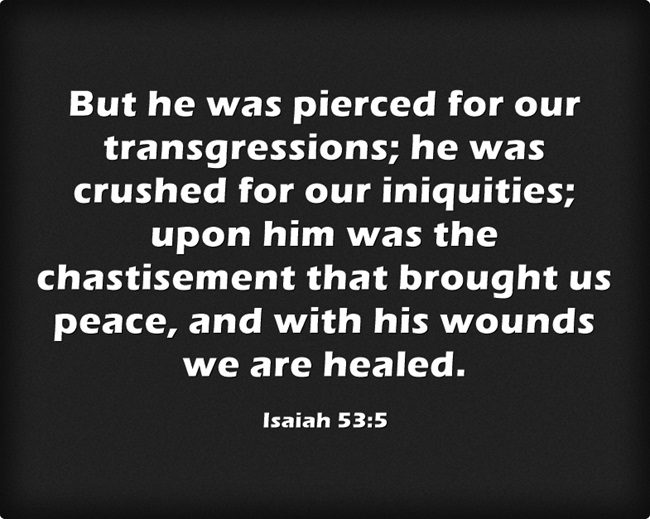
There are far too many people who don’t understand what Isaiah 53:5 is all about. Some claim that where the verse says, “by His wounds we are healed” (Isaiah 53:5b), is a promise of healing but what is the healing Isaiah is writing about? Is it a promise for God to heal everyone of everything, including the common cold? Did Jesus really die so that you could get over the flue or defeat cancer? Isaiah 53 is not about claiming this verse for themselves and saying they can be healed by Jesus’ wounds. This chapter speaks about Jesus being smitten and afflicted by God (Isaiah 53:4) for our transgressions and our iniquities (Isaiah 53:5a) and it was “Out of the anguish of his soul he shall see and be satisfied; by his knowledge shall the righteous one, my servant, make many to be accounted righteous, and he shall bear their iniquities” (Isaiah 53:11). There is nothing in this chapter about a promise for God to heal everyone who claims this verse. It’s not a “name it and claim it” verse but a verse that resides in a chapter about Jesus’ being brutally beaten and tortured and killed, not so we could get healed, but so that we could have peace with God (Rom 5:1) and have our condemnation lifted (Rom 8:1), because it was Jesus’ “chastisement that brought us peace” (Isaiah 53:5c), not a chastisement that we can claim to be healed. The greatest healing is not of the physical body but a spiritual healing where our sins are taken away and we are seen as having Jesus’ own righteousness (2nd Cor 5:21). Of course God can heal whom He wants to heal, but He may use our suffering as a way to make us more like Christ and to keep us humble and reliant upon God. We can be healed…but if we die again outside of the faith, what good is that?
Why Suffering?
Suffering has always been a problem on this planet. We can’t get away from the pictures of starving children, abandoned animals, and diseases and sicknesses claiming one life after another. The Apostle Paul wrote “we rejoice in our sufferings, knowing that suffering produces endurance” (Rom 5:3), so Paul didn’t pray to have his suffering removed because he knew God was working in him to produce endurance, which Paul would certainly need as the world’s foremost missionary (at least at that time). Suffering is what we naturally tend to avoid but the Apostle Peter wrote that it is “a gracious thing, when, mindful of God, one endures sorrows while suffering unjustly” (1st Pet 2:19), so we should “rejoice insofar as you share Christ’s sufferings, that you may also rejoice and be glad when his glory is revealed” (1st Pet 4:13). You are certainly not alone if you suffer since “the same kinds of suffering are being experienced by your brotherhood throughout the world” (1st Pet 5:9). Paul went even further in writing that he shared in Jesus’ suffering “so that I may know him and the power of his resurrection, and may share his sufferings, becoming like him in his death, that by any means possible I may attain the resurrection from the dead” (Phil 3:10-11). If you suffer, it’s for a reason, since “as we share abundantly in Christ’s sufferings, so through Christ we share abundantly in comfort too” (2nd Cor 1:5). If you suffer from something, you can sympathize with those who suffer from the same thing or something very similar. And most of all, we are sharing in the suffering of Christ, particularly if we suffer from persecution for Jesus’ sake.
Conclusion
Healing is not a given in this world. We can have faith to move mountains but if we are not healed after praying and obeying, we must trust God in all this because even the bad things can be used for good (Gen 50:20). The Christian knows (or at least should know) that whatever happens in this life will work out for our ultimate good, whether it looks like it or not (Rom 8:28), so look at today’s suffering and contrast that with the glory that’s coming, and you’ll see that today’s suffering and the glory that’s coming cannot even be compared (Rom 8:18). Today, as in the past, God is still healing people miraculously, but He has never promised to heal everyone of everything… at least not on this side of the veil (Rev 21:4).
Article by Jack Wellman
Jack Wellman is Pastor of the Mulvane Brethren Church in Mulvane Kansas. Jack is host of Spiritual Fitness and also the Senior Writer at What Christians Want To Know whose mission is to equip, encourage, and energize Christians and to address questions about the believer’s daily walk with God and the Bible. You can follow Jack on Google Plus or check out his book Teaching Children the Gospel available on Amazon.
Previous Post

May 10, 2017
What Does The Bible Say About Dreams And Visions?
Next Post
May 15, 2017 Why Couldn’t God Just Forgive Sins Without Jesus’ Death?
Browse Our Archives
Select a Category Bible Answers Bible Definitions Bible Story Bible Study Bible Verses Christian Books Christian Entertainment Christian Fathers Christian Mothers Christian Quotes Devotional Famous Christians Music News Parables Prayers Quotes Sunday School Lesson Uncategorized Youth Sermons
Select a Month October 2019 September 2019 August 2019 July 2019 June 2019 May 2019 April 2019 March 2019 February 2019 January 2019 December 2018 November 2018 October 2018 September 2018 August 2018 July 2018 June 2018 May 2018 April 2018 March 2018 February 2018 January 2018 December 2017 November 2017 October 2017 September 2017 August 2017 July 2017 June 2017 May 2017 April 2017 March 2017 February 2017 January 2017 December 2016 November 2016 October 2016 September 2016 August 2016 July 2016 June 2016 May 2016 March 2016 February 2016 January 2016 December 2015 November 2015 October 2015 September 2015 August 2015 July 2015 June 2015 May 2015 April 2015 March 2015 February 2015 January 2015 December 2014 November 2014 October 2014 September 2014 August 2014 July 2014 June 2014 May 2014 April 2014 March 2014 February 2014 January 2014 December 2013 November 2013 October 2013 September 2013 August 2013 July 2013 June 2013 May 2013 April 2013 March 2013
Follow Us!
TAKE THE
Religious Wisdom Quiz
Who anointed Jesus' feet with expensive perfume and her hair?
Select your answer to see how you score.
Mary of Bethany Anna Mary Magdalene Elizabeth
Related posts from Christian Crier

What Does The Bible Say About Our Thoughts?

Do Colors Have Special Meaning In The Bible?

The Glass – Half Empty Or Half Full?

TRENDING AT PATHEOS Evangelical

The REST of Your Life: A Creative Wrestles...
This week I had a conversation with a good friend from church....

How the author of the world's best hymn...
I've been working with John Newton for a while now. This makes...

Long before this Lectio Divina, Psalm 130 - the song - started...

What About the Trees? Another Living Parable
After I finished writing the last article about falling leaves as a...

Why Classical Education Is a Conversation, Not a...
Come and Read: Joy in Classical Education When I was a little...

Cornell University has received a great deal of negative publicity and intense...
view all Evangelical blogs
Ad-Free & Subscriber Log-In Subscription Support
- About Us
- 2026 Calendar
- Videos
- Podcasts
- Library of World Religions
- Faith In Media Tracker
- Advertise With Us
- Write for Us
- Privacy Policy
- Terms of Service
- Do Not Sell My Data
- Contact Us
- Radiant Digital
- Manage Newsletter Subscriptions
- Unsubscribe From Notifications
- Sitemap
Copyright 2008-2026, Patheos. All rights reserved.
Subscription Support Ad-Free & Subscriber Log-In
Follow Patheos