
BuddhistCatholicContemplativeEvangelicalGeneral ChristianHinduJewishLatter-day SaintMuslimNew VisionsProgressive Christian
Beliefs
- Buddhist
- Catholic
- Contemplative
- Evangelical
- General Christian
- Hindu
- Jewish
- Latter-day Saint
- More Voices
- Muslim
- New Visions
- Pagan
- Progressive Christian
Topics
- Religion News
- Food and Religion
- Sports and Religion
- Religious Art
- Religious Music and Entertainment
- Religious Events
- History and Religion
- Style and Religion
- Politics and Religion
- Women in Religion
- Recreation Outdoors and Religion
- Business Finance and Religion
- Careers Workplace and Religion
- Education and Religion
- Family Parenting and Religion
- Health Fitness and Religion
- Home and Religion
- Relationships and Religion
- Technology and Religion
- Travel and Religion
Columnists
- Buddhist Columnists
- Business Finance and Religion Columnists
- Careers Workplace and Religion Columnists
- Catholic Columnists
- Contemplative Columnists
- Education and Religion Columnists
- Evangelists Columnists
- Family Parenting and Religion Columnists
- General Christian Columnists
- Health Fitness and Religion Columnists
- Hindu Columnists
- History and Religion Columnists
- Home and Religion Columnists
- Jewish Columnists
- More Voices Columnists
- Latter Day Columnists
- Muslim Columnists
- New Visions Columnists
- Nonreligious Columnists
- Pagan Columnists
- Politics and Religion Columnists
- Progressive Columnists
- Recreation Outdoors and Religion Columnists
- Relationships and Religion Columnists
- Religion News Columnists
- Religious Art Columnists
- Religious Events Columnists
- Religious Music and Entertainment Columnists
- Sports and Religion Columnists
- Style and Religion Columnists
- Technology and Religion Columnists
- Travel and Religion Columnists
- Women in Religion Columnists
Resource Library
- 2026 Calendar
- Library of World Religions
- The 100 Most Holy Places on Earth
- Patheos Answers
- Podcasts
- Videos
- Faith Leaders Database
- Anglican Episcopalian
- Bahai
- Baptist
- Buddhism
- Christianity
- Confucianism
- Eastern Orthodoxy
- Hinduism
- Holiness and Pentecostal
- ISKCON
- Islam
- Judaism
- Lutheran
- Methodist
- The Church of Jesus Christ of Latter-day Saints
- New Age
- Paganism
- Presbytarian and Reformed
- Protestantism
- Religion Behind the Scenes
- Roman Catholic
- Scientology
- Shia Islam
- Sikhism
- Sufism
- Sunni Islam
- Taoism
- Zen
- See all religions
Research Tools
 Ad-Free & Subscriber Log-In Subscription Support
Ad-Free & Subscriber Log-In Subscription Support
Follow Patheos 

- Trending:
- Forgiveness
- |
- Marriage
- |
- Consciousness
- |
- Death Penalty
- |
- Election
- |
- Halloween
 Christian Crier
- Home
- Evangelical
- What Does The Bible Say About Dreams And Visions?
What Does The Bible Say About Dreams And Visions?
Last updated on: May 10, 2017 at 5:00 am by Jack Wellman
What Does The Bible Say About Dreams And Visions? 2017-04-22T13:47:35-05:00 Jack Wellman
Patheos Explore the world's faith through different perspectives on religion and spirituality! Patheos has the views of the prevalent religions and spiritualities of the world.
Many people claim to have had a vision or dream from God, so how can we know for sure that it is from God?
Interpreting Dreams
There is a lot about dreams and visions in the Bible and one of the first occurrences of a dream being interpreted is from Joseph who was thrown into prison after being falsely accused, and while there, “the cupbearer and the baker of the king of Egypt, who were confined in the prison—each his own dream, and each dream with its own interpretation” (Gen 40:5). After asking about the dreams, Joseph asked them a rhetorical question, “Do not interpretations belong to God” (Gen 40:8)? The obvious answer is God interprets the dreams and not Joseph or any man. I have not seen a Scripture where a man interprets the dream or dreams of another but only with God’s help. Pharaoh also had a dream “but there was none who could interpret them to Pharaoh” (Gen 41:8), so the cupbearer told Pharaoh, “A young Hebrew was there with us, a servant of the captain of the guard. When we told him, he interpreted our dreams to us, giving an interpretation to each man according to his dream” (Gen 41:12), so Joseph said to Pharaoh after he had a vision, “The dreams of Pharaoh are one; God has revealed to Pharaoh what he is about to do” (Gen 41:25), and so Joseph interpreted Pharaoh’s dream but only with the help of God could he possibly have understood them.
Visions and Dreams
The Bible speaks about visions and dreams to occur in the latter days like with Joel the Prophet who wrote, “And it shall come to pass afterward, that I will pour out my Spirit on all flesh” (which happened on the Day of Pentecost), and “your sons and your daughters shall prophesy, your old men shall dream dreams, and your young men shall see visions” (Joel 2:28). God did pour out His Spirit on the Day of Pentecost and some had visions like the Apostle Peter’s vision about the unclean foods, which was God’s way of telling him that the Gentiles are to no longer be considered unclean. The Apostle Paul had “a vision of a man named Ananias come in and lay his hands on him so that he might regain his sight” (Acts 9:12), and that’s what happened, but Ananias wasn’t the source of this vision, as we clearly read in Scripture that it was from God, so it was never the figment of any person’s imagination, but rather, it was sent intentionally by God and for a very specific purpose. Even so, many claim to have had a dream or vision from God, but the Bible says “when dreams increase and words grow many, there is vanity; but God is the one you must fear” (Eccl 5:7), so fear of God and His Word trumps the dreams and visions anyone claims to have or has actually had. The Word of God is objective truth while dreams and visions are subjective and speculative, and why would God reveal His will in dreams and visions when His will is already revealed in Scripture? Any dream or vision should always be placed against the Word to see if it matches God’s purposes and will, and if it doesn’t, it was likely something they ate…or it could be from the Enemy.
Tests from God
The Old Testament has several references to those who have dreams and says in Deuteronomy 31:1-3, “If a prophet or a dreamer of dreams arises among you and gives you a sign or a wonder,” and “if the sign or wonder that he tells you comes to pass, and if he says, ‘Let us go after other gods,’ which you have not known, ‘and let us serve them,’ you shall not listen to the words of that prophet or that dreamer of dreams. For the Lord your God is testing you, to know whether you love the Lord your God with all your heart and with all your soul,” and worse, “that prophet or that dreamer of dreams shall be put to death, because he has taught rebellion against the LORD your God” (Deut 13:5). The penalty for giving a false vision or dream was death in the Old Testament because God sees that as an attempt to speak for Him when God has already spoken in the last days through His Son (Heb 1:1-2), and by the Scriptures already delivered to the saints (Jude 1:3). That’s how God feels about people who claim to have a dream or vision from God when it clearly is not. God doesn’t use visions or dreams as the normative but rather He points us to Scripture, saying “You shall walk after the LORD your God and fear him and keep his commandments and obey his voice, and you shall serve him and hold fast to him” (Deut 13:4). Of course, God can send dreams or visions to whomever He wills, but again, this is not the typical and anything that is said to be dreamt or seen in a vision must be according to Scripture or it’s not from God.
Conclusion
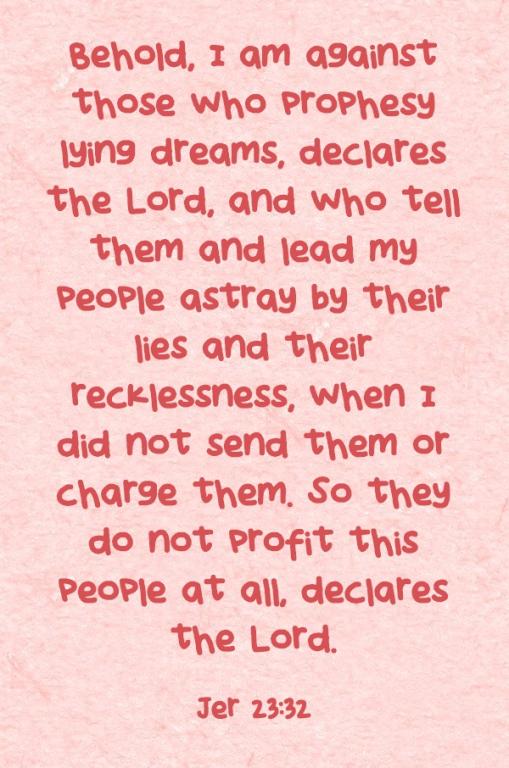
If you or someone you know has claimed to have had a vision or dream from God, Jeremiah the Prophet warns them (and us) that God is “against those who prophesy lying dreams, declares the Lord, and who tell them and lead my people astray by their lies and their recklessness, when I did not send them or charge them. So they do not profit this people at all, declares the Lord” (Jer 23:32). Today, there are even “prophets” who “are prophesying lies in my name. I did not send them, nor did I command them or speak to them. They are prophesying to you a lying vision, worthless divination, and the deceit of their own minds” (Jer 14:14). Many men in the Bible did have dreams and visions like Ezekiel, Daniel, the Apostle John (in Revelation), but these are recorded in Scripture and are part of Scripture, and God was always the source of their writings, including their visons or dreams. Today, do we really need visions and dreams to put a “PS” to God’s Word? God may use a dream to try and tell you something, but unless it is scriptural, it is just a dream and dreams are so random that we can’t put any real stock in them. God is using dreams and can still use visions, but that is the rarest of exceptions from what I’ve read and heard. We are best served to put our trust in the Word and we will never have any doubt as to the way and the truth and the life (John 14:6).
Article by Jack Wellman
Jack Wellman is Pastor of the Mulvane Brethren Church in Mulvane Kansas. Jack is host of Spiritual Fitness and also the Senior Writer at What Christians Want To Know whose mission is to equip, encourage, and energize Christians and to address questions about the believer’s daily walk with God and the Bible. You can follow Jack on Google Plus or check out his book Teaching Children the Gospel available on Amazon.
Previous Post

May 8, 2017
Are Christians No Longer Sinners?
Next Post
May 12, 2017 Why Doesn’t God Heal Everyone?
Browse Our Archives
Select a Category Bible Answers Bible Definitions Bible Story Bible Study Bible Verses Christian Books Christian Entertainment Christian Fathers Christian Mothers Christian Quotes Devotional Famous Christians Music News Parables Prayers Quotes Sunday School Lesson Uncategorized Youth Sermons
Select a Month October 2019 September 2019 August 2019 July 2019 June 2019 May 2019 April 2019 March 2019 February 2019 January 2019 December 2018 November 2018 October 2018 September 2018 August 2018 July 2018 June 2018 May 2018 April 2018 March 2018 February 2018 January 2018 December 2017 November 2017 October 2017 September 2017 August 2017 July 2017 June 2017 May 2017 April 2017 March 2017 February 2017 January 2017 December 2016 November 2016 October 2016 September 2016 August 2016 July 2016 June 2016 May 2016 March 2016 February 2016 January 2016 December 2015 November 2015 October 2015 September 2015 August 2015 July 2015 June 2015 May 2015 April 2015 March 2015 February 2015 January 2015 December 2014 November 2014 October 2014 September 2014 August 2014 July 2014 June 2014 May 2014 April 2014 March 2014 February 2014 January 2014 December 2013 November 2013 October 2013 September 2013 August 2013 July 2013 June 2013 May 2013 April 2013 March 2013
Follow Us!
TAKE THE
Religious Wisdom Quiz
Which letter encourages believers to "be quick to listen, slow to speak, and slow to anger"?
Select your answer to see how you score.
James Romans 2 Peter 1 John
Related posts from Christian Crier

What Does The Bible Say About Our Thoughts?

Do Colors Have Special Meaning In The Bible?

The Glass – Half Empty Or Half Full?

TRENDING AT PATHEOS Evangelical

The REST of Your Life: A Creative Wrestles...
This week I had a conversation with a good friend from church....

How the author of the world's best hymn...
I've been working with John Newton for a while now. This makes...

Long before this Lectio Divina, Psalm 130 - the song - started...

What About the Trees? Another Living Parable
After I finished writing the last article about falling leaves as a...

Why Classical Education Is a Conversation, Not a...
Come and Read: Joy in Classical Education When I was a little...

Cornell University has received a great deal of negative publicity and intense...
view all Evangelical blogs
Ad-Free & Subscriber Log-In Subscription Support
- About Us
- 2026 Calendar
- Videos
- Podcasts
- Library of World Religions
- Faith In Media Tracker
- Advertise With Us
- Write for Us
- Privacy Policy
- Terms of Service
- Do Not Sell My Data
- Contact Us
- Radiant Digital
- Manage Newsletter Subscriptions
- Unsubscribe From Notifications
- Sitemap
Copyright 2008-2026, Patheos. All rights reserved.
Subscription Support Ad-Free & Subscriber Log-In
Follow Patheos