
BuddhistCatholicContemplativeEvangelicalGeneral ChristianHinduJewishLatter-day SaintMuslimNew VisionsProgressive Christian
Beliefs
- Buddhist
- Catholic
- Contemplative
- Evangelical
- General Christian
- Hindu
- Jewish
- Latter-day Saint
- More Voices
- Muslim
- New Visions
- Pagan
- Progressive Christian
Topics
- Religion News
- Food and Religion
- Sports and Religion
- Religious Art
- Religious Music and Entertainment
- Religious Events
- History and Religion
- Style and Religion
- Politics and Religion
- Women in Religion
- Recreation Outdoors and Religion
- Business Finance and Religion
- Careers Workplace and Religion
- Education and Religion
- Family Parenting and Religion
- Health Fitness and Religion
- Home and Religion
- Relationships and Religion
- Technology and Religion
- Travel and Religion
Columnists
- Buddhist Columnists
- Business Finance and Religion Columnists
- Careers Workplace and Religion Columnists
- Catholic Columnists
- Contemplative Columnists
- Education and Religion Columnists
- Evangelists Columnists
- Family Parenting and Religion Columnists
- General Christian Columnists
- Health Fitness and Religion Columnists
- Hindu Columnists
- History and Religion Columnists
- Home and Religion Columnists
- Jewish Columnists
- More Voices Columnists
- Latter Day Columnists
- Muslim Columnists
- New Visions Columnists
- Nonreligious Columnists
- Pagan Columnists
- Politics and Religion Columnists
- Progressive Columnists
- Recreation Outdoors and Religion Columnists
- Relationships and Religion Columnists
- Religion News Columnists
- Religious Art Columnists
- Religious Events Columnists
- Religious Music and Entertainment Columnists
- Sports and Religion Columnists
- Style and Religion Columnists
- Technology and Religion Columnists
- Travel and Religion Columnists
- Women in Religion Columnists
Resource Library
- 2026 Calendar
- Library of World Religions
- The 100 Most Holy Places on Earth
- Patheos Answers
- Podcasts
- Videos
- Faith Leaders Database
- Anglican Episcopalian
- Bahai
- Baptist
- Buddhism
- Christianity
- Confucianism
- Eastern Orthodoxy
- Hinduism
- Holiness and Pentecostal
- ISKCON
- Islam
- Judaism
- Lutheran
- Methodist
- The Church of Jesus Christ of Latter-day Saints
- New Age
- Paganism
- Presbytarian and Reformed
- Protestantism
- Religion Behind the Scenes
- Roman Catholic
- Scientology
- Shia Islam
- Sikhism
- Sufism
- Sunni Islam
- Taoism
- Zen
- See all religions
Research Tools
 Ad-Free & Subscriber Log-In Subscription Support
Ad-Free & Subscriber Log-In Subscription Support
Follow Patheos 

- Trending:
- Forgiveness
- |
- Marriage
- |
- Consciousness
- |
- Death Penalty
- |
- Election
- |
- Halloween
 Christian Crier
- Home
- Evangelical
- Is “By His Stripes We Are Healed” A Promise To Heal Everyone?
Is “By His Stripes We Are Healed” A Promise To Heal Everyone?
Last updated on: May 1, 2017 at 5:00 am by Jack Wellman
Is “By His Stripes We Are Healed” A Promise To Heal Everyone? 2017-04-12T17:51:26-05:00 Jack Wellman
Patheos Explore the world's faith through different perspectives on religion and spirituality! Patheos has the views of the prevalent religions and spiritualities of the world.
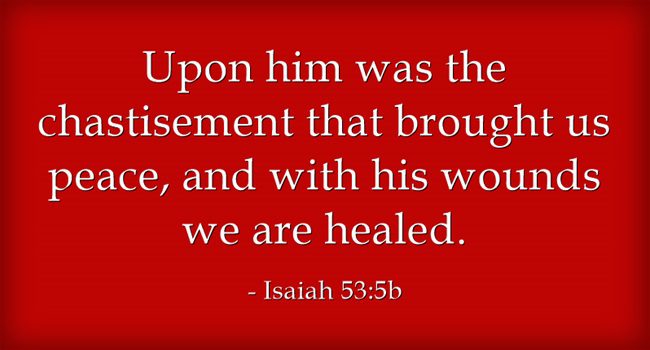
Is Isaiah 53:5 a promise of healing for all who claim it?
Paul’s Ordeal
If anyone was close to God in the first century church, it was the Apostle Paul. Paul even said that the Lord Himself stood by Him (2nd Pet 4:17), but whether that was literally or in his spirit, only he knew this, but Paul trusted in God’s sovereignty and trusted it enough to know that whatever happened to Him, nothing could separate him from God (Rom 8:35), and that everything that was happening to him was going to work out for his ultimate best (Rom 8:28). He understood that his suffering today was no comparison to what’s coming (Rom 8:18), and I think that kept him content. Paul had a problem and it was a thorn in the flesh, and even though he prayed three times to have it removed, God’s answer was “My grace is sufficient for you, for my power is made perfect in weakness.” Therefore I will boast all the more gladly of my weaknesses, so that the power of Christ may rest upon me” (2nd Cor 12:9). But why didn’t Paul claim, “with his wounds we are healed” (Isaiah 53:5d)? We know he believed the Scriptures, because that’s what most of the Book of Roman’s contained, so he must have known Isaiah 53:5 and understood what it meant, but the silence of this verse being used for healing in the New Testament is evidence that the context was not about having someone physically, although we cannot limit God, but this verse is not an unlimited promise for God to heal everyone who believes it. It is much more than that. In fact, I would say, it’s infinitely more than that (John 3:16).
Paul’s Thorn
Since Paul was an Apostle and had a thorn in the flesh, why didn’t Peter or one of the other Apostle’s come lay their hands on him and heal him? Earlier we read that even some in Peter’s shadow were healed, so did Peter lose his touch (Acts 5:12-16)? I think God explains why Paul was never healed and maybe gives us a possible clue as to why he doesn’t heal everyone. Paul writes, “Three times I pleaded with the Lord about this, that it should leave me. But he said to me, “My grace is sufficient for you, for my power is made perfect in weakness.” Therefore I will boast all the more gladly of my weaknesses, so that the power of Christ may rest upon me” (2nd Cor 12:8-9), with God’s point being, “For when I am weak, then I am strong” (2nd Cor 12:10b). If Paul was strong in himself, he’d actually be weak, but in his chronic “thorn,” he could be strong in Christ (Phil 4:13). Besides, suffering is never wasted (John 3:16). God uses suffering to refine us just like gold passes through the fire and the dross is removed. We don’t know what Paul’s thorn was. Some say it was his eyesight and others believe it was the constant hounding of the Jews who followed him and persecuted him wherever he went. Some even say it was gout or some other health problem, but Paul trusted God. He knew what He was doing. He was slowly being conformed into the image of Christ and sharing in His sufferings (Rom 8:17; 1st Pet 4:12-19), and the truth is, *“if we are children, then we are heirs-heirs of God and co-heirs with Christ, if indeed we share in his sufferings in order that we may also share in his glory”(*Rom 8:17).
Scriptural Context
If we take one text out of context it can become a pretext, and I believe that’s what happens with Isaiah 53:5. Most leave out the fact that this chapter mentions our “transgressions” and “iniquities” (Isaiah 53:5a), but nowhere in this chapter does it refer to the context as being a claim for physical healing for all who claim it. It says Jesus “was pierced for our transgressions; he was crushed for our iniquities” and with these wounds He incurred, “we can be healed,” but not from a common cold. I don’t think that’s what the author was thinking about when he wrote, “All we like sheep have gone astray; we have turned—every one—to his own way; and the Lord has laid on him the iniquity of us all” (Isaiah 53:6), and so we cannot claim healing from this verse, unless you are talking about eternal healing in the sense of having your sins removed by the blood of Christ upon repentance and faith. “He was oppressed, and he was afflicted” and led to the slaughter (Isaiah 53:7), but not so that your aunt can feel better. Of course, you can pray for her healing and God sometimes choses to answer that prayer, but He knows what He’s doing (Rom 8:28). We cannot comprehend God’s ways! Being content in our suffering is very pleasing to God, and that may be part of what He’s doing in us. And think about this: If God had healed Paul of his thorn in the flesh, and his life was a life of comfort where he never knew suffering, then how could he have ever learned contentment or come to know Christ by sharing in His sufferings? Paul suffered a lot at the hands of the Romans and the Jews, so he had lots of practice for being content and he had the marks of his beatings and lashings to prove it because his body bore the marks of his missions (Gal 6:17), but God wanted him to remain humble, and suffering does that. Paul writes, “I know how to be brought low, and I know how to abound. In any and every circumstance, I have learned the secret of facing plenty and hunger, abundance and need” (Phil 4:12). That’s hard for me and others in our culture to learn. We’re easily angered if someone jumps ahead of us and takes our parking spot, but what about hunger, need, thirst, want cold, heat, beatings, and so on? Few of us know what these are like and being content with the many things we have is hard enough at times.
Conclusion
I remember talking to an Orthodox Jew in mall once and we talked about Isaiah 53 (and really, Isaiah 52:13-15) and he said many Jews believe it was written about the them and not about one person, like Christians who believe it was referring to Jesus Christ, the Messiah. This Jewish man could not explain the verse where it says, “with his wounds we are healed” (Isaiah 55:3d). I asked him, “How are we healed by the Jewish people?” He couldn’t answer, but in an ironic way, the ultimate double-quick cure to what ails us is the blood of Jesus Christ. That is the infinite healing, because even if God chooses to heal someone, they will die again, but if they’re born again, their death opens the door to eternal life. Nothing less will do if we are to be saved. Jesus didn’t bleed and died to cure our colds, although God can do what God wants to do, but Jesus’ first presentation of the gospel included the need for repentance and belief (Mark 1:14-15), and even if you’re healed, “unless you repent, you will all likewise perish” (Luke 13:3b).
Article by Jack Wellman
Jack Wellman is Pastor of the Mulvane Brethren Church in Mulvane Kansas. Jack is host of Spiritual Fitness and also the Senior Writer at What Christians Want To Know whose mission is to equip, encourage, and energize Christians and to address questions about the believer’s daily walk with God and the Bible. You can follow Jack on Google Plus or check out his book Teaching Children the Gospel available on Amazon.
Previous Post

April 28, 2017
How Can A Christian Glorify God At Work?
Next Post
May 3, 2017 What Does It Mean To Be Ashamed Of The Gospel?
Browse Our Archives
Select a Category Bible Answers Bible Definitions Bible Story Bible Study Bible Verses Christian Books Christian Entertainment Christian Fathers Christian Mothers Christian Quotes Devotional Famous Christians Music News Parables Prayers Quotes Sunday School Lesson Uncategorized Youth Sermons
Select a Month October 2019 September 2019 August 2019 July 2019 June 2019 May 2019 April 2019 March 2019 February 2019 January 2019 December 2018 November 2018 October 2018 September 2018 August 2018 July 2018 June 2018 May 2018 April 2018 March 2018 February 2018 January 2018 December 2017 November 2017 October 2017 September 2017 August 2017 July 2017 June 2017 May 2017 April 2017 March 2017 February 2017 January 2017 December 2016 November 2016 October 2016 September 2016 August 2016 July 2016 June 2016 May 2016 March 2016 February 2016 January 2016 December 2015 November 2015 October 2015 September 2015 August 2015 July 2015 June 2015 May 2015 April 2015 March 2015 February 2015 January 2015 December 2014 November 2014 October 2014 September 2014 August 2014 July 2014 June 2014 May 2014 April 2014 March 2014 February 2014 January 2014 December 2013 November 2013 October 2013 September 2013 August 2013 July 2013 June 2013 May 2013 April 2013 March 2013
Follow Us!
TAKE THE
Religious Wisdom Quiz
What is the "Great Commission" Jesus gave his followers?
Select your answer to see how you score.
Stay hidden Gather riches Go and make disciples Build a temple
Related posts from Christian Crier

What Does The Bible Say About Our Thoughts?

Do Colors Have Special Meaning In The Bible?

The Glass – Half Empty Or Half Full?

TRENDING AT PATHEOS Evangelical

The REST of Your Life: A Creative Wrestles...
This week I had a conversation with a good friend from church....

How the author of the world's best hymn...
I've been working with John Newton for a while now. This makes...

Long before this Lectio Divina, Psalm 130 - the song - started...

What About the Trees? Another Living Parable
After I finished writing the last article about falling leaves as a...

Why Classical Education Is a Conversation, Not a...
Come and Read: Joy in Classical Education When I was a little...

Cornell University has received a great deal of negative publicity and intense...
view all Evangelical blogs
Ad-Free & Subscriber Log-In Subscription Support
- About Us
- 2026 Calendar
- Videos
- Podcasts
- Library of World Religions
- Faith In Media Tracker
- Advertise With Us
- Write for Us
- Privacy Policy
- Terms of Service
- Do Not Sell My Data
- Contact Us
- Radiant Digital
- Manage Newsletter Subscriptions
- Unsubscribe From Notifications
- Sitemap
Copyright 2008-2026, Patheos. All rights reserved.
Subscription Support Ad-Free & Subscriber Log-In
Follow Patheos