
BuddhistCatholicContemplativeEvangelicalGeneral ChristianHinduJewishLatter-day SaintMuslimNew VisionsProgressive Christian
Beliefs
- Buddhist
- Catholic
- Contemplative
- Evangelical
- General Christian
- Hindu
- Jewish
- Latter-day Saint
- More Voices
- Muslim
- New Visions
- Pagan
- Progressive Christian
Topics
- Religion News
- Food and Religion
- Sports and Religion
- Religious Art
- Religious Music and Entertainment
- Religious Events
- History and Religion
- Style and Religion
- Politics and Religion
- Women in Religion
- Recreation Outdoors and Religion
- Business Finance and Religion
- Careers Workplace and Religion
- Education and Religion
- Family Parenting and Religion
- Health Fitness and Religion
- Home and Religion
- Relationships and Religion
- Technology and Religion
- Travel and Religion
Columnists
- Buddhist Columnists
- Business Finance and Religion Columnists
- Careers Workplace and Religion Columnists
- Catholic Columnists
- Contemplative Columnists
- Education and Religion Columnists
- Evangelists Columnists
- Family Parenting and Religion Columnists
- General Christian Columnists
- Health Fitness and Religion Columnists
- Hindu Columnists
- History and Religion Columnists
- Home and Religion Columnists
- Jewish Columnists
- More Voices Columnists
- Latter Day Columnists
- Muslim Columnists
- New Visions Columnists
- Nonreligious Columnists
- Pagan Columnists
- Politics and Religion Columnists
- Progressive Columnists
- Recreation Outdoors and Religion Columnists
- Relationships and Religion Columnists
- Religion News Columnists
- Religious Art Columnists
- Religious Events Columnists
- Religious Music and Entertainment Columnists
- Sports and Religion Columnists
- Style and Religion Columnists
- Technology and Religion Columnists
- Travel and Religion Columnists
- Women in Religion Columnists
Resource Library
- 2026 Calendar
- Library of World Religions
- The 100 Most Holy Places on Earth
- Patheos Answers
- Podcasts
- Videos
- Faith Leaders Database
- Anglican Episcopalian
- Bahai
- Baptist
- Buddhism
- Christianity
- Confucianism
- Eastern Orthodoxy
- Hinduism
- Holiness and Pentecostal
- ISKCON
- Islam
- Judaism
- Lutheran
- Methodist
- The Church of Jesus Christ of Latter-day Saints
- New Age
- Paganism
- Presbytarian and Reformed
- Protestantism
- Religion Behind the Scenes
- Roman Catholic
- Scientology
- Shia Islam
- Sikhism
- Sufism
- Sunni Islam
- Taoism
- Zen
- See all religions
Research Tools
 Ad-Free & Subscriber Log-In Subscription Support
Follow Patheos 

- Trending:
- Advent
- |
- Forgiveness
- |
- Thanksgiving
- |
- Election
- |
- Seasonal Holidays
- |
- Marriage
 Christian Crier
- Home
- Evangelical
- When Do Believer’s Reach Sainthood?
When Do Believer’s Reach Sainthood?
Last updated on: February 24, 2017 at 1:00 am by Jack Wellman
When Do Believer’s Reach Sainthood? 2017-02-16T21:15:09-06:00 Jack Wellman
Patheos Explore the world's faith through different perspectives on religion and spirituality! Patheos has the views of the prevalent religions and spiritualities of the world.
Does a believer have to die and wait so many years to be declared a saint?
What is a Saint?
The Roman Catholic Church doesn’t declare every one of its followers as saints. Sainthood is usually reserved for a precious few, and those only by the Vatican, but can the Vatican really declare who is and who isn’t a saint? What does the Bible say about who is and who isn’t a saint? Does someone have to be known publically for their charitable work or work on earth for the Lord and then die and wait several more years in the hopes the Vatican will approve their sainthood? The word saint comes from the Old French word “seinte” which means, “a saint; a holy relic,” which was the altered Old English word “sanct,” both of which come from the Latin word “sanctus,” meaning “holy, consecrated.” This was an adjective prefixed to the name of a canonized person and by 1300 and it came to be regarded as a noun, meaning, “a person of extraordinary holiness,” but is this the biblical definition or a manmade one? Isn’t every believer a saint according to the Bible, and isn’t the Bible the ultimate source for making this determination?
Old Testament Saints
One of the earliest mentions of saints doesn’t come in the New Testament, but in the Old Testament. Part of Solomon’s prayer in the dedication of the temple was to say, “And now arise, O Lord God, and go to your resting place, you and the ark of Your might. Let Your priests, O Lord God, be clothed with salvation, and let Your saints rejoice in your goodness” (2nd Chron 6:41), and the Hebrew word used for saints in the Old Testament is “chaciyd” and it means “godly, faithful,” and “holy.” I see that Solomon was not speaking about dead people who died in belief, but to those who were still living. Again, Solomon asks God’s blessing on His people by praying, “And now arise, O Lord God, and go to Your resting place, You and the ark of Your might. Let Your priests, O Lord God, be clothed with salvation, and let Your saints rejoice in your goodness” (2nd Chron 6:41), but David also writes, “As for the saints in the land, they are the excellent ones, in whom is all my delight” (Psalm 16:3), so “Sing praises to the Lord, O you His saints, and give thanks to His holy name” (Psalm 30:4). These references to saints is obviously not written to the dead or those who have qualified to be a saint, but for those still living as the dead can’t sing praises to God. In other words, God considered those who believed in Him as saints in the Old Testament, but what about the New Testament?
New Testament Saints
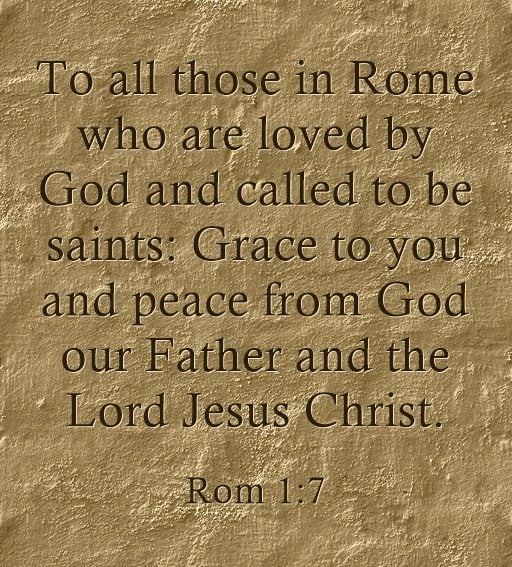
In the New Testament, the Greek word used for saint is “hagios” which means, “saint, most holy thing,” but where did this holiness come from? It wasn’t from them but from God Himself as the Apostle Paul wrote that it was “For our sake he made him to be sin who knew no sin, so that in him we might become the righteousness of God” (2nd Cor 5:21). The person that is a saint, according to the Bible and not human tradition, is a person being declared righteous before God. That person who trusts in Christ has that declaration and as far as God is concerned (and that’s all that really matters), you are a saint if you have repented and trusted in Christ. To these saints, many of the apostles wrote to them as if they were presently saints or in the present tense and not the future tense. One of many examples is when “Peter went here and there among them all, he came down also to the saints who lived at Lydda” (Acts 9:32) and when Ananias was told to go to Saul, said “Lord, I have heard from many about this man, how much evil he has done to your saints at Jerusalem” (Acts 9:13). Obviously, God refers to His own children as saints in the present indicative and just as Paul typically opens his letters by writing “To the church of God that is in Corinth, to those sanctified in Christ Jesus, called to be saints together with all those who in every place call upon the name of our Lord Jesus Christ, both their Lord and ours” (1st Cor 1:2).
Who is a Saint?
The Apostle Paul already mentioned that those who are “sanctified in Christ Jesus” are already “called to be saints” as well as “those who in every place call upon the name of the Lord Jesus Christ” (1st Cor 1:2), and writing elsewhere, “Or do you not know that the saints will judge the world? And if the world is to be judged by you, are you incompetent to try trivial cases” (1st Cor 6:2)? Paul isn’t speaking of the saints who have passed into glory but those who were living at the time. In true and godly humility, Paull said “To me, though I am the very least of all the saints, this grace was given, to preach to the Gentiles the unsearchable riches of Christ” (Eph 3:8), so if you have trusted in Christ, “then you are no longer strangers and aliens, but you are fellow citizens with the saints and members of the household of God” (Eph 2:19).
Conclusion
You don’t have to wait for any manmade declaration to declare you a saint because what God declares to be true is always true, regardless of whatever human tradition dictates. God alone is the One Who declares us saints…we do not declare ourselves as such…it is only through faith in Christ that we become the saints of God. When you get down to the bottom line, there are only two groups of people on the planet; saints and aint’s. You are either saved and have the wrath of God removed from you or you have the wrath of God still abiding on you by your rejecting Jesus Christ (John 3:18, 36). The choice is up to you, but knowing tomorrow might not come, today should be your day of salvation (2nd Cor 6:2). To sit on the fence about this decision is to risk having all on the other side of the fence along with those who sit on the fence cast into hell.
Article by Jack Wellman
Jack Wellman is Pastor of the Mulvane Brethren Church in Mulvane Kansas. Jack is also the Senior Writer at What Christians Want To Know whose mission is to equip, encourage, and energize Christians and to address questions about the believer’s daily walk with God and the Bible. You can follow Jack on Google Plus or check out his book Teaching Children the Gospel available on Amazon.
Previous Post

February 22, 2017
What The Bible Says About Prayer Cloths And Anointing Oil?
Next Post
February 27, 2017 What Jesus Meant By Prophesying Many False Christs Will Come
Browse Our Archives
Select a Category Bible Answers Bible Definitions Bible Story Bible Study Bible Verses Christian Books Christian Entertainment Christian Fathers Christian Mothers Christian Quotes Devotional Famous Christians Music News Parables Prayers Quotes Sunday School Lesson Uncategorized Youth Sermons
Select a Month October 2019 September 2019 August 2019 July 2019 June 2019 May 2019 April 2019 March 2019 February 2019 January 2019 December 2018 November 2018 October 2018 September 2018 August 2018 July 2018 June 2018 May 2018 April 2018 March 2018 February 2018 January 2018 December 2017 November 2017 October 2017 September 2017 August 2017 July 2017 June 2017 May 2017 April 2017 March 2017 February 2017 January 2017 December 2016 November 2016 October 2016 September 2016 August 2016 July 2016 June 2016 May 2016 March 2016 February 2016 January 2016 December 2015 November 2015 October 2015 September 2015 August 2015 July 2015 June 2015 May 2015 April 2015 March 2015 February 2015 January 2015 December 2014 November 2014 October 2014 September 2014 August 2014 July 2014 June 2014 May 2014 April 2014 March 2014 February 2014 January 2014 December 2013 November 2013 October 2013 September 2013 August 2013 July 2013 June 2013 May 2013 April 2013 March 2013
Follow Us!
TAKE THE
Religious Wisdom Quiz
I am a sea that parted to let my people cross on dry ground but drowned their enemies. What am I?
Select your answer to see how you score.
The Mediterranean Sea The Sea of Galilee The Jordan River The Red Sea
Related posts from Christian Crier

What Does The Bible Say About Our Thoughts?
Do Colors Have Special Meaning In The Bible?

The Glass – Half Empty Or Half Full?

TRENDING AT PATHEOS Evangelical

When you hear the word riches, what comes to mind? For most...

Don’t Miss the Parents: A Creative Christmas Meditation
As we enter the Advent Season, I see many people trying to...

Making Stones Into Bread: Choosing the “Right” Work
I was on my online arts ministry Zoom meeting with the International...

Ukraine’s exhausted Christians face fifth winter of war
By Julian Lukins The full-scale war in Ukraine is taking “a serious...

Russell Brand's Conviction is not anti-Christian Persecution
How do we shed the reputation that the Church is OK with...

Have you ever caught yourself saying, “I’ll do it tomorrow,” or “Now...
view all Evangelical blogs
Ad-Free & Subscriber Log-In Subscription Support
- About Us
- 2026 Calendar
- Videos
- Podcasts
- Library of World Religions
- Faith In Media Tracker
- Advertise With Us
- Write for Us
- Privacy Policy
- Terms of Service
- Do Not Sell My Data
- Contact Us
- Radiant Digital
- Manage Newsletter Subscriptions
- Unsubscribe From Notifications
- Sitemap
Copyright 2008-2026, Patheos, part of the Radiant Digital network of media brands. All rights reserved.
Subscription Support Ad-Free & Subscriber Log-In
Follow Patheos