
BuddhistCatholicContemplativeEvangelicalGeneral ChristianHinduJewishLatter-day SaintMuslimNew VisionsProgressive Christian
Beliefs
- Buddhist
- Catholic
- Contemplative
- Evangelical
- General Christian
- Hindu
- Jewish
- Latter-day Saint
- More Voices
- Muslim
- New Visions
- Pagan
- Progressive Christian
Topics
- Religion News
- Food and Religion
- Sports and Religion
- Religious Art
- Religious Music and Entertainment
- Religious Events
- History and Religion
- Style and Religion
- Politics and Religion
- Women in Religion
- Recreation Outdoors and Religion
- Business Finance and Religion
- Careers Workplace and Religion
- Education and Religion
- Family Parenting and Religion
- Health Fitness and Religion
- Home and Religion
- Relationships and Religion
- Technology and Religion
- Travel and Religion
Columnists
- Buddhist Columnists
- Business Finance and Religion Columnists
- Careers Workplace and Religion Columnists
- Catholic Columnists
- Contemplative Columnists
- Education and Religion Columnists
- Evangelists Columnists
- Family Parenting and Religion Columnists
- General Christian Columnists
- Health Fitness and Religion Columnists
- Hindu Columnists
- History and Religion Columnists
- Home and Religion Columnists
- Jewish Columnists
- More Voices Columnists
- Latter Day Columnists
- Muslim Columnists
- New Visions Columnists
- Nonreligious Columnists
- Pagan Columnists
- Politics and Religion Columnists
- Progressive Columnists
- Recreation Outdoors and Religion Columnists
- Relationships and Religion Columnists
- Religion News Columnists
- Religious Art Columnists
- Religious Events Columnists
- Religious Music and Entertainment Columnists
- Sports and Religion Columnists
- Style and Religion Columnists
- Technology and Religion Columnists
- Travel and Religion Columnists
- Women in Religion Columnists
Resource Library
- 2026 Calendar
- Library of World Religions
- The 100 Most Holy Places on Earth
- Patheos Answers
- Podcasts
- Videos
- Faith Leaders Database
- Anglican Episcopalian
- Bahai
- Baptist
- Buddhism
- Christianity
- Confucianism
- Eastern Orthodoxy
- Hinduism
- Holiness and Pentecostal
- ISKCON
- Islam
- Judaism
- Lutheran
- Methodist
- The Church of Jesus Christ of Latter-day Saints
- New Age
- Paganism
- Presbytarian and Reformed
- Protestantism
- Religion Behind the Scenes
- Roman Catholic
- Scientology
- Shia Islam
- Sikhism
- Sufism
- Sunni Islam
- Taoism
- Zen
- See all religions
Research Tools
 Ad-Free & Subscriber Log-In Subscription Support
Ad-Free & Subscriber Log-In Subscription Support
Follow Patheos 

- Trending:
- Forgiveness
- |
- Marriage
- |
- Consciousness
- |
- Death Penalty
- |
- Election
- |
- Halloween
 Christian Crier
- Home
- Evangelical
- First Peter Chapter Three Bible Study And Commentary
First Peter Chapter Three Bible Study And Commentary
Last updated on: January 17, 2017 at 1:03 pm by Jack Wellman
First Peter Chapter Three Bible Study And Commentary 2017-01-17T13:03:26-06:00 Jack Wellman
Patheos Explore the world's faith through different perspectives on religion and spirituality! Patheos has the views of the prevalent religions and spiritualities of the world.
Here is a Bible study and commentary on First Peter chapter three.
First Peter 3:1-2 “Likewise, wives, be subject to your own husbands, so that even if some do not obey the word, they may be won without a word by the conduct of their wives, when they see your respectful and pure conduct.”
If submission is so bad, then why did Jesus Himself submit to the Father? They too were co-equal as God, so submission to someone doesn’t mean they are inferior to them. God sees no difference between men, women, Jew or Greek. Even so, there is a line of God-given authority in the family, just as there is in society. The Apostle Peter says that godly conduct may be able to bring others to Christ, even if it’s her husband. Pure or godly conduct speaks louder than words.
Why is submission so despised in society?
How does a person’s conduct persuade someone about Christ?
First Peter 3:3-4 “Do not let your adorning be external—the braiding of hair and the putting on of gold jewelry, or the clothing you wear—but let your adorning be the hidden person of the heart with the imperishable beauty of a gentle and quiet spirit, which in God’s sight is very precious.”
The way that God looks at people is the way He desires that we look at people, and that is not from what we see with our eyes. God looks at the heart (1st Sam 16:7) and not at the outward appearances, because appearances can be deceiving. A “gentle and quite spirit” is very precious in God’s sight. That is true beauty to God.
Does this say that wearing braided hair or gold is wrong?
What is the “hidden person of the heart?”
First Peter 3:5-6 “For this is how the holy women who hoped in God used to adorn themselves, by submitting to their own husbands, as Sarah obeyed Abraham, calling him lord. And you are her children, if you do good and do not fear anything that is frightening.”
Notice that Peter is describing how holy women acted in the days of old. They adorned themselves, not by things outside or on the body but by submission to their husbands. This is just what Sarah did and she gives us a model or pattern for how we are to be submitting to God and those who are in authority over us, and since we are her children, figuratively, we too should submit and not “fear anything that is frightening.”
What is it that should frighten us?
How is submission seen as being godly?
First Peter 3:8-9 “Finally, all of you, have unity of mind, sympathy, brotherly love, a tender heart, and a humble mind. Do not repay evil for evil or reviling for reviling, but on the contrary, bless, for to this you were called, that you may obtain a blessing.”
This has long since been the goal of the church; to be in “unity of mind,” having brother love and a tender heart, but also a humble mind. Those who rely on God’s judgment won’t repay evil for evil but rather leave vengeance to God (Rom 12:19). In fact, they respond just the opposite of the way the world reacts because we are called to bless them that hate us so that we might obtain a blessing from God (Matt 5:43-45).
Why is having “unity of mind” important for the church?
What blessing may we attain by having humility and a tender heart?
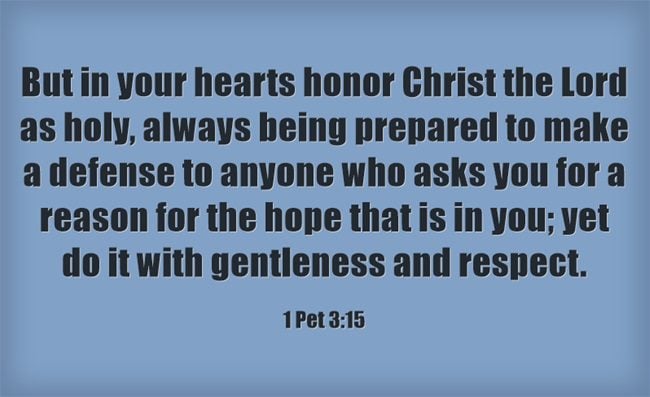
First Peter 3:15-17 “But in your hearts honor Christ the Lord as holy, always being prepared to make a defense to anyone who asks you for a reason for the hope that is in you; yet do it with gentleness and respect, having a good conscience, so that, when you are slandered, those who revile your good behavior in Christ may be put to shame. For it is better to suffer for doing good, if that should be God’s will, than for doing evil.”
There is a lot to be said about how some Christians witness to the lost. Many strive to debate the issue of God’s existence and try to “brow beat” others into believing, but no one that I know of has ever been debated into heaven. We can win an argument but lose a chance to witness. We must be ready to give an answer for the hope that we have, but we must do so “with gentleness and respect,” as Jesus did. Jesus never tried to coerce anyone into the kingdom. In fact, He said that others will know we are His disciples by the love we show to one another (John 13:35), not by who has the best argument.
What does “the hope that is in you” mean? What is this hope?
Why does Peter say it is good to suffer for good?
First Peter 3:18-19 “For Christ also suffered once for sins, the righteous for the unrighteous, that he might bring us to God, being put to death in the flesh but made alive in the spirit, in which he went and proclaimed to the spirits in prison.”
Jesus Christ came to give His life as a ransom for many (Mark 10:45), but not all, because it says that Jesus “suffered once for sins” as “the righteous for the unrighteous” in order that He might bring us to God through Christ (John 6:44). Jesus body was killed, but not His Spirit, since He is God and God cannot die. After this, He is said to have preached to the “spirits in prison,” perhaps meaning those who had not yet heard the gospel finally heard it. This may refer to Noah’s preaching the gospel prior to the flood or perhaps Christ announced His victory to those wicked ones who perished in Noah’s day. The main point though is that Jesus was vindicated by God as Christians will be.
What do you think Peter meant by Jesus’ proclaiming “to the spirits in prison.”
Who are these “spirits?”
Conclusion
The third chapter of 1st Peter is just as relevant today as it was in the day in which it was written. God’s Word never changes because God never changes. It is we who need to change and it begins with repentance and faith, for no one who trusts in Christ shall ever be ashamed, unlike those who reject Jesus and will forever regret that decision.
Article by Jack Wellman
Jack Wellman is Pastor of the Mulvane Brethren Church in Mulvane Kansas. Jack is also the Senior Writer at What Christians Want To Know whose mission is to equip, encourage, and energize Christians and to address questions about the believer’s daily walk with God and the Bible. You can follow Jack on Google Plus or check out his book Teaching Children the Gospel available on Amazon.
Previous Post

January 16, 2017
First Peter Chapter Two Bible Study And Commentary
Next Post
January 17, 2017 First Peter Chapter Four Bible Study And Commentary
Browse Our Archives
Select a Category Bible Answers Bible Definitions Bible Story Bible Study Bible Verses Christian Books Christian Entertainment Christian Fathers Christian Mothers Christian Quotes Devotional Famous Christians Music News Parables Prayers Quotes Sunday School Lesson Uncategorized Youth Sermons
Select a Month October 2019 September 2019 August 2019 July 2019 June 2019 May 2019 April 2019 March 2019 February 2019 January 2019 December 2018 November 2018 October 2018 September 2018 August 2018 July 2018 June 2018 May 2018 April 2018 March 2018 February 2018 January 2018 December 2017 November 2017 October 2017 September 2017 August 2017 July 2017 June 2017 May 2017 April 2017 March 2017 February 2017 January 2017 December 2016 November 2016 October 2016 September 2016 August 2016 July 2016 June 2016 May 2016 March 2016 February 2016 January 2016 December 2015 November 2015 October 2015 September 2015 August 2015 July 2015 June 2015 May 2015 April 2015 March 2015 February 2015 January 2015 December 2014 November 2014 October 2014 September 2014 August 2014 July 2014 June 2014 May 2014 April 2014 March 2014 February 2014 January 2014 December 2013 November 2013 October 2013 September 2013 August 2013 July 2013 June 2013 May 2013 April 2013 March 2013
Follow Us!
TAKE THE
Religious Wisdom Quiz
Who was the king of Babylon during the exile of the Israelites?
Select your answer to see how you score.
Nebuchadnezzar Cyrus Belshazzar Darius
Related posts from Christian Crier

The Surprising Truth About Persecution

Seeing The Gospel In Biblical Accounts

Getting The Most Out Of Your Bible Reading
TRENDING AT PATHEOS Evangelical

How the author of the world's best hymn...
I've been working with John Newton for a while now. This makes...

Long before this Lectio Divina, Psalm 130 - the song - started...

What About the Trees? Another Living Parable
After I finished writing the last article about falling leaves as a...

Why Classical Education Is a Conversation, Not a...
Come and Read: Joy in Classical Education When I was a little...

Falling Leaves: A Living Parable on Letting Go
I’ve spent the vast majority of my life in the southeast corner...

Cornell University has received a great deal of negative publicity and intense...
view all Evangelical blogs
Ad-Free & Subscriber Log-In Subscription Support
- About Us
- 2026 Calendar
- Videos
- Podcasts
- Library of World Religions
- Faith In Media Tracker
- Advertise With Us
- Write for Us
- Privacy Policy
- Terms of Service
- Do Not Sell My Data
- Contact Us
- Radiant Digital
- Manage Newsletter Subscriptions
- Unsubscribe From Notifications
- Sitemap
Copyright 2008-2026, Patheos. All rights reserved.
Subscription Support Ad-Free & Subscriber Log-In
Follow Patheos