
BuddhistCatholicContemplativeEvangelicalGeneral ChristianHinduJewishLatter-day SaintMuslimNew VisionsProgressive Christian
Beliefs
- Buddhist
- Catholic
- Contemplative
- Evangelical
- General Christian
- Hindu
- Jewish
- Latter-day Saint
- More Voices
- Muslim
- New Visions
- Pagan
- Progressive Christian
Topics
- Religion News
- Food and Religion
- Sports and Religion
- Religious Art
- Religious Music and Entertainment
- Religious Events
- History and Religion
- Style and Religion
- Politics and Religion
- Women in Religion
- Recreation Outdoors and Religion
- Business Finance and Religion
- Careers Workplace and Religion
- Education and Religion
- Family Parenting and Religion
- Health Fitness and Religion
- Home and Religion
- Relationships and Religion
- Technology and Religion
- Travel and Religion
Columnists
- Buddhist Columnists
- Business Finance and Religion Columnists
- Careers Workplace and Religion Columnists
- Catholic Columnists
- Contemplative Columnists
- Education and Religion Columnists
- Evangelists Columnists
- Family Parenting and Religion Columnists
- General Christian Columnists
- Health Fitness and Religion Columnists
- Hindu Columnists
- History and Religion Columnists
- Home and Religion Columnists
- Jewish Columnists
- More Voices Columnists
- Latter Day Columnists
- Muslim Columnists
- New Visions Columnists
- Nonreligious Columnists
- Pagan Columnists
- Politics and Religion Columnists
- Progressive Columnists
- Recreation Outdoors and Religion Columnists
- Relationships and Religion Columnists
- Religion News Columnists
- Religious Art Columnists
- Religious Events Columnists
- Religious Music and Entertainment Columnists
- Sports and Religion Columnists
- Style and Religion Columnists
- Technology and Religion Columnists
- Travel and Religion Columnists
- Women in Religion Columnists
Resource Library
- 2026 Calendar
- Library of World Religions
- The 100 Most Holy Places on Earth
- Patheos Answers
- Podcasts
- Videos
- Faith Leaders Database
- Anglican Episcopalian
- Bahai
- Baptist
- Buddhism
- Christianity
- Confucianism
- Eastern Orthodoxy
- Hinduism
- Holiness and Pentecostal
- ISKCON
- Islam
- Judaism
- Lutheran
- Methodist
- The Church of Jesus Christ of Latter-day Saints
- New Age
- Paganism
- Presbytarian and Reformed
- Protestantism
- Religion Behind the Scenes
- Roman Catholic
- Scientology
- Shia Islam
- Sikhism
- Sufism
- Sunni Islam
- Taoism
- Zen
- See all religions
Research Tools
 Ad-Free & Subscriber Log-In Subscription Support
Ad-Free & Subscriber Log-In Subscription Support
Follow Patheos 

- Trending:
- Forgiveness
- |
- Marriage
- |
- Consciousness
- |
- Death Penalty
- |
- Election
- |
- Halloween
 Christian Crier
- Home
- Evangelical
- First Peter Chapter Two Bible Study And Commentary
First Peter Chapter Two Bible Study And Commentary
Last updated on: January 17, 2017 at 1:03 pm by Jack Wellman
First Peter Chapter Two Bible Study And Commentary 2017-01-17T13:03:06-06:00 Jack Wellman
Patheos Explore the world's faith through different perspectives on religion and spirituality! Patheos has the views of the prevalent religions and spiritualities of the world.
Here is a Bible study and commentary on 1st Peter chapter two.
First Peter 2:1-3 “So put away all malice and all deceit and hypocrisy and envy and all slander. Like newborn infants, long for the pure spiritual milk, that by it you may grow up into salvation— if indeed you have tasted that the Lord is good.”
When the Apostle Peter was writing to the Jews, most of whom had been displaced from their homes, he wanted them to focus on growing in grace and feeding on “the pure spiritual milk” of the Word, so that they would “grow up into salvation” and this should help them to put away all malice, deceit, hypocrisy, envy, and slander. Why is this so? Because the Word of God has power to change lives and when the Spirit of God works with the Word of God the children of God are changed.
Why does the Apostle Peter call them to “long for the pure spiritual milk?”
What is this milk?
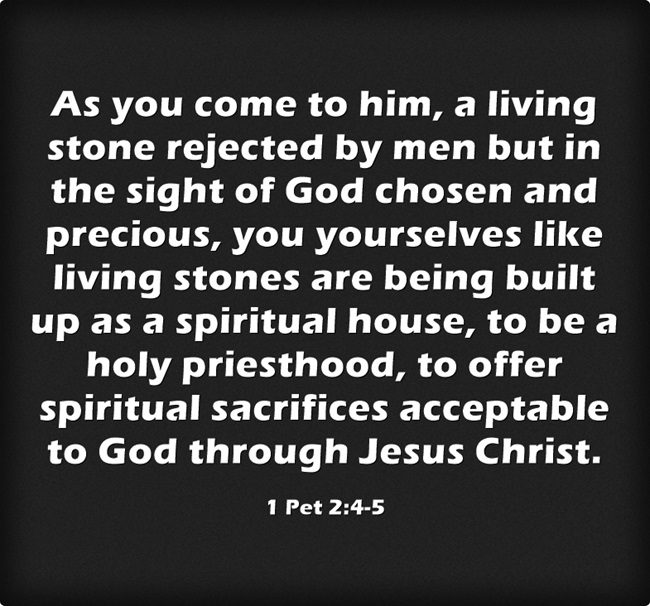
First Peter 2:4-5 “As you come to him, a living stone rejected by men but in the sight of God chosen and precious, you yourselves like living stones are being built up as a spiritual house, to be a holy priesthood, to offer spiritual sacrifices acceptable to God through Jesus Christ.”
The “living stone” the Apostle Peter is writing about is clearly Jesus Christ and He was a major stumbling block to the Jews but this same “living stone” that was rejected by mankind (and still is today) was the stone that the church was built on, Jesus Himself being the Chief Cornerstone (Eph 2:20), and the “living stones” of the members of Jesus’ church are placed upon this solid rock of a foundation that shall never be destroyed.
What is the “spiritual house” called today?
Why are believer’s called “living stones?”
First Peter 2:6-8 “For it stands in Scripture: ‘Behold, I am laying in Zion a stone, a cornerstone chosen and precious, and whoever believes in him will not be put to shame. So the honor is for you who believe, but for those who do not believe, The stone that the builders rejected has become the cornerstone,’ and ‘A stone of stumbling, and a rock of offense.’ They stumble because they disobey the word, as they were destined to do.”
As the Old Testament prophets had prophesied, they rejected the “living stone,” or Jesus Christ, but for those who put their trust in Him, they “will not be put to shame” on the day of judgment, however for those who reject the “living stone,” this same stone will be a cause or “rock of offense” and that is why “They stumble because they disobey the word” just “as they were destined to do.”
How does this “living stone” cause people to stumble?
Why did the builders reject the Chief Cornerstone?
First Peter 2:9-10 “But you are a chosen race, a royal priesthood, a holy nation, a people for his own possession, that you may proclaim the excellencies of him who called you out of darkness into his marvelous light. Once you were not a people, but now you are God’s people; once you had not received mercy, but now you have received mercy.”
Peter says that we are a royal priesthood and a holy nation that God has chosen as a possession for Himself, but first He had to call us out of darkness to bring us into the Light of the World (John 8:12). At one time, we too were not a people of God, but now, we have “received mercy” but only because God has chosen us, not that we ever chose Him (John 6:70, 15:16).
What does it mean we are “his own possession?”
Why were we once “not a people” of God?”
What changed?
First Peter 2:11-12 “Beloved, I urge you as sojourners and exiles to abstain from the passions of the flesh, which wage war against your soul. Keep your conduct among the Gentiles honorable, so that when they speak against you as evildoers, they may see your good deeds and glorify God on the day of visitation.”
As Billy Graham once said, “this is not our home, we are only passing through” and this fits nicely with Scripture because we are called sojourners and are not of this world. We are only passing through and seeking a better kingdom, and one without end. If we live lives above reproach, as citizens of this new kingdom, we should have our conduct honorable before those who don’t believe, perhaps as a way to witness as Jesus said we are called to be lights of the world (Matt 5:14).
Why are we often called “sojourners” or “pilgrims?”
What does our conduct today have to do with “the day of visitation?”
First Peter 2:13-16 “Be subject for the Lord’s sake to every human institution, whether it be to the emperor as supreme, or to governors as sent by him to punish those who do evil and to praise those who do good. For this is the will of God, that by doing good you should put to silence the ignorance of foolish people. Live as people who are free, not using your freedom as a cover-up for evil, but living as servants of God.”
These verses are similar to what the Apostle Paul said where he wrote, “Let every person be subject to the governing authorities. For there is no authority except from God, and those that exist have been instituted by God. Therefore whoever resists the authorities resists what God has appointed, and those who resist will incur judgment” (Rom13:1-2). Peter adds that this freedom we have in Christ should not be used as a cover for sinning. All authority comes from God and it’s never to be used for evil.
How can believers “put to silence the ignorance of foolish people” who reject the gospel?
How can we use our “freedom as a cover-up for evil?”
First Peter 2:20-21 “For what credit is it if, when you sin and are beaten for it, you endure? But if when you do good and suffer for it you endure, this is a gracious thing in the sight of God. For to this you have been called, because Christ also suffered for you, leaving you an example, so that you might follow in his steps.”
It’s not pleasing in God’s sight to suffer for things that are our own fault and that we cause, but if we suffer for doing good, “this is a gracious thing in the sight of God” because Jesus’ suffered, and He was without sin. We are actually called to suffer “because Christ also suffered for you” and me, and has left us an example “so that [we] might follow in his steps.”
How can we suffer from doing good?
Why is it pleasing to God to suffer for doing good?
First Peter 2:22-25 “He committed no sin, neither was deceit found in his mouth. When he was reviled, he did not revile in return; when he suffered, he did not threaten, but continued entrusting himself to him who judges justly. He himself bore our sins in his body on the tree, that we might die to sin and live to righteousness. By his wounds you have been healed. For you were straying like sheep, but have now returned to the Shepherd and Overseer of your souls.”
Again, this is very similar to what Paul wrote in Romans 12 where he says we should “Repay no one evil for evil, but give thought to do what is honorable in the sight of all” (Rom 12:17), and “never avenge yourselves, but leave it to the wrath of God, for it is written, “Vengeance is mine, I will repay, says the Lord” (Rom 12:19). Instead of responding with evil to those who hate us, “if your enemy is hungry, feed him; if he is thirsty, give him something to drink; for by so doing you will heap burning coals on his head.” Do not be overcome by evil, but overcome evil with good” (Rom 12:20-21). We love our enemies, do good to them that do bad things to us, and pray for those who persecute us. That is our calling.
What does it mean Jesus “did not revile in return” when He was reviled?
How can we die to sin?
How can we live to righteousness?
Conclusion
First Peter is full of admonitions and admonishment for the believer and it is still just as relevant today as it was in the day it was written, because “All Scripture is breathed out by God and profitable for teaching, for reproof, for correction, and for training in righteousness” (2nd Tim 3:16), and since God doesn’t change (Mal 3:6), His Word doesn’t change. It doesn’t need to.
Article by Jack Wellman
Jack Wellman is Pastor of the Mulvane Brethren Church in Mulvane Kansas. Jack is also the Senior Writer at What Christians Want To Know whose mission is to equip, encourage, and energize Christians and to address questions about the believer’s daily walk with God and the Bible. You can follow Jack on Google Plus or check out his book Teaching Children the Gospel available on Amazon.
Previous Post

January 14, 2017
First Peter Chapter One Bible Study and Commentary
Next Post
January 17, 2017 First Peter Chapter Three Bible Study And Commentary
Browse Our Archives
Select a Category Bible Answers Bible Definitions Bible Story Bible Study Bible Verses Christian Books Christian Entertainment Christian Fathers Christian Mothers Christian Quotes Devotional Famous Christians Music News Parables Prayers Quotes Sunday School Lesson Uncategorized Youth Sermons
Select a Month October 2019 September 2019 August 2019 July 2019 June 2019 May 2019 April 2019 March 2019 February 2019 January 2019 December 2018 November 2018 October 2018 September 2018 August 2018 July 2018 June 2018 May 2018 April 2018 March 2018 February 2018 January 2018 December 2017 November 2017 October 2017 September 2017 August 2017 July 2017 June 2017 May 2017 April 2017 March 2017 February 2017 January 2017 December 2016 November 2016 October 2016 September 2016 August 2016 July 2016 June 2016 May 2016 March 2016 February 2016 January 2016 December 2015 November 2015 October 2015 September 2015 August 2015 July 2015 June 2015 May 2015 April 2015 March 2015 February 2015 January 2015 December 2014 November 2014 October 2014 September 2014 August 2014 July 2014 June 2014 May 2014 April 2014 March 2014 February 2014 January 2014 December 2013 November 2013 October 2013 September 2013 August 2013 July 2013 June 2013 May 2013 April 2013 March 2013
Follow Us!
TAKE THE
Religious Wisdom Quiz
True or False: The Thessalonians were told that the day of the Lord will come like a thief in the night.
Select your answer to see how you score.
FALSE TRUE
Related posts from Christian Crier


Seeing The Gospel In Biblical Accounts

Getting The Most Out Of Your Bible Reading

I’m Saved, So Why Do I Still Keep...
TRENDING AT PATHEOS Evangelical

How the author of the world's best hymn...
I've been working with John Newton for a while now. This makes...

Long before this Lectio Divina, Psalm 130 - the song - started...

What About the Trees? Another Living Parable
After I finished writing the last article about falling leaves as a...

Why Classical Education Is a Conversation, Not a...
Come and Read: Joy in Classical Education When I was a little...

Falling Leaves: A Living Parable on Letting Go
I’ve spent the vast majority of my life in the southeast corner...

Cornell University has received a great deal of negative publicity and intense...
view all Evangelical blogs
Ad-Free & Subscriber Log-In Subscription Support
- About Us
- 2026 Calendar
- Videos
- Podcasts
- Library of World Religions
- Faith In Media Tracker
- Advertise With Us
- Write for Us
- Privacy Policy
- Terms of Service
- Do Not Sell My Data
- Contact Us
- Radiant Digital
- Manage Newsletter Subscriptions
- Unsubscribe From Notifications
- Sitemap
Copyright 2008-2026, Patheos. All rights reserved.
Subscription Support Ad-Free & Subscriber Log-In
Follow Patheos