
BuddhistCatholicContemplativeEvangelicalGeneral ChristianHinduJewishLatter-day SaintMuslimNew VisionsProgressive Christian
Beliefs
- Buddhist
- Catholic
- Contemplative
- Evangelical
- General Christian
- Hindu
- Jewish
- Latter-day Saint
- More Voices
- Muslim
- New Visions
- Pagan
- Progressive Christian
Topics
- Religion News
- Food and Religion
- Sports and Religion
- Religious Art
- Religious Music and Entertainment
- Religious Events
- History and Religion
- Style and Religion
- Politics and Religion
- Women in Religion
- Recreation Outdoors and Religion
- Business Finance and Religion
- Careers Workplace and Religion
- Education and Religion
- Family Parenting and Religion
- Health Fitness and Religion
- Home and Religion
- Relationships and Religion
- Technology and Religion
- Travel and Religion
Columnists
- Buddhist Columnists
- Business Finance and Religion Columnists
- Careers Workplace and Religion Columnists
- Catholic Columnists
- Contemplative Columnists
- Education and Religion Columnists
- Evangelists Columnists
- Family Parenting and Religion Columnists
- General Christian Columnists
- Health Fitness and Religion Columnists
- Hindu Columnists
- History and Religion Columnists
- Home and Religion Columnists
- Jewish Columnists
- More Voices Columnists
- Latter Day Columnists
- Muslim Columnists
- New Visions Columnists
- Nonreligious Columnists
- Pagan Columnists
- Politics and Religion Columnists
- Progressive Columnists
- Recreation Outdoors and Religion Columnists
- Relationships and Religion Columnists
- Religion News Columnists
- Religious Art Columnists
- Religious Events Columnists
- Religious Music and Entertainment Columnists
- Sports and Religion Columnists
- Style and Religion Columnists
- Technology and Religion Columnists
- Travel and Religion Columnists
- Women in Religion Columnists
Resource Library
- 2026 Calendar
- Library of World Religions
- The 100 Most Holy Places on Earth
- Patheos Answers
- Podcasts
- Videos
- Faith Leaders Database
- Anglican Episcopalian
- Bahai
- Baptist
- Buddhism
- Christianity
- Confucianism
- Eastern Orthodoxy
- Hinduism
- Holiness and Pentecostal
- ISKCON
- Islam
- Judaism
- Lutheran
- Methodist
- The Church of Jesus Christ of Latter-day Saints
- New Age
- Paganism
- Presbytarian and Reformed
- Protestantism
- Religion Behind the Scenes
- Roman Catholic
- Scientology
- Shia Islam
- Sikhism
- Sufism
- Sunni Islam
- Taoism
- Zen
- See all religions
Research Tools
 Ad-Free & Subscriber Log-In Subscription Support
Ad-Free & Subscriber Log-In Subscription Support
Follow Patheos 

- Trending:
- Forgiveness
- |
- Marriage
- |
- Consciousness
- |
- Death Penalty
- |
- Election
- |
- Halloween
 Christian Crier
- Home
- Evangelical
- First Peter Chapter One Bible Study and Commentary
First Peter Chapter One Bible Study and Commentary
Last updated on: January 17, 2017 at 1:02 pm by Jack Wellman
First Peter Chapter One Bible Study and Commentary 2017-01-17T13:02:37-06:00 Jack Wellman
Patheos Explore the world's faith through different perspectives on religion and spirituality! Patheos has the views of the prevalent religions and spiritualities of the world.
Here is a Bible study and commentary on the first chapter of 1st Peter.
First Peter 1:1-2 “Peter, an apostle of Jesus Christ, To those who are elect exiles of the Dispersion in Pontus, Galatia, Cappadocia, Asia, and Bithynia, according to the foreknowledge of God the Father, in the sanctification of the Spirit, for obedience to Jesus Christ and for sprinkling with his blood.”
The Apostle Peter was writing to the Jews who had been dispersed or exiled out of Jerusalem and Judea, and wrote to comfort them by telling them that they are the elect of God who were chosen “according to the foreknowledge of God the Father,” and not according to their own wisdom. These saints of God have been sanctified by the blood of the Lamb of God for the purpose of living in “obedience to Jesus Christ.”
Why were the Jews dispersed?
Was their dispersion foreknown to God?
First Peter 1:3-5 “Blessed be the God and Father of our Lord Jesus Christ! According to his great mercy, he has caused us to be born again to a living hope through the resurrection of Jesus Christ from the dead, to an inheritance that is imperishable, undefiled, and unfading, kept in heaven for you, who by God’s power are being guarded through faith for a salvation ready to be revealed in the last time.”
Peter focuses on the reason that we have been saved and it is “According to his great mercy” that God “had caused us to be born again to a living hope” which is through the resurrection of Jesus Christ, and since He was raised from the dead, so too shall our mortal bodies put on incorruption someday (1st Cor 15:53). Our inheritance isn’t like the worlds where people fight over it and can lose it, but our inheritance is imperishable and is presently being “kept in heaven for you” and is being guarded “by God’s power.” In other words, it is untouchable.
What is the believer’s inheritance?
Why is it kept in heaven?
First Peter 1:6-7 “In this you rejoice, though now for a little while, if necessary, you have been grieved by various trials, so that the tested genuineness of your faith—more precious than gold that perishes though it is tested by fire—may be found to result in praise and glory and honor at the revelation of Jesus Christ.”
Peter moves from the assurance of their salvation to the fact that they are secure in Christ. That means they are preserved in heaven but Peter also assures them that they will suffer, because it may be necessary to have their faith tested to see if it’s the real thing (genuineness), but this testing is like gold that passes through the fire; it makes it more precious. That’s why Peter wants them to realize, “Though you do not now see him, you believe in him and rejoice with joy that is inexpressible and filled with glory, obtaining the outcome of your faith, the salvation of your souls” (1st Pet 1:8-9).
Is suffering a good thing according to God?
Why is our faith tested by fire?
First Peter 1:10-11 “Concerning this salvation, the prophets who prophesied about the grace that was to be yours searched and inquired carefully, inquiring what person or time the Spirit of Christ in them was indicating when he predicted the sufferings of Christ and the subsequent glories.”
Peter understood that all of the Old Testament prophets had been writing about the coming Messiah, like Isaiah the Prophet who foretold Jesus suffering (Isaiah 53), as “he predicted the sufferings of Christ” but also, the subsequent glories. No wonder these are “things into which angels long to look” into (1st Pet 1:12).
Who else can you think of that prophesied about Jesus’ coming?
Why are the angels curious about salvation?
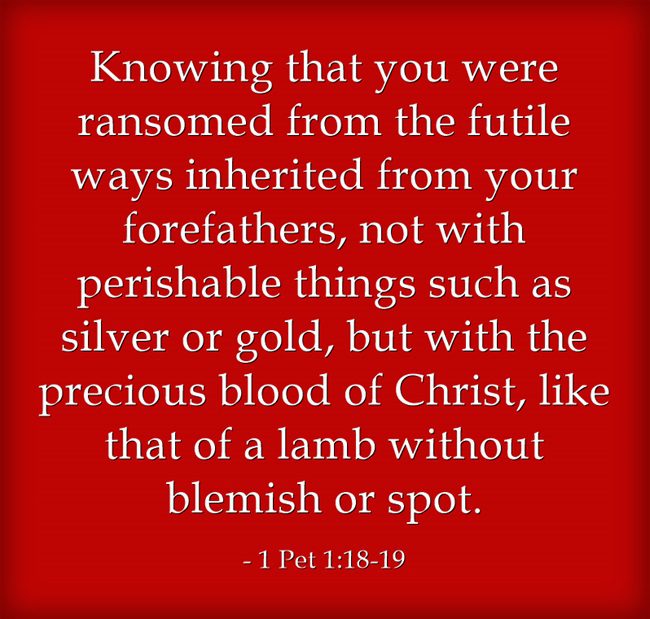
First Peter 1:14-16 “As obedient children, do not be conformed to the passions of your former ignorance, but as he who called you is holy, you also be holy in all your conduct, since it is written, “You shall be holy, for I am holy.”
Peter writes something very similar to what the Apostle Paul wrote in that we should “not be conformed” (Rom 12:2)to this world, and specifically, do not be conformed to our former way of life because God has called us to be holy, just as He is holy. This holy living is how we conduct our lives. At one time, these former passions kept us in ignorance, but after we are saved, God’s Spirit has revealed the holiness of God and God’s desire that we too live lives that are pleasing to God. Not a life of perfection, since that’s not possible, but a life that strives to obey God and please Him in all we do.
How can we be holy if we are still going to sin this side of the kingdom?
Why are we often told to not be conformed to this world, including our passions?
First Peter 1:18-21 “Knowing that you were ransomed from the futile ways inherited from your forefathers, not with perishable things such as silver or gold, but with the precious blood of Christ, like that of a lamb without blemish or spot. He was foreknown before the foundation of the world but was made manifest in the last times for the sake of you who through him are believers in God, who raised him from the dead and gave him glory, so that your faith and hope are in God.”
Peter ties in God’s desire that we live holy lives to the fact that we were ransomed from the god of this world and his futile ways, just as the ancient Israelite forefathers had been from brought out of Egypt, but not with things like gold and silver. In fact, there is nothing more precious in all the universe than the precious blood of the Lamb of God, Who is “without blemish or spot.” That’s Who our “faith and hope” is in.
Why does it say the Jews were ransomed from their futile ways?
How was Jesus Christ made manifest or known to you?
First Peter 1:22-23 “Having purified your souls by your obedience to the truth for a sincere brotherly love, love one another earnestly from a pure heart, since you have been born again, not of perishable seed but of imperishable, through the living and abiding word of God.”
After we have put our trust in Christ, God sees it as having our souls purified, and this should naturally produce obedience in us, and since we’ve been born again of an imperishable seed, the Holy Spirit, we are to earnestly love one another out of sincere or pure desire to serve God and please Him, and when we love one another, we prove that we are Jesus’ disciples (John 13:35).
How can obedience purify our souls?
What does Peter mean to love the brothers earnestly?
First Peter 1:24-25 “All flesh is like grass and all its glory like the flower of grass. The grass withers, and the flower falls, but the word of the Lord remains forever. And this word is the good news that was preached to you.”
In these final verses of 1st Peter chapter one, the apostle reminds us of the fact that we are no better than the grass of the field. It’s beautiful in the beginning, but as time passes, it fades away and passes, but those who are born again, not so. The Christ follower knows that God’s Word remains forever and doesn’t change with seasons and times. That’s the very same gospel or “good news that was preached to you” and is found in the Word of God and is still being preached today.
What is the summation of the “good news?”
Why does Peter compare our life with the grass of the field?
Conclusion
This letter from Peter is still just as relevant today as it was in the day in which it was written because God’s Word remains forever and it contains the good news of the gospel of Jesus Christ which gives sinners hope that they can be “born again of an imperishable seed, the Holy Spirit” and redeemed by God through the precious blood of the Lamb of God, Jesus Christ.
Article by Jack Wellman
Jack Wellman is Pastor of the Mulvane Brethren Church in Mulvane Kansas. Jack is also the Senior Writer at What Christians Want To Know whose mission is to equip, encourage, and energize Christians and to address questions about the believer’s daily walk with God and the Bible. You can follow Jack on Google Plus or check out his book Teaching Children the Gospel available on Amazon.
Previous Post

January 13, 2017
Can You Lose Your Salvation?
Next Post
January 16, 2017 First Peter Chapter Two Bible Study And Commentary
Browse Our Archives
Select a Category Bible Answers Bible Definitions Bible Story Bible Study Bible Verses Christian Books Christian Entertainment Christian Fathers Christian Mothers Christian Quotes Devotional Famous Christians Music News Parables Prayers Quotes Sunday School Lesson Uncategorized Youth Sermons
Select a Month October 2019 September 2019 August 2019 July 2019 June 2019 May 2019 April 2019 March 2019 February 2019 January 2019 December 2018 November 2018 October 2018 September 2018 August 2018 July 2018 June 2018 May 2018 April 2018 March 2018 February 2018 January 2018 December 2017 November 2017 October 2017 September 2017 August 2017 July 2017 June 2017 May 2017 April 2017 March 2017 February 2017 January 2017 December 2016 November 2016 October 2016 September 2016 August 2016 July 2016 June 2016 May 2016 March 2016 February 2016 January 2016 December 2015 November 2015 October 2015 September 2015 August 2015 July 2015 June 2015 May 2015 April 2015 March 2015 February 2015 January 2015 December 2014 November 2014 October 2014 September 2014 August 2014 July 2014 June 2014 May 2014 April 2014 March 2014 February 2014 January 2014 December 2013 November 2013 October 2013 September 2013 August 2013 July 2013 June 2013 May 2013 April 2013 March 2013
Follow Us!
TAKE THE
Religious Wisdom Quiz
Who did Jesus raise from the dead after four days?
Select your answer to see how you score.
Lazarus Himself Widow's son Jairus’ daughter
Related posts from Christian Crier

There Are Only Two Ways To God

TRENDING AT PATHEOS Evangelical

How the author of the world's best hymn...
I've been working with John Newton for a while now. This makes...

Long before this Lectio Divina, Psalm 130 - the song - started...

What About the Trees? Another Living Parable
After I finished writing the last article about falling leaves as a...

Why Classical Education Is a Conversation, Not a...
Come and Read: Joy in Classical Education When I was a little...

Falling Leaves: A Living Parable on Letting Go
I’ve spent the vast majority of my life in the southeast corner...

Cornell University has received a great deal of negative publicity and intense...
view all Evangelical blogs
Ad-Free & Subscriber Log-In Subscription Support
- About Us
- 2026 Calendar
- Videos
- Podcasts
- Library of World Religions
- Faith In Media Tracker
- Advertise With Us
- Write for Us
- Privacy Policy
- Terms of Service
- Do Not Sell My Data
- Contact Us
- Radiant Digital
- Manage Newsletter Subscriptions
- Unsubscribe From Notifications
- Sitemap
Copyright 2008-2026, Patheos. All rights reserved.
Subscription Support Ad-Free & Subscriber Log-In
Follow Patheos