
BuddhistCatholicContemplativeEvangelicalGeneral ChristianHinduJewishLatter-day SaintMuslimNew VisionsProgressive Christian
Beliefs
- Buddhist
- Catholic
- Contemplative
- Evangelical
- General Christian
- Hindu
- Jewish
- Latter-day Saint
- More Voices
- Muslim
- New Visions
- Pagan
- Progressive Christian
Topics
- Religion News
- Food and Religion
- Sports and Religion
- Religious Art
- Religious Music and Entertainment
- Religious Events
- History and Religion
- Style and Religion
- Politics and Religion
- Women in Religion
- Recreation Outdoors and Religion
- Business Finance and Religion
- Careers Workplace and Religion
- Education and Religion
- Family Parenting and Religion
- Health Fitness and Religion
- Home and Religion
- Relationships and Religion
- Technology and Religion
- Travel and Religion
Columnists
- Buddhist Columnists
- Business Finance and Religion Columnists
- Careers Workplace and Religion Columnists
- Catholic Columnists
- Contemplative Columnists
- Education and Religion Columnists
- Evangelists Columnists
- Family Parenting and Religion Columnists
- General Christian Columnists
- Health Fitness and Religion Columnists
- Hindu Columnists
- History and Religion Columnists
- Home and Religion Columnists
- Jewish Columnists
- More Voices Columnists
- Latter Day Columnists
- Muslim Columnists
- New Visions Columnists
- Nonreligious Columnists
- Pagan Columnists
- Politics and Religion Columnists
- Progressive Columnists
- Recreation Outdoors and Religion Columnists
- Relationships and Religion Columnists
- Religion News Columnists
- Religious Art Columnists
- Religious Events Columnists
- Religious Music and Entertainment Columnists
- Sports and Religion Columnists
- Style and Religion Columnists
- Technology and Religion Columnists
- Travel and Religion Columnists
- Women in Religion Columnists
Resource Library
- 2026 Calendar
- Library of World Religions
- The 100 Most Holy Places on Earth
- Patheos Answers
- Podcasts
- Videos
- Faith Leaders Database
- Anglican Episcopalian
- Bahai
- Baptist
- Buddhism
- Christianity
- Confucianism
- Eastern Orthodoxy
- Hinduism
- Holiness and Pentecostal
- ISKCON
- Islam
- Judaism
- Lutheran
- Methodist
- The Church of Jesus Christ of Latter-day Saints
- New Age
- Paganism
- Presbytarian and Reformed
- Protestantism
- Religion Behind the Scenes
- Roman Catholic
- Scientology
- Shia Islam
- Sikhism
- Sufism
- Sunni Islam
- Taoism
- Zen
- See all religions
Research Tools
 Ad-Free & Subscriber Log-In Subscription Support
Ad-Free & Subscriber Log-In Subscription Support
Follow Patheos 

- Trending:
- Forgiveness
- |
- Marriage
- |
- Consciousness
- |
- Death Penalty
- |
- Election
- |
- Halloween
 Christian Crier
- Home
- Evangelical
- How Did Jesus Fulfill The Law?
How Did Jesus Fulfill The Law?
Last updated on: January 12, 2017 at 1:24 pm by Jack Wellman
How Did Jesus Fulfill The Law? 2017-01-12T13:24:10-06:00 Jack Wellman
Patheos Explore the world's faith through different perspectives on religion and spirituality! Patheos has the views of the prevalent religions and spiritualities of the world.
What did Jesus mean when He said He came to fulfill the law?
Fulfill Which Law?
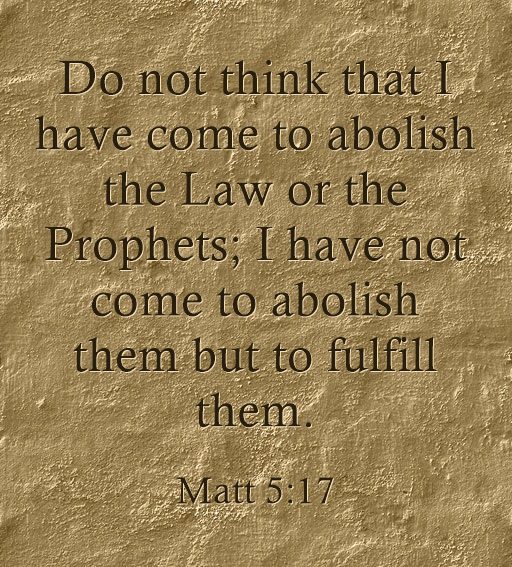
What law was Jesus’ speaking about when He said, “Do not think that I have come to abolish the Law or the Prophets; I have not come to abolish them but to fulfill them” (Matt 5:17)? In fact, He went on to say, “until heaven and earth pass away, not the smallest letter or stroke shall pass from the Law until all is accomplished” (Matt 5:18). Was it the Mosaic Law or the Ten Commandments or some other Old Testament laws Jesus was speaking about? Jesus said that the law will be “not the smallest letter or stroke shall pass from the Law until all is accomplished.” What was it that He would accomplish and what law was Jesus speaking of? It seems evident that this is not referring to the Ten Commandments but the old Mosaic Laws of sacrifices, oblations, washings, and other such rituals that the Old Testament Mosaic Law required and were but a shadow of the reality to come in Jesus Christ. The author of Hebrews tells us that “under the law almost everything is purified with blood, and without the shedding of blood there is no forgiveness of sins” (Heb 9:22), so they were to cover their sins, but they could never take them away since they had to be repeated over and over again because humanity sins over and over again. This is the very essence of the atonement as God says, “the life of the flesh is in the blood, and I have given it for you on the altar to make atonement for your souls, for it is the blood that makes atonement by the life” (Lev 17:11).
The Mosaic Law’s Purpose
As I touched on in the above paragraph, the sacrificial system was to remind the people that sin is costly. It requires blood to cover sins, however the “gifts and sacrifices are offered that cannot perfect the conscience of the worshiper” (Heb 9:9), but “when Christ appeared as a high priest of the good things that have come” (Heb 9:11a), “he entered once for all into the holy places, not by means of the blood of goats and calves but by means of his own blood, thus securing an eternal redemption” (Heb 9:12). Though the Old Testament sacrifices covered sin, they were only temporary, so “how much more will the blood of Christ, who through the eternal Spirit offered himself without blemish to God, purify our conscience from dead works to serve the living God” (Heb 9:14). This is why Jesus is “the mediator of a new covenant, so that those who are called may receive the promised eternal inheritance, since a death has occurred that redeems them from the transgressions committed under the first covenant” (Heb 9:15). The priests could only cover sins and even their own sins needed repeated sacrifices, but now, “Christ has entered, not into holy places made with hands, which are copies of the true things, but into heaven itself, now to appear in the presence of God on our behalf” (Heb 9:24). This is the reason Jesus “has appeared once for all at the end of the ages to put away sin by the sacrifice of himself” (Heb 9:26).
Old Testament Laws
Why did Jesus say that He didn’t come to abolish the Law but to fulfill it? How did Jesus Christ fulfil the Law? Did He fulfill the Old Testament laws? Yes and He did so perfectly. Some of the laws concerned the ceremonial washings and such things as these, but the Jews had added hundreds of other requirements that were not written in the Old Testament, so when the highly legalistic Pharisees asked Jesus, “Why do your disciples not walk according to the tradition of the elders, but eat with defiled hands” (Mark 7:5), He rebuked them by saying, ”Well did Isaiah prophesy of you hypocrites, as it is written, ‘This people honors me with their lips, but their heart is far from me” (Mark 7:6), and “in vain do they worship me, teaching as doctrines the commandments of men” (Mark 7:7). Regarding the dietary laws of clean and unclean foods, Jesus told them, “Then are you also without understanding? Do you not see that whatever goes into a person from outside cannot defile him, since it enters not his heart but his stomach, and is expelled?” (Thus he declared all foods clean)” (Mark 7:18-20). Some churches still teach these Old Testament laws as required, and so they too are “without understanding.” He reminds them, and also all churches who still teach that these Old Testament dietary laws are still in effect, that it is “What comes out of a person is what defiles him. For from within, out of the heart of man, come evil thoughts, sexual immorality, theft, murder, adultery, coveting, wickedness, deceit, sensuality, envy, slander, pride, foolishness. All these evil things come from within, and they defile a person” (Mark 7:20-23). In fact, the Pharisees never kept the Old Testament laws (Mark 7:9-13), because it’s not humanly possible to keep them all. And I think that’s the main point, as we shall read.
Fulfilling the Law
Jesus because a curse for us so that we wouldn’t have to bear the curse for eternity, but “For all who rely on works of the law are under a curse; for it is written, “Cursed be everyone who does not abide by all things written in the Book of the Law, and do them” (Gal 3:10). Back in the early 1980’s, I attended a church that kept the holy days, observed the dietary laws, and the Sabbath. They believed that all other churches were apostate and were all destined for hell, but who can possibly ever keep the law? Does the law save anyone? Absolutely not (Eph 2:8). An important point is that these laws were written for a specific people or nation, which was ancient Israel, so that’s the audience to whom these laws were written. This old church of mine (which I quickly left) still taught these Old Testament laws were valid, but they left out the fact that these were preceded by words, “Speak to the children of Israel, and thou shalt say to them” (Ex 13:13), but never, “Say to the nations.” I am not an orthodox Jew. Besides, there is no way I could ever keep the Law perfectly anyway. And, were all guilty anyway, because sin is the transgression of the law of God, so “sin is lawlessness” (1st John 3:4b), and we know that “the law brings wrath, but where there is no law there is no transgression” (Rom 4:15), however the law was necessary in that it shows us what sin is (Rom 7:7). The Ten Commandments were written by the finger of God on tablets of stone, indicating their permanence and their authorship, but even these we can’t keep perfectly, but that doesn’t mean we should strive to do so, and the Ten Commandments came before the Mosaic Laws, and so this is not the law that the Apostle Paul is writing about in Galatians 3. Paul never teaches the abolishment of the Ten Commandments, and neither does Jesus or any of the other Apostles in Scripture.
Conclusion
I am just thankful to God that even though I was found guilty under the law, as we all have, because “The very commandment that promised life proved to be death to me” (Rom 7:10), however, “it is evident that no one is justified before God by the law, for “The righteous shall live by faith” (Gal 3:11), and this is only possible because “Christ redeemed us from the curse of the law by becoming a curse for us” (Gal 3:13b), so “the law was our guardian until Christ came, in order that we might be justified by faith” (Gal 3:24), “But now that faith has come, we are no longer under a guardian, for in Christ Jesus you are all sons of God, through faith” (Gal 3:25-26). Jesus fulfilled the requirements of the law but also the requirements of a perfect sacrifice because He lived a sinless life, kept the law, suffered and died, and was raised on the third day, and at the cross, “It is finished” (John 19:30).
Article by Jack Wellman
Jack Wellman is Pastor of the Mulvane Brethren Church in Mulvane Kansas. Jack is also the Senior Writer at What Christians Want To Know whose mission is to equip, encourage, and energize Christians and to address questions about the believer’s daily walk with God and the Bible. You can follow Jack on Google Plus or check out his book Teaching Children the Gospel available on Amazon.
Previous Post

January 5, 2017
How Do I Get Joy In My Life And Keep It?
Next Post
January 12, 2017 Does The Prodigal Son Parable Mean Christians Can Be Prodigals?
Browse Our Archives
Select a Category Bible Answers Bible Definitions Bible Story Bible Study Bible Verses Christian Books Christian Entertainment Christian Fathers Christian Mothers Christian Quotes Devotional Famous Christians Music News Parables Prayers Quotes Sunday School Lesson Uncategorized Youth Sermons
Select a Month October 2019 September 2019 August 2019 July 2019 June 2019 May 2019 April 2019 March 2019 February 2019 January 2019 December 2018 November 2018 October 2018 September 2018 August 2018 July 2018 June 2018 May 2018 April 2018 March 2018 February 2018 January 2018 December 2017 November 2017 October 2017 September 2017 August 2017 July 2017 June 2017 May 2017 April 2017 March 2017 February 2017 January 2017 December 2016 November 2016 October 2016 September 2016 August 2016 July 2016 June 2016 May 2016 March 2016 February 2016 January 2016 December 2015 November 2015 October 2015 September 2015 August 2015 July 2015 June 2015 May 2015 April 2015 March 2015 February 2015 January 2015 December 2014 November 2014 October 2014 September 2014 August 2014 July 2014 June 2014 May 2014 April 2014 March 2014 February 2014 January 2014 December 2013 November 2013 October 2013 September 2013 August 2013 July 2013 June 2013 May 2013 April 2013 March 2013
Follow Us!
TAKE THE
Religious Wisdom Quiz
Who is traditionally believed to have written the book of Ecclesiastes?
Select your answer to see how you score.
Ezra Solomon David Isaiah
Related posts from Christian Crier

What Does The Bible Say About Our Thoughts?

Do Colors Have Special Meaning In The Bible?

The Glass – Half Empty Or Half Full?

TRENDING AT PATHEOS Evangelical

How the author of the world's best hymn...
I've been working with John Newton for a while now. This makes...

Long before this Lectio Divina, Psalm 130 - the song - started...

What About the Trees? Another Living Parable
After I finished writing the last article about falling leaves as a...

Why Classical Education Is a Conversation, Not a...
Come and Read: Joy in Classical Education When I was a little...

Falling Leaves: A Living Parable on Letting Go
I’ve spent the vast majority of my life in the southeast corner...

Cornell University has received a great deal of negative publicity and intense...
view all Evangelical blogs
Ad-Free & Subscriber Log-In Subscription Support
- About Us
- 2026 Calendar
- Videos
- Podcasts
- Library of World Religions
- Faith In Media Tracker
- Advertise With Us
- Write for Us
- Privacy Policy
- Terms of Service
- Do Not Sell My Data
- Contact Us
- Radiant Digital
- Manage Newsletter Subscriptions
- Unsubscribe From Notifications
- Sitemap
Copyright 2008-2026, Patheos. All rights reserved.
Subscription Support Ad-Free & Subscriber Log-In
Follow Patheos