
BuddhistCatholicContemplativeEvangelicalGeneral ChristianHinduJewishLatter-day SaintMuslimNew VisionsProgressive Christian
Beliefs
- Buddhist
- Catholic
- Contemplative
- Evangelical
- General Christian
- Hindu
- Jewish
- Latter-day Saint
- More Voices
- Muslim
- New Visions
- Pagan
- Progressive Christian
Topics
- Religion News
- Food and Religion
- Sports and Religion
- Religious Art
- Religious Music and Entertainment
- Religious Events
- History and Religion
- Style and Religion
- Politics and Religion
- Women in Religion
- Recreation Outdoors and Religion
- Business Finance and Religion
- Careers Workplace and Religion
- Education and Religion
- Family Parenting and Religion
- Health Fitness and Religion
- Home and Religion
- Relationships and Religion
- Technology and Religion
- Travel and Religion
Columnists
- Buddhist Columnists
- Business Finance and Religion Columnists
- Careers Workplace and Religion Columnists
- Catholic Columnists
- Contemplative Columnists
- Education and Religion Columnists
- Evangelists Columnists
- Family Parenting and Religion Columnists
- General Christian Columnists
- Health Fitness and Religion Columnists
- Hindu Columnists
- History and Religion Columnists
- Home and Religion Columnists
- Jewish Columnists
- More Voices Columnists
- Latter Day Columnists
- Muslim Columnists
- New Visions Columnists
- Nonreligious Columnists
- Pagan Columnists
- Politics and Religion Columnists
- Progressive Columnists
- Recreation Outdoors and Religion Columnists
- Relationships and Religion Columnists
- Religion News Columnists
- Religious Art Columnists
- Religious Events Columnists
- Religious Music and Entertainment Columnists
- Sports and Religion Columnists
- Style and Religion Columnists
- Technology and Religion Columnists
- Travel and Religion Columnists
- Women in Religion Columnists
Resource Library
- 2026 Calendar
- Library of World Religions
- The 100 Most Holy Places on Earth
- Patheos Answers
- Podcasts
- Videos
- Faith Leaders Database
- Anglican Episcopalian
- Bahai
- Baptist
- Buddhism
- Christianity
- Confucianism
- Eastern Orthodoxy
- Hinduism
- Holiness and Pentecostal
- ISKCON
- Islam
- Judaism
- Lutheran
- Methodist
- The Church of Jesus Christ of Latter-day Saints
- New Age
- Paganism
- Presbytarian and Reformed
- Protestantism
- Religion Behind the Scenes
- Roman Catholic
- Scientology
- Shia Islam
- Sikhism
- Sufism
- Sunni Islam
- Taoism
- Zen
- See all religions
Research Tools
 Ad-Free & Subscriber Log-In Subscription Support
Ad-Free & Subscriber Log-In Subscription Support
Follow Patheos 

- Trending:
- Forgiveness
- |
- Marriage
- |
- Consciousness
- |
- Death Penalty
- |
- Election
- |
- Halloween
 Christian Crier
- Home
- Evangelical
- How Did Christianity Become The Official Religion Of Rome?
How Did Christianity Become The Official Religion Of Rome?
Last updated on: December 26, 2016 at 8:16 pm by Jack Wellman
How Did Christianity Become The Official Religion Of Rome? 2016-12-26T20:16:45-06:00 Jack Wellman
Patheos Explore the world's faith through different perspectives on religion and spirituality! Patheos has the views of the prevalent religions and spiritualities of the world.
How did Christianity come to be the official Church of Rome? Did it end up the same as the first century church?
The First Roman Church
The Apostle Paul was chiefly responsible for the church at Rome, even though it was a church he didn’t plant, but interestingly, Paul did plant the seeds of the church by being chained to a Roman guard. Imagine that! Paul had fresh sets of ears to hear the gospel every shift changed, so many of the Roman guards heard the gospel. The seed had been planted. Most kingdoms come from without and take over, but this kingdom is different. It begins within and will eventually take over the empire itself…or at least, what’s left of the Roman Empire. Later, Paul writes a letter to the church at Rome, perhaps his best of all his books, but this church was already in Rome, long before Rome would be in the church. That first church in Rome was very much like it was in Jerusalem. It is described in Acts 2:42-47 where “they devoted themselves to the apostles’ teaching and the fellowship, to the breaking of bread and the prayers. And awe came upon every soul, and many wonders and signs were being done through the apostles. And all who believed were together and had all things in common. And they were selling their possessions and belongings and distributing the proceeds to all, as any had need. And day by day, attending the temple together and breaking bread in their homes, they received their food with glad and generous hearts, praising God and having favor with all the people. And the Lord added to their number day by day those who were being saved” (Acts 2:42-47). That is probably very close to the way the church at Rome operated…just like the primitive church of the first century.
Paul’s House Church
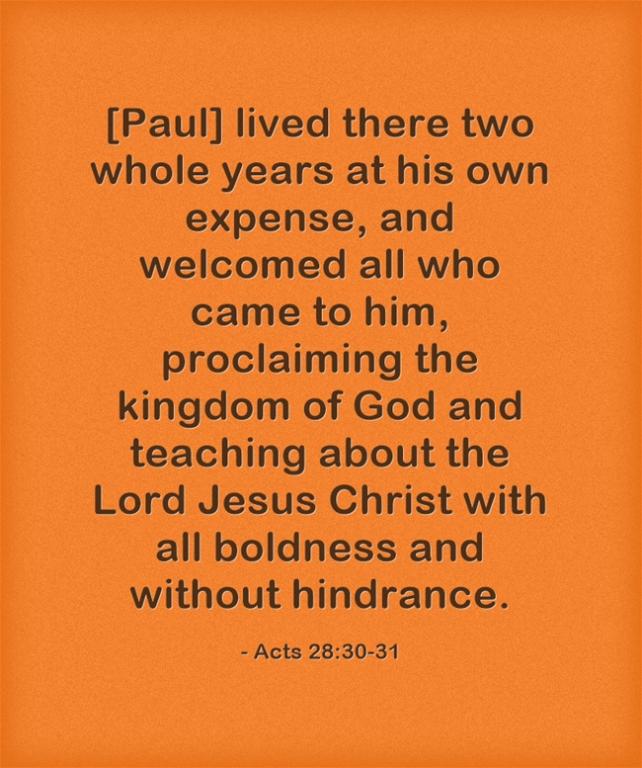
Paul also must have impacted many in Rome because he had been a prisoner at Rome, but near the end of the Book of Acts, we read that Paul was probably under house arrest and allowed certain freedoms and privileges and “lived there two whole years at his own expense, and welcomed all who came to him, proclaiming the kingdom of God and teaching about the Lord Jesus Christ with all boldness and without hindrance” (Acts 28:30-31). This means he could come and go as he pleased; otherwise he could not have paid his own expenses. It’s possible he had to be at home by nightfall, but in any event, he was allowed many visitors, and he welcomed everyone who came to him, and it was to this same “everyone,” he proclaimed the kingdom of God, and did so boldly, because he was “without hindrance.” There must have been several thousands who had come to faith by the time Paul was beheaded, so what Paul had begun, would later flourish. Paul’s faithfulness proved fruitful. Some estimate that there were at least a few thousand Christians in Rome by the time the apostles were gone. Paul had planted many seeds, but God gave the increase.
Revolution From Within
As is often the case, the seeds of revolution came from within the nation or empire, but this would not be a violent revolution or overthrow of the government. It would be a revolution of love; one that came from loving others, praying for their enemies, doing good to their persecutors, and giving them the love of God, just as God have us the free gift of eternal life (Rom 6:23), without merit (Eph 2:8-9), and purely with love the motivation (Rom 5:8). We don’t repay evil for evil (Rom 12:17) but “live peaceably with all” (Rom 12:18) and are told, “never avenge yourselves, but leave it to the wrath of God, for it is written, “Vengeance is mine, I will repay, says the Lord” (Rom 12:19), but instead, “if your enemy is hungry, feed him; if he is thirsty, give him something to drink” (Rom12:20a). That is what Jesus taught (Matt 5) and what can transform the culture, but the transformation begins within each individual who shares this precious pearl with another and they in turn tell others. Believers were taught that they are to obey those in authority and honor them, regardless of whether they deserve it or not (Rom 13:1-7). They were model citizens and loving those who often persecuted them. In this way, their rejoicing in suffering was like an evangelistic sermon to those around them, including those in authority.
Christianity Grows
As the Roman Empire crumbled, it was divided into smaller domains, but the Christian church continued to grow. By the time the Constantine Dynasty arrived, around 306 AD, the different emperors were fighting among themselves for domination. Constantine fought a series of civil wars against the emperors Maxentius and Licinius and sought to unit all the other empires. Constantine did win a great battle, including victory over his own brother-in-law, Maxentius, who was the co-emperor in the west. Constantine wasn’t told by God to win this battle for the Lord. There is no real evidence that he received a vision from God. The fact is Constantine had been a worshipper of the Sun God, Sol Invictus, even though he began to be more interested in Christianity, however this was not Christian in origin and Constantine still didn’t appear to have a personal relationship with Jesus Christ. He just liked “religion.” Does someone who executes their own son (Crispus) and wife (Fausta) in a very sinful way, and for no cause worthy of death, sound like someone who is a Christ follower? By the time that Emperor Theodosius declared the Edict of Thessalonica in 380 AD, the emperor finally made it the Empire’s sole authorized religion, but again, was this the original church? Was it the church that Jesus Christ founded? Some of the fruit makes you wonder. That is at least how “Christianity” became the official religion of Rome.
Conclusion
By the time Christianity became the official religion of Rome, the religion had seemed to change; at least in practice, but the empire was already “Christian” more than they thought because there were already thousands upon thousands of Christians scattered around the former Roman Empire by now, so it was largely Christian by the time Constantine or Theodosius ever showed up. Besides, Christianity is not really about religion; it’s about a relationship, and having a saving relationship with Jesus Christ by repenting of your sins and trusting in Him.
Article by Jack Wellman
Jack Wellman is Pastor of the Mulvane Brethren Church in Mulvane Kansas. Jack is also the Senior Writer at What Christians Want To Know whose mission is to equip, encourage, and energize Christians and to address questions about the believer’s daily walk with God and the Bible. You can follow Jack on Google Plus or check out his book Teaching Children the Gospel available on Amazon.
Previous Post

December 26, 2016
How Does Christianity Affect Gender Roles?
Next Post
December 27, 2016 Who Translated The King James Bible?
Browse Our Archives
Select a Category Bible Answers Bible Definitions Bible Story Bible Study Bible Verses Christian Books Christian Entertainment Christian Fathers Christian Mothers Christian Quotes Devotional Famous Christians Music News Parables Prayers Quotes Sunday School Lesson Uncategorized Youth Sermons
Select a Month October 2019 September 2019 August 2019 July 2019 June 2019 May 2019 April 2019 March 2019 February 2019 January 2019 December 2018 November 2018 October 2018 September 2018 August 2018 July 2018 June 2018 May 2018 April 2018 March 2018 February 2018 January 2018 December 2017 November 2017 October 2017 September 2017 August 2017 July 2017 June 2017 May 2017 April 2017 March 2017 February 2017 January 2017 December 2016 November 2016 October 2016 September 2016 August 2016 July 2016 June 2016 May 2016 March 2016 February 2016 January 2016 December 2015 November 2015 October 2015 September 2015 August 2015 July 2015 June 2015 May 2015 April 2015 March 2015 February 2015 January 2015 December 2014 November 2014 October 2014 September 2014 August 2014 July 2014 June 2014 May 2014 April 2014 March 2014 February 2014 January 2014 December 2013 November 2013 October 2013 September 2013 August 2013 July 2013 June 2013 May 2013 April 2013 March 2013
Follow Us!
TAKE THE
Religious Wisdom Quiz
Who said: "Yet I hold this against you: You have forsaken the love you had at first"?
Select your answer to see how you score.
An angel Jesus (to the church in Ephesus) The Spirit John
Related posts from Christian Crier

What Does The Bible Say About Our Thoughts?

Do Colors Have Special Meaning In The Bible?

The Glass – Half Empty Or Half Full?

TRENDING AT PATHEOS Evangelical

The REST of Your Life: A Creative Wrestles...
This week I had a conversation with a good friend from church....

How the author of the world's best hymn...
I've been working with John Newton for a while now. This makes...

Long before this Lectio Divina, Psalm 130 - the song - started...

What About the Trees? Another Living Parable
After I finished writing the last article about falling leaves as a...

Why Classical Education Is a Conversation, Not a...
Come and Read: Joy in Classical Education When I was a little...

Cornell University has received a great deal of negative publicity and intense...
view all Evangelical blogs
Ad-Free & Subscriber Log-In Subscription Support
- About Us
- 2026 Calendar
- Videos
- Podcasts
- Library of World Religions
- Faith In Media Tracker
- Advertise With Us
- Write for Us
- Privacy Policy
- Terms of Service
- Do Not Sell My Data
- Contact Us
- Radiant Digital
- Manage Newsletter Subscriptions
- Unsubscribe From Notifications
- Sitemap
Copyright 2008-2026, Patheos. All rights reserved.
Subscription Support Ad-Free & Subscriber Log-In
Follow Patheos