
BuddhistCatholicContemplativeEvangelicalGeneral ChristianHinduJewishLatter-day SaintMuslimNew VisionsProgressive Christian
Beliefs
- Buddhist
- Catholic
- Contemplative
- Evangelical
- General Christian
- Hindu
- Jewish
- Latter-day Saint
- More Voices
- Muslim
- New Visions
- Pagan
- Progressive Christian
Topics
- Religion News
- Food and Religion
- Sports and Religion
- Religious Art
- Religious Music and Entertainment
- Religious Events
- History and Religion
- Style and Religion
- Politics and Religion
- Women in Religion
- Recreation Outdoors and Religion
- Business Finance and Religion
- Careers Workplace and Religion
- Education and Religion
- Family Parenting and Religion
- Health Fitness and Religion
- Home and Religion
- Relationships and Religion
- Technology and Religion
- Travel and Religion
Columnists
- Buddhist Columnists
- Business Finance and Religion Columnists
- Careers Workplace and Religion Columnists
- Catholic Columnists
- Contemplative Columnists
- Education and Religion Columnists
- Evangelists Columnists
- Family Parenting and Religion Columnists
- General Christian Columnists
- Health Fitness and Religion Columnists
- Hindu Columnists
- History and Religion Columnists
- Home and Religion Columnists
- Jewish Columnists
- More Voices Columnists
- Latter Day Columnists
- Muslim Columnists
- New Visions Columnists
- Nonreligious Columnists
- Pagan Columnists
- Politics and Religion Columnists
- Progressive Columnists
- Recreation Outdoors and Religion Columnists
- Relationships and Religion Columnists
- Religion News Columnists
- Religious Art Columnists
- Religious Events Columnists
- Religious Music and Entertainment Columnists
- Sports and Religion Columnists
- Style and Religion Columnists
- Technology and Religion Columnists
- Travel and Religion Columnists
- Women in Religion Columnists
Resource Library
- 2026 Calendar
- Library of World Religions
- The 100 Most Holy Places on Earth
- Patheos Answers
- Podcasts
- Videos
- Faith Leaders Database
- Anglican Episcopalian
- Bahai
- Baptist
- Buddhism
- Christianity
- Confucianism
- Eastern Orthodoxy
- Hinduism
- Holiness and Pentecostal
- ISKCON
- Islam
- Judaism
- Lutheran
- Methodist
- The Church of Jesus Christ of Latter-day Saints
- New Age
- Paganism
- Presbytarian and Reformed
- Protestantism
- Religion Behind the Scenes
- Roman Catholic
- Scientology
- Shia Islam
- Sikhism
- Sufism
- Sunni Islam
- Taoism
- Zen
- See all religions
Research Tools
 Ad-Free & Subscriber Log-In Subscription Support
Ad-Free & Subscriber Log-In Subscription Support
Follow Patheos 

- Trending:
- Forgiveness
- |
- Marriage
- |
- Consciousness
- |
- Death Penalty
- |
- Election
- |
- Halloween
 Christian Crier
- Home
- Evangelical
- Should Churches Work Together?
Should Churches Work Together?
Last updated on: October 27, 2016 at 5:12 pm by Jack Wellman
Should Churches Work Together? 2016-10-27T17:12:08-05:00 Jack Wellman
Patheos Explore the world's faith through different perspectives on religion and spirituality! Patheos has the views of the prevalent religions and spiritualities of the world.
Should churches work together in doing work for the kingdom of God?
Having all things in Common
The primitive church in the first century shared all that they had with the rest of the church, the body of Christ. And by their benevolence and unity, God gave increase to the church. Luke writes about the very first gathering of the saints of God and writes, “And all who believed were together and had all things in common. And they were selling their possessions and belongings and distributing the proceeds to all, as any had need.” (Acts 2:44-45). Churches and even individual Christians may have differences, but we should put these differences aside and work together for the common good of our communities. We all have the same Father and as His children, He would expect them to cooperate. We have the same mission and purpose, so why shouldn’t churches work together? With the church so unified in the first century, it was said that “day by day, attending the temple together and breaking bread in their homes, they received their food with glad and generous hearts, praising God and having favor with all the people. And the Lord added to their number day by day those who were being saved” (Acts 2:46-47).
Unifying for God
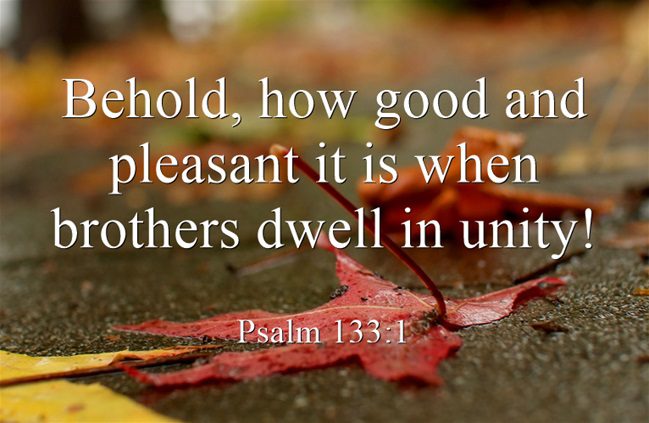
The psalmist gives all Christians and churches an admonition in writing “Behold, how good and pleasant it is when brothers dwell in unity” (Psalm 133:1), and indeed, it is good. When churches pool their resources and members, they can join together in a common cause, and that is to seek and to save those who are lost (Matt 28:19-20; Acts 1:8), but there’s so much more to it than that. Jesus gave us marching orders for the church in Matthew, saying “For I was hungry and you gave me food, I was thirsty and you gave me drink, I was a stranger and you welcomed me, I was naked and you clothed me, I was sick and you visited me, I was in prison and you came to me” (Matt 25:35-36). Churches can work together and help feed the hungry, make strangers feel welcome in church or on the streets, give drinks to the thirsty, and visit those who are sick and in prison. That’s what James calls “pure religion” (James 1:27). When we do these things for others, Jesus says, “as you did it to one of the least of these my brothers, you did it to me” (Matt 25:40). On the other hand, by not doing these things, Jesus rebukes those by telling them who did nothing, “Truly, I say to you, as you did not do it to one of the least of these, you did not do it to me.’ And these will go away into eternal punishment, but the righteous into eternal life” (Matt 25:45-46). Even though we’re not saved by works, we’re saved to do good works that God has prepared for us to do (Eph 2:10), but if we don’t walk in these or do these good works for God’s glory, then we are that lazy, wicked servant who might think they’re Christian, but find out to their horror that they’re not (Matt 7:21-23).
Ministerial Alliances
Many smaller towns have what are called, ministerial alliances. These alliances are where churches work together for the common good of their communities, pooling their resources and feeding the hungry, dispensing clothing, helping those who need help with school supplies, and also filling in during community emergencies. We are certainly stronger together than we are individually, and we are greater in capacity than we are in individual churches. Many hands do make for lighter work, and the joy we felt when our church joined other churches in working for the same purpose made us feel that we are all unified in the faith, in purpose, and in the pursuit of doing the work of God for His glory. There was no division and no boasting about which church gave more. We all had the same mind. We all had the same purpose, and we realized that we could all do more together than by ourselves as one church. When the Apostle Paul heard that there was a famine in Jerusalem, he gathered together collections from the various churches in the area to bring to those who had lost virtually everything. The generosity of the churches in giving was so great that it was said that they had to be told to stop giving. Such were the hearts of these churches, as if they were knit together by the Spirit of God, and indeed they were. There was no rivalry and no one claimed to be superior over the other churches. They had the same purpose and cause. That’s all that mattered.
What you can Do
If your community, city, or town doesn’t have a ministerial alliance, why not start one? It may be that the churches in the area had never thought to work together before. Maybe it had not occurred to them to pool their resources with other area churches so that they could all serve their community in a more comprehensive manner. When churches join hands, everybody wins. There is no room for division in the body of Christ. Each and every member and church are needed. Don’t let the fact that it’s never been done stop you. Don’t allow pride to set in and keep us from working together. We have a common cause and purpose because we have in common the same God.
Conclusion
Should churches work together? By all means, yes! Why not? What’s stopping us from joining together and ministering to those around us? We can do a lot more together than we can by ourselves. We are stronger together but weaker by staying separated. Be bold. Encourage unity in the community and see where that takes you. Join or start a ministerial alliance. Don’t settle for the status quo. It’s not enough. We need to put hands and feet to our faith as the body of Christ ministers to those who are hurting and those who are lost. It really is “good and pleasant it is when brothers dwell in unity” (Psalm 133:1).
Article by Jack Wellman
Jack Wellman is Pastor of the Mulvane Brethren Church in Mulvane Kansas. Jack is also the Senior Writer at What Christians Want To Know whose mission is to equip, encourage, and energize Christians and to address questions about the believer’s daily walk with God and the Bible. You can follow Jack on Google Plus or check out his book Teaching Children the Gospel available on Amazon.
Previous Post

October 27, 2016
Should Churches Invest Money In The Stock Market?
Next Post
October 28, 2016 Should Churches Take Attendance?
Browse Our Archives
Select a Category Bible Answers Bible Definitions Bible Story Bible Study Bible Verses Christian Books Christian Entertainment Christian Fathers Christian Mothers Christian Quotes Devotional Famous Christians Music News Parables Prayers Quotes Sunday School Lesson Uncategorized Youth Sermons
Select a Month October 2019 September 2019 August 2019 July 2019 June 2019 May 2019 April 2019 March 2019 February 2019 January 2019 December 2018 November 2018 October 2018 September 2018 August 2018 July 2018 June 2018 May 2018 April 2018 March 2018 February 2018 January 2018 December 2017 November 2017 October 2017 September 2017 August 2017 July 2017 June 2017 May 2017 April 2017 March 2017 February 2017 January 2017 December 2016 November 2016 October 2016 September 2016 August 2016 July 2016 June 2016 May 2016 March 2016 February 2016 January 2016 December 2015 November 2015 October 2015 September 2015 August 2015 July 2015 June 2015 May 2015 April 2015 March 2015 February 2015 January 2015 December 2014 November 2014 October 2014 September 2014 August 2014 July 2014 June 2014 May 2014 April 2014 March 2014 February 2014 January 2014 December 2013 November 2013 October 2013 September 2013 August 2013 July 2013 June 2013 May 2013 April 2013 March 2013
Follow Us!
TAKE THE
Religious Wisdom Quiz
Which book of the Bible contains the most direct prophecies about the Messiah?
Select your answer to see how you score.
Zechariah Micah Isaiah Psalms
Related posts from Christian Crier

What Does The Bible Say About Our Thoughts?

Do Colors Have Special Meaning In The Bible?

The Glass – Half Empty Or Half Full?

TRENDING AT PATHEOS Evangelical

How the author of the world's best hymn...
I've been working with John Newton for a while now. This makes...

Long before this Lectio Divina, Psalm 130 - the song - started...

What About the Trees? Another Living Parable
After I finished writing the last article about falling leaves as a...

Why Classical Education Is a Conversation, Not a...
Come and Read: Joy in Classical Education When I was a little...

Falling Leaves: A Living Parable on Letting Go
I’ve spent the vast majority of my life in the southeast corner...

Cornell University has received a great deal of negative publicity and intense...
view all Evangelical blogs
Ad-Free & Subscriber Log-In Subscription Support
- About Us
- 2026 Calendar
- Videos
- Podcasts
- Library of World Religions
- Faith In Media Tracker
- Advertise With Us
- Write for Us
- Privacy Policy
- Terms of Service
- Do Not Sell My Data
- Contact Us
- Radiant Digital
- Manage Newsletter Subscriptions
- Unsubscribe From Notifications
- Sitemap
Copyright 2008-2026, Patheos. All rights reserved.
Subscription Support Ad-Free & Subscriber Log-In
Follow Patheos