
BuddhistCatholicContemplativeEvangelicalGeneral ChristianHinduJewishLatter-day SaintMuslimNew VisionsProgressive Christian
Beliefs
- Buddhist
- Catholic
- Contemplative
- Evangelical
- General Christian
- Hindu
- Jewish
- Latter-day Saint
- More Voices
- Muslim
- New Visions
- Pagan
- Progressive Christian
Topics
- Religion News
- Food and Religion
- Sports and Religion
- Religious Art
- Religious Music and Entertainment
- Religious Events
- History and Religion
- Style and Religion
- Politics and Religion
- Women in Religion
- Recreation Outdoors and Religion
- Business Finance and Religion
- Careers Workplace and Religion
- Education and Religion
- Family Parenting and Religion
- Health Fitness and Religion
- Home and Religion
- Relationships and Religion
- Technology and Religion
- Travel and Religion
Columnists
- Buddhist Columnists
- Business Finance and Religion Columnists
- Careers Workplace and Religion Columnists
- Catholic Columnists
- Contemplative Columnists
- Education and Religion Columnists
- Evangelists Columnists
- Family Parenting and Religion Columnists
- General Christian Columnists
- Health Fitness and Religion Columnists
- Hindu Columnists
- History and Religion Columnists
- Home and Religion Columnists
- Jewish Columnists
- More Voices Columnists
- Latter Day Columnists
- Muslim Columnists
- New Visions Columnists
- Nonreligious Columnists
- Pagan Columnists
- Politics and Religion Columnists
- Progressive Columnists
- Recreation Outdoors and Religion Columnists
- Relationships and Religion Columnists
- Religion News Columnists
- Religious Art Columnists
- Religious Events Columnists
- Religious Music and Entertainment Columnists
- Sports and Religion Columnists
- Style and Religion Columnists
- Technology and Religion Columnists
- Travel and Religion Columnists
- Women in Religion Columnists
Resource Library
- 2026 Calendar
- Library of World Religions
- The 100 Most Holy Places on Earth
- Patheos Answers
- Podcasts
- Videos
- Faith Leaders Database
- Anglican Episcopalian
- Bahai
- Baptist
- Buddhism
- Christianity
- Confucianism
- Eastern Orthodoxy
- Hinduism
- Holiness and Pentecostal
- ISKCON
- Islam
- Judaism
- Lutheran
- Methodist
- The Church of Jesus Christ of Latter-day Saints
- New Age
- Paganism
- Presbytarian and Reformed
- Protestantism
- Religion Behind the Scenes
- Roman Catholic
- Scientology
- Shia Islam
- Sikhism
- Sufism
- Sunni Islam
- Taoism
- Zen
- See all religions
Research Tools
 Ad-Free & Subscriber Log-In Subscription Support
Ad-Free & Subscriber Log-In Subscription Support
Follow Patheos 

- Trending:
- Forgiveness
- |
- Marriage
- |
- Consciousness
- |
- Death Penalty
- |
- Election
- |
- Halloween
 Christian Crier
- Home
- Evangelical
- Is Your Conscience The Voice Of God?
Is Your Conscience The Voice Of God?
Last updated on: June 28, 2016 at 8:15 am by Jack Wellman
Is Your Conscience The Voice Of God? 2016-06-28T08:15:52-05:00 Jack Wellman
Patheos Explore the world's faith through different perspectives on religion and spirituality! Patheos has the views of the prevalent religions and spiritualities of the world.
Is your conscience the voice of God speaking to you? How can you know if it is or isn’t?
What is the Conscience?
The word “conscience” is a compound of two words meaning “con” (with) “science” (knowledge), so our own conscience means having the knowledge of something we’re going to do or say, have done and said, or will do or say in the future. The conscience is not an audible voice but many say it’s very close to one since the conscience speaks to them (and us,) in thoughts about whether their actions are okay or not. The conscience lets us know what we’re doing and whether we should or shouldn’t do something or say something. In a sense, our conscience makes us responsible for our actions. When the Apostle Paul was brought before the council he said the same thing to them as he did to the church at Corinth; “For our boast is this, the testimony of our conscience, that we behaved in the world with simplicity and godly sincerity, not by earthly wisdom but by the grace of God, and supremely so toward you” (2nd Cor 1:12). Paul was giving testimony to why their consciences are not troubled, as he said “our,” meaning he was speaking for the others in the missionary party. Their consciences were not troubled at all, meaning that they were in a right relationship with God and with the church, so does our conscience actually God speaking to us? What does the Bible say about our conscience and whether this is how God speaks to us? Is our conscience our guide? It depends on whether it’s been seared or not, as we will later read.
Having a Clear Conscience
The Apostle Paul refers to the conscience when Luke records, “And looking intently at the council, Paul said, “Brothers, I have lived my life before God in all good conscience up to this day” (Acts 23:1). He had nothing to be ashamed of or his conscience would’ve been troubled. That’s what our conscience can do; it can differentiate between what is good and what is bad. For example, we can be “sinning against [our] brothers and wounding their conscience when it is weak [but then], you sin against Christ” (1st Cor 8:12), referring to offending them and what hurts the Body of Christ, hurts Christ Himself (Acts 9:4-5). Your conscience should tell you not to serve wine when entertaining someone who has struggled with alcohol. Paul used this same example when he wrote “If one of the unbelievers invites you to dinner and you are disposed to go, eat whatever is set before you without raising any question on the ground of conscience” (1st Cor 10:27). In this verse, Paul refers to the possibility of offending someone else’s conscience which is what he would have us do too. He wanted the Corinthians to have a clear conscience by avoiding offending others. Paul wanted them to be more considerate of others and in humility, esteeming others as better than themselves (Phil 2:3).
Our Conscience
I cannot recall all the times when my conscience seemed to be speaking to me, saying, “Don’t do it!” and only later regretted not listening to it. I have had others tell me of similar experiences. They knew better, but they just didn’t listen to their conscience. Often, it was pride that was the reason and that’s why Paul tied in the necessity of humility to their (and our) not offending anyone’s conscience, but there are those who have so hardened their hearts that their conscience is either so suppressed that they can no longer “hear” it, or they have seared it or burned it so badly that it cannot even speak to the person. It’s like swallowing so much sin so often that the vocal cords of the conscience can no longer speak to the person. Paul refers to that happening in the next paragraph. Is there a point of no return for the conscience? It seems so because in Noah’s day the wickedness grew so great that God was going to destroy all of mankind, save Noah and his immediately family. In Genesis 6:5 we can see why: “The Lord saw that the wickedness of man was great in the earth, and that every intention of the thoughts of his heart was only evil continually.” It was so bad that evil was all they thought about, and they probably used their imaginations to think of even more despicable sins. They had so muffled their conscience that it was as if they had none.
Seared Conscience
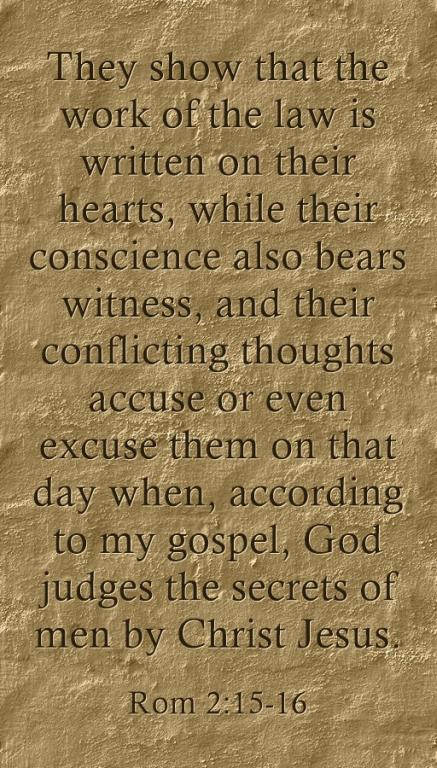
Paul writes “that in later times some will depart from the faith by devoting themselves to deceitful spirits and teachings of demons, through the insincerity of liars whose consciences are seared” (1st Tim 4:1-2), and that has already happened. These false teachers, pastors, and so-called “apostles” today actually look good on camera because they appear as “angels of light,” (2nd Cor 11:14) but in reality, they’re wolves in sheep’s clothing. People clearly know right from wrong, even at a young age, and these false teachers are no exception. For them and other who refuse to repent, Paul writes, “They show that the work of the law is written on their hearts, while their conscience also bears witness, and their conflicting thoughts accuse or even excuse them on that day when, according to my gospel, God judges the secrets of men by Christ Jesus” (Rom 2:15-16). Paul adds that they have no excuse since they know God exists but they are simply suppressing that knowledge (Rom 1:18-21), and if you suppress your conscience long enough, you stop hearing from it, and as a result, “they became futile in their thinking, and their foolish hearts were darkened” (Rom 1:21). Like a callous that forms on a hand, after a time, there is no more feeling left where that callous is at. That’s what happens to unrepentant sinners; the sear their conscience to the point they can no longer hear from it.
Conclusion
God speaks to us by His Word, sometimes by His Spirit, but even through our conscience. The author of Hebrews wrote about the conscience, writing, “how much more will the blood of Christ, who through the eternal Spirit offered himself without blemish to God, purify our conscience from dead works to serve the living God” (Heb 9:14) and since our place before God is secure, “let us draw near with a true heart in full assurance of faith, with our hearts sprinkled clean from an evil conscience and our bodies washed with pure water” (Heb 10:22). The context of this verse is the blood of the Lamb of God saving us. After that happens, our conscious’ are now clear, but let a little sin sneak it, and it’s back to work for our God-given conscience. Listen to your conscience. It can help you avoid a lot of things you’ll later regret.
Article by Jack Wellman
Jack Wellman is Pastor of the Mulvane Brethren Church in Mulvane Kansas. Jack is also the Senior Writer at What Christians Want To Know whose mission is to equip, encourage, and energize Christians and to address questions about the believer’s daily walk with God and the Bible. You can follow Jack on Google Plus or check out his book Teaching Children the Gospel available on Amazon.
Previous Post

June 27, 2016
11 Motivational Bible Verses
Next Post
June 27, 2016 Top 7 Bible Verses About Listening
Browse Our Archives
Select a Category Bible Answers Bible Definitions Bible Story Bible Study Bible Verses Christian Books Christian Entertainment Christian Fathers Christian Mothers Christian Quotes Devotional Famous Christians Music News Parables Prayers Quotes Sunday School Lesson Uncategorized Youth Sermons
Select a Month October 2019 September 2019 August 2019 July 2019 June 2019 May 2019 April 2019 March 2019 February 2019 January 2019 December 2018 November 2018 October 2018 September 2018 August 2018 July 2018 June 2018 May 2018 April 2018 March 2018 February 2018 January 2018 December 2017 November 2017 October 2017 September 2017 August 2017 July 2017 June 2017 May 2017 April 2017 March 2017 February 2017 January 2017 December 2016 November 2016 October 2016 September 2016 August 2016 July 2016 June 2016 May 2016 March 2016 February 2016 January 2016 December 2015 November 2015 October 2015 September 2015 August 2015 July 2015 June 2015 May 2015 April 2015 March 2015 February 2015 January 2015 December 2014 November 2014 October 2014 September 2014 August 2014 July 2014 June 2014 May 2014 April 2014 March 2014 February 2014 January 2014 December 2013 November 2013 October 2013 September 2013 August 2013 July 2013 June 2013 May 2013 April 2013 March 2013
Follow Us!
TAKE THE
Religious Wisdom Quiz
Who did Paul call "my true child in the faith"?
Select your answer to see how you score.
Barnabas Silas James Timothy
Related posts from Christian Crier

What Does The Bible Say About Our Thoughts?

Do Colors Have Special Meaning In The Bible?

The Glass – Half Empty Or Half Full?

TRENDING AT PATHEOS Evangelical

How the author of the world's best hymn...
I've been working with John Newton for a while now. This makes...

Long before this Lectio Divina, Psalm 130 - the song - started...

What About the Trees? Another Living Parable
After I finished writing the last article about falling leaves as a...

Why Classical Education Is a Conversation, Not a...
Come and Read: Joy in Classical Education When I was a little...

Falling Leaves: A Living Parable on Letting Go
I’ve spent the vast majority of my life in the southeast corner...

Cornell University has received a great deal of negative publicity and intense...
view all Evangelical blogs
Ad-Free & Subscriber Log-In Subscription Support
- About Us
- 2026 Calendar
- Videos
- Podcasts
- Library of World Religions
- Faith In Media Tracker
- Advertise With Us
- Write for Us
- Privacy Policy
- Terms of Service
- Do Not Sell My Data
- Contact Us
- Radiant Digital
- Manage Newsletter Subscriptions
- Unsubscribe From Notifications
- Sitemap
Copyright 2008-2026, Patheos. All rights reserved.
Subscription Support Ad-Free & Subscriber Log-In
Follow Patheos