
BuddhistCatholicContemplativeEvangelicalGeneral ChristianHinduJewishLatter-day SaintMuslimNew VisionsProgressive Christian
Beliefs
- Buddhist
- Catholic
- Contemplative
- Evangelical
- General Christian
- Hindu
- Jewish
- Latter-day Saint
- More Voices
- Muslim
- New Visions
- Pagan
- Progressive Christian
Topics
- Religion News
- Food and Religion
- Sports and Religion
- Religious Art
- Religious Music and Entertainment
- Religious Events
- History and Religion
- Style and Religion
- Politics and Religion
- Women in Religion
- Recreation Outdoors and Religion
- Business Finance and Religion
- Careers Workplace and Religion
- Education and Religion
- Family Parenting and Religion
- Health Fitness and Religion
- Home and Religion
- Relationships and Religion
- Technology and Religion
- Travel and Religion
Columnists
- Buddhist Columnists
- Business Finance and Religion Columnists
- Careers Workplace and Religion Columnists
- Catholic Columnists
- Contemplative Columnists
- Education and Religion Columnists
- Evangelists Columnists
- Family Parenting and Religion Columnists
- General Christian Columnists
- Health Fitness and Religion Columnists
- Hindu Columnists
- History and Religion Columnists
- Home and Religion Columnists
- Jewish Columnists
- More Voices Columnists
- Latter Day Columnists
- Muslim Columnists
- New Visions Columnists
- Nonreligious Columnists
- Pagan Columnists
- Politics and Religion Columnists
- Progressive Columnists
- Recreation Outdoors and Religion Columnists
- Relationships and Religion Columnists
- Religion News Columnists
- Religious Art Columnists
- Religious Events Columnists
- Religious Music and Entertainment Columnists
- Sports and Religion Columnists
- Style and Religion Columnists
- Technology and Religion Columnists
- Travel and Religion Columnists
- Women in Religion Columnists
Resource Library
- 2026 Calendar
- Library of World Religions
- The 100 Most Holy Places on Earth
- Patheos Answers
- Podcasts
- Videos
- Faith Leaders Database
- Anglican Episcopalian
- Bahai
- Baptist
- Buddhism
- Christianity
- Confucianism
- Eastern Orthodoxy
- Hinduism
- Holiness and Pentecostal
- ISKCON
- Islam
- Judaism
- Lutheran
- Methodist
- The Church of Jesus Christ of Latter-day Saints
- New Age
- Paganism
- Presbytarian and Reformed
- Protestantism
- Religion Behind the Scenes
- Roman Catholic
- Scientology
- Shia Islam
- Sikhism
- Sufism
- Sunni Islam
- Taoism
- Zen
- See all religions
Research Tools
 Ad-Free & Subscriber Log-In Subscription Support
Ad-Free & Subscriber Log-In Subscription Support
Follow Patheos 

- Trending:
- Forgiveness
- |
- Marriage
- |
- Consciousness
- |
- Death Penalty
- |
- Election
- |
- Halloween
 Christian Crier
- Home
- Evangelical
- How To Correctly Interpret The Bible
How To Correctly Interpret The Bible
Last updated on: June 28, 2016 at 8:05 am by Jack Wellman
How To Correctly Interpret The Bible 2016-06-28T08:05:26-05:00 Jack Wellman
Patheos Explore the world's faith through different perspectives on religion and spirituality! Patheos has the views of the prevalent religions and spiritualities of the world.
How can we correctly interpret the Bible? Are there certain things to look for?
The Bible
The Bible is an amazing book. It has been written over a 1,500-year period with 40 different authors, most who didn’t know one another personally but still being in agreement on things like being saved by faith because believing God is seen as having faith in God. The rreference of being saved by faith goes all the way back to Genesis 15:6 where it said, “And he believed the LORD, and he counted it to him as righteousness.” The Apostle Paul refers to that doctrine by writing, “as Abraham believed God, and it was counted to him as righteousness” (Gal 3:6). The Bible is an unveiling of the redemptive plan of God and that plan is that we are saved by faith so the revelation of the knowledge of God is revealed more and more as you move through the Scriptures, from Genesis until the New Testament.
Context
When we try to interpret the Bible we can say what we think it means but someone else will come along and say, “Well, that’s your interpretation,” so how do you know when it’s the correct interpretation? The Apostle Peter reminds us all “that no prophecy of Scripture comes from someone’s own interpretation” (2nd Pet 1:20) because “All Scripture is breathed out by God and profitable for teaching, for reproof, for correction, and for training in righteousness” (2nd Tim 3:16). We can’t interpret the Bible. We can only take care to read the verses within the context of the chapter and within the fuller context of the Book. To take one text out of context can create a pretext and quite possibly, a false one. Many a cult are formed by proof-texting and then using that verse to create a set of beliefs, however the problem is it may be a false set of beliefs because we can easily rip out a verse from the proper context and make it mean something that it not really accurate.
The Helper
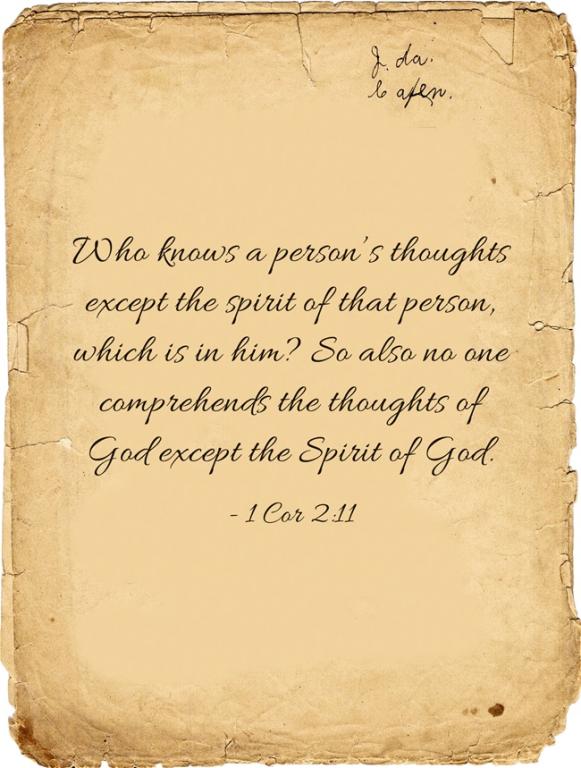
Just before Jesus was about to go to the cross and die and then return to the Father, the disciples were deeply troubled. Jesus had been all they knew and now He was going away, but Jesus said that He would send “the Helper, the Holy Spirit, whom the Father will send in my name, he will teach you all things and bring to your remembrance all that I have said to you” (John 14:26) and “When the Spirit of truth comes, he will guide you into all the truth, for he will not speak on his own authority, but whatever he hears he will speak, and he will declare to you the things that are to come” (John 16:13). Paul reminds us by writing, “who knows a person’s thoughts except the spirit of that person, which is in him? So also no one comprehends the thoughts of God except the Spirit of God” (1st Cor 2:11). In fact, the “the Spirit helps us in our weakness. For we do not know what to pray for as we ought, but the Spirit himself intercedes for us with groanings too deep for words. And he who searches hearts knows what is the mind of the Spirit, because the Spirit intercedes for the saints according to the will of God” (Rom 8:26-27).
Prescriptive vs Descriptive
Many people get in trouble when they begin to apply Bible verses to others and themselves but are specifically written to someone or a group of people. For example, the Mosaic Laws of washings, feast days, sacrifices, and clean vs unclean foods were always prescriptive to Israel as it would say, “And thus say to the children of Israel.” The Bible contains many Bible verses that are descriptive, like Jesus died on the cross, but aren’t prescriptive for us…they are descriptive. The Ten Commandments are prescriptive for all mankind but raising the dead is descriptive. These laws were prescriptive for Israel, just as the Saturday Sabbath was. To say the Sabbath is commanded of all people is to take prescriptive commands that were written “to Israel” and try to make them be applied to Christians today, whom they were never intended for.
Interpreting Scripture
When we say “interpreting Scripture,” we don’t mean that we can interpret a verse and say “This is what it means to me,” rather, we should ask, “Who it was written too.” Who was the original audience? Who wrote it and to whom? Was the verse(s) describing an event? If so, should we use that event as being intended for us? Again, context is king. Let the Scripture be interpreted within the broader context of the chapter and perhaps, even the Book. We also need the help of the Holy Spirit because spiritual truths are not discerned by the human spirit but by the Holy Spirit. No man or woman can really understand the things of God without the Spirit of God. Some are universal principles but some are written to a specific group of people. Some churches teach that circumcision and that we should avoid unclean foods but this is contrary to what Jesus taught in the New Testament, as He said, “Do you not see that whatever goes into a person from outside cannot defile him, since it enters not his heart but his stomach, and is expelled?” (Thus he declared all foods clean)” (Mark 7:18-19).
Conclusion
It’s so easy to miss-interpret the Bible because we bring presuppositions with us. We might have been raised to believe this or have been taught that and when we read certain Bible verses we shoehorn them into what we think they mean and then try to make our interpretation something that others should be believe. Thankfully, God’s Spirit can help us discern what is prescriptive for us and what is descriptive for everyone. To know the difference is to be better equipped from falling into error and being misled while misleading others.
Article by Jack Wellman
Jack Wellman is Pastor of the Mulvane Brethren Church in Mulvane Kansas. Jack is also the Senior Writer at What Christians Want To Know whose mission is to equip, encourage, and energize Christians and to address questions about the believer’s daily walk with God and the Bible. You can follow Jack on Google Plus or check out his book Teaching Children the Gospel available on Amazon.
Previous Post

June 25, 2016
What Does The Bible Forbid?
Next Post
June 27, 2016 20 Ice Breaker Questions For Small Groups
Browse Our Archives
Select a Category Bible Answers Bible Definitions Bible Story Bible Study Bible Verses Christian Books Christian Entertainment Christian Fathers Christian Mothers Christian Quotes Devotional Famous Christians Music News Parables Prayers Quotes Sunday School Lesson Uncategorized Youth Sermons
Select a Month October 2019 September 2019 August 2019 July 2019 June 2019 May 2019 April 2019 March 2019 February 2019 January 2019 December 2018 November 2018 October 2018 September 2018 August 2018 July 2018 June 2018 May 2018 April 2018 March 2018 February 2018 January 2018 December 2017 November 2017 October 2017 September 2017 August 2017 July 2017 June 2017 May 2017 April 2017 March 2017 February 2017 January 2017 December 2016 November 2016 October 2016 September 2016 August 2016 July 2016 June 2016 May 2016 March 2016 February 2016 January 2016 December 2015 November 2015 October 2015 September 2015 August 2015 July 2015 June 2015 May 2015 April 2015 March 2015 February 2015 January 2015 December 2014 November 2014 October 2014 September 2014 August 2014 July 2014 June 2014 May 2014 April 2014 March 2014 February 2014 January 2014 December 2013 November 2013 October 2013 September 2013 August 2013 July 2013 June 2013 May 2013 April 2013 March 2013
Follow Us!
TAKE THE
Religious Wisdom Quiz
How many clean animal pairs were in Noah's Ark?
Select your answer to see how you score.
6 7 5 3
Related posts from Christian Crier

What Does The Bible Say About Our Thoughts?

Do Colors Have Special Meaning In The Bible?

The Glass – Half Empty Or Half Full?

TRENDING AT PATHEOS Evangelical

How the author of the world's best hymn...
I've been working with John Newton for a while now. This makes...

Long before this Lectio Divina, Psalm 130 - the song - started...

What About the Trees? Another Living Parable
After I finished writing the last article about falling leaves as a...

Why Classical Education Is a Conversation, Not a...
Come and Read: Joy in Classical Education When I was a little...

Falling Leaves: A Living Parable on Letting Go
I’ve spent the vast majority of my life in the southeast corner...

Cornell University has received a great deal of negative publicity and intense...
view all Evangelical blogs
Ad-Free & Subscriber Log-In Subscription Support
- About Us
- 2026 Calendar
- Videos
- Podcasts
- Library of World Religions
- Faith In Media Tracker
- Advertise With Us
- Write for Us
- Privacy Policy
- Terms of Service
- Do Not Sell My Data
- Contact Us
- Radiant Digital
- Manage Newsletter Subscriptions
- Unsubscribe From Notifications
- Sitemap
Copyright 2008-2026, Patheos. All rights reserved.
Subscription Support Ad-Free & Subscriber Log-In
Follow Patheos