
BuddhistCatholicContemplativeEvangelicalGeneral ChristianHinduJewishLatter-day SaintMuslimNew VisionsProgressive Christian
Beliefs
- Buddhist
- Catholic
- Contemplative
- Evangelical
- General Christian
- Hindu
- Jewish
- Latter-day Saint
- More Voices
- Muslim
- New Visions
- Pagan
- Progressive Christian
Topics
- Religion News
- Food and Religion
- Sports and Religion
- Religious Art
- Religious Music and Entertainment
- Religious Events
- History and Religion
- Style and Religion
- Politics and Religion
- Women in Religion
- Recreation Outdoors and Religion
- Business Finance and Religion
- Careers Workplace and Religion
- Education and Religion
- Family Parenting and Religion
- Health Fitness and Religion
- Home and Religion
- Relationships and Religion
- Technology and Religion
- Travel and Religion
Columnists
- Buddhist Columnists
- Business Finance and Religion Columnists
- Careers Workplace and Religion Columnists
- Catholic Columnists
- Contemplative Columnists
- Education and Religion Columnists
- Evangelists Columnists
- Family Parenting and Religion Columnists
- General Christian Columnists
- Health Fitness and Religion Columnists
- Hindu Columnists
- History and Religion Columnists
- Home and Religion Columnists
- Jewish Columnists
- More Voices Columnists
- Latter Day Columnists
- Muslim Columnists
- New Visions Columnists
- Nonreligious Columnists
- Pagan Columnists
- Politics and Religion Columnists
- Progressive Columnists
- Recreation Outdoors and Religion Columnists
- Relationships and Religion Columnists
- Religion News Columnists
- Religious Art Columnists
- Religious Events Columnists
- Religious Music and Entertainment Columnists
- Sports and Religion Columnists
- Style and Religion Columnists
- Technology and Religion Columnists
- Travel and Religion Columnists
- Women in Religion Columnists
Resource Library
- 2026 Calendar
- Library of World Religions
- The 100 Most Holy Places on Earth
- Patheos Answers
- Podcasts
- Videos
- Faith Leaders Database
- Anglican Episcopalian
- Bahai
- Baptist
- Buddhism
- Christianity
- Confucianism
- Eastern Orthodoxy
- Hinduism
- Holiness and Pentecostal
- ISKCON
- Islam
- Judaism
- Lutheran
- Methodist
- The Church of Jesus Christ of Latter-day Saints
- New Age
- Paganism
- Presbytarian and Reformed
- Protestantism
- Religion Behind the Scenes
- Roman Catholic
- Scientology
- Shia Islam
- Sikhism
- Sufism
- Sunni Islam
- Taoism
- Zen
- See all religions
Research Tools
 Ad-Free & Subscriber Log-In Subscription Support
Ad-Free & Subscriber Log-In Subscription Support
Follow Patheos 

- Trending:
- Forgiveness
- |
- Marriage
- |
- Consciousness
- |
- Death Penalty
- |
- Election
- |
- Halloween
 Christian Crier
- Home
- Evangelical
- Who Was The Apostle Paul?
Who Was The Apostle Paul?
Last updated on: June 16, 2016 at 6:08 pm by Jack Wellman
Who Was The Apostle Paul? 2016-06-16T18:08:43-05:00 Jack Wellman
Patheos Explore the world's faith through different perspectives on religion and spirituality! Patheos has the views of the prevalent religions and spiritualities of the world.
Who was the Apostle Paul? What was his background and end of his life like?
Saul
Before the Apostle Paul, it was Saul, a Pharisee of the Pharisees (Acts 23:6), a Hebrew of the Hebrews, and a Jew through and through, but somehow God would use this man who was a Jewish thoroughbred to reach the Gentiles. Saul lived from about 5 to 67 in the first century. This meant that Saul would certainly have known about Jesus and perhaps even heard him preach. For all we know, Saul was present at Jesus’ crucifixion. It is at least possible. This may have been why Saul was so opposed to the people of “the Way.” He had sat at the feet of Gamaliel and must have been a man of means because he was also a Roman citizen, meaning he had paid his own way out from being a subject of Rome (Acts 22:26-29). We know these things because after Paul’s conversion he wrote, “I am a Jew, born in Tarsus in Cilicia, but brought up in this city, educated at the feet of Gamaliel according to the strict manner of the law of our fathers, being zealous for God as all of you are this day” (Acts 22:3). Before this of course, Paul said “I persecuted this Way to the death, binding and delivering to prison both men and women, as the high priest and the whole council of elders can bear me witness” (Acts 22:4-5a) “and I journeyed toward Damascus to take those also who were there and bring them in bonds to Jerusalem to be punished” (Acts 22:5b) but Jesus was about to put a stop to that.
Damascus Road
When Saul was standing before the Jewish authorities after a near-riot broke out, and for which he was blamed (Acts 21), he explained to them why he was now preaching Christ. It was Jesus Who has fulfilled the Old Testament prophecies and requirements for being the Messiah or the Christ (the “anointed”). Paul explains how he went from being Saul to being Paul by saying, “I was on my way and drew near to Damascus, about noon a great light from heaven suddenly shone around me. And I fell to the ground and heard a voice saying to me, ‘Saul, Saul, why are you persecuting me’” (Acts 22:6-7). That was when Paul cried out “Who are you, Lord?’ And he said to me, ‘I am Jesus of Nazareth, whom you are persecuting” (Acts 22:8). Paul now understood that he hadn’t been persecuting the church as much as he had been persecuting Jesus because the church is the Body of Christ. When he attacked Stephen by condoning his stoning to death, he was doing it to Christ. As far as Christ is concerned, doing it to others is like doing it to Him (Matt 25:40). The greatest destroyer of the church became her greatest strength. Paul was an expert in the law of God and so this made grace even more amazing but this also allowed him to show how the law shows us we’re all sinners (Rom 7:7), which makes Jesus’ standing in our place even more amazing (Rom 5:1, 8:1; 2nd Cor 5:21; Gal 2:8-9).
An Apostle
Paul wasn’t an apostle of his own choice. In fact, the Bible says that no man chooses to be an apostle of God…no man chooses that for himself. It is God alone Who does. Every apostle was called personally by God. They didn’t find Him; He found them, and so in that context we can understand why Paul opens his letters or books by putting his God-given credentials at the very beginning. He wants the churches (and the readers/listeners) to know that this is not Paul’s teachings, but God’s. He has been commissioned by God to write and evangelize, but it was God’s choice. For example, in Ephesians 1:1a Paul writes, “Paul, an apostle of Christ Jesus by the will of God.” In Galatians, he includes the fact that his apostleship was not of human origin as he writes “Paul, an apostle—not from men nor through man, but through Jesus Christ and God the Father, who raised him from the dead” (Gal 1:1). Even the disciples had qualifications for being an apostle, as it says in Acts 1:21-22 “So one of the men who have accompanied us during all the time that the Lord Jesus went in and out among us, beginning from the baptism of John until the day when he was taken up from us—one of these men must become with us a witness to his resurrection.” If someone walked up to me and told me they’re an Apostle with a capital A (and there are many self-proclaimed one’s today), I would ask, were you there with Christ and “accompanied [them] during all the time that the Lord Jesus went in and out among us?” Were you there, “beginning from the baptism of John until the day when he was taken up from us?” I would have to tell them; “Friend, you don’t look that old.”
Conclusion
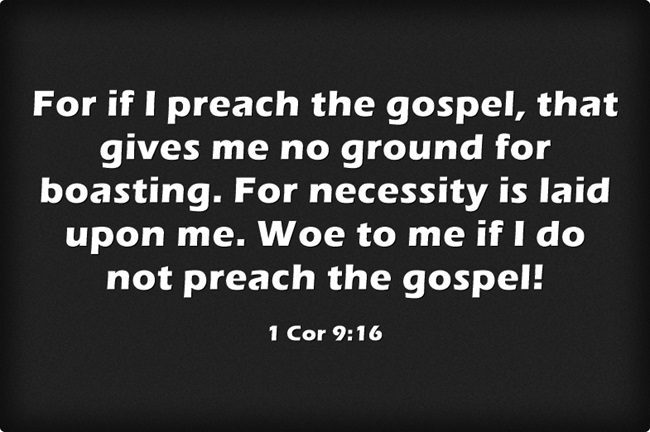
The Apostle Paul was the father of missions, having traveled thousands of miles planting churches and these churches would in turn plant others. If there was a father of mission, Paul would be it. He faced dangers, toils, cold, beatings, hunger, thirst, shipwrecks, imprisonments, and even being stoned, but for him, he had no choice but to preach the gospel. In his own word he writes “For if I preach the gospel, that gives me no ground for boasting. For necessity is laid upon me. Woe to me if I do not preach the gospel” (1st Cor 9:16)! Paul was about to be martyred and so wrote his final and most famous last words, “For I am already being poured out as a drink offering, and the time of my departure has come. I have fought the good fight, I have finished the race, I have kept the faith. Henceforth there is laid up for me the crown of righteousness, which the Lord, the righteous judge, will award to me on that Day, and not only to me but also to all who have loved his appearing” (2nd Tim 4:6-8).
Article by Jack Wellman
Jack Wellman is Pastor of the Mulvane Brethren Church in Mulvane Kansas. Jack is also the Senior Writer at What Christians Want To Know whose mission is to equip, encourage, and energize Christians and to address questions about the believer’s daily walk with God and the Bible. You can follow Jack on Google Plus or check out his book Teaching Children the Gospel available on Amazon.
Previous Post

June 16, 2016
Who Was Oral Roberts?
Next Post
June 16, 2016 Who Was John The Apostle?
Browse Our Archives
Select a Category Bible Answers Bible Definitions Bible Story Bible Study Bible Verses Christian Books Christian Entertainment Christian Fathers Christian Mothers Christian Quotes Devotional Famous Christians Music News Parables Prayers Quotes Sunday School Lesson Uncategorized Youth Sermons
Select a Month October 2019 September 2019 August 2019 July 2019 June 2019 May 2019 April 2019 March 2019 February 2019 January 2019 December 2018 November 2018 October 2018 September 2018 August 2018 July 2018 June 2018 May 2018 April 2018 March 2018 February 2018 January 2018 December 2017 November 2017 October 2017 September 2017 August 2017 July 2017 June 2017 May 2017 April 2017 March 2017 February 2017 January 2017 December 2016 November 2016 October 2016 September 2016 August 2016 July 2016 June 2016 May 2016 March 2016 February 2016 January 2016 December 2015 November 2015 October 2015 September 2015 August 2015 July 2015 June 2015 May 2015 April 2015 March 2015 February 2015 January 2015 December 2014 November 2014 October 2014 September 2014 August 2014 July 2014 June 2014 May 2014 April 2014 March 2014 February 2014 January 2014 December 2013 November 2013 October 2013 September 2013 August 2013 July 2013 June 2013 May 2013 April 2013 March 2013
Follow Us!
TAKE THE
Religious Wisdom Quiz
I asked for wisdom above all else, and God granted me riches and honor as well. Who am I?
Select your answer to see how you score.
David Hezekiah Solomon Josiah
Related posts from Christian Crier

What Does The Bible Say About Our Thoughts?

Do Colors Have Special Meaning In The Bible?

The Glass – Half Empty Or Half Full?

TRENDING AT PATHEOS Evangelical

How the author of the world's best hymn...
I've been working with John Newton for a while now. This makes...

Long before this Lectio Divina, Psalm 130 - the song - started...

What About the Trees? Another Living Parable
After I finished writing the last article about falling leaves as a...

Why Classical Education Is a Conversation, Not a...
Come and Read: Joy in Classical Education When I was a little...

Falling Leaves: A Living Parable on Letting Go
I’ve spent the vast majority of my life in the southeast corner...

Cornell University has received a great deal of negative publicity and intense...
view all Evangelical blogs
Ad-Free & Subscriber Log-In Subscription Support
- About Us
- 2026 Calendar
- Videos
- Podcasts
- Library of World Religions
- Faith In Media Tracker
- Advertise With Us
- Write for Us
- Privacy Policy
- Terms of Service
- Do Not Sell My Data
- Contact Us
- Radiant Digital
- Manage Newsletter Subscriptions
- Unsubscribe From Notifications
- Sitemap
Copyright 2008-2026, Patheos. All rights reserved.
Subscription Support Ad-Free & Subscriber Log-In
Follow Patheos