
BuddhistCatholicContemplativeEvangelicalGeneral ChristianHinduJewishLatter-day SaintMuslimNew VisionsProgressive Christian
Beliefs
- Buddhist
- Catholic
- Contemplative
- Evangelical
- General Christian
- Hindu
- Jewish
- Latter-day Saint
- More Voices
- Muslim
- New Visions
- Pagan
- Progressive Christian
Topics
- Religion News
- Food and Religion
- Sports and Religion
- Religious Art
- Religious Music and Entertainment
- Religious Events
- History and Religion
- Style and Religion
- Politics and Religion
- Women in Religion
- Recreation Outdoors and Religion
- Business Finance and Religion
- Careers Workplace and Religion
- Education and Religion
- Family Parenting and Religion
- Health Fitness and Religion
- Home and Religion
- Relationships and Religion
- Technology and Religion
- Travel and Religion
Columnists
- Buddhist Columnists
- Business Finance and Religion Columnists
- Careers Workplace and Religion Columnists
- Catholic Columnists
- Contemplative Columnists
- Education and Religion Columnists
- Evangelists Columnists
- Family Parenting and Religion Columnists
- General Christian Columnists
- Health Fitness and Religion Columnists
- Hindu Columnists
- History and Religion Columnists
- Home and Religion Columnists
- Jewish Columnists
- More Voices Columnists
- Latter Day Columnists
- Muslim Columnists
- New Visions Columnists
- Nonreligious Columnists
- Pagan Columnists
- Politics and Religion Columnists
- Progressive Columnists
- Recreation Outdoors and Religion Columnists
- Relationships and Religion Columnists
- Religion News Columnists
- Religious Art Columnists
- Religious Events Columnists
- Religious Music and Entertainment Columnists
- Sports and Religion Columnists
- Style and Religion Columnists
- Technology and Religion Columnists
- Travel and Religion Columnists
- Women in Religion Columnists
Resource Library
- 2026 Calendar
- Library of World Religions
- The 100 Most Holy Places on Earth
- Patheos Answers
- Podcasts
- Videos
- Faith Leaders Database
- Anglican Episcopalian
- Bahai
- Baptist
- Buddhism
- Christianity
- Confucianism
- Eastern Orthodoxy
- Hinduism
- Holiness and Pentecostal
- ISKCON
- Islam
- Judaism
- Lutheran
- Methodist
- The Church of Jesus Christ of Latter-day Saints
- New Age
- Paganism
- Presbytarian and Reformed
- Protestantism
- Religion Behind the Scenes
- Roman Catholic
- Scientology
- Shia Islam
- Sikhism
- Sufism
- Sunni Islam
- Taoism
- Zen
- See all religions
Research Tools
 Ad-Free & Subscriber Log-In Subscription Support
Ad-Free & Subscriber Log-In Subscription Support
Follow Patheos 

- Trending:
- Forgiveness
- |
- Marriage
- |
- Consciousness
- |
- Death Penalty
- |
- Election
- |
- Halloween
 Christian Crier
- Home
- Evangelical
- Romans 15: Bible Study, Commentary and Summary
Romans 15: Bible Study, Commentary and Summary
Last updated on: May 26, 2016 at 3:17 pm by Jack Wellman
Romans 15: Bible Study, Commentary and Summary 2016-05-26T15:17:13-05:00 Jack Wellman
Patheos Explore the world's faith through different perspectives on religion and spirituality! Patheos has the views of the prevalent religions and spiritualities of the world.
Here is a Bible study, commentary, and summary of Romans chapter fifteen.
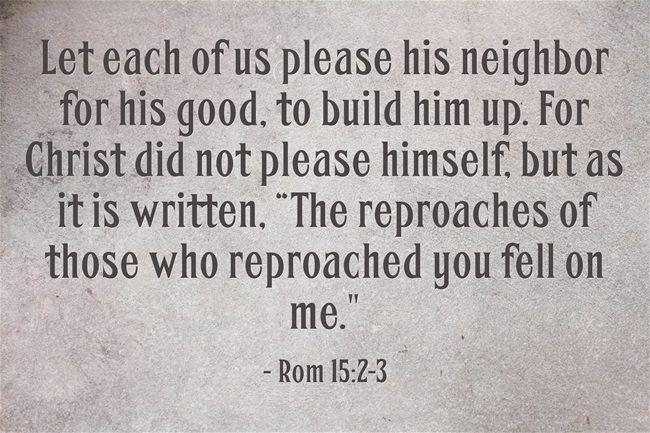
Romans 15:1-3 “We who are strong have an obligation to bear with the failings of the weak, and not to please ourselves. Let each of us please his neighbor for his good, to build him up. For Christ did not please himself, but as it is written, “The reproaches of those who reproached you fell on me.”
When Paul is getting close to closing the letter to the Romans, he wants to emphasize that those of us who are strong should feel compelled to help those who are weak. I don’t believe he’s talking about physical strength but possibly financial or spiritual support. Who is our neighbor? Our neighbor is everyone we meet and we are to love our neighbor as ourselves, especially considering that the reproaches of God that we deserved as sinners fell upon Christ Who deserved none of it because He was sinless. How can we not help build up others when we ourselves were spared by God and it had nothing to do with us (Eph 2:8-9)?
Who is our neighbor today?
What did Paul mean by “We who are strong?”
What strength was Paul writing about?
What are “reproaches?”
Romans 15:4 “For whatever was written in former days was written for our instruction, that through endurance and through the encouragement of the Scriptures we might have hope.”
Paul quotes a lot out of the Book of Isaiah and his point is that these things written by the prophet, as well as all of the Old Testament, weren’t written just to entertain us. They were written for our instruction so that we might learn to endure suffering. The Scriptures are to be an encouragement to us so that we might have hope of a future. When you read the Old Testament, remember that God never wastes suffering. A.W. Tozer once said, (paraphrasing), “God cannot use a man greatly until He has first wounded him deeply.”
Have you ever thought about the Old Testament as instructional?
Do you look at the Old Testament as an encouragement?
Why would the Old Testament help us endure in this life?
Romans 15:8 “For I tell you that Christ became a servant to the circumcised to show God’s truthfulness, in order to confirm the promises given to the patriarchs.”
If Jesus Christ came, not to be served but to serve, and more so, to give His life as a ransom for many (Mark 10:45), why can’t we be a servant to our brothers and sisters? Jesus came to be a servant of the Jews (circumcised) but also opened up the way of salvation for all who would believe (Act 4:12). These promises given to the patriarchs were solidly confirmed in Jesus’ earthly ministry, His sinless life, His suffering, His crucifixion, His death, and His resurrection. Not one of these precious promises failed.
Who are the patriarchs?
Who were the circumcised?
Did Jesus only come for the circumcised?
Romans 15:12-13 “And again Isaiah says, ‘The root of Jesse will come, even he who arises to rule the Gentiles; in him will the Gentiles hope.’ May the God of hope fill you with all joy and peace in believing, so that by the power of the Holy Spirit you may abound in hope.”
When John the Baptist came, he was a voice crying in the wilderness, but it wasn’t a physical wilderness he was going into but a spiritual wilderness. The ground was parched from the manmade and legalistic traditions that the Jews tried to burden everyone down with. This root of Jesse was Jesus Christ Who emerged from the wasteland that was Judea at the time. The Jews held their traditions above and over the Word of God and that makes their place a wasteland for those who wanted to really know God.
Why is Jesus called “the root of Jesse?”
What does the root typify?
Why can Gentiles (non-Jews) place their hope in Him?
Romans 15:15-16 “But on some points I have written to you very boldly by way of reminder, because of the grace given me by God to be a minister of Christ Jesus to the Gentiles in the priestly service of the gospel of God, so that the offering of the Gentiles may be acceptable, sanctified by the Holy Spirit.”
Near the end of the letter to the Romans, Paul wants to clarify Jesus’ work as a priestly service of God. The main difference was that He was the sacrifice. Christianity is the only religion where God demands a sacrifice and then provides it Himself. The Gentiles had sacrifice so that others could hear the gospel and as Paul writes, “I hope to see you in passing as I go to Spain, and to be helped on my journey there by you, once I have enjoyed your company for a while. At present, however, I am going to Jerusalem bringing aid to the saints. For Macedonia and Achaia have been pleased to make some contribution for the poor among the saints at Jerusalem” (Rom 15:24-26).
What was the offering the Gentiles made?
What does it mean to be sanctified by the Holy Spirit?
What is a “priestly service?
Summary
In Romans 15:30-31 Paul writes, “I appeal to you, brothers, by our Lord Jesus Christ and by the love of the Spirit, to strive together with me in your prayers to God on my behalf, that I may be delivered from the unbelievers in Judea, and that my service for Jerusalem may be acceptable to the saints.” Apparently the Jews were his worst enemy because at least he was treated somewhat fairly by the Romans, being a Roman citizen, but in summary, Romans 15 was focused on the strong helping the weak, Jesus Christ saving the Gentiles, and the Gentiles supporting the Jews in Jerusalem, many of whom who had lost everything. This is what Paul wants us to build up our neighbor because there is enough “tearing down” in the world as it is.
Article by Jack Wellman
Jack Wellman is Pastor of the Mulvane Brethren Church in Mulvane Kansas. Jack is also the Senior Writer at What Christians Want To Know whose mission is to equip, encourage, and energize Christians and to address questions about the believer’s daily walk with God and the Bible. You can follow Jack on Google Plus or check out his book Teaching Children the Gospel available on Amazon.
Previous Post

May 26, 2016
Romans 14: Bible Study, Commentary and Summary
Next Post
May 26, 2016 Hebrews 5: Bible Study, Commentary and Summary
Browse Our Archives
Select a Category Bible Answers Bible Definitions Bible Story Bible Study Bible Verses Christian Books Christian Entertainment Christian Fathers Christian Mothers Christian Quotes Devotional Famous Christians Music News Parables Prayers Quotes Sunday School Lesson Uncategorized Youth Sermons
Select a Month October 2019 September 2019 August 2019 July 2019 June 2019 May 2019 April 2019 March 2019 February 2019 January 2019 December 2018 November 2018 October 2018 September 2018 August 2018 July 2018 June 2018 May 2018 April 2018 March 2018 February 2018 January 2018 December 2017 November 2017 October 2017 September 2017 August 2017 July 2017 June 2017 May 2017 April 2017 March 2017 February 2017 January 2017 December 2016 November 2016 October 2016 September 2016 August 2016 July 2016 June 2016 May 2016 March 2016 February 2016 January 2016 December 2015 November 2015 October 2015 September 2015 August 2015 July 2015 June 2015 May 2015 April 2015 March 2015 February 2015 January 2015 December 2014 November 2014 October 2014 September 2014 August 2014 July 2014 June 2014 May 2014 April 2014 March 2014 February 2014 January 2014 December 2013 November 2013 October 2013 September 2013 August 2013 July 2013 June 2013 May 2013 April 2013 March 2013
Follow Us!
TAKE THE
Religious Wisdom Quiz
Who walked on water with Jesus before losing faith and sinking?
Select your answer to see how you score.
James Peter Philip Thomas
Related posts from Christian Crier


Seeing The Gospel In Biblical Accounts

Getting The Most Out Of Your Bible Reading

Philippians 2 As A Mission Statement
TRENDING AT PATHEOS Evangelical

How the author of the world's best hymn...
I've been working with John Newton for a while now. This makes...

Long before this Lectio Divina, Psalm 130 - the song - started...

What About the Trees? Another Living Parable
After I finished writing the last article about falling leaves as a...

Why Classical Education Is a Conversation, Not a...
Come and Read: Joy in Classical Education When I was a little...

Falling Leaves: A Living Parable on Letting Go
I’ve spent the vast majority of my life in the southeast corner...

Cornell University has received a great deal of negative publicity and intense...
view all Evangelical blogs
Ad-Free & Subscriber Log-In Subscription Support
- About Us
- 2026 Calendar
- Videos
- Podcasts
- Library of World Religions
- Faith In Media Tracker
- Advertise With Us
- Write for Us
- Privacy Policy
- Terms of Service
- Do Not Sell My Data
- Contact Us
- Radiant Digital
- Manage Newsletter Subscriptions
- Unsubscribe From Notifications
- Sitemap
Copyright 2008-2026, Patheos. All rights reserved.
Subscription Support Ad-Free & Subscriber Log-In
Follow Patheos