
BuddhistCatholicContemplativeEvangelicalGeneral ChristianHinduJewishLatter-day SaintMuslimNew VisionsProgressive Christian
Beliefs
- Buddhist
- Catholic
- Contemplative
- Evangelical
- General Christian
- Hindu
- Jewish
- Latter-day Saint
- More Voices
- Muslim
- New Visions
- Pagan
- Progressive Christian
Topics
- Religion News
- Food and Religion
- Sports and Religion
- Religious Art
- Religious Music and Entertainment
- Religious Events
- History and Religion
- Style and Religion
- Politics and Religion
- Women in Religion
- Recreation Outdoors and Religion
- Business Finance and Religion
- Careers Workplace and Religion
- Education and Religion
- Family Parenting and Religion
- Health Fitness and Religion
- Home and Religion
- Relationships and Religion
- Technology and Religion
- Travel and Religion
Columnists
- Buddhist Columnists
- Business Finance and Religion Columnists
- Careers Workplace and Religion Columnists
- Catholic Columnists
- Contemplative Columnists
- Education and Religion Columnists
- Evangelists Columnists
- Family Parenting and Religion Columnists
- General Christian Columnists
- Health Fitness and Religion Columnists
- Hindu Columnists
- History and Religion Columnists
- Home and Religion Columnists
- Jewish Columnists
- More Voices Columnists
- Latter Day Columnists
- Muslim Columnists
- New Visions Columnists
- Nonreligious Columnists
- Pagan Columnists
- Politics and Religion Columnists
- Progressive Columnists
- Recreation Outdoors and Religion Columnists
- Relationships and Religion Columnists
- Religion News Columnists
- Religious Art Columnists
- Religious Events Columnists
- Religious Music and Entertainment Columnists
- Sports and Religion Columnists
- Style and Religion Columnists
- Technology and Religion Columnists
- Travel and Religion Columnists
- Women in Religion Columnists
Resource Library
- 2026 Calendar
- Library of World Religions
- The 100 Most Holy Places on Earth
- Patheos Answers
- Podcasts
- Videos
- Faith Leaders Database
- Anglican Episcopalian
- Bahai
- Baptist
- Buddhism
- Christianity
- Confucianism
- Eastern Orthodoxy
- Hinduism
- Holiness and Pentecostal
- ISKCON
- Islam
- Judaism
- Lutheran
- Methodist
- The Church of Jesus Christ of Latter-day Saints
- New Age
- Paganism
- Presbytarian and Reformed
- Protestantism
- Religion Behind the Scenes
- Roman Catholic
- Scientology
- Shia Islam
- Sikhism
- Sufism
- Sunni Islam
- Taoism
- Zen
- See all religions
Research Tools
 Ad-Free & Subscriber Log-In Subscription Support
Ad-Free & Subscriber Log-In Subscription Support
Follow Patheos 

- Trending:
- Forgiveness
- |
- Marriage
- |
- Consciousness
- |
- Death Penalty
- |
- Election
- |
- Halloween
 Christian Crier
- Home
- Evangelical
- Romans 13: Bible Study, Commentary and Summary
Romans 13: Bible Study, Commentary and Summary
Last updated on: October 8, 2016 at 10:31 am by Jack Wellman
Romans 13: Bible Study, Commentary and Summary 2016-10-08T10:31:28-05:00 Jack Wellman
Patheos Explore the world's faith through different perspectives on religion and spirituality! Patheos has the views of the prevalent religions and spiritualities of the world.
Here is a Bible study with commentary and a summary over Romans chapter 13.
Romans 13:1-2 “Let every person be subject to the governing authorities. For there is no authority except from God, and those that exist have been instituted by God. Therefore whoever resists the authorities resists what God has appointed, and those who resist will incur judgment.”
Paul is clear about what God’s expectations are for believers in the world. Starting in verse one he says that every authority is from God and when we resist authority, we are resisting God Himself because the authorities that exist are appointed by God. Anyone that resists the authorities will incur God’s judgment, either in the Day of Judgment or in the present day with law enforcement authorities.
Who is Paul talking about here?
Who were the authorities that existed then?
Is breaking the speed limit resisting God’s authority?
Where does all authority come from?
Are there any exceptions for resisting those appointed by God (Acts 5:29)?
What does “God’s judgment” on lawbreakers look like in this society?
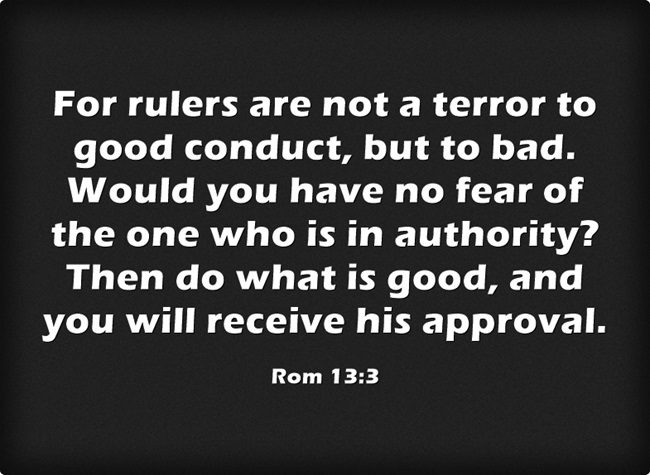
Romans 13:3-5 “For rulers are not a terror to good conduct, but to bad. Would you have no fear of the one who is in authority? Then do what is good, and you will receive his approval, for he is God’s servant for your good. But if you do wrong, be afraid, for he does not bear the sword in vain. For he is the servant of God, an avenger who carries out God’s wrath on the wrongdoer. Therefore one must be in subjection, not only to avoid God’s wrath but also for the sake of conscience.”
So being obedient, submissive, and a faithful citizen and worker is not an option. It is a command. When you see the blue lights flashing behind you and you’re not breaking the law, then “you have no fear” at all. But if you are, then you will fear indeed. In the same way, God has placed people in the society and in church as it pleases Him. Some churches have a deacon and an elder and every church should have a pastor, but they are acting in authority for the good of the body of Christ just as God has placed in authority over us those who protect and service like law enforcement, firefighters, and emergency services. We must obey the law while at work, in public, and yes, in private, because these men and women are God’s agents and it is God Who has placed each person in their position authority, as it pleased Him, not us. It is by His design and His purpose. Be a law-abiding citizen and you’ve got nothing to fear.
What would it be like in society with no law enforcement (authorities)?
Who does the man or woman in law enforcement really work for?
How are “rulers a terror to good works?”
Why should we obey our rulers for our “conscience’ sake?”
How would God display His wrath if we break the law?
Romans 13:6-7 “For because of this you also pay taxes, for the authorities are ministers of God, attending to this very thing. Pay to all what is owed to them: taxes to whom taxes are owed, revenue to whom revenue is owed, respect to whom respect is owed, honor to whom honor is owed.”
Clearly, Paul is saying that we are to esteem those in authority, showing them respect and honor because that is their God-granted right. It doesn’t say give them honor if they deserve it. Do you think when Paul wrote this that Nero deserved honor? They were probably using the taxes to pay for an occupying army! This clearly shows we are to obey the law and pay our taxes as Jesus said “render unto Caesar what is Caesar’s” (Mark 12:17) but also pay customs (which word meant “fees” or money), fear those in authority, and honor to all men and women.
Are there any exceptions to not paying taxes?
What does it mean “render to all their due?”
Does it matter who is in office?
To whom is honor due?
Romans 13:8-10 “Owe no one anything, except to love each other, for the one who loves another has fulfilled the law. For the commandments, “You shall not commit adultery, You shall not murder, You shall not steal, You shall not covet,” and any other commandment, are summed up in this word: “You shall love your neighbor as yourself.” Love does no wrong to a neighbor; therefore love is the fulfilling of the law.”
This doesn’t mean we can’t get a loan for a car or a house but we are to own no one anything but to love them. Love is the fulfillment of the law but not a way to be saved by the law. To love our neighbor properly, we need to treat them the way that we treat ourselves. Do we ever deprive ourselves of food, clothing or shelter? If we have means, we are to love our neighbor but not with words alone but in our deeds. Love is a verb. It’s not just what you say…it is even more so what you do.
Does this mean that we should never get a loan?
What debt does Paul seem to writing about?
Did Jesus see hate as murdering of the heart (Matt 5:21-22)?
Is gossip the same thing as “bearing false witness?”
When we gossip about others, are we breaking the commandment to love our neighbor as ourself?
Why is love “the fulfillment of the law?”
Romans 13:11-13 “Besides this you know the time, that the hour has come for you to wake from sleep. For salvation is nearer to us now than when we first believed. The night is far gone; the day is at hand. So then let us cast off the works of darkness and put on the armor of light. Let us walk properly as in the daytime, not in orgies and drunkenness, not in sexual immorality and sensuality, not in quarreling and jealousy.”
The Apostle Paul, like most of the early church, may have believed that Jesus was going to return very soon, thus Paul’s statement that “the day is at hand.” He was concerned that we live like Jesus is coming back today, for He could, but this means to cast off all of these old sins that we used to walk in like drunkenness, sexual immorality, jealously, and arguing. That is not becoming of a Christian at all.
What does Paul mean by “waking up?”
What day is it which is at hand?
Why is our salvation nearer now than the day we were saved?
What does Paul mean by writing the night is far spent?
What are the “works of darkness?”
What does it mean by “put on the Lord Jesus Christ?”
How can we not make any provisions for the flesh?
Summary
How different would the world be if Christians took to heart these commands to be a good neighbor, citizen, employer/employee, and fellow member of the Body of Christ? Then indeed, it would be said of us all, collectively, that “These that have turned the world upside down are come here also” (Acts 17:6). Maybe it should read we have turned the world right side up because that’s the way God originally intended for us to live, at least until the fall in the Garden ruined it.
Article by Jack Wellman
Jack Wellman is Pastor of the Mulvane Brethren Church in Mulvane Kansas. Jack is also the Senior Writer at What Christians Want To Know whose mission is to equip, encourage, and energize Christians and to address questions about the believer’s daily walk with God and the Bible. You can follow Jack on Google Plus or check out his book Teaching Children the Gospel available on Amazon.
Previous Post

May 26, 2016
Romans 12: Bible Study, Commentary and Summary
Next Post
May 26, 2016 Romans 14: Bible Study, Commentary and Summary
Browse Our Archives
Select a Category Bible Answers Bible Definitions Bible Story Bible Study Bible Verses Christian Books Christian Entertainment Christian Fathers Christian Mothers Christian Quotes Devotional Famous Christians Music News Parables Prayers Quotes Sunday School Lesson Uncategorized Youth Sermons
Select a Month October 2019 September 2019 August 2019 July 2019 June 2019 May 2019 April 2019 March 2019 February 2019 January 2019 December 2018 November 2018 October 2018 September 2018 August 2018 July 2018 June 2018 May 2018 April 2018 March 2018 February 2018 January 2018 December 2017 November 2017 October 2017 September 2017 August 2017 July 2017 June 2017 May 2017 April 2017 March 2017 February 2017 January 2017 December 2016 November 2016 October 2016 September 2016 August 2016 July 2016 June 2016 May 2016 March 2016 February 2016 January 2016 December 2015 November 2015 October 2015 September 2015 August 2015 July 2015 June 2015 May 2015 April 2015 March 2015 February 2015 January 2015 December 2014 November 2014 October 2014 September 2014 August 2014 July 2014 June 2014 May 2014 April 2014 March 2014 February 2014 January 2014 December 2013 November 2013 October 2013 September 2013 August 2013 July 2013 June 2013 May 2013 April 2013 March 2013
Follow Us!
TAKE THE
Religious Wisdom Quiz
What does "Satan" mean in Hebrew?
Select your answer to see how you score.
Adversary Destroyer Murderer Deceiver
Related posts from Christian Crier


Seeing The Gospel In Biblical Accounts

Getting The Most Out Of Your Bible Reading

Philippians 2 As A Mission Statement
TRENDING AT PATHEOS Evangelical

How the author of the world's best hymn...
I've been working with John Newton for a while now. This makes...

Long before this Lectio Divina, Psalm 130 - the song - started...

What About the Trees? Another Living Parable
After I finished writing the last article about falling leaves as a...

Why Classical Education Is a Conversation, Not a...
Come and Read: Joy in Classical Education When I was a little...

Falling Leaves: A Living Parable on Letting Go
I’ve spent the vast majority of my life in the southeast corner...

Cornell University has received a great deal of negative publicity and intense...
view all Evangelical blogs
Ad-Free & Subscriber Log-In Subscription Support
- About Us
- 2026 Calendar
- Videos
- Podcasts
- Library of World Religions
- Faith In Media Tracker
- Advertise With Us
- Write for Us
- Privacy Policy
- Terms of Service
- Do Not Sell My Data
- Contact Us
- Radiant Digital
- Manage Newsletter Subscriptions
- Unsubscribe From Notifications
- Sitemap
Copyright 2008-2026, Patheos. All rights reserved.
Subscription Support Ad-Free & Subscriber Log-In
Follow Patheos