
BuddhistCatholicContemplativeEvangelicalGeneral ChristianHinduJewishLatter-day SaintMuslimNew VisionsProgressive Christian
Beliefs
- Buddhist
- Catholic
- Contemplative
- Evangelical
- General Christian
- Hindu
- Jewish
- Latter-day Saint
- More Voices
- Muslim
- New Visions
- Pagan
- Progressive Christian
Topics
- Religion News
- Food and Religion
- Sports and Religion
- Religious Art
- Religious Music and Entertainment
- Religious Events
- History and Religion
- Style and Religion
- Politics and Religion
- Women in Religion
- Recreation Outdoors and Religion
- Business Finance and Religion
- Careers Workplace and Religion
- Education and Religion
- Family Parenting and Religion
- Health Fitness and Religion
- Home and Religion
- Relationships and Religion
- Technology and Religion
- Travel and Religion
Columnists
- Buddhist Columnists
- Business Finance and Religion Columnists
- Careers Workplace and Religion Columnists
- Catholic Columnists
- Contemplative Columnists
- Education and Religion Columnists
- Evangelists Columnists
- Family Parenting and Religion Columnists
- General Christian Columnists
- Health Fitness and Religion Columnists
- Hindu Columnists
- History and Religion Columnists
- Home and Religion Columnists
- Jewish Columnists
- More Voices Columnists
- Latter Day Columnists
- Muslim Columnists
- New Visions Columnists
- Nonreligious Columnists
- Pagan Columnists
- Politics and Religion Columnists
- Progressive Columnists
- Recreation Outdoors and Religion Columnists
- Relationships and Religion Columnists
- Religion News Columnists
- Religious Art Columnists
- Religious Events Columnists
- Religious Music and Entertainment Columnists
- Sports and Religion Columnists
- Style and Religion Columnists
- Technology and Religion Columnists
- Travel and Religion Columnists
- Women in Religion Columnists
Resource Library
- 2026 Calendar
- Library of World Religions
- The 100 Most Holy Places on Earth
- Patheos Answers
- Podcasts
- Videos
- Faith Leaders Database
- Anglican Episcopalian
- Bahai
- Baptist
- Buddhism
- Christianity
- Confucianism
- Eastern Orthodoxy
- Hinduism
- Holiness and Pentecostal
- ISKCON
- Islam
- Judaism
- Lutheran
- Methodist
- The Church of Jesus Christ of Latter-day Saints
- New Age
- Paganism
- Presbytarian and Reformed
- Protestantism
- Religion Behind the Scenes
- Roman Catholic
- Scientology
- Shia Islam
- Sikhism
- Sufism
- Sunni Islam
- Taoism
- Zen
- See all religions
Research Tools
 Ad-Free & Subscriber Log-In Subscription Support
Ad-Free & Subscriber Log-In Subscription Support
Follow Patheos 

- Trending:
- Forgiveness
- |
- Marriage
- |
- Consciousness
- |
- Death Penalty
- |
- Election
- |
- Halloween
 Christian Crier
- Home
- Evangelical
- Acts 7: Bible Study, Commentary and Summary
Acts 7: Bible Study, Commentary and Summary
Last updated on: May 25, 2016 at 10:03 pm by Jack Wellman
Acts 7: Bible Study, Commentary and Summary 2016-05-25T22:03:03-05:00 Jack Wellman
Patheos Explore the world's faith through different perspectives on religion and spirituality! Patheos has the views of the prevalent religions and spiritualities of the world.
Here is a Bible study, commentary, and summary of Acts chapter seven.
Acts 7:2-3 “Brothers and fathers, hear me. The God of glory appeared to our father Abraham when he was in Mesopotamia, before he lived in Haran, and said to him, ‘Go out from your land and from your kindred and go into the land that I will show you.”
What Stephen was doing was going back to the very beginning, before Israel was even a nation, saying “God spoke to this effect—that his offspring would be sojourners in a land belonging to others, who would enslave them and afflict them four hundred years” (Acts 7:6). Stephen began with Abraham, and brought it all the way to the twelve tribes of Israel (Acts 7:9) by revealing how the nation grew, even under the harsh bondage of their Egyptian taskmasters. Stephen was essentially running them through the history of Israel, something that they should have known, with a specific goal in mind.
What was Stephen’s primary purpose in giving Israel’s history?
Why was the ancient Israelite’s called “sojourners?”
Why does Stephen address them as “brothers and fathers?”
Acts 7:22-23 “And Moses was instructed in all the wisdom of the Egyptians, and he was mighty in his words and deeds. When he was forty years old, it came into his heart to visit his brothers, the children of Israel.”
Stephen continues with the history of Israel by mentioning Moses, who had all the same wisdom that the Egyptians did, and would later prove handy. When Moses reached the age of forty, he may have desired to be with his own people because it says, “it came into his heart to visit his brothers, the children of Israel” (Acts 7:23), and so he visited them, “And seeing one of them being wronged, he defended the oppressed man and avenged him by striking down the Egyptian” (Acts 7:24). Expecting to be thanked because he felt “that God was giving them salvation by his hand, but they did not understand” (Acts 7:25) they actually told him, “who made you a ruler and a judge over us? Do you want to kill me as you killed the Egyptian yesterday’” (Acts 7:27-28), so Moses ran for his life. Later he would return to Egypt to lead Israel out as a single nation.
What caused Moses to visit his brothers?
Is there something significant about forty, which was Moses’ age?
What subjects do you think was included in Moses education in “all the wisdom of Egypt?”
Acts 7:39-40 “Our fathers refused to obey him, but thrust him aside, and in their hearts they turned to Egypt, saying to Aaron, ‘Make for us gods who will go before us. As for this Moses who led us out from the land of Egypt, we do not know what has become of him.”
The Jews must have known their own history well enough to remember the wilderness journeying for forty years…a place they lived because of their disbelief and failure to trust God and cross over into the Promised Land. When Moses went up the mountain of God, the nation grew impatient with Moses so they sought to create their own worship…but in the image of a golden calf. The very same “god” they worshiped in Egypt. It was obvious that they already wanted to go back to Egypt but seen by God as a desire to go back to sin. It’s very much like Lot’s wife, and as she looked back, became a pillar of salt. She may have left Sodom but her heart was still there and Sodom was in her. Israel’s worship was nothing short of sexual immorality. Their “religious worship” gave them permission to do just about anything you can image.
Where did the Israelites borrow their religion?
Why did they want to go back to worshiping a false god when they knew the one, true God?
Do Idolatry and sexual immorality often come together?
Acts 7:46-47 “[David], who found favor in the sight of God and asked to find a dwelling place for the God of Jacob. But it was Solomon who built a house for him.”
King David had too much blood on his hands from his conquering the land, so God wanted Solomon to build the temple , even though “the Most High does not dwell in houses made by hands” (Acts 7:48), as “Heaven is my throne, and the earth is my footstool. What kind of house will you build for me, says the Lord, or what is the place of my rest” (Acts 7:49-50). Now, Stephen tells them exactly why the refuse to believe by saying, “You stiff-necked people, uncircumcised in heart and ears, you always resist the Holy Spirit. As your fathers did, so do you. Which of the prophets did your fathers not persecute? And they killed those who announced beforehand the coming of the Righteous One, whom you have now betrayed and murdered” (Acts 7:51-42).
After Stephen said this, they wanted to kill him immediately and because “when they heard these things they were enraged, and they ground their teeth at him” (Acts 7:54) and Stephen, “full of the Holy Spirit, gazed into heaven and saw the glory of God, and Jesus standing at the right hand of God. And he said, “Behold, I see the heavens opened, and the Son of Man standing at the right hand of God” (Acts 7:55-56). That was just too much for them to hear and so “they cried out with a loud voice and stopped their ears and rushed together at him. Then they cast him out of the city and stoned him. And the witnesses laid down their garments at the feet of a young man named Saul” (Acts 7:57-58).
Why did Stephen want God to not hold it against the Jews?
Why did Stephen call them a stiff-necked people who are uncircumcised in heart and eyes?
What does the phrase “stiff-necked” mean?
Summary
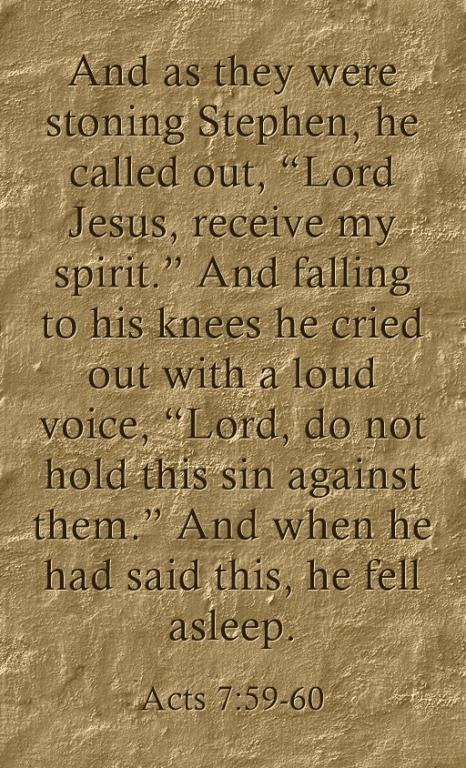
What is most inspiring at the end of Stephen’s death was “as they were stoning Stephen, he called out, “Lord Jesus, receive my spirit.” And falling to his knees he cried out with a loud voice, “Lord, do not hold this sin against them.” And when he had said this, he fell asleep” (Acts 7:59-60). Here, even in his brutal murder, he asked for God to not hold them accountable for it. Just as Jesus did on the cross, crying out “Father, forgive them, for they know not what they do” (Luke 23:34). Saul was apparently condoning or giving his approval of it or even supervising it as a Pharisee. Saul, being the archenemy of the church, would soon become the church’s greatest missionary and church planter.
Article by Jack Wellman
Jack Wellman is Pastor of the Mulvane Brethren Church in Mulvane Kansas. Jack is also the Senior Writer at What Christians Want To Know whose mission is to equip, encourage, and energize Christians and to address questions about the believer’s daily walk with God and the Bible. You can follow Jack on Google Plus or check out his book Teaching Children the Gospel available on Amazon.
Previous Post

May 25, 2016
Acts 6: Bible Study, Commentary and Summary
Next Post
May 26, 2016 Romans 10: Bible Study, Commentary and Summary
Browse Our Archives
Select a Category Bible Answers Bible Definitions Bible Story Bible Study Bible Verses Christian Books Christian Entertainment Christian Fathers Christian Mothers Christian Quotes Devotional Famous Christians Music News Parables Prayers Quotes Sunday School Lesson Uncategorized Youth Sermons
Select a Month October 2019 September 2019 August 2019 July 2019 June 2019 May 2019 April 2019 March 2019 February 2019 January 2019 December 2018 November 2018 October 2018 September 2018 August 2018 July 2018 June 2018 May 2018 April 2018 March 2018 February 2018 January 2018 December 2017 November 2017 October 2017 September 2017 August 2017 July 2017 June 2017 May 2017 April 2017 March 2017 February 2017 January 2017 December 2016 November 2016 October 2016 September 2016 August 2016 July 2016 June 2016 May 2016 March 2016 February 2016 January 2016 December 2015 November 2015 October 2015 September 2015 August 2015 July 2015 June 2015 May 2015 April 2015 March 2015 February 2015 January 2015 December 2014 November 2014 October 2014 September 2014 August 2014 July 2014 June 2014 May 2014 April 2014 March 2014 February 2014 January 2014 December 2013 November 2013 October 2013 September 2013 August 2013 July 2013 June 2013 May 2013 April 2013 March 2013
Follow Us!
TAKE THE
Religious Wisdom Quiz
Which king of Israel reigned the longest and led Israel into great wickedness?
Select your answer to see how you score.
Manasseh Joash Ahab Jehu
Related posts from Christian Crier


Seeing The Gospel In Biblical Accounts

Getting The Most Out Of Your Bible Reading

Philippians 2 As A Mission Statement
TRENDING AT PATHEOS Evangelical

How the author of the world's best hymn...
I've been working with John Newton for a while now. This makes...

Long before this Lectio Divina, Psalm 130 - the song - started...

What About the Trees? Another Living Parable
After I finished writing the last article about falling leaves as a...

Why Classical Education Is a Conversation, Not a...
Come and Read: Joy in Classical Education When I was a little...

Falling Leaves: A Living Parable on Letting Go
I’ve spent the vast majority of my life in the southeast corner...

Cornell University has received a great deal of negative publicity and intense...
view all Evangelical blogs
Ad-Free & Subscriber Log-In Subscription Support
- About Us
- 2026 Calendar
- Videos
- Podcasts
- Library of World Religions
- Faith In Media Tracker
- Advertise With Us
- Write for Us
- Privacy Policy
- Terms of Service
- Do Not Sell My Data
- Contact Us
- Radiant Digital
- Manage Newsletter Subscriptions
- Unsubscribe From Notifications
- Sitemap
Copyright 2008-2026, Patheos. All rights reserved.
Subscription Support Ad-Free & Subscriber Log-In
Follow Patheos