
BuddhistCatholicContemplativeEvangelicalGeneral ChristianHinduJewishLatter-day SaintMuslimNew VisionsProgressive Christian
Beliefs
- Buddhist
- Catholic
- Contemplative
- Evangelical
- General Christian
- Hindu
- Jewish
- Latter-day Saint
- More Voices
- Muslim
- New Visions
- Pagan
- Progressive Christian
Topics
- Religion News
- Food and Religion
- Sports and Religion
- Religious Art
- Religious Music and Entertainment
- Religious Events
- History and Religion
- Style and Religion
- Politics and Religion
- Women in Religion
- Recreation Outdoors and Religion
- Business Finance and Religion
- Careers Workplace and Religion
- Education and Religion
- Family Parenting and Religion
- Health Fitness and Religion
- Home and Religion
- Relationships and Religion
- Technology and Religion
- Travel and Religion
Columnists
- Buddhist Columnists
- Business Finance and Religion Columnists
- Careers Workplace and Religion Columnists
- Catholic Columnists
- Contemplative Columnists
- Education and Religion Columnists
- Evangelists Columnists
- Family Parenting and Religion Columnists
- General Christian Columnists
- Health Fitness and Religion Columnists
- Hindu Columnists
- History and Religion Columnists
- Home and Religion Columnists
- Jewish Columnists
- More Voices Columnists
- Latter Day Columnists
- Muslim Columnists
- New Visions Columnists
- Nonreligious Columnists
- Pagan Columnists
- Politics and Religion Columnists
- Progressive Columnists
- Recreation Outdoors and Religion Columnists
- Relationships and Religion Columnists
- Religion News Columnists
- Religious Art Columnists
- Religious Events Columnists
- Religious Music and Entertainment Columnists
- Sports and Religion Columnists
- Style and Religion Columnists
- Technology and Religion Columnists
- Travel and Religion Columnists
- Women in Religion Columnists
Resource Library
- 2026 Calendar
- Library of World Religions
- The 100 Most Holy Places on Earth
- Patheos Answers
- Podcasts
- Videos
- Faith Leaders Database
- Anglican Episcopalian
- Bahai
- Baptist
- Buddhism
- Christianity
- Confucianism
- Eastern Orthodoxy
- Hinduism
- Holiness and Pentecostal
- ISKCON
- Islam
- Judaism
- Lutheran
- Methodist
- The Church of Jesus Christ of Latter-day Saints
- New Age
- Paganism
- Presbytarian and Reformed
- Protestantism
- Religion Behind the Scenes
- Roman Catholic
- Scientology
- Shia Islam
- Sikhism
- Sufism
- Sunni Islam
- Taoism
- Zen
- See all religions
Research Tools
 Ad-Free & Subscriber Log-In Subscription Support
Ad-Free & Subscriber Log-In Subscription Support
Follow Patheos 

- Trending:
- Forgiveness
- |
- Marriage
- |
- Consciousness
- |
- Death Penalty
- |
- Election
- |
- Halloween
 Christian Crier
- Home
- Evangelical
- Acts 6: Bible Study, Commentary and Summary
Acts 6: Bible Study, Commentary and Summary
Last updated on: May 25, 2016 at 8:26 pm by Jack Wellman
Acts 6: Bible Study, Commentary and Summary 2016-05-25T20:26:58-05:00 Jack Wellman
Patheos Explore the world's faith through different perspectives on religion and spirituality! Patheos has the views of the prevalent religions and spiritualities of the world.
Here is a Bible study with commentary and a summary over Acts Chapter six.
Acts 6:1 “Now in these days when the disciples were increasing in number, a complaint by the Hellenists arose against the Hebrews because their widows were being neglected in the daily distribution.”
The disciples and the church had a problem. They were having growing pains and having trouble serving the widows themselves, so they said “pick out from among you seven men of good repute, full of the Spirit and of wisdom, whom we will appoint to this duty. But we will devote ourselves to prayer and to the ministry of the word” (Acts 6:3-4). This was to ensure that the Greek or Hellenistic widows would receive the support they needed, as apparently, only the Hebrew widows were being cared for at that time (Acts 6:1). This could have been because the early church was overwhelmingly Jewish. These kinds of problems come with church growth, and if you’ve read Acts chapter 3 – 5, you can see that the church was growing rapidly at this time, just as it says, “when the disciples were increasing in number” (Acts 6:1).
Why were the Hellenist widows being ignored?
Was it intentional?
What does it mean by requiring these “men be of good repute?”
Acts 6:7 “And the word of God continued to increase, and the number of the disciples multiplied greatly in Jerusalem, and a great many of the priests became obedient to the faith.”
When the church had settled the issue with caring for the Greek or Gentile widows, the church started another rapid growth period. The disciples increase in large proportion to the city of Jerusalem and even many of the Jewish priests, not just a few, came to believe and obey what they learned from the apostles. When church grow occurs, it usually means that they are devoting themselves to the apostle’s teachings and taking care of the widows, which to God is pure religion (James 1:17).
Can a church grow if they aren’t even taking care of their own widows?
What does it say that even “many” of the Jewish priests became obedient to the faith?
What does it mean that “the word of God continued to increase?”
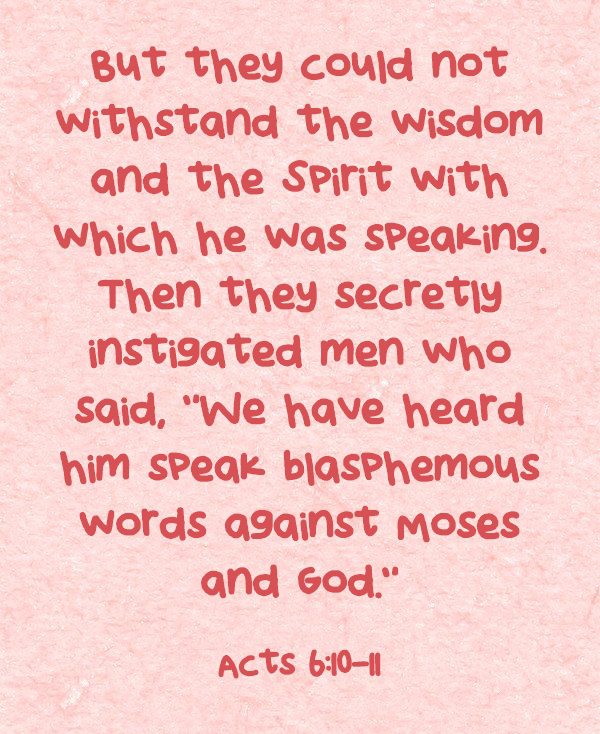
Acts 6:10-11 “But they could not withstand the wisdom and the Spirit with which he was speaking. Then they secretly instigated men who said, “We have heard him speak blasphemous words against Moses and God.”
Stephen was a powerful man of God, just as it says, he was “full of grace and power, was doing great wonders and signs among the people. Then some of those who belonged to the synagogue of the Freedmen (as it was called), and of the Cyrenians, and of the Alexandrians, and of those from Cilicia and Asia, rose up and disputed with Stephen” (Acts 6:8-9). It didn’t matter if he was outnumbered or had scholars debating him; none could withstand his wisdom from the Scriptures and with the empowerment of God’s Spirit, they were no match for Stephen.
What reasoning do you think Stephen used in proving Jesus is the Christ?
Why did they rise up and dispute with Stephen?
Do you think this took place in the synagogue?
Acts 6:11-12 “Then they secretly instigated men who said, “We have heard him speak blasphemous words against Moses and God.” And they stirred up the people and the elders and the scribes, and they came upon him and seized him and brought him before the council.”
The Jews had become so wicked in trying to get Stephen stoned, that they went so far as to “set up false witnesses who said, “This man never ceases to speak words against this holy place and the law” (Acts 6:13), which was obviously false. They were willing to go to any measures; give false testimony before the council, spreading rumors and lies, and even accuse Stephen of speaking against God’s law, which he never did, nor would he ever do. Some of the Jewish “witnesses” even said “we have heard him say that this Jesus of Nazareth will destroy this place and will change the customs that Moses delivered to us” (Acts 6:14). This is also false because Moses actually prophesied about the coming of Jesus (Deut 18:15-19). They also accused Stephen of blaspheming Moses and God. Notice that they put Moses before God, indicating that they held the law in higher regard than they did God. They had their rituals and traditions, and teaching the Jews about Jesus was s threat to them.
What does it mean “the stirred up the people?”
Why would they accuse Stephen of blasphemy against God and Moses?
Acts 6:15 “And gazing at him, all who sat in the council saw that his face was like the face of an angel.”
What was it about Stephen’s look that appeared to them as the face of an angel? Why did Luke record this passage in such a way? Was it because he had complete peace about everything? Had the Spirit told Stephen that he would soon be with the Lord? We are never told why he had that look but we can assume that he was confident in his upcoming trial. We just don’t know with certainty.
What was it that Stephen’s face must have looked like an angel?
Was that because he had great peace or knowing he’d soon be with the Lord?
Was this why the crowd was “gazing at him?”
Summary
Acts chapter six is a great chapter because it shows that the church was growing and that the troubles caused by the growth were easily solved by the church. Growth is a very good problem to have. Even the persecution shows us that the church must have been doing something right because no one is persecuted unless they are speaking the truth. It is so true that the truth will set you free…or it will make you really made. You have both in the Jewish leadership and in the church of God.
Article by Jack Wellman
Jack Wellman is Pastor of the Mulvane Brethren Church in Mulvane Kansas. Jack is also the Senior Writer at What Christians Want To Know whose mission is to equip, encourage, and energize Christians and to address questions about the believer’s daily walk with God and the Bible. You can follow Jack on Google Plus or check out his book Teaching Children the Gospel available on Amazon.
Previous Post

May 25, 2016
Acts 5: Bible Study, Commentary and Summary
Next Post
May 25, 2016 Acts 7: Bible Study, Commentary and Summary
Browse Our Archives
Select a Category Bible Answers Bible Definitions Bible Story Bible Study Bible Verses Christian Books Christian Entertainment Christian Fathers Christian Mothers Christian Quotes Devotional Famous Christians Music News Parables Prayers Quotes Sunday School Lesson Uncategorized Youth Sermons
Select a Month October 2019 September 2019 August 2019 July 2019 June 2019 May 2019 April 2019 March 2019 February 2019 January 2019 December 2018 November 2018 October 2018 September 2018 August 2018 July 2018 June 2018 May 2018 April 2018 March 2018 February 2018 January 2018 December 2017 November 2017 October 2017 September 2017 August 2017 July 2017 June 2017 May 2017 April 2017 March 2017 February 2017 January 2017 December 2016 November 2016 October 2016 September 2016 August 2016 July 2016 June 2016 May 2016 March 2016 February 2016 January 2016 December 2015 November 2015 October 2015 September 2015 August 2015 July 2015 June 2015 May 2015 April 2015 March 2015 February 2015 January 2015 December 2014 November 2014 October 2014 September 2014 August 2014 July 2014 June 2014 May 2014 April 2014 March 2014 February 2014 January 2014 December 2013 November 2013 October 2013 September 2013 August 2013 July 2013 June 2013 May 2013 April 2013 March 2013
Follow Us!
TAKE THE
Religious Wisdom Quiz
In Revelation, what does John eat that is sweet in his mouth but sour in his stomach?
Select your answer to see how you score.
Honey A little scroll A sealed book The word of God
Related posts from Christian Crier


Seeing The Gospel In Biblical Accounts

Getting The Most Out Of Your Bible Reading

Philippians 2 As A Mission Statement
TRENDING AT PATHEOS Evangelical

How the author of the world's best hymn...
I've been working with John Newton for a while now. This makes...

Long before this Lectio Divina, Psalm 130 - the song - started...

What About the Trees? Another Living Parable
After I finished writing the last article about falling leaves as a...

Why Classical Education Is a Conversation, Not a...
Come and Read: Joy in Classical Education When I was a little...

Falling Leaves: A Living Parable on Letting Go
I’ve spent the vast majority of my life in the southeast corner...

Cornell University has received a great deal of negative publicity and intense...
view all Evangelical blogs
Ad-Free & Subscriber Log-In Subscription Support
- About Us
- 2026 Calendar
- Videos
- Podcasts
- Library of World Religions
- Faith In Media Tracker
- Advertise With Us
- Write for Us
- Privacy Policy
- Terms of Service
- Do Not Sell My Data
- Contact Us
- Radiant Digital
- Manage Newsletter Subscriptions
- Unsubscribe From Notifications
- Sitemap
Copyright 2008-2026, Patheos. All rights reserved.
Subscription Support Ad-Free & Subscriber Log-In
Follow Patheos