
BuddhistCatholicContemplativeEvangelicalGeneral ChristianHinduJewishLatter-day SaintMuslimNew VisionsProgressive Christian
Beliefs
- Buddhist
- Catholic
- Contemplative
- Evangelical
- General Christian
- Hindu
- Jewish
- Latter-day Saint
- More Voices
- Muslim
- New Visions
- Pagan
- Progressive Christian
Topics
- Religion News
- Food and Religion
- Sports and Religion
- Religious Art
- Religious Music and Entertainment
- Religious Events
- History and Religion
- Style and Religion
- Politics and Religion
- Women in Religion
- Recreation Outdoors and Religion
- Business Finance and Religion
- Careers Workplace and Religion
- Education and Religion
- Family Parenting and Religion
- Health Fitness and Religion
- Home and Religion
- Relationships and Religion
- Technology and Religion
- Travel and Religion
Columnists
- Buddhist Columnists
- Business Finance and Religion Columnists
- Careers Workplace and Religion Columnists
- Catholic Columnists
- Contemplative Columnists
- Education and Religion Columnists
- Evangelists Columnists
- Family Parenting and Religion Columnists
- General Christian Columnists
- Health Fitness and Religion Columnists
- Hindu Columnists
- History and Religion Columnists
- Home and Religion Columnists
- Jewish Columnists
- More Voices Columnists
- Latter Day Columnists
- Muslim Columnists
- New Visions Columnists
- Nonreligious Columnists
- Pagan Columnists
- Politics and Religion Columnists
- Progressive Columnists
- Recreation Outdoors and Religion Columnists
- Relationships and Religion Columnists
- Religion News Columnists
- Religious Art Columnists
- Religious Events Columnists
- Religious Music and Entertainment Columnists
- Sports and Religion Columnists
- Style and Religion Columnists
- Technology and Religion Columnists
- Travel and Religion Columnists
- Women in Religion Columnists
Resource Library
- 2026 Calendar
- Library of World Religions
- The 100 Most Holy Places on Earth
- Patheos Answers
- Podcasts
- Videos
- Faith Leaders Database
- Anglican Episcopalian
- Bahai
- Baptist
- Buddhism
- Christianity
- Confucianism
- Eastern Orthodoxy
- Hinduism
- Holiness and Pentecostal
- ISKCON
- Islam
- Judaism
- Lutheran
- Methodist
- The Church of Jesus Christ of Latter-day Saints
- New Age
- Paganism
- Presbytarian and Reformed
- Protestantism
- Religion Behind the Scenes
- Roman Catholic
- Scientology
- Shia Islam
- Sikhism
- Sufism
- Sunni Islam
- Taoism
- Zen
- See all religions
Research Tools
 Ad-Free & Subscriber Log-In Subscription Support
Follow Patheos 

- Trending:
- Advent
- |
- Forgiveness
- |
- Thanksgiving
- |
- Election
- |
- Seasonal Holidays
- |
- Marriage
 Christian Crier
- Home
- Evangelical
- What Does “Do Not Muzzle The Ox” Mean In The Bible? A Biblical Definition
What Does “Do Not Muzzle The Ox” Mean In The Bible? A Biblical Definition
Last updated on: June 14, 2017 at 8:47 am by Jack Wellman
What Does “Do Not Muzzle The Ox” Mean In The Bible? A Biblical Definition 2017-06-14T08:47:04-05:00 Jack Wellman
Patheos Explore the world's faith through different perspectives on religion and spirituality! Patheos has the views of the prevalent religions and spiritualities of the world.
What does “Do not muzzle the ox” mean in the Bible?
The Old Testament Meaning
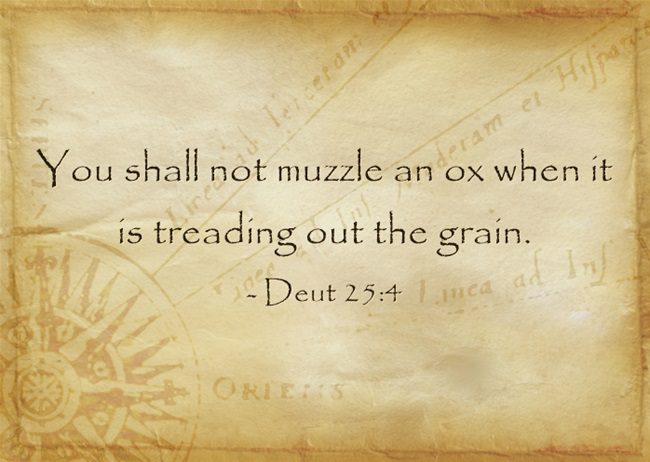
Does the command, “You shall not muzzle an ox when it is treading out the grain” (Deut 25:4) mean the same thing as it does in the New Testament? In the first place, this command shows God’s heart for His creatures. Solomon wrote “Whoever is righteous has regard for the life of his beast, but the mercy of the wicked is cruel” (Prov 12:10). The idea behind the law to not muzzle an ox while it is working to produce grain is that the ox deserves to partake in some of his own labor and so the command is to not to muzzle the ox. This means they allow him to eat from part of his labor while he treads out the grain. It seems cruel to make an animal work for man to produce food while depriving it of the same thing. That’s why this law was given to Israel; to protect the animals that labored for the people because this apparently wasn’t happening outside of the nation of Israel. This is also the principle that can be taken out of this verse in the way we treat laborers. That is, the laborer should be treated fairly and not be deprived of the wages that they deserve.
 New Testament Meaning.
The Apostle Paul quotes Deuteronomy 25:4 as you can tell by his writing, “For it is written in the Law of Moses, “You shall not muzzle an ox when it treads out the grain.” Is it for oxen that God is concerned” (1st Cor 9:9). When anyone in the New Testament says “It is written” or “You have heard it said of old” so Paul was using the example of Deuteronomy 25:4. The context of 1st Corinthians 9 is that Paul has the right or those who preach the gospel have the right to be supported in their ministry. It is the same principle of showing mercy to the servant of God for his or her labor and being merciful to the servant of man (the ox) for their labor and that neither should be muzzled and not be able to partake in the fruits of that labor. Paul writes, “If others share this rightful claim on you, do not we even more” (1st Cor 9:12) and to make sure everyone knows exactly what he is writing about, he continues by writing, “Do you not know that those who are employed in the temple service get their food from the temple, and those who serve at the altar share in the sacrificial offerings? In the same way, the Lord commanded that those who proclaim the gospel should get their living by the gospel” (1st Cor 9:13-14). That could not be any clearer to the reader. You don’t need to be a theologian or Bible scholar to understand that “those who proclaim the gospel should get their living by the gospel” (1st Cor 9:14). You cannot reach any other possible conclusion with these verses than to not muzzle the ox and not support those who are laboring in the fields of the world.
What does it Mean?
To be sure that this important point of not muzzling the ox by supporting the preachers of the word, including missionaries, support staff, and so on, Paul writes to Timothy to remind him that “the Scripture says, “You shall not muzzle an ox when it treads out the grain,” and, “The laborer deserves his wages” (1st Tim 5:18). In the same chapter where we’re told to not muzzle the ox, the Law said in regards to laborers, “You shall give him his wages on the same day, before the sun sets (for he is poor and counts on it), lest he cry against you to the LORD, and you be guilty of sin” (Deut 24:15). Even with this law, many employers took great advantage of their laborers and sometimes didn’t pay them at all. This was not uncommon in Jesus’ day either as Jesus’ half-brother James giving a scathing indictment against the rich by writing, “Behold, the wages of the laborers who mowed your fields, which you kept back by fraud, are crying out against you, and the cries of the harvesters have reached the ears of the Lord of hosts” (James 5:4). They knew better because even the Old Testament law said “You shall not oppress your neighbor or rob him. The wages of a hired worker shall not remain with you all night until the morning” (Lev 19:13). If the rich are defrauding their laborers and not paying them a fair wage, then they are also breaking the command to not steal (Ex 20:15).
Conclusion
Today it is not unusual for a company to relocate overseas or in Mexico because they laborers will work for less and the fat-cat CEO’s will make even more. The disparity between the rich and the poor is ever widening and more rapidly today than ever before. It’s like a disease almost. The conclusion of the verse “Do not muzzle the ox” is clear; a worker is worthy of his or her wages, no matter who they labor for and ultimately, we all work for God anyway (Gal 3:23) and really, you and I are “rendering service with a good will as to the Lord and not to man” (Eph 6:7).
Article by Jack Wellman
Jack Wellman is Pastor of the Mulvane Brethren Church in Mulvane Kansas. Jack is also the Senior Writer at What Christians Want To Know whose mission is to equip, encourage, and energize Christians and to address questions about the believer’s daily walk with God and the Bible. You can follow Jack on Google Plus or check out his book Teaching Children the Gospel available on Amazon.
Previous Post

March 7, 2016
What Did They Use For Money In Bible Times?
Next Post
March 7, 2016 What Did Early Christians Do Different From Modern Day Christians?
Browse Our Archives
Select a Category Bible Answers Bible Definitions Bible Story Bible Study Bible Verses Christian Books Christian Entertainment Christian Fathers Christian Mothers Christian Quotes Devotional Famous Christians Music News Parables Prayers Quotes Sunday School Lesson Uncategorized Youth Sermons
Select a Month October 2019 September 2019 August 2019 July 2019 June 2019 May 2019 April 2019 March 2019 February 2019 January 2019 December 2018 November 2018 October 2018 September 2018 August 2018 July 2018 June 2018 May 2018 April 2018 March 2018 February 2018 January 2018 December 2017 November 2017 October 2017 September 2017 August 2017 July 2017 June 2017 May 2017 April 2017 March 2017 February 2017 January 2017 December 2016 November 2016 October 2016 September 2016 August 2016 July 2016 June 2016 May 2016 March 2016 February 2016 January 2016 December 2015 November 2015 October 2015 September 2015 August 2015 July 2015 June 2015 May 2015 April 2015 March 2015 February 2015 January 2015 December 2014 November 2014 October 2014 September 2014 August 2014 July 2014 June 2014 May 2014 April 2014 March 2014 February 2014 January 2014 December 2013 November 2013 October 2013 September 2013 August 2013 July 2013 June 2013 May 2013 April 2013 March 2013
Follow Us!
TAKE THE
Religious Wisdom Quiz
What does the Bible say about rest?
Select your answer to see how you score.
Avoid rest God rested on the seventh day Rest is evil Only rest when you're old
Related posts from Christian Crier

What Does The Bible Say About Our Thoughts?

Top 13 Bible Verses About Virtue
Do Colors Have Special Meaning In The Bible?
The Greatest Father In History
TRENDING AT PATHEOS Evangelical

Don’t Miss the Parents: A Creative Christmas Meditation
As we enter the Advent Season, I see many people trying to...

Making Stones Into Bread: Choosing the “Right” Work
I was on my online arts ministry Zoom meeting with the International...

Ukraine’s exhausted Christians face fifth winter of war
By Julian Lukins The full-scale war in Ukraine is taking “a serious...

Russell Brand's Conviction is not anti-Christian Persecution
How do we shed the reputation that the Church is OK with...

Have you ever caught yourself saying, “I’ll do it tomorrow,” or “Now...

Throughout history, people have pursued pleasure, possessions, relationships, and success in an...
view all Evangelical blogs
Ad-Free & Subscriber Log-In Subscription Support
- About Us
- 2026 Calendar
- Videos
- Podcasts
- Library of World Religions
- Faith In Media Tracker
- Advertise With Us
- Write for Us
- Privacy Policy
- Terms of Service
- Do Not Sell My Data
- Contact Us
- Radiant Digital
- Manage Newsletter Subscriptions
- Unsubscribe From Notifications
- Sitemap
Copyright 2008-2026, Patheos, part of the Radiant Digital network of media brands. All rights reserved.
Subscription Support Ad-Free & Subscriber Log-In
Follow Patheos