
BuddhistCatholicContemplativeEvangelicalGeneral ChristianHinduJewishLatter-day SaintMuslimNew VisionsProgressive Christian
Beliefs
- Buddhist
- Catholic
- Contemplative
- Evangelical
- General Christian
- Hindu
- Jewish
- Latter-day Saint
- More Voices
- Muslim
- New Visions
- Pagan
- Progressive Christian
Topics
- Religion News
- Food and Religion
- Sports and Religion
- Religious Art
- Religious Music and Entertainment
- Religious Events
- History and Religion
- Style and Religion
- Politics and Religion
- Women in Religion
- Recreation Outdoors and Religion
- Business Finance and Religion
- Careers Workplace and Religion
- Education and Religion
- Family Parenting and Religion
- Health Fitness and Religion
- Home and Religion
- Relationships and Religion
- Technology and Religion
- Travel and Religion
Columnists
- Buddhist Columnists
- Business Finance and Religion Columnists
- Careers Workplace and Religion Columnists
- Catholic Columnists
- Contemplative Columnists
- Education and Religion Columnists
- Evangelists Columnists
- Family Parenting and Religion Columnists
- General Christian Columnists
- Health Fitness and Religion Columnists
- Hindu Columnists
- History and Religion Columnists
- Home and Religion Columnists
- Jewish Columnists
- More Voices Columnists
- Latter Day Columnists
- Muslim Columnists
- New Visions Columnists
- Nonreligious Columnists
- Pagan Columnists
- Politics and Religion Columnists
- Progressive Columnists
- Recreation Outdoors and Religion Columnists
- Relationships and Religion Columnists
- Religion News Columnists
- Religious Art Columnists
- Religious Events Columnists
- Religious Music and Entertainment Columnists
- Sports and Religion Columnists
- Style and Religion Columnists
- Technology and Religion Columnists
- Travel and Religion Columnists
- Women in Religion Columnists
Resource Library
- 2026 Calendar
- Library of World Religions
- The 100 Most Holy Places on Earth
- Patheos Answers
- Podcasts
- Videos
- Faith Leaders Database
- Anglican Episcopalian
- Bahai
- Baptist
- Buddhism
- Christianity
- Confucianism
- Eastern Orthodoxy
- Hinduism
- Holiness and Pentecostal
- ISKCON
- Islam
- Judaism
- Lutheran
- Methodist
- The Church of Jesus Christ of Latter-day Saints
- New Age
- Paganism
- Presbytarian and Reformed
- Protestantism
- Religion Behind the Scenes
- Roman Catholic
- Scientology
- Shia Islam
- Sikhism
- Sufism
- Sunni Islam
- Taoism
- Zen
- See all religions
Research Tools
 Ad-Free & Subscriber Log-In Subscription Support
Ad-Free & Subscriber Log-In Subscription Support
Follow Patheos 

- Trending:
- Forgiveness
- |
- Marriage
- |
- Consciousness
- |
- Death Penalty
- |
- Election
- |
- Halloween
 Christian Crier
- Home
- Evangelical
- A Sunday School Lesson On Gideon
A Sunday School Lesson On Gideon
Last updated on: January 30, 2016 at 2:53 pm by Jack Wellman
A Sunday School Lesson On Gideon 2016-01-30T14:53:03-06:00 Jack Wellman
Patheos Explore the world's faith through different perspectives on religion and spirituality! Patheos has the views of the prevalent religions and spiritualities of the world.
Here is a Sunday school lesson or Bible study on Gideon.
Right in their own Eyes
Judges 6:1-2 “The people of Israel did what was evil in the sight of the Lord, and the Lord gave them into the hand of Midian seven years. And the hand of Midian overpowered Israel, and because of Midian the people of Israel made for themselves the dens that are in the mountains and the caves and the strongholds.”
During the time of the Judges, Israel did whatever seemed right to them at the time and as a consequence of doing what they thought was right instead of doing what they knew to be right, brought the judgment of God by the Midianites who “would come up with their livestock and their tents; they would come like locusts in number—both they and their camels could not be counted—so that they laid waste the land as they came in. And Israel was brought very low because of Midian. And the people of Israel cried out for help to the Lord” (Judge 6:5-6).
Does God allow evil to do good for us (Gen 50:20; Rom 8:28)?
What is significant about the years being seven?
Why did God bring His judgment upon Israel?
Gideon’s Call
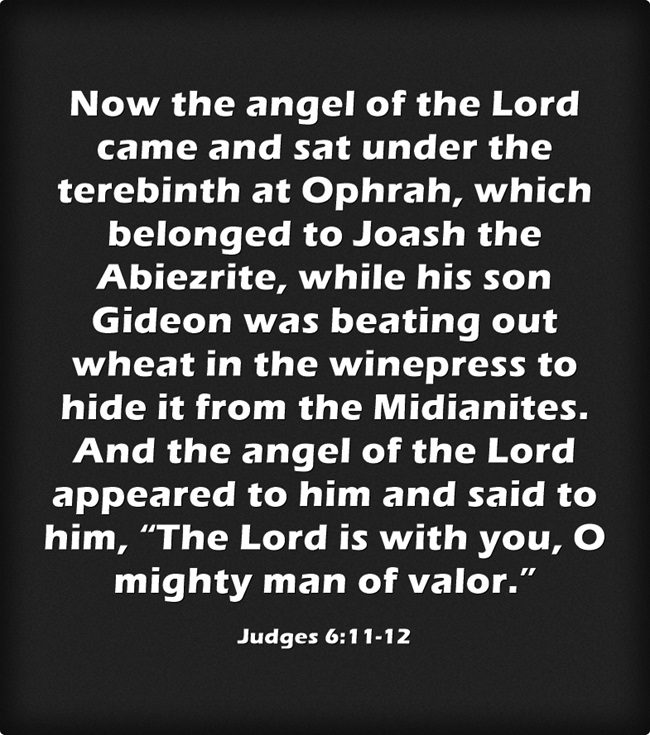
Judges 6:11-12 “Now the angel of the Lord came and sat under the terebinth at Ophrah, which belonged to Joash the Abiezrite, while his son Gideon was beating out wheat in the winepress to hide it from the Midianites. And the angel of the Lord appeared to him and said to him, “The Lord is with you, O mighty man of valor.”
When Gideon “was beating out wheat in the wine press in order to save it from the Midianites. The angel of the Lord appeared to him and said to him, “The Lord is with you, O valiant warrior” (Judge 6:11-12). Why call Gideon a “mighty man of valor?” Gideon “answered the angel of the Lord by saying “how shall I deliver Israel? Behold, my family is the least in Manasseh, and I am the youngest in my father’s house” (Judge 6:15). Every time a harvest was ripe or the livestock grew in number, the Midianites would come sweeping in and devouring it all so “Israel was brought very low because of Midian. And the people of Israel cried out for help to the Lord” (Judges 6:6) but that’s just what God wanted. When Gideon tried to resist this call, God overlooked his reluctance and said, “I will be with you, and you shall strike the Midianites as one man” (Judges 6:16).
Are we reluctant or hesitant to do what God may be asking us to do, even more so if the odds are stacked against us?
How often does God overlook our reluctance?
Are there some things in your life that are “devouring the harvest?”
Unlikely Hero
Judges 6:15-16 “And he said to him, “Please, Lord, how can I save Israel? Behold, my clan is the weakest in Manasseh, and I am the least in my father’s house.” And the Lord said to him, “But I will be with you, and you shall strike the Midianites as one man.”
Talk about an unlikely hero. Here was Gideon, in hiding like most of Israel, and he was the least of his tribe or clan of Manasseh. He was the youngest in his family and thought of himself as the runt of the litter, so why would God say “The Lord is with you, O mighty man of valor” (Judges 6:12)? God typically calls things that are not yet as though they are because He has the power to bring it to pass (Rom 4:17). God already knew that victory was coming because He was the One Who ensures it!
Do you feel like the “runt of the litter in your family?”
Are you looked down on by most of your family, even now?
What does it mean that Gideon “shall strike the Midianites as one man?”
Assembling the Forces
When Gideon was mustering the armies of Israel to go against the Midianites, the Lord told Gideon to send everyone home who was not brave enough to face the enemy and 22,000 left. That may be because fear is contagious and it could spread during the battle and they would fear the enemy more than trust in God. The Midianites were skilled, experience soldiers; Gideon’s men were shepherds and farmers. Gideon’s army was now down to 300 so now it’s 300 verses 132,000! Remember that “the Midianites and the Amalekites and all the people of the East lay along the valley like locusts in abundance, and their camels were without number, as the sand that is on the seashore in abundance” (Judges 7:12). God’s purpose in this was so He’d be glorified because it couldn’t have possibly come from man.
How must have these 300 men felt?
Why did God send home some of the men based upon how they took a drink of water (Judges 7:5-7)?
Do you think fear is contagious?
The Battle Tactic
Judges 7:20-21 “Then the three companies blew the trumpets and broke the jars. They held in their left hands the torches, and in their right hands the trumpets to blow. And they cried out, “A sword for the Lord and for Gideon!” Every man stood in his place around the camp, and all the army ran. They cried out and fled.”
God instructed Gideon to find simple clay pots and them put cracks in them and put a light inside and so when “they blew the trumpets and smashed the jars that were in their hands…the three companies blew the trumpets and broke the jars. They held in their left hands the torches, and in their right hands the trumpets to blow. And they cried out, “A sword for the Lord and for Gideon” (Judges 7:19-20) and “when they blew the 300 trumpets, the LORD set every man’s sword against his comrade and against all the army” (Judge 7:22). It was just as God had said. They were so were so frightened that they killed one another. Just like Gideon’s army, we too carry the light of Christ in broken clay vessels but God can still use us for His glory but God cannot use what is first not broken.
How can God be glorified in what you do?
Why is the “broken clay vessel” significant?
What do the torches symbolize?
Conclusion
I urge you in your study to look at all of the Bible verses and read them aloud in the class so that you can get the most out of this lesson on Gideon and one of the lessons is that God used Gideon mightily because the humble tend to see themselves as small in their own eyes. In the end, “the Lord set every man’s sword against his comrade and against all the army. And the army fled as far as Beth-shittah toward Zererah, as far as the border of Abel-meholah, by Tabbath” (Judges 7:22) and the very last thing we ever hear about the Amalekites is that Israel “defeated the remnant of the Amalekites who had escaped, and they have lived there to this day” (1 Chron 4:43). Gideon went from the least of his family and the least of the tribe of Manasseh to “Rule over us, both you and your son, also your son’s son, for you have delivered us from the hand of Midian” but Gideon said to them, “I will not rule over you, nor shall my son rule over you; the Lord shall rule over you” (Judges 8:22-23).
Why did Gideon not want to rule over Israel?
Is this a sign of humility?
What lesson is most important to you in this study of Gideon?
What has changed in your understanding about Gideon after this study?
Article by Jack Wellman
Jack Wellman is Pastor of the Mulvane Brethren Church in Mulvane Kansas. Jack is also the Senior Writer at What Christians Want To Know whose mission is to equip, encourage, and energize Christians and to address questions about the believer’s daily walk with God and the Bible. You can follow Jack on Google Plus or check out his book Teaching Children the Gospel available on Amazon.
Previous Post

January 30, 2016
A Sunday School Lesson On Cain and Abel
Next Post
January 31, 2016 A Sunday School Lesson On Noah
Browse Our Archives
Select a Category Bible Answers Bible Definitions Bible Story Bible Study Bible Verses Christian Books Christian Entertainment Christian Fathers Christian Mothers Christian Quotes Devotional Famous Christians Music News Parables Prayers Quotes Sunday School Lesson Uncategorized Youth Sermons
Select a Month October 2019 September 2019 August 2019 July 2019 June 2019 May 2019 April 2019 March 2019 February 2019 January 2019 December 2018 November 2018 October 2018 September 2018 August 2018 July 2018 June 2018 May 2018 April 2018 March 2018 February 2018 January 2018 December 2017 November 2017 October 2017 September 2017 August 2017 July 2017 June 2017 May 2017 April 2017 March 2017 February 2017 January 2017 December 2016 November 2016 October 2016 September 2016 August 2016 July 2016 June 2016 May 2016 March 2016 February 2016 January 2016 December 2015 November 2015 October 2015 September 2015 August 2015 July 2015 June 2015 May 2015 April 2015 March 2015 February 2015 January 2015 December 2014 November 2014 October 2014 September 2014 August 2014 July 2014 June 2014 May 2014 April 2014 March 2014 February 2014 January 2014 December 2013 November 2013 October 2013 September 2013 August 2013 July 2013 June 2013 May 2013 April 2013 March 2013
Follow Us!
TAKE THE
Religious Wisdom Quiz
Who cried at the tomb of Lazarus?
Select your answer to see how you score.
Jesus John Peter David
Related posts from Christian Crier


Seeing The Gospel In Biblical Accounts

Getting The Most Out Of Your Bible Reading

Philippians 2 As A Mission Statement
TRENDING AT PATHEOS Evangelical

How the author of the world's best hymn...
I've been working with John Newton for a while now. This makes...

Long before this Lectio Divina, Psalm 130 - the song - started...

What About the Trees? Another Living Parable
After I finished writing the last article about falling leaves as a...

Why Classical Education Is a Conversation, Not a...
Come and Read: Joy in Classical Education When I was a little...

Falling Leaves: A Living Parable on Letting Go
I’ve spent the vast majority of my life in the southeast corner...

Cornell University has received a great deal of negative publicity and intense...
view all Evangelical blogs
Ad-Free & Subscriber Log-In Subscription Support
- About Us
- 2026 Calendar
- Videos
- Podcasts
- Library of World Religions
- Faith In Media Tracker
- Advertise With Us
- Write for Us
- Privacy Policy
- Terms of Service
- Do Not Sell My Data
- Contact Us
- Radiant Digital
- Manage Newsletter Subscriptions
- Unsubscribe From Notifications
- Sitemap
Copyright 2008-2026, Patheos. All rights reserved.
Subscription Support Ad-Free & Subscriber Log-In
Follow Patheos