
BuddhistCatholicContemplativeEvangelicalGeneral ChristianHinduJewishLatter-day SaintMuslimNew VisionsProgressive Christian
Beliefs
- Buddhist
- Catholic
- Contemplative
- Evangelical
- General Christian
- Hindu
- Jewish
- Latter-day Saint
- More Voices
- Muslim
- New Visions
- Pagan
- Progressive Christian
Topics
- Religion News
- Food and Religion
- Sports and Religion
- Religious Art
- Religious Music and Entertainment
- Religious Events
- History and Religion
- Style and Religion
- Politics and Religion
- Women in Religion
- Recreation Outdoors and Religion
- Business Finance and Religion
- Careers Workplace and Religion
- Education and Religion
- Family Parenting and Religion
- Health Fitness and Religion
- Home and Religion
- Relationships and Religion
- Technology and Religion
- Travel and Religion
Columnists
- Buddhist Columnists
- Business Finance and Religion Columnists
- Careers Workplace and Religion Columnists
- Catholic Columnists
- Contemplative Columnists
- Education and Religion Columnists
- Evangelists Columnists
- Family Parenting and Religion Columnists
- General Christian Columnists
- Health Fitness and Religion Columnists
- Hindu Columnists
- History and Religion Columnists
- Home and Religion Columnists
- Jewish Columnists
- More Voices Columnists
- Latter Day Columnists
- Muslim Columnists
- New Visions Columnists
- Nonreligious Columnists
- Pagan Columnists
- Politics and Religion Columnists
- Progressive Columnists
- Recreation Outdoors and Religion Columnists
- Relationships and Religion Columnists
- Religion News Columnists
- Religious Art Columnists
- Religious Events Columnists
- Religious Music and Entertainment Columnists
- Sports and Religion Columnists
- Style and Religion Columnists
- Technology and Religion Columnists
- Travel and Religion Columnists
- Women in Religion Columnists
Resource Library
- 2026 Calendar
- Library of World Religions
- The 100 Most Holy Places on Earth
- Patheos Answers
- Podcasts
- Videos
- Faith Leaders Database
- Anglican Episcopalian
- Bahai
- Baptist
- Buddhism
- Christianity
- Confucianism
- Eastern Orthodoxy
- Hinduism
- Holiness and Pentecostal
- ISKCON
- Islam
- Judaism
- Lutheran
- Methodist
- The Church of Jesus Christ of Latter-day Saints
- New Age
- Paganism
- Presbytarian and Reformed
- Protestantism
- Religion Behind the Scenes
- Roman Catholic
- Scientology
- Shia Islam
- Sikhism
- Sufism
- Sunni Islam
- Taoism
- Zen
- See all religions
Research Tools
 Ad-Free & Subscriber Log-In Subscription Support
Ad-Free & Subscriber Log-In Subscription Support
Follow Patheos 

- Trending:
- Forgiveness
- |
- Marriage
- |
- Consciousness
- |
- Death Penalty
- |
- Election
- |
- Halloween
 Christian Crier
- Home
- Evangelical
- A Sunday School Lesson On Cain and Abel
A Sunday School Lesson On Cain and Abel
Last updated on: January 30, 2016 at 1:06 pm by Jack Wellman
A Sunday School Lesson On Cain and Abel 2016-01-30T13:06:58-06:00 Jack Wellman
Patheos Explore the world's faith through different perspectives on religion and spirituality! Patheos has the views of the prevalent religions and spiritualities of the world.
Here is a Sunday school lesson on Cain and Abel.
The Firstborn of Man
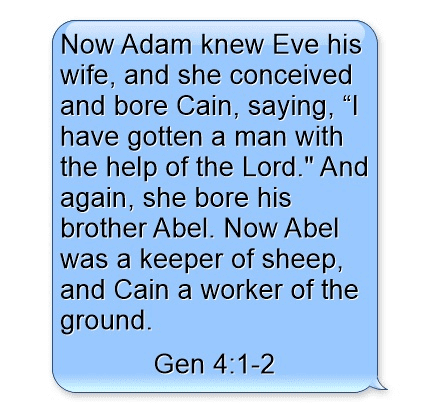
Genesis 4:1-2 “Now Adam knew Eve his wife, and she conceived and bore Cain, saying, “I have gotten a man with the help of the Lord.” And again, she bore his brother Abel. Now Abel was a keeper of sheep, and Cain a worker of the ground.”
The first birth of humanity turned out not to be so good as Adam and Eve had a child named Cain but the second child born, Abel, was nearly the opposite of Cain as Cain was a farmer but Abel a shepherd. The problem was not with Abel but with Cain, as we shall see.
Why was Cain given the name which means “possession” (from the Hebrew “Qayin”)?
Why would Abel’s name mean “breath” from the Hebrew word “hebel?”
Was there anything wrong with Cain being a farmer as opposed to Abel being a shepherd or keeper of sheep?
Acceptable Offerings
Genesis 4:3-5 “In the course of time Cain brought to the Lord an offering of the fruit of the ground, and Abel also brought of the firstborn of his flock and of their fat portions. And the Lord had regard for Abel and his offering, but for Cain and his offering he had no regard. So Cain was very angry, and his face fell.”
We don’t exactly know why God accepted Abel’s offer but not Cain’s. Perhaps it was due to Cain’s attitude or that he labored in the fields to grow what was offered. In contrast, Abel’s offering of a sacrificial lamb was the “firstborn of his flock” and had the “fat portions” included in the offering. Both gave an offering but Cain offered what was produced from his hands which God might consider works but it may be that Abel gave a better offering since he give the first and the best while Cain may have simply brought a bunch of vegetables to offer, which showed little or no cost to him. That may be why God had regard for Abel’s offering but not for Cain’s. Then “The Lord said to Cain, “Why are you angry, and why has your face fallen? If you do well, will you not be accepted? And if you do not do well, sin is crouching at the door. Its desire is for you, but you must rule over it” (Gen 4:6-7).
Did God accept Abel’s sacrifice because it showed the necessity for shed blood as an offering or sacrifice for sin?
Was a blood sacrifice given by Abel the reason God accepted it?
Does Cain’s offering have anything to do with works?
What did God mean by saying “sin is crouching at the door…but you must rule over it?”
The First Murder
Genesis 4:8-9 “Cain spoke to Abel his brother. And when they were in the field, Cain rose up against his brother Abel and killed him. Then the Lord said to Cain, “Where is Abel your brother?” He said, “I do not know; am I my brother’s keeper.”
Why did Cain kill his brother Abel? Was it jealousy or anger that God accepted Abel’s offering but not Cain’s? This we know for sure, it was “By faith Abel offered to God a more acceptable sacrifice than Cain, through which he was commended as righteous, God commending him by accepting his gifts. And through his faith, though he died, he still speaks” (Heb 11:4). The Apostle John adds that “We should not be like Cain, who was of the evil one and murdered his brother. And why did he murder him? Because his own deeds were evil and his brother’s righteous” (1st John 3:12). That might explain why Cain’s offer was not accepted while Abel’s was accepted. Cain’s “own deeds were evil” but “his brother’s righteous” so this might be why Cain was angry and God didn’t accept his offering.
Are we our brothers and sisters keepers?
Why was Cain so angry?
Was Cain’s anger at God or was it directed toward Abel?
Have you felt perhaps what Cain felt when others gave greater gifts or offerings than you?
The Cursed Ground
Genesis 4:10-12 “And the Lord said, “What have you done? The voice of your brother’s blood is crying to me from the ground. And now you are cursed from the ground, which has opened its mouth to receive your brother’s blood from your hand. When you work the ground, it shall no longer yield to you its strength. You shall be a fugitive and a wanderer on the earth.”
God put a mark on Cain to protect him, perhaps from revenge of Cain’s relatives who would begin to populate the earth later. We don’t know what kind of mark this was, we can only guess but it must have been obvious to anyone that saw it. God not only placed a curse on Cain but God cursed the ground on account of Cain and now, like today, work takes the sweat of the brow and the earth doesn’t yield its produce without a lot of effort. In the end, “the Lord put a mark on Cain, lest any who found him should attack him. Then Cain went away from the presence of the Lord and settled in the land of Nod, east of Eden” (Gen 4:15-16).
What kind of mark might God have placed on Cain?
What changed in the ground that it now took a lot of work to grow and harvest food?
What does God mean that Abel’s blood “is crying to me from the ground?”
Conclusion
I urge you in your study to look at all of the Bible verses and read them aloud in the class so that you can get the most out of this lesson on Cain and Abel but one lesson for sure is that Scriptures says, “Woe to them! For they walked in the way of Cain and abandoned themselves for the sake of gain to Balaam’s error and perished in Korah’s rebellion” (Jude 1:11), giving us a warning about walking contrary to the ways of God. Later, “Cain knew his wife, and she conceived and bore Enoch. When he built a city, he called the name of the city after the name of his son, Enoch” (Gen 4:17) but Enoch ended up being a very godly man, who unlike Cain, walked with God and was taken up and was no more or as the Scriptures say, “Enoch walked with God, and he was not, for God took him” (Gen 5:24).
Why did God take Enoch?
What does that mean?
What are the “ways of Cain?”
What has changed in your understanding about Cain and Abel in this study?
Article by Jack Wellman
Jack Wellman is Pastor of the Mulvane Brethren Church in Mulvane Kansas. Jack is also the Senior Writer at What Christians Want To Know whose mission is to equip, encourage, and energize Christians and to address questions about the believer’s daily walk with God and the Bible. You can follow Jack on Google Plus or check out his book Teaching Children the Gospel available on Amazon.
Previous Post

January 30, 2016
A Sunday School Lesson On Angels
Next Post
January 30, 2016 A Sunday School Lesson On Gideon
Browse Our Archives
Select a Category Bible Answers Bible Definitions Bible Story Bible Study Bible Verses Christian Books Christian Entertainment Christian Fathers Christian Mothers Christian Quotes Devotional Famous Christians Music News Parables Prayers Quotes Sunday School Lesson Uncategorized Youth Sermons
Select a Month October 2019 September 2019 August 2019 July 2019 June 2019 May 2019 April 2019 March 2019 February 2019 January 2019 December 2018 November 2018 October 2018 September 2018 August 2018 July 2018 June 2018 May 2018 April 2018 March 2018 February 2018 January 2018 December 2017 November 2017 October 2017 September 2017 August 2017 July 2017 June 2017 May 2017 April 2017 March 2017 February 2017 January 2017 December 2016 November 2016 October 2016 September 2016 August 2016 July 2016 June 2016 May 2016 March 2016 February 2016 January 2016 December 2015 November 2015 October 2015 September 2015 August 2015 July 2015 June 2015 May 2015 April 2015 March 2015 February 2015 January 2015 December 2014 November 2014 October 2014 September 2014 August 2014 July 2014 June 2014 May 2014 April 2014 March 2014 February 2014 January 2014 December 2013 November 2013 October 2013 September 2013 August 2013 July 2013 June 2013 May 2013 April 2013 March 2013
Follow Us!
TAKE THE
Religious Wisdom Quiz
What animals were Daniel thrown to for worshiping God?
Select your answer to see how you score.
Lions Wolves Bears Dogs
Related posts from Christian Crier


Seeing The Gospel In Biblical Accounts

Getting The Most Out Of Your Bible Reading

Philippians 2 As A Mission Statement
TRENDING AT PATHEOS Evangelical

How the author of the world's best hymn...
I've been working with John Newton for a while now. This makes...

Long before this Lectio Divina, Psalm 130 - the song - started...

What About the Trees? Another Living Parable
After I finished writing the last article about falling leaves as a...

Why Classical Education Is a Conversation, Not a...
Come and Read: Joy in Classical Education When I was a little...

Falling Leaves: A Living Parable on Letting Go
I’ve spent the vast majority of my life in the southeast corner...

Cornell University has received a great deal of negative publicity and intense...
view all Evangelical blogs
Ad-Free & Subscriber Log-In Subscription Support
- About Us
- 2026 Calendar
- Videos
- Podcasts
- Library of World Religions
- Faith In Media Tracker
- Advertise With Us
- Write for Us
- Privacy Policy
- Terms of Service
- Do Not Sell My Data
- Contact Us
- Radiant Digital
- Manage Newsletter Subscriptions
- Unsubscribe From Notifications
- Sitemap
Copyright 2008-2026, Patheos. All rights reserved.
Subscription Support Ad-Free & Subscriber Log-In
Follow Patheos