
BuddhistCatholicContemplativeEvangelicalGeneral ChristianHinduJewishLatter-day SaintMuslimNew VisionsProgressive Christian
Beliefs
- Buddhist
- Catholic
- Contemplative
- Evangelical
- General Christian
- Hindu
- Jewish
- Latter-day Saint
- More Voices
- Muslim
- New Visions
- Pagan
- Progressive Christian
Topics
- Religion News
- Food and Religion
- Sports and Religion
- Religious Art
- Religious Music and Entertainment
- Religious Events
- History and Religion
- Style and Religion
- Politics and Religion
- Women in Religion
- Recreation Outdoors and Religion
- Business Finance and Religion
- Careers Workplace and Religion
- Education and Religion
- Family Parenting and Religion
- Health Fitness and Religion
- Home and Religion
- Relationships and Religion
- Technology and Religion
- Travel and Religion
Columnists
- Buddhist Columnists
- Business Finance and Religion Columnists
- Careers Workplace and Religion Columnists
- Catholic Columnists
- Contemplative Columnists
- Education and Religion Columnists
- Evangelists Columnists
- Family Parenting and Religion Columnists
- General Christian Columnists
- Health Fitness and Religion Columnists
- Hindu Columnists
- History and Religion Columnists
- Home and Religion Columnists
- Jewish Columnists
- More Voices Columnists
- Latter Day Columnists
- Muslim Columnists
- New Visions Columnists
- Nonreligious Columnists
- Pagan Columnists
- Politics and Religion Columnists
- Progressive Columnists
- Recreation Outdoors and Religion Columnists
- Relationships and Religion Columnists
- Religion News Columnists
- Religious Art Columnists
- Religious Events Columnists
- Religious Music and Entertainment Columnists
- Sports and Religion Columnists
- Style and Religion Columnists
- Technology and Religion Columnists
- Travel and Religion Columnists
- Women in Religion Columnists
Resource Library
- 2026 Calendar
- Library of World Religions
- The 100 Most Holy Places on Earth
- Patheos Answers
- Podcasts
- Videos
- Faith Leaders Database
- Anglican Episcopalian
- Bahai
- Baptist
- Buddhism
- Christianity
- Confucianism
- Eastern Orthodoxy
- Hinduism
- Holiness and Pentecostal
- ISKCON
- Islam
- Judaism
- Lutheran
- Methodist
- The Church of Jesus Christ of Latter-day Saints
- New Age
- Paganism
- Presbytarian and Reformed
- Protestantism
- Religion Behind the Scenes
- Roman Catholic
- Scientology
- Shia Islam
- Sikhism
- Sufism
- Sunni Islam
- Taoism
- Zen
- See all religions
Research Tools
 Ad-Free & Subscriber Log-In Subscription Support
Ad-Free & Subscriber Log-In Subscription Support
Follow Patheos 

- Trending:
- Forgiveness
- |
- Marriage
- |
- Consciousness
- |
- Death Penalty
- |
- Election
- |
- Halloween
 Christian Crier
- Home
- Evangelical
- A Sunday School Lesson On Words
A Sunday School Lesson On Words
Last updated on: January 28, 2016 at 1:38 pm by Jack Wellman
A Sunday School Lesson On Words 2016-01-28T13:38:39-06:00 Jack Wellman
Patheos Explore the world's faith through different perspectives on religion and spirituality! Patheos has the views of the prevalent religions and spiritualities of the world.
Here is a Sunday school lesson or Bible study about words.
Enticing Words
Proverbs 2:16-17 “So you will be delivered from the forbidden woman, from the adulteress with her smooth words who forsakes the companion of her youth and forgets the covenant of her God.”
Who is this “forbidden woman” anyway? Just like the forbidden tree of the knowledge of good and evil, a forbidden woman is one that God commands that we don’t even touch because anyone who goes to “her house sinks down to death, and her paths to the departed; none who go to her come back, nor do they regain the paths of life” (Prov 2:18-19). Indeed, Job said “I have made a covenant with my eyes; how then could I gaze at a virgin” (Prov 31:1) so the point is “the upright will inhabit the land, and those with integrity will remain in it, but the wicked will be cut off from the land, and the treacherous will be rooted out of it” (Prov 2:21-22) which is why Solomon writes, “Let your heart hold fast my words; keep my commandments, and live” (Prov 4:4).
Who is this “companion of her youth” that is forsaken?
What is “forbidden” today besides actual physical sexual immorality (Matt 5:27-30)?
What did Job mean by making “a covenant with his eyes?”
Life or Death in Words
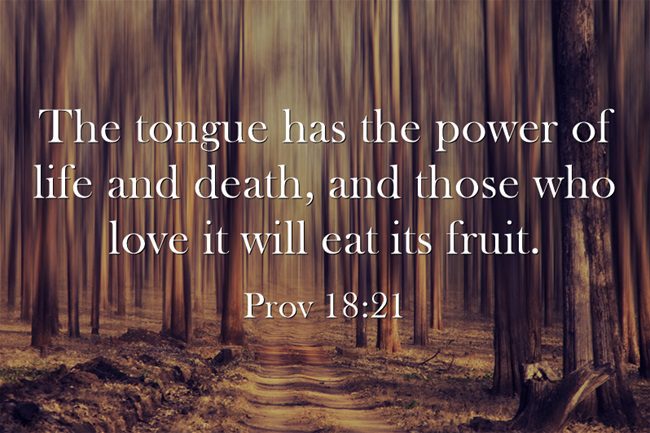
Proverbs 18:21 “The tongue has the power of life and death, and those who love it will eat its fruit.”
Words are not like sticks and stone bruises or cuts which can heal because words go deep into our soul and scar the heart for life. You can take back something, but words you cannot. By words people have soared into a successful life, some have achieved great goals but by words of a different nature, some have sank low into a deep depression from which they never escape. Others choose to end their lives by the destructive words spoken by parents, spouse, or friends. Some have been told they were worthless and meant nothing by parents and those words were death to the child; either literally or in the sense of the way their life was lived. You hold power of good and evil in your tongue just like I do as “we bless our Lord and Father” but we also “curse people who are made in the likeness of God” (James 3:9).
What is the fruit that those who love it eat?
Have you been hurt by the words of others? By who?
How does it feel when words hurt us?
Have you hurt others with your words?
The Words of Life
John 6:67-69 “So Jesus said to the Twelve, “Do you want to go away as well?” Simon Peter answered him, “Lord, to whom shall we go? You have the words of eternal life, and we have believed, and have come to know, that you are the Holy One of God.”
Jesus asked the Twelve if they too would stop following Him just after “many of his disciples turned back and no longer walked with him” (John 6:66). Jesus had just been saying some very hard things and many of them said “This is a hard saying; who can listen to it” (John 6:6)? Jesus does say some very hard things but He says hard things to soften hearts because soft words harden hearts but hard words can soften or humble hearts. Peter and the other disciples were convinced and knew that only Jesus had the words that led to eternal life. They had been with Him long enough to know that this was the Son of God.
Do you use hard words in witness to the lost?
Should you (Rom 3:10-12, 23; 6:23)?
Is this why most of the world doesn’t follow Christ?
How did the disciples know that Jesus was “the Holy One of God?”
Abiding in the Word
John 15:7 “If you abide in me, and my words abide in you, ask whatever you wish, and it will be done for you.”
The Greek word used for “abide” means “to remain” or “not depart from” (“menō”) so Jesus is telling the disciples that they must abide in Him by His words abiding in them. Just like Christians today, we need to get in the Word every day so that the Word gets into us or will abide in us because then Christ, Who is the Word of God (John 1:1, 14), will remain in us. God’s Word can only remain in us if we remain in it. If the disciples do abide in Christ’s words, they can pray for whatever they wish and God will hear and answer their prayers. Naturally, those prayers should be aligned with God’s will (Matt 6:10) but we can be certain the disciples knew God’s will. There is also an cleansing that the Word of God has as it says in John 15:3; “Already you are clean because of the word that I have spoken to you” and referenced by Paul as he wrote about “the washing of water with the word” (Eph 5:26) and at the foot washing Jesus says, “you are clean, though not every one of you.” This cleansing by the Word helps to present a spotless virgin to Christ as the Bridegrooms return for His Bride.
What is it about the Word of God that cleanses?
Why is water sometimes used in reference to the Word of God?
Do you abide daily in the Word so that the Word will abide in you?
Conclusion
I urge you in your study to look at all of the Bible verses and read them aloud in the class so that you can get the most out of this lesson on words and how they impact people’s lives. Words can build up or they can tear down. Why would we ever want to tear down people with words? Perhaps those who tear down others are the ones who are hurting the most and like someone that’s hurt, they’ll snap at others more easily. One good thing about that is the heartbroken person is closer to God (Psalm 34:18) than those who feel they need nothing or no one, and above all, they don’t need God. What is certain is that “on the day of judgment people will give account for every careless word they speak, for by your words you will be justified, and by your words you will be condemned” (Matt 12:36-37). If we remember that, perhaps our words will be few and those we wished we could take back.
What was the last thing you regretted saying to someone?
How many of your words were building up of others today?
How many of your words were or were thought to be tearing down someone or others?
What has changed in your understanding about words in this study?
Article by Jack Wellman
Jack Wellman is Pastor of the Mulvane Brethren Church in Mulvane Kansas. Jack is also the Senior Writer at What Christians Want To Know whose mission is to equip, encourage, and energize Christians and to address questions about the believer’s daily walk with God and the Bible. You can follow Jack on Google Plus or check out his book Teaching Children the Gospel available on Amazon.
Previous Post

January 28, 2016
A Sunday School Lesson On Wisdom
Next Post
January 28, 2016 A Sunday School Lesson On Witnessing
Browse Our Archives
Select a Category Bible Answers Bible Definitions Bible Story Bible Study Bible Verses Christian Books Christian Entertainment Christian Fathers Christian Mothers Christian Quotes Devotional Famous Christians Music News Parables Prayers Quotes Sunday School Lesson Uncategorized Youth Sermons
Select a Month October 2019 September 2019 August 2019 July 2019 June 2019 May 2019 April 2019 March 2019 February 2019 January 2019 December 2018 November 2018 October 2018 September 2018 August 2018 July 2018 June 2018 May 2018 April 2018 March 2018 February 2018 January 2018 December 2017 November 2017 October 2017 September 2017 August 2017 July 2017 June 2017 May 2017 April 2017 March 2017 February 2017 January 2017 December 2016 November 2016 October 2016 September 2016 August 2016 July 2016 June 2016 May 2016 March 2016 February 2016 January 2016 December 2015 November 2015 October 2015 September 2015 August 2015 July 2015 June 2015 May 2015 April 2015 March 2015 February 2015 January 2015 December 2014 November 2014 October 2014 September 2014 August 2014 July 2014 June 2014 May 2014 April 2014 March 2014 February 2014 January 2014 December 2013 November 2013 October 2013 September 2013 August 2013 July 2013 June 2013 May 2013 April 2013 March 2013
Follow Us!
TAKE THE
Religious Wisdom Quiz
Who interpreted Nebuchadnezzar's dream of a statue?
Select your answer to see how you score.
Ezekiel Joseph Abraham Daniel
Related posts from Christian Crier



Seeing The Gospel In Biblical Accounts
TRENDING AT PATHEOS Evangelical

How the author of the world's best hymn...
I've been working with John Newton for a while now. This makes...

Long before this Lectio Divina, Psalm 130 - the song - started...

What About the Trees? Another Living Parable
After I finished writing the last article about falling leaves as a...

Why Classical Education Is a Conversation, Not a...
Come and Read: Joy in Classical Education When I was a little...

Falling Leaves: A Living Parable on Letting Go
I’ve spent the vast majority of my life in the southeast corner...

Cornell University has received a great deal of negative publicity and intense...
view all Evangelical blogs
Ad-Free & Subscriber Log-In Subscription Support
- About Us
- 2026 Calendar
- Videos
- Podcasts
- Library of World Religions
- Faith In Media Tracker
- Advertise With Us
- Write for Us
- Privacy Policy
- Terms of Service
- Do Not Sell My Data
- Contact Us
- Radiant Digital
- Manage Newsletter Subscriptions
- Unsubscribe From Notifications
- Sitemap
Copyright 2008-2026, Patheos. All rights reserved.
Subscription Support Ad-Free & Subscriber Log-In
Follow Patheos