
BuddhistCatholicContemplativeEvangelicalGeneral ChristianHinduJewishLatter-day SaintMuslimNew VisionsProgressive Christian
Beliefs
- Buddhist
- Catholic
- Contemplative
- Evangelical
- General Christian
- Hindu
- Jewish
- Latter-day Saint
- More Voices
- Muslim
- New Visions
- Pagan
- Progressive Christian
Topics
- Religion News
- Food and Religion
- Sports and Religion
- Religious Art
- Religious Music and Entertainment
- Religious Events
- History and Religion
- Style and Religion
- Politics and Religion
- Women in Religion
- Recreation Outdoors and Religion
- Business Finance and Religion
- Careers Workplace and Religion
- Education and Religion
- Family Parenting and Religion
- Health Fitness and Religion
- Home and Religion
- Relationships and Religion
- Technology and Religion
- Travel and Religion
Columnists
- Buddhist Columnists
- Business Finance and Religion Columnists
- Careers Workplace and Religion Columnists
- Catholic Columnists
- Contemplative Columnists
- Education and Religion Columnists
- Evangelists Columnists
- Family Parenting and Religion Columnists
- General Christian Columnists
- Health Fitness and Religion Columnists
- Hindu Columnists
- History and Religion Columnists
- Home and Religion Columnists
- Jewish Columnists
- More Voices Columnists
- Latter Day Columnists
- Muslim Columnists
- New Visions Columnists
- Nonreligious Columnists
- Pagan Columnists
- Politics and Religion Columnists
- Progressive Columnists
- Recreation Outdoors and Religion Columnists
- Relationships and Religion Columnists
- Religion News Columnists
- Religious Art Columnists
- Religious Events Columnists
- Religious Music and Entertainment Columnists
- Sports and Religion Columnists
- Style and Religion Columnists
- Technology and Religion Columnists
- Travel and Religion Columnists
- Women in Religion Columnists
Resource Library
- 2026 Calendar
- Library of World Religions
- The 100 Most Holy Places on Earth
- Patheos Answers
- Podcasts
- Videos
- Faith Leaders Database
- Anglican Episcopalian
- Bahai
- Baptist
- Buddhism
- Christianity
- Confucianism
- Eastern Orthodoxy
- Hinduism
- Holiness and Pentecostal
- ISKCON
- Islam
- Judaism
- Lutheran
- Methodist
- The Church of Jesus Christ of Latter-day Saints
- New Age
- Paganism
- Presbytarian and Reformed
- Protestantism
- Religion Behind the Scenes
- Roman Catholic
- Scientology
- Shia Islam
- Sikhism
- Sufism
- Sunni Islam
- Taoism
- Zen
- See all religions
Research Tools
 Ad-Free & Subscriber Log-In Subscription Support
Ad-Free & Subscriber Log-In Subscription Support
Follow Patheos 

- Trending:
- Forgiveness
- |
- Marriage
- |
- Consciousness
- |
- Death Penalty
- |
- Election
- |
- Halloween
 Christian Crier
- Home
- Evangelical
- A Sunday School Lesson On Authority
A Sunday School Lesson On Authority
Last updated on: January 28, 2016 at 6:54 pm by Jack Wellman
A Sunday School Lesson On Authority 2016-01-28T18:54:13-06:00 Jack Wellman
Patheos Explore the world's faith through different perspectives on religion and spirituality! Patheos has the views of the prevalent religions and spiritualities of the world.
Here is a Sunday school lesson or Bible study on authority.
Governing Authorities
Romans 13:1-2 “Let every person be subject to the governing authorities. For there is no authority except from God, and those that exist have been instituted by God. Therefore whoever resists the authorities resists what God has appointed, and those who resist will incur judgment.”
Romans chapter 13 is instructive to all believers to not resist authority because those placed in authority or representatives of God’s institution over mankind, therefore we have to “be subject to the governing authorities” because “there is no authority except from God” and this authority exists by God’s having instituted them. The point is, if we break the law, we are disobeying God for we must obey the laws of man and only when they conflict with the laws of God are we given permission to break them (Acts 5:29).
When are we allowed to break man’s laws?
What are the exceptions like?
What does it mean that those who break man’s laws “will incur judgment?”
Jesus’ Authority
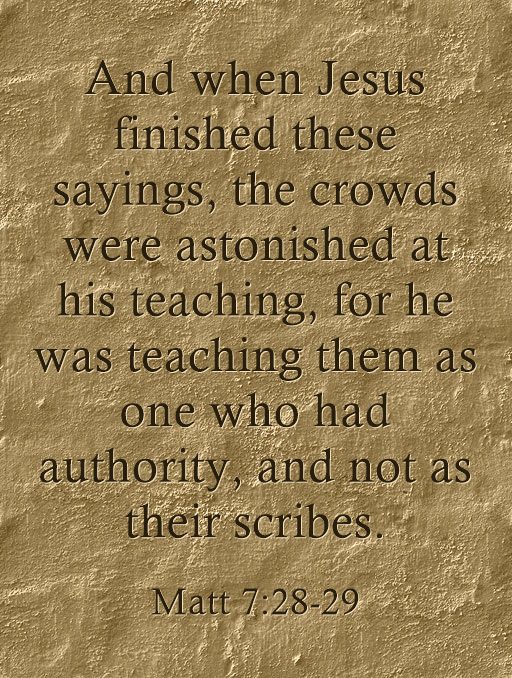
Matthew 7:28-29 “And when Jesus finished these sayings, the crowds were astonished at his teaching, for he was teaching them as one who had authority, and not as their scribes.”
Jesus taught like no other Man ever did, that’s for certain. He could teach like no other because He was totally “other,” meaning He is both God and Man and as God and as such, He has all authority and so it’s no wonder that they were astonished at Jesus’ teachings. They are still being astonished at His teachings today which are found in the Bible. Many of Jesus’ sayings were hard sayings and not easy to accept because our pride doesn’t want to accept it. Jesus used hard words to soften hearts because soft words harden hearts. On one occasion, “When many of his disciples heard it, they said, his is a hard saying; who can listen to it” (John 6:60) and “After this many of his disciples turned back and no longer walked with him” (John 6:66). This is why many are called but only a few are chosen (Matt 22:14) since only a few can accept what Jesus and the Bible teaches. Only the humble can receive these “hard sayings” and why the majority (the “many”) cannot receive them. God will resist the proud and give His grace only to those who are humbled before Him (James 4:6).
Why was Jesus’ authority seen to be greater than the scribes?
What is one of the hard sayings of Jesus that you can remember?
Why did many of them turn back and no longer walk with Him?
The Authority to Forgive Sins
Mark 2:9-11 “Which is easier, to say to the paralytic, ‘Your sins are forgiven,’ or to say, ‘Rise, take up your bed and walk’? But that you may know that the Son of Man has authority on earth to forgive sins”—he said to the paralytic—“I say to you, rise, pick up your bed, and go home.”
After Jesus had just healed a paralytic He told him his sins were forgiven and so “some of the scribes were sitting there, questioning in their hearts, “Why does this man speak like that? He is blaspheming! Who can forgive sins but God alone” (Mark 2:6-7)? They were right! Only God can forgive sins but they didn’t realize that they had God sitting right in front of them and so as God, He had the authority to forgive sins. Then Jesus asks them, “Which is easier, to say to the paralytic, ‘Your sins are forgiven,’ or to say, ‘Rise, take up your bed and walk’?” How would you answer that? Is it easier to say “rise up and walk” or “your sins are given you?” It’s easier to say “Your sins are forgiven you” because we can’t look into the human heart like God can (1st Sam 16:7) but we can see someone who’s been healed get up and walk.
Why did the scribes question Jesus’ authority?
Why is it easier to say “Your sins are forgiven you?”
Is this symbolic of the authority of Jesus Christ?
The Apostles’ Authority
Matthew 28:18-20 “And Jesus came and said to them, “All authority in heaven and on earth has been given to me. Go therefore and make disciples of all nations, baptizing them in the name of the Father and of the Son and of the Holy Spirit, teaching them to observe all that I have commanded you. And behold, I am with you always, to the end of the age.”
When Jesus was teaching in the temple “the chief priests and the elders of the people came up to him as he was teaching, and said, “By what authority are you doing these things, and who gave you this authority” (Matt 21:23)? Little did they realize or if they did realize it, they still rejected Him, that Jesus had been given all authority in heaven and on earth so He could commission anyone He wanted to and He did commission the disciples in giving them the imperative command to go “and make disciples of all nations” and reminded them that all authority has been given to them by Jesus Who was given all authority.
Does this mean that the disciples had Jesus’ authority?
Do you have authority to “make disciples of all nations,” even if it’s your next door neighbor?
Are there limits to our God-given authority?
Conclusion
I urge you in your study to look at all of the Bible verses and read them aloud in the class so that you can get the most out of this lesson on authority and I hope you have now understood that all authority comes from the ultimate authority; God. We have no authority but that which has been given to us by God but this doesn’t mean we can break the laws of mankind. It doesn’t give us immunity to the laws of man; rather it gives us reason to follow them. There is only one exception where we are not to follow man’s laws and that is when God’s higher, moral law might be broken. Our first obligation is to the kingdom and then to mankind.
What is a case where we might have to break man’s laws to obey God?
Do we have authority? What are the limits to our authority?
What has changed in your understanding about authority in this study?
Article by Jack Wellman
Jack Wellman is Pastor of the Mulvane Brethren Church in Mulvane Kansas. Jack is also the Senior Writer at What Christians Want To Know whose mission is to equip, encourage, and energize Christians and to address questions about the believer’s daily walk with God and the Bible. You can follow Jack on Google Plus or check out his book Teaching Children the Gospel available on Amazon.
Previous Post

January 28, 2016
Bold, Boldness, Sunday School Lesson, Bible Study
Next Post
January 28, 2016 A Sunday School Lesson On Attitude
Browse Our Archives
Select a Category Bible Answers Bible Definitions Bible Story Bible Study Bible Verses Christian Books Christian Entertainment Christian Fathers Christian Mothers Christian Quotes Devotional Famous Christians Music News Parables Prayers Quotes Sunday School Lesson Uncategorized Youth Sermons
Select a Month October 2019 September 2019 August 2019 July 2019 June 2019 May 2019 April 2019 March 2019 February 2019 January 2019 December 2018 November 2018 October 2018 September 2018 August 2018 July 2018 June 2018 May 2018 April 2018 March 2018 February 2018 January 2018 December 2017 November 2017 October 2017 September 2017 August 2017 July 2017 June 2017 May 2017 April 2017 March 2017 February 2017 January 2017 December 2016 November 2016 October 2016 September 2016 August 2016 July 2016 June 2016 May 2016 March 2016 February 2016 January 2016 December 2015 November 2015 October 2015 September 2015 August 2015 July 2015 June 2015 May 2015 April 2015 March 2015 February 2015 January 2015 December 2014 November 2014 October 2014 September 2014 August 2014 July 2014 June 2014 May 2014 April 2014 March 2014 February 2014 January 2014 December 2013 November 2013 October 2013 September 2013 August 2013 July 2013 June 2013 May 2013 April 2013 March 2013
Follow Us!
TAKE THE
Religious Wisdom Quiz
Who was the king who arranged for Hezekiah's scribes to compile additional Proverbs?
Select your answer to see how you score.
Jeroboam Hezekiah Ahab Solomon
Related posts from Christian Crier


Seeing The Gospel In Biblical Accounts

Getting The Most Out Of Your Bible Reading

Philippians 2 As A Mission Statement
TRENDING AT PATHEOS Evangelical

How the author of the world's best hymn...
I've been working with John Newton for a while now. This makes...

Long before this Lectio Divina, Psalm 130 - the song - started...

What About the Trees? Another Living Parable
After I finished writing the last article about falling leaves as a...

Why Classical Education Is a Conversation, Not a...
Come and Read: Joy in Classical Education When I was a little...

Falling Leaves: A Living Parable on Letting Go
I’ve spent the vast majority of my life in the southeast corner...

Cornell University has received a great deal of negative publicity and intense...
view all Evangelical blogs
Ad-Free & Subscriber Log-In Subscription Support
- About Us
- 2026 Calendar
- Videos
- Podcasts
- Library of World Religions
- Faith In Media Tracker
- Advertise With Us
- Write for Us
- Privacy Policy
- Terms of Service
- Do Not Sell My Data
- Contact Us
- Radiant Digital
- Manage Newsletter Subscriptions
- Unsubscribe From Notifications
- Sitemap
Copyright 2008-2026, Patheos. All rights reserved.
Subscription Support Ad-Free & Subscriber Log-In
Follow Patheos