
BuddhistCatholicContemplativeEvangelicalGeneral ChristianHinduJewishLatter-day SaintMuslimNew VisionsProgressive Christian
Beliefs
- Buddhist
- Catholic
- Contemplative
- Evangelical
- General Christian
- Hindu
- Jewish
- Latter-day Saint
- More Voices
- Muslim
- New Visions
- Pagan
- Progressive Christian
Topics
- Religion News
- Food and Religion
- Sports and Religion
- Religious Art
- Religious Music and Entertainment
- Religious Events
- History and Religion
- Style and Religion
- Politics and Religion
- Women in Religion
- Recreation Outdoors and Religion
- Business Finance and Religion
- Careers Workplace and Religion
- Education and Religion
- Family Parenting and Religion
- Health Fitness and Religion
- Home and Religion
- Relationships and Religion
- Technology and Religion
- Travel and Religion
Columnists
- Buddhist Columnists
- Business Finance and Religion Columnists
- Careers Workplace and Religion Columnists
- Catholic Columnists
- Contemplative Columnists
- Education and Religion Columnists
- Evangelists Columnists
- Family Parenting and Religion Columnists
- General Christian Columnists
- Health Fitness and Religion Columnists
- Hindu Columnists
- History and Religion Columnists
- Home and Religion Columnists
- Jewish Columnists
- More Voices Columnists
- Latter Day Columnists
- Muslim Columnists
- New Visions Columnists
- Nonreligious Columnists
- Pagan Columnists
- Politics and Religion Columnists
- Progressive Columnists
- Recreation Outdoors and Religion Columnists
- Relationships and Religion Columnists
- Religion News Columnists
- Religious Art Columnists
- Religious Events Columnists
- Religious Music and Entertainment Columnists
- Sports and Religion Columnists
- Style and Religion Columnists
- Technology and Religion Columnists
- Travel and Religion Columnists
- Women in Religion Columnists
Resource Library
- 2026 Calendar
- Library of World Religions
- The 100 Most Holy Places on Earth
- Patheos Answers
- Podcasts
- Videos
- Faith Leaders Database
- Anglican Episcopalian
- Bahai
- Baptist
- Buddhism
- Christianity
- Confucianism
- Eastern Orthodoxy
- Hinduism
- Holiness and Pentecostal
- ISKCON
- Islam
- Judaism
- Lutheran
- Methodist
- The Church of Jesus Christ of Latter-day Saints
- New Age
- Paganism
- Presbytarian and Reformed
- Protestantism
- Religion Behind the Scenes
- Roman Catholic
- Scientology
- Shia Islam
- Sikhism
- Sufism
- Sunni Islam
- Taoism
- Zen
- See all religions
Research Tools
 Ad-Free & Subscriber Log-In Subscription Support
Ad-Free & Subscriber Log-In Subscription Support
Follow Patheos 

- Trending:
- Forgiveness
- |
- Marriage
- |
- Consciousness
- |
- Death Penalty
- |
- Election
- |
- Halloween
 Christian Crier
- Home
- Evangelical
- A Sunday School Lesson On Money
A Sunday School Lesson On Money
Last updated on: January 23, 2016 at 2:18 pm by Jack Wellman
A Sunday School Lesson On Money 2016-01-23T14:18:23-06:00 Jack Wellman
Patheos Explore the world's faith through different perspectives on religion and spirituality! Patheos has the views of the prevalent religions and spiritualities of the world.
Here is a Sunday school lesson or Bible study on the subject of money as found in the Bible.
A Root of Evil
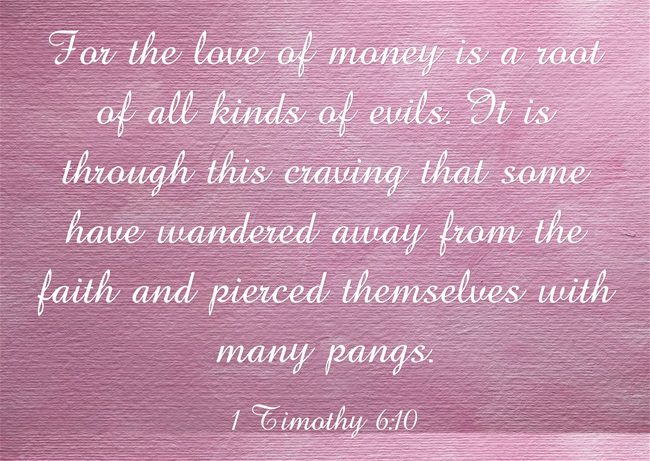
First Timothy 6:10 “For the love of money is a root of all kinds of evils. It is through this craving that some have wandered away from the faith and pierced themselves with many pangs.”
Paul also tells Timothy that an overseer (bishop or pastor) should not be “a drunkard, not violent but gentle, not quarrelsome, not a lover of money” (1st Tim 3:3) because a church leader with a love of money will cause them to water down the gospel as to not offend anyone and that will cause the church to grow because they last thing they want to hear about is repentance, confession of sin, the cross, and that we’re to live a life that is pleasing to God and that would mean living in holiness (as much as possible). For this reason Paul warned Timothy that “people will be lovers of self, lovers of money, proud, arrogant, abusive, disobedient to their parents, ungrateful, unholy, heartless, unappeasable, slanderous, without self-control, brutal, not loving good” (2nd Tim 3:2-3). The problem isn’t money…it’s what it does to the human heart and instead of owning money, money can own us. This love of many leads to “many pangs” and sorrows and by this craving it, “some have wandered away from the faith.”
How can money make us wander away from the faith?
What is Paul talking about when he says they “pierced themselves with many pangs?”
Is money the root of “all evil” or “all kinds of evil?”
Serving Two Masters
Matthew 6:24 “No one can serve two masters, for either he will hate the one and love the other, or he will be devoted to the one and despise the other. You cannot serve God and money.”
Money can be like a god to us in that it satisfies our wants, it feeds our stomach, it warms our bodies, it gives us shelter, and it provides for all of our needs so how easy it is for money to become an idol in our lives and when money replaces God on the throne and the dollar sits as the chairman of the board in our life, we’re not serving God anymore but we’re serving the kingdom of darkness. Why can I say that? I am reminded of Jesus either/or statement where He said “Whoever is not with me is against me, and whoever does not gather with me scatters” (Matt 12:30) or “If you’re for Me, I’m for you, but if you’re against Me, I’m against you.” You can’t love both God and money because by comparison, one will be despised while the other will be cherished.
Is it hard working two jobs?
Have you ever done that or know someone who has?
Do you know someone who’s going to college and working?
How long can they continue doing that?
Proportional Giving
Mark 12:43-44 “And he called his disciples to him and said to them, “Truly, I say to you, this poor widow has put in more than all those who are contributing to the offering box. For they all contributed out of their abundance, but she out of her poverty has put in everything she had, all she had to live on.”
These above verses were spoken by Jesus just after they “had sat down opposite the treasury and watched the people putting money into the offering box. Many rich people put in large sums. And a poor widow came and put in two small copper coins, which make a penny” (Mark 12:41-42). These two coins, Greek for “two lepta,” was all that she had but the offerings the rich gave were proportionally less than what the widow gave because she gave all she had and they were “rich people.” Part of this may be an indictment against the religious rulers themselves because they were commanded to take care of the widows and orphans and provide them with some means so apparently they were breaking the law because that’s what the law required, but we know that “The Pharisees…were lovers of money” (Luke 16:14) and they weren’t about to part with any more than they wanted to.
Was the widow showing her trust in God to provide for her needs?
Do you think anyone but Jesus noticed the two coins the widow put in?
Who actually gave more?
In God We Trust
Hebrews 13:5 “Keep your life free from love of money, and be content with what you have, for he has said, “I will never leave you nor forsake you.”
The reason that the author of Hebrews writes 13:5 may be due to the fact that many of the Jewish Christians had been persecuted and had lost their possessions so the author focused on being content with what they had, especially since God isn’t ever going to leave them or forsake them like most others probably had. Loving money is something that the world naturally does (2nd Tim 3:2) but the wisdom of the psalmist reminds us that the one “who does not put out his money at interest and does not take a bribe against the innocent. He who does these things shall never be moved” (Psalm 15:5). Like the widow who gave all she had, showing that she could trust God, we too must look to God as our One, True Source and Giver Who receives pleasure by giving His children good things. Can’t we trust a benevolent God like Him? All we need to do is lift up our eyes and gaze into the first heaven and “Look at the birds of the air: they neither sow nor reap nor gather into barns, and yet your heavenly Father feeds them. Are you not of more value than they” (Matt 6:26) and “if God so clothes the grass of the field, which today is alive and tomorrow is thrown into the oven, will he not much more clothe you, O you of little faith” (Matt 6:30)? Which do you trust more? A visible checkbook ledger that shows a low balance or the God of Heaven Who owns the fullness of the earth (Psalm 24:1) Who has said He’ll never leave you or forsake you?
Is it hard to trust God when your checkbook ledger is low?
Is contentment based upon the volume of something (i.e. money)?
How can we keep our life free from the love of money?
Conclusion
I urge you in your study to look at all of the Bible verses and read them aloud in the class so that you can get the most out of this lesson on money and I hope you have learned that money is not the root of all evil nor is it evil in itself but it can easily deceive us because our hearts are deceitful anyway (Jer 17:9). Money can get a root in our lives and send a taproot into our hearts and start tapping our energies so that we’ll strengthen that root and focus more on money instead of the Giver of All Good Things; God! It’s not whether we have money that’s the question but rather does money have us? Hopefully, God has us and we are seeking Him first and foremost (Matt 6:33).
Why is it easy for money to become like a god?
How can we learn to focus more on Christ and not on money and money worries like bills, illness, relationship problems, etc.?
What have you learned about money in this Bible lesson?
Article by Jack Wellman
Jack Wellman is Pastor of the Mulvane Brethren Church in Mulvane Kansas. Jack is also the Senior Writer at What Christians Want To Know whose mission is to equip, encourage, and energize Christians and to address questions about the believer’s daily walk with God and the Bible. You can follow Jack on Google Plus or check out his book Teaching Children the Gospel available on Amazon.
Previous Post

January 22, 2016
A Sunday School Lesson On Loving Your Neighbor
Next Post
January 22, 2016 A Sunday School Lesson On Marriage
Browse Our Archives
Select a Category Bible Answers Bible Definitions Bible Story Bible Study Bible Verses Christian Books Christian Entertainment Christian Fathers Christian Mothers Christian Quotes Devotional Famous Christians Music News Parables Prayers Quotes Sunday School Lesson Uncategorized Youth Sermons
Select a Month October 2019 September 2019 August 2019 July 2019 June 2019 May 2019 April 2019 March 2019 February 2019 January 2019 December 2018 November 2018 October 2018 September 2018 August 2018 July 2018 June 2018 May 2018 April 2018 March 2018 February 2018 January 2018 December 2017 November 2017 October 2017 September 2017 August 2017 July 2017 June 2017 May 2017 April 2017 March 2017 February 2017 January 2017 December 2016 November 2016 October 2016 September 2016 August 2016 July 2016 June 2016 May 2016 March 2016 February 2016 January 2016 December 2015 November 2015 October 2015 September 2015 August 2015 July 2015 June 2015 May 2015 April 2015 March 2015 February 2015 January 2015 December 2014 November 2014 October 2014 September 2014 August 2014 July 2014 June 2014 May 2014 April 2014 March 2014 February 2014 January 2014 December 2013 November 2013 October 2013 September 2013 August 2013 July 2013 June 2013 May 2013 April 2013 March 2013
Follow Us!
TAKE THE
Religious Wisdom Quiz
Who was the high priest during the boyhood of Samuel?
Select your answer to see how you score.
Ahijah Eli Phinehas Hophni
Related posts from Christian Crier


The Perils And Pleasures of Money

Seeing The Gospel In Biblical Accounts

Getting The Most Out Of Your Bible Reading
TRENDING AT PATHEOS Evangelical

How the author of the world's best hymn...
I've been working with John Newton for a while now. This makes...

Long before this Lectio Divina, Psalm 130 - the song - started...

What About the Trees? Another Living Parable
After I finished writing the last article about falling leaves as a...

Why Classical Education Is a Conversation, Not a...
Come and Read: Joy in Classical Education When I was a little...

Falling Leaves: A Living Parable on Letting Go
I’ve spent the vast majority of my life in the southeast corner...

Cornell University has received a great deal of negative publicity and intense...
view all Evangelical blogs
Ad-Free & Subscriber Log-In Subscription Support
- About Us
- 2026 Calendar
- Videos
- Podcasts
- Library of World Religions
- Faith In Media Tracker
- Advertise With Us
- Write for Us
- Privacy Policy
- Terms of Service
- Do Not Sell My Data
- Contact Us
- Radiant Digital
- Manage Newsletter Subscriptions
- Unsubscribe From Notifications
- Sitemap
Copyright 2008-2026, Patheos. All rights reserved.
Subscription Support Ad-Free & Subscriber Log-In
Follow Patheos