
BuddhistCatholicContemplativeEvangelicalGeneral ChristianHinduJewishLatter-day SaintMuslimNew VisionsProgressive Christian
Beliefs
- Buddhist
- Catholic
- Contemplative
- Evangelical
- General Christian
- Hindu
- Jewish
- Latter-day Saint
- More Voices
- Muslim
- New Visions
- Pagan
- Progressive Christian
Topics
- Religion News
- Food and Religion
- Sports and Religion
- Religious Art
- Religious Music and Entertainment
- Religious Events
- History and Religion
- Style and Religion
- Politics and Religion
- Women in Religion
- Recreation Outdoors and Religion
- Business Finance and Religion
- Careers Workplace and Religion
- Education and Religion
- Family Parenting and Religion
- Health Fitness and Religion
- Home and Religion
- Relationships and Religion
- Technology and Religion
- Travel and Religion
Columnists
- Buddhist Columnists
- Business Finance and Religion Columnists
- Careers Workplace and Religion Columnists
- Catholic Columnists
- Contemplative Columnists
- Education and Religion Columnists
- Evangelists Columnists
- Family Parenting and Religion Columnists
- General Christian Columnists
- Health Fitness and Religion Columnists
- Hindu Columnists
- History and Religion Columnists
- Home and Religion Columnists
- Jewish Columnists
- More Voices Columnists
- Latter Day Columnists
- Muslim Columnists
- New Visions Columnists
- Nonreligious Columnists
- Pagan Columnists
- Politics and Religion Columnists
- Progressive Columnists
- Recreation Outdoors and Religion Columnists
- Relationships and Religion Columnists
- Religion News Columnists
- Religious Art Columnists
- Religious Events Columnists
- Religious Music and Entertainment Columnists
- Sports and Religion Columnists
- Style and Religion Columnists
- Technology and Religion Columnists
- Travel and Religion Columnists
- Women in Religion Columnists
Resource Library
- 2026 Calendar
- Library of World Religions
- The 100 Most Holy Places on Earth
- Patheos Answers
- Podcasts
- Videos
- Faith Leaders Database
- Anglican Episcopalian
- Bahai
- Baptist
- Buddhism
- Christianity
- Confucianism
- Eastern Orthodoxy
- Hinduism
- Holiness and Pentecostal
- ISKCON
- Islam
- Judaism
- Lutheran
- Methodist
- The Church of Jesus Christ of Latter-day Saints
- New Age
- Paganism
- Presbytarian and Reformed
- Protestantism
- Religion Behind the Scenes
- Roman Catholic
- Scientology
- Shia Islam
- Sikhism
- Sufism
- Sunni Islam
- Taoism
- Zen
- See all religions
Research Tools
 Ad-Free & Subscriber Log-In Subscription Support
Ad-Free & Subscriber Log-In Subscription Support
Follow Patheos 

- Trending:
- Forgiveness
- |
- Marriage
- |
- Consciousness
- |
- Death Penalty
- |
- Election
- |
- Halloween
 Christian Crier
- Home
- Evangelical
- A Sunday School Lesson On Compassion
A Sunday School Lesson On Compassion
Last updated on: January 23, 2016 at 2:34 pm by Jack Wellman
A Sunday School Lesson On Compassion 2016-01-23T14:34:07-06:00 Jack Wellman
Patheos Explore the world's faith through different perspectives on religion and spirituality! Patheos has the views of the prevalent religions and spiritualities of the world.
Here is a Sunday school lesson or Bible study I hope you can use about compassion.
Compassion
Compassion is a combination of two words, com “with” and passion or “to suffer together,” and so it is with great passion of others, someone could be said to be sharing in their suffering and that’s biblical as Paul writes, “who comforts us in all our affliction, so that we may be able to comfort those who are in any affliction, with the comfort with which we ourselves are comforted by God” (2nd Cor 1:4). The question is, “Have you ever felt compassion for somebody?” Was your response to their suffering a desire to help? Whether its commiseration, condolence, sympathy or any other act or capacity for sharing the painful feelings of another, compassion is indispensable in the Body of Christ, the church.
Have you shared in someone else’s suffering?
Could you call it “to suffer together?”
How are we to comfort others?
Israel’s Compassionless Shepherds
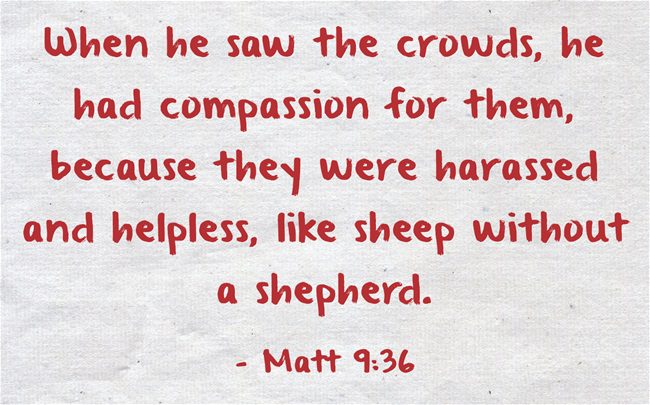
Matthew 9:36 “When he saw the crowds, he had compassion for them, because they were harassed and helpless, like sheep without a shepherd.”
Jesus knew that Jerusalem was a valley of dry bones because the religious leadership had abandoned the Word of God and replaced it with the traditions of men (Mark 7:8) and so Jesus had great compassion for this people and knew they didn’t have a true shepherd. More than once, Jesus would say, “I have compassion on the crowd because they have been with me now three days and have nothing to eat. And I am unwilling to send them away hungry, lest they faint on the way” (Matt 14:14), showing the greatness of this One, True Shepherd in Jesus Christ. He is the Great Shepherd, full of compassion (Psalm 23; Psalm 103) as when “he went ashore he saw a great crowd, and he had compassion on them and healed their sick” (Matt 15:32). When you read Isaiah 49, which says “the Lord has comforted his people and will have compassion on his afflicted” (Isaiah 49:13) you can see how Jesus fulfilled that during His earthly ministry (Matt 14:14, 15:32).
What does the word “afflicted” mean in the context of Isaiah 49:13?
Why were the crowds without a shepherd since they had all those Jewish religious teachers there?
When was a time when you had compassion for someone?
Do you ever have compassion for the lost like Jesus did?
Vindication and Compassion
Deuteronomy 32:36 “For the Lord will vindicate his people and have compassion on his servants, when he sees that their power is gone and there is none remaining, bond or free.”
As we read in the definition of compassion, God was compassionate toward His chosen people and moved to act to help His servants as they had no power in them to free themselves from the bitter bondage of Egyptian slavery. The important thing is that it is “the Lord [Who] will vindicate his people” and not the people themselves. The lesson for us might be to avoid taking the law into our own hands, but more likely for us, to let God deal with it someday as He has promised to do, so we must trust God and do just as Paul wrote, “never avenge yourselves, but leave it to the wrath of God, for it is written, “Vengeance is mine, I will repay, says the Lord” (Rom 12:19).
Does forgiving mean forgetting?
Does this trust in God mean people can do unlawful things to us (Acts 22:27-29)?
Was Israel’s being freed from Egyptian slavery symbolic of something for the new Christian?
The God of Compassion
Psalm 103:13 “As a father shows compassion to his children, so the Lord shows compassion to those who fear him.”
God is merciful to His own children and infinitely more so than any human father and “he knows our frame; he remembers that we are dust” (Psalm 103:14) just as a human father knows that young children are fragile but this compassion of God should extend into our hearts too because “as far as the east is from the west, so far does he remove our transgressions from us” (Psalm 103:12) so why shouldn’t that motivate us to be more compassionate since we’ve been shown such great mercy? The author of Hebrews writes, “For you had compassion on those in prison, and you joyfully accepted the plundering of your property, since you knew that you yourselves had a better possession and an abiding one” (10:34). The Jewish Christians, who are the intended recipients of the Book of Hebrews, wrote this because they had gone through severe persecution; some had lost everything they had and all their source of income but thousands more lost their lives.
Did you have a compassionate parent(s)?
Who do you know that is very compassionate?
Why motivates us to be more compassionate of others?
Conclusion
I urge you in your study to look at all of the Bible verses and read them aloud in the class so that you can get the most out of these lessons. We can’t wrap our minds around God’s compassion “For he says to Moses, “I will have mercy on whom I have mercy, and I will have compassion on whom I have compassion” (Rom 9:15) but if you want God’s compassion on you, you must look to the Man of Passion, Jesus Christ as “all who did receive him, who believed in his name, he gave the right to become children of God who were born, not of blood nor of the will of the flesh nor of the will of man, but of God” (John 1:12-13).
Has your view of compassion changed after this study?
Does it motivate you do be more compassionate to the lost?
What is your definition of compassion?
Article by Jack Wellman
Jack Wellman is Pastor of the Mulvane Brethren Church in Mulvane Kansas. Jack is also the Senior Writer at What Christians Want To Know whose mission is to equip, encourage, and energize Christians and to address questions about the believer’s daily walk with God and the Bible. You can follow Jack on Google Plus or check out his book Teaching Children the Gospel available on Amazon.
Previous Post

January 19, 2016
A Sunday School Lesson On Creation
Next Post
January 19, 2016 A Sunday School Lesson On Change
Browse Our Archives
Select a Category Bible Answers Bible Definitions Bible Story Bible Study Bible Verses Christian Books Christian Entertainment Christian Fathers Christian Mothers Christian Quotes Devotional Famous Christians Music News Parables Prayers Quotes Sunday School Lesson Uncategorized Youth Sermons
Select a Month October 2019 September 2019 August 2019 July 2019 June 2019 May 2019 April 2019 March 2019 February 2019 January 2019 December 2018 November 2018 October 2018 September 2018 August 2018 July 2018 June 2018 May 2018 April 2018 March 2018 February 2018 January 2018 December 2017 November 2017 October 2017 September 2017 August 2017 July 2017 June 2017 May 2017 April 2017 March 2017 February 2017 January 2017 December 2016 November 2016 October 2016 September 2016 August 2016 July 2016 June 2016 May 2016 March 2016 February 2016 January 2016 December 2015 November 2015 October 2015 September 2015 August 2015 July 2015 June 2015 May 2015 April 2015 March 2015 February 2015 January 2015 December 2014 November 2014 October 2014 September 2014 August 2014 July 2014 June 2014 May 2014 April 2014 March 2014 February 2014 January 2014 December 2013 November 2013 October 2013 September 2013 August 2013 July 2013 June 2013 May 2013 April 2013 March 2013
Follow Us!
TAKE THE
Religious Wisdom Quiz
Who cried at the tomb of Lazarus?
Select your answer to see how you score.
Jesus John Peter David
Related posts from Christian Crier


Seeing The Gospel In Biblical Accounts

Getting The Most Out Of Your Bible Reading

Philippians 2 As A Mission Statement
TRENDING AT PATHEOS Evangelical

How the author of the world's best hymn...
I've been working with John Newton for a while now. This makes...

Long before this Lectio Divina, Psalm 130 - the song - started...

What About the Trees? Another Living Parable
After I finished writing the last article about falling leaves as a...

Why Classical Education Is a Conversation, Not a...
Come and Read: Joy in Classical Education When I was a little...

Falling Leaves: A Living Parable on Letting Go
I’ve spent the vast majority of my life in the southeast corner...

Cornell University has received a great deal of negative publicity and intense...
view all Evangelical blogs
Ad-Free & Subscriber Log-In Subscription Support
- About Us
- 2026 Calendar
- Videos
- Podcasts
- Library of World Religions
- Faith In Media Tracker
- Advertise With Us
- Write for Us
- Privacy Policy
- Terms of Service
- Do Not Sell My Data
- Contact Us
- Radiant Digital
- Manage Newsletter Subscriptions
- Unsubscribe From Notifications
- Sitemap
Copyright 2008-2026, Patheos. All rights reserved.
Subscription Support Ad-Free & Subscriber Log-In
Follow Patheos