
BuddhistCatholicContemplativeEvangelicalGeneral ChristianHinduJewishLatter-day SaintMuslimNew VisionsProgressive Christian
Beliefs
- Buddhist
- Catholic
- Contemplative
- Evangelical
- General Christian
- Hindu
- Jewish
- Latter-day Saint
- More Voices
- Muslim
- New Visions
- Pagan
- Progressive Christian
Topics
- Religion News
- Food and Religion
- Sports and Religion
- Religious Art
- Religious Music and Entertainment
- Religious Events
- History and Religion
- Style and Religion
- Politics and Religion
- Women in Religion
- Recreation Outdoors and Religion
- Business Finance and Religion
- Careers Workplace and Religion
- Education and Religion
- Family Parenting and Religion
- Health Fitness and Religion
- Home and Religion
- Relationships and Religion
- Technology and Religion
- Travel and Religion
Columnists
- Buddhist Columnists
- Business Finance and Religion Columnists
- Careers Workplace and Religion Columnists
- Catholic Columnists
- Contemplative Columnists
- Education and Religion Columnists
- Evangelists Columnists
- Family Parenting and Religion Columnists
- General Christian Columnists
- Health Fitness and Religion Columnists
- Hindu Columnists
- History and Religion Columnists
- Home and Religion Columnists
- Jewish Columnists
- More Voices Columnists
- Latter Day Columnists
- Muslim Columnists
- New Visions Columnists
- Nonreligious Columnists
- Pagan Columnists
- Politics and Religion Columnists
- Progressive Columnists
- Recreation Outdoors and Religion Columnists
- Relationships and Religion Columnists
- Religion News Columnists
- Religious Art Columnists
- Religious Events Columnists
- Religious Music and Entertainment Columnists
- Sports and Religion Columnists
- Style and Religion Columnists
- Technology and Religion Columnists
- Travel and Religion Columnists
- Women in Religion Columnists
Resource Library
- 2026 Calendar
- Library of World Religions
- The 100 Most Holy Places on Earth
- Patheos Answers
- Podcasts
- Videos
- Faith Leaders Database
- Anglican Episcopalian
- Bahai
- Baptist
- Buddhism
- Christianity
- Confucianism
- Eastern Orthodoxy
- Hinduism
- Holiness and Pentecostal
- ISKCON
- Islam
- Judaism
- Lutheran
- Methodist
- The Church of Jesus Christ of Latter-day Saints
- New Age
- Paganism
- Presbytarian and Reformed
- Protestantism
- Religion Behind the Scenes
- Roman Catholic
- Scientology
- Shia Islam
- Sikhism
- Sufism
- Sunni Islam
- Taoism
- Zen
- See all religions
Research Tools
 Ad-Free & Subscriber Log-In Subscription Support
Ad-Free & Subscriber Log-In Subscription Support
Follow Patheos 

- Trending:
- Forgiveness
- |
- Marriage
- |
- Consciousness
- |
- Death Penalty
- |
- Election
- |
- Halloween
 Christian Crier
- Home
- Evangelical
- What Is Predestination? Is Predestination Biblical?
What Is Predestination? Is Predestination Biblical?
Last updated on: January 23, 2016 at 2:38 pm by Jack Wellman
What Is Predestination? Is Predestination Biblical? 2016-01-23T14:38:40-06:00 Jack Wellman
Patheos Explore the world's faith through different perspectives on religion and spirituality! Patheos has the views of the prevalent religions and spiritualities of the world.
What does the Bible teach about predestination? Is it biblical? What does it mean to the saved and the lost?
What is Predestination?
Predestination is the act of predestinating or predestining someone or something to happen before it ever occurs. For example, I’ve predestined to do something tomorrow and it’s similar to how God predestines certain things to happen in prophecy and it has come to pass, so too has God foreordained or predestined some to be saved. Who is and who isn’t can only be known by God before a person comes to saving faith in Christ. Biblically, predestination is the action that God takes in foreordaining from eternity whatever comes to pass and that includes those who were predestined or elected by God to be saved. It’s like God had an election and only He got to vote. The prefix “pre” means that somethings been done before or is preparing ahead of time to do whatever follows or in this case, God has predetermined who will be saved. It’s like God is ensuring that someone will be saved (pre) before they arrive at saving faith in Christ (destination). Some would call it a decree of God by which certain souls are foreordained to salvation.
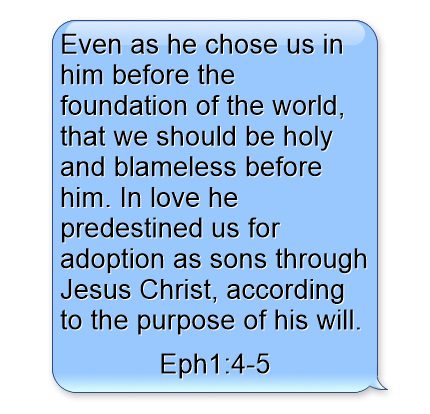
Ephesians 1:4-5 “Even as he chose us in him before the foundation of the world, that we should be holy and blameless before him. In love he predestined us for adoption as sons through Jesus Christ, according to the purpose of his will.”
The Bible says that God has chosen us before the foundation or creation of the world for the purpose of being held blameless before God. Our destination in Christ was determined before the earth even existed and this was only motivated by love and this love is an effectual love where we are adopted as sons and daughters of God but only through Jesus Christ (Acts 4:12). It is not according to our purpose or will but “according to the purpose of [God’s] will.”
What does this mean to the freewill of mankind?
Can someone resist this call?
What was God’s motivation to save us beforehand?
Not of Man’s Will
John 1:12-13 “But to all who did receive him, who believed in his name, he gave the right to become children of God, who were born, not of blood nor of the will of the flesh nor of the will of man, but of God.”
God speaks through the Apostle John and he writes that whoever was and is yet to believe in Christ was not by “the will of the flesh nor of the will of man” but actually “of God.” Whoever believes in Christ will be saved (John 3:16) or “all who did receive him” and were born of God or as John 3:3-7 says, they are “born from above” (in the Greek) indicating that God was the initiator of their new birth in Christ and not themselves. God was the One Who gave those born again “the right to become children of God” and not mankind. It was God’s will. We couldn’t do this without God’s calling us through Christ (John 6:44).
How do we know we’ve been called by God?
Whose will determines our salvation; God or mankind?
What does it mean that it wasn’t of “the will of the flesh or of the will of man?”
Obtaining an Inheritance
Ephesians 1:11-12 “In him we have obtained an inheritance, having been predestined according to the purpose of him who works all things according to the counsel of his will, so that we who were the first to hope in Christ might be to the praise of his glory.”
When a person is saved they obtain an inheritance and that is more than inheriting eternal life but inheriting a kingdom someday (Rev 22). This wasn’t our idea, as much as we like to think it was. Those who say “They have found God” don’t understand that God wasn’t lost; they were. They didn’t find Him, He found them. It’s just as Jesus told the disciples “You did not choose me, but I chose you and appointed you that you should go and bear fruit and that your fruit should abide, so that whatever you ask the Father in my name, he may give it to you” (John 15:16).
What is the inheritance that the children of God receive?
Can a believer resist this call or has it already been determined?
What does our being saved have to do with the glory or praise of Christ?
Who Choses Whom?
John 6:70 “Did I not choose you, the Twelve? And yet one of you is a devil.”
Apparently Jesus was speaking about Judas who was of the Devil but the other disciples understood that Jesus chose them and not the other way around. In the gospels, you often read Jesus saying to the disciples He chose them or follow me and not the other way around. One time, “While walking by the Sea of Galilee, he saw two brothers, Simon (who is called Peter) and Andrew his brother, casting a net into the sea, for they were fishermen. And he said to them, “Follow me, and I will make you fishers of men.” Immediately they left their nets and followed him” (Matt 18-20).
Is Jesus’ command to “follow me” part of His divine call?
What was Judas chosen too if he was going to betray Jesus?
What does “follow me” mean to the Christian today?
The Elect
1st Peter 1:1-2 “Peter, an apostle of Jesus Christ. To those who are elect exiles of the Dispersion in Pontus, Galatia, Cappadocia, Asia, and Bithynia, according to the foreknowledge of God the Father, in the sanctification of the Spirit, for obedience to Jesus Christ and for sprinkling with his blood: May grace and peace be multiplied to you.”
Peter uses the word “elect” much like Paul used “predestined” but either way, it is not about our will being done but about God’s will being done, as Paul said it was “in love” (Eph 1:5) that God willed to save us so the calling was motivated by God’s love for us (John 3:16) not our love for Him because “he first loved us” (1st John 4:19). The truth is, we were hostile enemies of God (Rom 5:10). The elect that were scattered throughout the Roman Empire were the Jews who were dispersed (the Dispersion) by persecution and took the gospel with them as God uses persecution to spread the good news about Jesus Christ coming to die for and to save sinners.
Why does Peter call them “those who are elect?”
Was Peter agreeing with Paul about predestination?
Did Peter feel that He was called?
Who loved first? Was it God or us?
Conclusion
The doctrine of predestination is a hard one to grasp because the Bible also teaches that whosoever will may come to Christ and that means “that whoever believes in him should not perish but have eternal life” (John 3:16b) but can these “whoever may believe” people take responsibility for saving themselves? No, because the Bible teaches that it was of the will of God and not the will of man because “No one can come to me unless the Father who sent me draws him. And I will raise him up on the last day” (John 6:44). The truth is “you (and I) were dead in the trespasses and sins in which you once walked, following the course of this world, following the prince of the power of the air, the spirit that is now at work in the sons of disobedience— among whom we all once lived in the passions of our flesh, carrying out the desires of the body and the mind, and were by nature children of wrath, like the rest of mankind” (Eph 2:1-3). This would be like asking Lazarus to raise himself from the dead, being four days dead, and Jesus asking him, “Okay Lazarus, if you’ll only lift a finger, I’ll do the rest.” No, the Father draws us, the Son saves us, and the Spirit convicts us. None of this is about us. All we bring is our sins and the necessity to repent and believe (Mark 1:15) and in this way, God receives all the glory for our salvation (Eph 2:8-9).
Article by Jack Wellman
Jack Wellman is Pastor of the Mulvane Brethren Church in Mulvane Kansas. Jack is also the Senior Writer at What Christians Want To Know whose mission is to equip, encourage, and energize Christians and to address questions about the believer’s daily walk with God and the Bible. You can follow Jack on Google Plus or check out his book Teaching Children the Gospel available on Amazon.
Previous Post

January 15, 2016
Where Is Divorce Talked About In The Bible?
Next Post
January 15, 2016 A Sunday School Lesson On Prayer
Browse Our Archives
Select a Category Bible Answers Bible Definitions Bible Story Bible Study Bible Verses Christian Books Christian Entertainment Christian Fathers Christian Mothers Christian Quotes Devotional Famous Christians Music News Parables Prayers Quotes Sunday School Lesson Uncategorized Youth Sermons
Select a Month October 2019 September 2019 August 2019 July 2019 June 2019 May 2019 April 2019 March 2019 February 2019 January 2019 December 2018 November 2018 October 2018 September 2018 August 2018 July 2018 June 2018 May 2018 April 2018 March 2018 February 2018 January 2018 December 2017 November 2017 October 2017 September 2017 August 2017 July 2017 June 2017 May 2017 April 2017 March 2017 February 2017 January 2017 December 2016 November 2016 October 2016 September 2016 August 2016 July 2016 June 2016 May 2016 March 2016 February 2016 January 2016 December 2015 November 2015 October 2015 September 2015 August 2015 July 2015 June 2015 May 2015 April 2015 March 2015 February 2015 January 2015 December 2014 November 2014 October 2014 September 2014 August 2014 July 2014 June 2014 May 2014 April 2014 March 2014 February 2014 January 2014 December 2013 November 2013 October 2013 September 2013 August 2013 July 2013 June 2013 May 2013 April 2013 March 2013
Follow Us!
TAKE THE
Religious Wisdom Quiz
Who helped Jesus carry His cross?
Select your answer to see how you score.
Peter John Judas Simon of Cyrene
Related posts from Christian Crier

What Does The Bible Say About Our Thoughts?

Do Colors Have Special Meaning In The Bible?

The Glass – Half Empty Or Half Full?

TRENDING AT PATHEOS Evangelical

How the author of the world's best hymn...
I've been working with John Newton for a while now. This makes...

Long before this Lectio Divina, Psalm 130 - the song - started...

What About the Trees? Another Living Parable
After I finished writing the last article about falling leaves as a...

Why Classical Education Is a Conversation, Not a...
Come and Read: Joy in Classical Education When I was a little...

Falling Leaves: A Living Parable on Letting Go
I’ve spent the vast majority of my life in the southeast corner...

Cornell University has received a great deal of negative publicity and intense...
view all Evangelical blogs
Ad-Free & Subscriber Log-In Subscription Support
- About Us
- 2026 Calendar
- Videos
- Podcasts
- Library of World Religions
- Faith In Media Tracker
- Advertise With Us
- Write for Us
- Privacy Policy
- Terms of Service
- Do Not Sell My Data
- Contact Us
- Radiant Digital
- Manage Newsletter Subscriptions
- Unsubscribe From Notifications
- Sitemap
Copyright 2008-2026, Patheos. All rights reserved.
Subscription Support Ad-Free & Subscriber Log-In
Follow Patheos