
BuddhistCatholicContemplativeEvangelicalGeneral ChristianHinduJewishLatter-day SaintMuslimNew VisionsProgressive Christian
Beliefs
- Buddhist
- Catholic
- Contemplative
- Evangelical
- General Christian
- Hindu
- Jewish
- Latter-day Saint
- More Voices
- Muslim
- New Visions
- Pagan
- Progressive Christian
Topics
- Religion News
- Food and Religion
- Sports and Religion
- Religious Art
- Religious Music and Entertainment
- Religious Events
- History and Religion
- Style and Religion
- Politics and Religion
- Women in Religion
- Recreation Outdoors and Religion
- Business Finance and Religion
- Careers Workplace and Religion
- Education and Religion
- Family Parenting and Religion
- Health Fitness and Religion
- Home and Religion
- Relationships and Religion
- Technology and Religion
- Travel and Religion
Columnists
- Buddhist Columnists
- Business Finance and Religion Columnists
- Careers Workplace and Religion Columnists
- Catholic Columnists
- Contemplative Columnists
- Education and Religion Columnists
- Evangelists Columnists
- Family Parenting and Religion Columnists
- General Christian Columnists
- Health Fitness and Religion Columnists
- Hindu Columnists
- History and Religion Columnists
- Home and Religion Columnists
- Jewish Columnists
- More Voices Columnists
- Latter Day Columnists
- Muslim Columnists
- New Visions Columnists
- Nonreligious Columnists
- Pagan Columnists
- Politics and Religion Columnists
- Progressive Columnists
- Recreation Outdoors and Religion Columnists
- Relationships and Religion Columnists
- Religion News Columnists
- Religious Art Columnists
- Religious Events Columnists
- Religious Music and Entertainment Columnists
- Sports and Religion Columnists
- Style and Religion Columnists
- Technology and Religion Columnists
- Travel and Religion Columnists
- Women in Religion Columnists
Resource Library
- 2026 Calendar
- Library of World Religions
- The 100 Most Holy Places on Earth
- Patheos Answers
- Podcasts
- Videos
- Faith Leaders Database
- Anglican Episcopalian
- Bahai
- Baptist
- Buddhism
- Christianity
- Confucianism
- Eastern Orthodoxy
- Hinduism
- Holiness and Pentecostal
- ISKCON
- Islam
- Judaism
- Lutheran
- Methodist
- The Church of Jesus Christ of Latter-day Saints
- New Age
- Paganism
- Presbytarian and Reformed
- Protestantism
- Religion Behind the Scenes
- Roman Catholic
- Scientology
- Shia Islam
- Sikhism
- Sufism
- Sunni Islam
- Taoism
- Zen
- See all religions
Research Tools
 Ad-Free & Subscriber Log-In Subscription Support
Ad-Free & Subscriber Log-In Subscription Support
Follow Patheos 

- Trending:
- Forgiveness
- |
- Marriage
- |
- Consciousness
- |
- Death Penalty
- |
- Election
- |
- Halloween
 Christian Crier
- Home
- Evangelical
- What Does The Bible Say About Self Pity?
What Does The Bible Say About Self Pity?
Last updated on: December 30, 2015 at 3:20 pm by Jack Wellman
What Does The Bible Say About Self Pity? 2015-12-30T15:20:59-06:00 Jack Wellman
Patheos Explore the world's faith through different perspectives on religion and spirituality! Patheos has the views of the prevalent religions and spiritualities of the world.
What does the Bible say about self-pity? Is it sin?
What is Self-Pity?
Self-pity is a psychological state of mind of an individual in a perceived-to-be adverse situation who has not accepted it and does not have the confidence to deal with it. They could be facing real issues or it might only be the perception of it. In short, it’s like focusing on ourselves to the exclusion of everyone else and then inviting everyone to our “pity party.” The truth is, few will show up for those kinds of parties and those that do won’t be around for long because it’s hard to be around a person so full of self-pity. It is self-centered to be so focused on ourselves when there are so many in far worse conditions than we are in and often, they have no hope of escaping it. I speak from experience about hosting my own self-pity party. Thankfully, I discovered that I was focusing on myself way too much and not focusing on others. It’s so easy for us to drown in own self-pity but this renders us inoperative for God’s service. We are useless to God when we are useless to ourselves.
Overloaded
When I was working construction in my youth, we had very little of the right equipment with which to build so we often used a wheel barrow to take the concrete to the place it was being poured. Since we didn’t have a cement mixer, our supervisor told us we’d have to use a wheelbarrow but he warned us to not overload it because it’s too hard to navigate with one man. I don’t really need to tell you what happened, do I? Naturally, we overloaded it and concrete ended up going everywhere. It spilled onto the tools, open holes for sewer lines, and…my supervisor’s boots, because he was right behind me! What a disaster, all because the wheelbarrow operator didn’t take the warning to not overfill it. The same thing applies for the Christian who decides to take upon themselves the whole weight of their problems and place them on their own shoulders. Once more, I plead guilty to this but I had no excuse because I had read Matthew 11:28-30 which is in the Greek form of the imperative, so it’s a command for us, to “Come to me, all who labor and are heavy laden, and I will give you rest. Take my yoke upon you, and learn from me, for I am gentle and lowly in heart, and you will find rest for your souls. For my yoke is easy, and my burden is light.” Like my supervisor, I should listen and obey what Jesus says; all who are laboring hard and all who are burdened down by great weights, come and take the Master’s yoke for yourself for His “yoke is easy” and His “burden is light.” The yoke is designed to share the load but in this case, we’re not told to share the yoke, but to take it! That means, take Jesus’ yoke and then put all that stuff on it! Get rid of it.
Learning Contentment
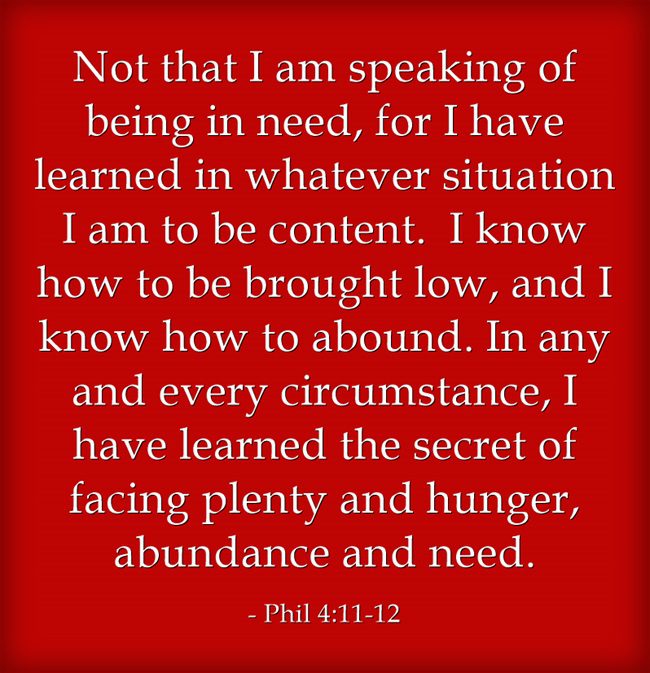
Paul could have hosted many a self-pity party and there would’ve been a lot of people showing up because they knew how much Paul had suffered. Anyone that knew Paul knew that he was deprived of nearly every creature comfort there was. Second Corinthians 1:8 is Paul’s honest testimony of suffering, that “we do not want you to be unaware, brothers, of the affliction we experienced in Asia. For we were so utterly burdened beyond our strength that we despaired of life itself.” He would echo his letter in Philippians 4:11-12 where he wrote that he was not “speaking of being in need, for I have learned in whatever situation I am to be content. I know how to be brought low, and I know how to abound. In any and every circumstance, I have learned the secret of facing plenty and hunger, abundance and need.” Yes, Paul and his companions were overloaded beyond their capacity to bear it; so much so that they even despaired of life. Did that mean he entertained suicidal thoughts? I don’t think so because in the context of his “despairing of life” he “felt that we had received the sentence of death” but God made it clear to him that God wanted “to make us rely not on ourselves but on God who raises the dead” (2 Cor 1:9). Paul could have easily felt despondent and gave up since he had “labored and toiled and have often gone without sleep; I have known hunger and thirst and have often gone without food; I have been cold and naked” (2nd Cor 11:27) but God was teaching him to rely up Him! Paul didn’t stay in his “despairing of life” frame of mind for long because he said “we have set our hope that he will deliver us again” (2nd Cor 1:10b). This was because Paul had to learn how to be content (Phil 4:11-12) so just like any subject he had to learn it. So how did Paul learn how to be content in any state he found himself in? He realized that God was teaching him to stop relying “on ourselves but on God who raises the dead” (2 Cor 1:9), meaning that is resurrection, raising the dead, God-power. Can’t we trust it like Paul did?
Conclusion
Don’t you think Paul could have easily felt sorry for himself after reading 1st Corinthians 4:11-13 where he wrote, “To the present hour we hunger and thirst, we are poorly dressed and buffeted and homeless, and we labor, working with our own hands. When reviled, we bless; when persecuted, we endure; when slandered, we entreat. We have become, and are still, like the scum of the world, the refuse of all things.” That’s pretty low, isn’t it? Self-pity is a sin of pride. I know. I’ve done it, but iff we are so full of self-pity that we can’t even count our many blessings, then we’re not being content in whatever situation we find ourselves in. It’s like telling God, “God, you are not a good God.” Let Peter’s words in 1st Peter 5:6-7 sink in for a moment; “Humble yourselves, therefore, under the mighty hand of God so that at the proper time he may exalt you, casting all your anxieties on him, because he cares for you.” There are only two tents in life that we can live in; the tent of contentment or the tent of discontentment. Where you live is up to you. You can choose which tent you want to live in but if its discontentment, you won’t have much company.
Article by Jack Wellman
Jack Wellman is Pastor of the Mulvane Brethren Church in Mulvane Kansas. Jack is also the Senior Writer at What Christians Want To Know whose mission is to equip, encourage, and energize Christians and to address questions about the believer’s daily walk with God and the Bible. You can follow Jack on Google Plus or check out his book Teaching Children the Gospel available on Amazon.
Previous Post

December 30, 2015
Top 7 Bible Verses About Protecting Or Defending Yourself
Next Post
December 30, 2015 Top 7 Bible Verses About Ignorance
Browse Our Archives
Select a Category Bible Answers Bible Definitions Bible Story Bible Study Bible Verses Christian Books Christian Entertainment Christian Fathers Christian Mothers Christian Quotes Devotional Famous Christians Music News Parables Prayers Quotes Sunday School Lesson Uncategorized Youth Sermons
Select a Month October 2019 September 2019 August 2019 July 2019 June 2019 May 2019 April 2019 March 2019 February 2019 January 2019 December 2018 November 2018 October 2018 September 2018 August 2018 July 2018 June 2018 May 2018 April 2018 March 2018 February 2018 January 2018 December 2017 November 2017 October 2017 September 2017 August 2017 July 2017 June 2017 May 2017 April 2017 March 2017 February 2017 January 2017 December 2016 November 2016 October 2016 September 2016 August 2016 July 2016 June 2016 May 2016 March 2016 February 2016 January 2016 December 2015 November 2015 October 2015 September 2015 August 2015 July 2015 June 2015 May 2015 April 2015 March 2015 February 2015 January 2015 December 2014 November 2014 October 2014 September 2014 August 2014 July 2014 June 2014 May 2014 April 2014 March 2014 February 2014 January 2014 December 2013 November 2013 October 2013 September 2013 August 2013 July 2013 June 2013 May 2013 April 2013 March 2013
Follow Us!
TAKE THE
Religious Wisdom Quiz
Which Christian group practices foot washing as an ordinance?
Select your answer to see how you score.
Methodists Anabaptists Baptists Catholics
Related posts from Christian Crier

What Does The Bible Say About Our Thoughts?

Do Colors Have Special Meaning In The Bible?

The Glass – Half Empty Or Half Full?

TRENDING AT PATHEOS Evangelical

The REST of Your Life: A Creative Wrestles...
This week I had a conversation with a good friend from church....

How the author of the world's best hymn...
I've been working with John Newton for a while now. This makes...

Long before this Lectio Divina, Psalm 130 - the song - started...

What About the Trees? Another Living Parable
After I finished writing the last article about falling leaves as a...

Why Classical Education Is a Conversation, Not a...
Come and Read: Joy in Classical Education When I was a little...

Cornell University has received a great deal of negative publicity and intense...
view all Evangelical blogs
Ad-Free & Subscriber Log-In Subscription Support
- About Us
- 2026 Calendar
- Videos
- Podcasts
- Library of World Religions
- Faith In Media Tracker
- Advertise With Us
- Write for Us
- Privacy Policy
- Terms of Service
- Do Not Sell My Data
- Contact Us
- Radiant Digital
- Manage Newsletter Subscriptions
- Unsubscribe From Notifications
- Sitemap
Copyright 2008-2026, Patheos. All rights reserved.
Subscription Support Ad-Free & Subscriber Log-In
Follow Patheos