
BuddhistCatholicContemplativeEvangelicalGeneral ChristianHinduJewishLatter-day SaintMuslimNew VisionsProgressive Christian
Beliefs
- Buddhist
- Catholic
- Contemplative
- Evangelical
- General Christian
- Hindu
- Jewish
- Latter-day Saint
- More Voices
- Muslim
- New Visions
- Pagan
- Progressive Christian
Topics
- Religion News
- Food and Religion
- Sports and Religion
- Religious Art
- Religious Music and Entertainment
- Religious Events
- History and Religion
- Style and Religion
- Politics and Religion
- Women in Religion
- Recreation Outdoors and Religion
- Business Finance and Religion
- Careers Workplace and Religion
- Education and Religion
- Family Parenting and Religion
- Health Fitness and Religion
- Home and Religion
- Relationships and Religion
- Technology and Religion
- Travel and Religion
Columnists
- Buddhist Columnists
- Business Finance and Religion Columnists
- Careers Workplace and Religion Columnists
- Catholic Columnists
- Contemplative Columnists
- Education and Religion Columnists
- Evangelists Columnists
- Family Parenting and Religion Columnists
- General Christian Columnists
- Health Fitness and Religion Columnists
- Hindu Columnists
- History and Religion Columnists
- Home and Religion Columnists
- Jewish Columnists
- More Voices Columnists
- Latter Day Columnists
- Muslim Columnists
- New Visions Columnists
- Nonreligious Columnists
- Pagan Columnists
- Politics and Religion Columnists
- Progressive Columnists
- Recreation Outdoors and Religion Columnists
- Relationships and Religion Columnists
- Religion News Columnists
- Religious Art Columnists
- Religious Events Columnists
- Religious Music and Entertainment Columnists
- Sports and Religion Columnists
- Style and Religion Columnists
- Technology and Religion Columnists
- Travel and Religion Columnists
- Women in Religion Columnists
Resource Library
- 2026 Calendar
- Library of World Religions
- The 100 Most Holy Places on Earth
- Patheos Answers
- Podcasts
- Videos
- Faith Leaders Database
- Anglican Episcopalian
- Bahai
- Baptist
- Buddhism
- Christianity
- Confucianism
- Eastern Orthodoxy
- Hinduism
- Holiness and Pentecostal
- ISKCON
- Islam
- Judaism
- Lutheran
- Methodist
- The Church of Jesus Christ of Latter-day Saints
- New Age
- Paganism
- Presbytarian and Reformed
- Protestantism
- Religion Behind the Scenes
- Roman Catholic
- Scientology
- Shia Islam
- Sikhism
- Sufism
- Sunni Islam
- Taoism
- Zen
- See all religions
Research Tools
 Ad-Free & Subscriber Log-In Subscription Support
Ad-Free & Subscriber Log-In Subscription Support
Follow Patheos 

- Trending:
- Forgiveness
- |
- Marriage
- |
- Consciousness
- |
- Death Penalty
- |
- Election
- |
- Halloween
 Christian Crier
- Home
- Evangelical
- What Does The Bible Teach About Euthanasia?
What Does The Bible Teach About Euthanasia?
Last updated on: December 28, 2015 at 8:37 pm by Jack Wellman
What Does The Bible Teach About Euthanasia? 2015-12-28T20:37:36-06:00 Jack Wellman
Patheos Explore the world's faith through different perspectives on religion and spirituality! Patheos has the views of the prevalent religions and spiritualities of the world.
Does the Bible say anything about euthanasia or assisted suicide or is the Bible silent on this subject?
Suicidal Thoughts
I believe that all of us go through periods of our life when we feel utterly depressed. It is actually normal to pass through these so-called “dark nights of the soul” when we feel so despondent that we might even contemplate suicide. It has at least passed through the minds of many people, even among Christians. Depression and thoughts of suicide is an equal opportunity occurrence. It cuts through the social strata of society and there were even those in the Bible who wanted God to take their life. Elijah once just gave up and sought for God to just kill him but God never did and told him to rest, eat and recuperate. When we get tired, hungry, and stressed, we are more vulnerable to thoughts of harming ourselves and for some, even worse, we contemplate or entertain thoughts about suicide. Even the Apostle Paul despaired of life at times, although I don’t believe he meant to end his own life. Paul was not going to ever do that.
Suffering’s Never Wasted
Many Christians may not realize that we are actually called to suffer for Jesus’ sake. The Holy “Spirit himself bears witness with our spirit that we are children of God, and if children, then heirs—heirs of God and fellow heirs with Christ, provided we suffer with him in order that we may also be glorified with him” (Rom 8:16-17) and few suffered like Paul did but he considered “that the sufferings of this present time are not worth comparing with the glory that is to be revealed to us” (Rom 8:18) so as much as is possible, “rejoice insofar as you share Christ’s sufferings, that you may also rejoice and be glad when his glory is revealed” (1st Pet 4:13).
You Shall Not Murder
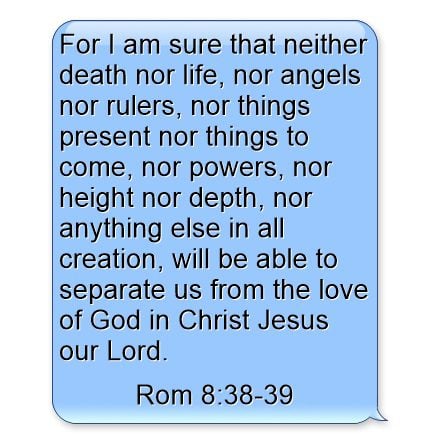
The Sixth Commandment is “You shall not murder” (Ex 20:13) and this includes what is called mercy-killing or physician assisted-suicide. The person being killed is innocent, thereby making it murder. Yes, it is a mercy killing and in some severe cases, this might be the best, but euthanasia should be absolutely the very last option. Some people are so ravaged by their disease and pain and there is no medical hope at all and all that they face is exceedingly intense suffering for the rest of their life and feel that they just can’t take it anymore. For these beleaguered souls who put their faith in Christ, how can we think that they’ll be cast into hell if they go through euthanasia? The Bible teaches that “neither death nor life, nor angels nor rulers, nor things present nor things to come, nor powers, nor height nor depth, nor anything else in all creation, will be able to separate us from the love of God in Christ Jesus our Lord” (Rom 8:38-39). The question is; do we believe it?
When you Suffering
I know that the Word of God has real power (Isaiah 55:11; Rom 1:16) so why not use it? The Bible says that we all have an appointed day of death, after which comes the judgment (Heb 9:27), but it should be God’s decision and not ours. The psalmist wrote, “Your eyes saw my unformed substance; in your book were written, every one of them, the days that were formed for me, when as yet there was none of them” (Psalm 139:16) so call out to Him and He will deliver you (Psalm 50:15), either in this life or the next. Isaiah the Prophet wrote a prophecy a few thousand years ago about the Messiah or Jesus Christ and wrote “The Spirit of the Lord God is upon me, because the Lord has anointed me to bring good news to the poor; he has sent me to bind up the brokenhearted” (Isaiah 61:1) and “to grant to those who mourn in Zion— to give them a beautiful headdress instead of ashes, the oil of gladness instead of mourning, the garment of praise instead of a faint spirit” (Isaiah 61:3). Does that not sound comforting? Read the Book of Psalms for strength in your time of suffering and just pour your heart out to God and He can help you endure your present circumstance.
Conclusion
The Bible is silent on euthanasia but we can understand how God sees life because we’re all made in the image of God (Gen 1:27). There are a few rare examples of people in the Bible wanting to take their own life but they never tried to do it themselves? Judas was the only exception but he was never saved in the first place, so why did everyone else who thought of ending their life never try taking their life? Was this because they knew it was sin? It could be. It is sin to take one’s own life, even if it’s your own, but thankfully, not anything in life or death can separate the believer from the love of God (Rom 8:38-39), even if it includes euthanasia for those in special circumstances.
Article by Jack Wellman
Jack Wellman is Pastor of the Mulvane Brethren Church in Mulvane Kansas. Jack is also the Senior Writer at What Christians Want To Know whose mission is to equip, encourage, and energize Christians and to address questions about the believer’s daily walk with God and the Bible. You can follow Jack on Google Plus or check out his book Teaching Children the Gospel available on Amazon.
Next Post

December 29, 2015 What Is The Difference Between Religion and Spirituality?
Browse Our Archives
Select a Category Bible Answers Bible Definitions Bible Story Bible Study Bible Verses Christian Books Christian Entertainment Christian Fathers Christian Mothers Christian Quotes Devotional Famous Christians Music News Parables Prayers Quotes Sunday School Lesson Uncategorized Youth Sermons
Select a Month October 2019 September 2019 August 2019 July 2019 June 2019 May 2019 April 2019 March 2019 February 2019 January 2019 December 2018 November 2018 October 2018 September 2018 August 2018 July 2018 June 2018 May 2018 April 2018 March 2018 February 2018 January 2018 December 2017 November 2017 October 2017 September 2017 August 2017 July 2017 June 2017 May 2017 April 2017 March 2017 February 2017 January 2017 December 2016 November 2016 October 2016 September 2016 August 2016 July 2016 June 2016 May 2016 March 2016 February 2016 January 2016 December 2015 November 2015 October 2015 September 2015 August 2015 July 2015 June 2015 May 2015 April 2015 March 2015 February 2015 January 2015 December 2014 November 2014 October 2014 September 2014 August 2014 July 2014 June 2014 May 2014 April 2014 March 2014 February 2014 January 2014 December 2013 November 2013 October 2013 September 2013 August 2013 July 2013 June 2013 May 2013 April 2013 March 2013
Follow Us!
TAKE THE
Religious Wisdom Quiz
They will beat their swords into plowshares and their spears into what farming tool?
Select your answer to see how you score.
Pruning hooks Hoes Scythes Sickles
Related posts from Christian Crier

What Does The Bible Say About Our Thoughts?

Do Colors Have Special Meaning In The Bible?

The Glass – Half Empty Or Half Full?

TRENDING AT PATHEOS Evangelical

How the author of the world's best hymn...
I've been working with John Newton for a while now. This makes...

Long before this Lectio Divina, Psalm 130 - the song - started...

What About the Trees? Another Living Parable
After I finished writing the last article about falling leaves as a...

Why Classical Education Is a Conversation, Not a...
Come and Read: Joy in Classical Education When I was a little...

Falling Leaves: A Living Parable on Letting Go
I’ve spent the vast majority of my life in the southeast corner...

Cornell University has received a great deal of negative publicity and intense...
view all Evangelical blogs
Ad-Free & Subscriber Log-In Subscription Support
- About Us
- 2026 Calendar
- Videos
- Podcasts
- Library of World Religions
- Faith In Media Tracker
- Advertise With Us
- Write for Us
- Privacy Policy
- Terms of Service
- Do Not Sell My Data
- Contact Us
- Radiant Digital
- Manage Newsletter Subscriptions
- Unsubscribe From Notifications
- Sitemap
Copyright 2008-2026, Patheos. All rights reserved.
Subscription Support Ad-Free & Subscriber Log-In
Follow Patheos