
BuddhistCatholicContemplativeEvangelicalGeneral ChristianHinduJewishLatter-day SaintMuslimNew VisionsProgressive Christian
Beliefs
- Buddhist
- Catholic
- Contemplative
- Evangelical
- General Christian
- Hindu
- Jewish
- Latter-day Saint
- More Voices
- Muslim
- New Visions
- Pagan
- Progressive Christian
Topics
- Religion News
- Food and Religion
- Sports and Religion
- Religious Art
- Religious Music and Entertainment
- Religious Events
- History and Religion
- Style and Religion
- Politics and Religion
- Women in Religion
- Recreation Outdoors and Religion
- Business Finance and Religion
- Careers Workplace and Religion
- Education and Religion
- Family Parenting and Religion
- Health Fitness and Religion
- Home and Religion
- Relationships and Religion
- Technology and Religion
- Travel and Religion
Columnists
- Buddhist Columnists
- Business Finance and Religion Columnists
- Careers Workplace and Religion Columnists
- Catholic Columnists
- Contemplative Columnists
- Education and Religion Columnists
- Evangelists Columnists
- Family Parenting and Religion Columnists
- General Christian Columnists
- Health Fitness and Religion Columnists
- Hindu Columnists
- History and Religion Columnists
- Home and Religion Columnists
- Jewish Columnists
- More Voices Columnists
- Latter Day Columnists
- Muslim Columnists
- New Visions Columnists
- Nonreligious Columnists
- Pagan Columnists
- Politics and Religion Columnists
- Progressive Columnists
- Recreation Outdoors and Religion Columnists
- Relationships and Religion Columnists
- Religion News Columnists
- Religious Art Columnists
- Religious Events Columnists
- Religious Music and Entertainment Columnists
- Sports and Religion Columnists
- Style and Religion Columnists
- Technology and Religion Columnists
- Travel and Religion Columnists
- Women in Religion Columnists
Resource Library
- 2026 Calendar
- Library of World Religions
- The 100 Most Holy Places on Earth
- Patheos Answers
- Podcasts
- Videos
- Faith Leaders Database
- Anglican Episcopalian
- Bahai
- Baptist
- Buddhism
- Christianity
- Confucianism
- Eastern Orthodoxy
- Hinduism
- Holiness and Pentecostal
- ISKCON
- Islam
- Judaism
- Lutheran
- Methodist
- The Church of Jesus Christ of Latter-day Saints
- New Age
- Paganism
- Presbytarian and Reformed
- Protestantism
- Religion Behind the Scenes
- Roman Catholic
- Scientology
- Shia Islam
- Sikhism
- Sufism
- Sunni Islam
- Taoism
- Zen
- See all religions
Research Tools
 Ad-Free & Subscriber Log-In Subscription Support
Ad-Free & Subscriber Log-In Subscription Support
Follow Patheos 

- Trending:
- Forgiveness
- |
- Marriage
- |
- Consciousness
- |
- Death Penalty
- |
- Election
- |
- Halloween
 Christian Crier
- Home
- Evangelical
- What Does The Bible Say About Church Discipline?
What Does The Bible Say About Church Discipline?
Last updated on: November 30, 2015 at 8:46 am by Jack Wellman
What Does The Bible Say About Church Discipline? 2015-11-30T08:46:15-06:00 Jack Wellman
Patheos Explore the world's faith through different perspectives on religion and spirituality! Patheos has the views of the prevalent religions and spiritualities of the world.
What does the Bible say about church discipline? Does it still have application today?
Love and Discipline
God sees discipline as an act of love. What parent would let their children do anything? Don’t most parents care enough to keep their children out of danger? To God, and I hope you can see it too, love and discipline are necessarily tied together. The author of Hebrews writes “My son, do not regard lightly the discipline of the Lord, nor be weary when reproved by him. For the Lord disciplines the one he loves, and chastises every son whom he receives” (Heb 12:5-6) so “God is treating you as sons. For what son is there whom his father does not discipline? If you are left without discipline, in which all have participated, then you are illegitimate children and not sons” (Heb 12:7-8). You cannot say that you love your child if you don’t discipline them because the opposite of love is not hate…it is apathy and that’s a dangerous thing to have if you’re a parent; dangerous for the child that is. Our church has a prison ministry and the numbers
The Blessings of Discipline
It is not easy to see blessings come from discipline? Apparently the psalmist could and so wrote “Blessed is the man whom you discipline, O LORD, and whom you teach out of your law, to give him rest from days of trouble, until a pit is dug for the wicked” (Psalm 94:12-13). Our church has a prison ministry and the numbers of men who said that they had no father or that they could do just about anything they wanted to as a youth ended up getting them into trouble, although they would still say they take responsibility for their actions, however many wish they had been disciplined more when they were young. They now see this as a lack of love, care, and affection. God disciplines us because He loves us as Paul wrote “we are disciplined so that we may not be condemned along with the world” (1st Cor 11:32) so you may not see the connection between love and discipline and blessings and discipline but there is no doubt that “blessed is the one whom God reproves; therefore despise not the discipline of the Almighty” (Job 5:17).
Church Discipline: Step One
The basic model for church discipline is found in Matthew 18:15-20. In the first step of church discipline methods that Jesus taught, He says “If your brother sins against you, go and tell him his fault, between you and him alone. If he listens to you, you have gained your brother” (Matt 18:15). Hopefully your brother or sister can be shown their fault and they will repent and turn again to God but you must go to them privately as first. There is no reason to tell anyone else if you can settle the matter one on one. It is unwise to bring anyone else into it or tell others and cloaks it in a prayer request by saying “Brother or sister so and so is doing this or that and I’m going to pray for them so would you pray for them too?” That is nothing less than gossip.
Church Discipline: Step Two
If going to them privately doesn’t help because “he does not listen, take one or two others along with you, that every charge may be established by the evidence of two or three witnesses” (Matt 18:16). That doesn’t mean take half a dozen witnesses with you and show up at the person’s door or confront them at church publically. No, this is still a private matter, even though you are taking someone else with you now. Perhaps the second or third (at most) person will see this as a non-issue and think that it’s not a problem that should be brought up at all, and certainly not before the church. If there is a serious sin issue, perhaps the other witnesses will help persuade the one in sin to repent and that they will repent of that and turn away from that sin. If that is the case, then this is where it should end. It doesn’t need to shared with others.
Church Discipline: Step Three
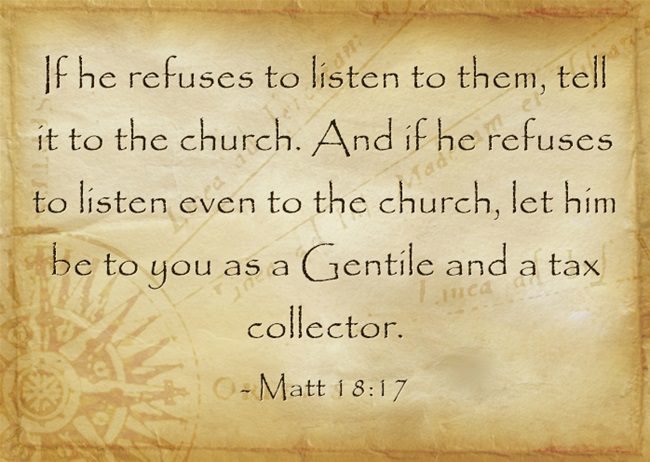
The main purpose of church discipline is so that the brother or sister who is in sin and is warned will turn from that, whatever it is, but “If he refuses to listen to them, tell it to the church. And if he refuses to listen even to the church, let him be to you as a Gentile and a tax collector” (Matt 18:17). This is the most difficult part of church discipline. It should always be the very last option every time but if talking to them one on one and in private doesn’t help, you must bring one or two more with you but if that still doesn’t work, then sadly, it’s time to bring it before the whole church in the hopes that they would see their error and turn away from it and forsake whatever that sin was. Jesus says that “if two of you agree on earth about anything they ask, it will be done for them by my Father in heaven” (Matt 18:19) because “where two or three are gathered in my name, there am I among them” (Matt 18:20).
Conclusion
Church discipline should be reserved only when a Christian is in a grievous sin. It is not for gray areas where the Bible is silent or some other imagined infraction. A Christian that desires to live in obedience to God and is truly humble will not be offended when they are corrected. They know that “Faithful are the wounds of a friend” (Prov 27:6a) and “Blows that wound cleanse away evil; strokes make clean the innermost parts” (Prov 20:30). The believer should not only believe but live out the verse that says “Great peace have those who love your law; nothing shall offend them” (Psalm 119:165). If they are offended, then that’s not your fault. Either they don’t love God’s law and thus don’t have great peace or they love their sin and don’t want to repent. Either way, it is a risk you must take because you love your brother or sister. It is the most loving thing you can do for your friend or fellow brother or sister in Christ.
Article by Jack Wellman
Jack Wellman is Pastor of the Mulvane Brethren Church in Mulvane Kansas. Jack is also the Senior Writer at What Christians Want To Know whose mission is to equip, encourage, and energize Christians and to address questions about the believer’s daily walk with God and the Bible. You can follow Jack on Google Plus or check out his book Teaching Children the Gospel available on Amazon.
Previous Post

November 29, 2015
Why Do Christians Get Baptized?
Next Post
November 30, 2015 Should Christians Fear Satan or Demons?
Browse Our Archives
Select a Category Bible Answers Bible Definitions Bible Story Bible Study Bible Verses Christian Books Christian Entertainment Christian Fathers Christian Mothers Christian Quotes Devotional Famous Christians Music News Parables Prayers Quotes Sunday School Lesson Uncategorized Youth Sermons
Select a Month October 2019 September 2019 August 2019 July 2019 June 2019 May 2019 April 2019 March 2019 February 2019 January 2019 December 2018 November 2018 October 2018 September 2018 August 2018 July 2018 June 2018 May 2018 April 2018 March 2018 February 2018 January 2018 December 2017 November 2017 October 2017 September 2017 August 2017 July 2017 June 2017 May 2017 April 2017 March 2017 February 2017 January 2017 December 2016 November 2016 October 2016 September 2016 August 2016 July 2016 June 2016 May 2016 March 2016 February 2016 January 2016 December 2015 November 2015 October 2015 September 2015 August 2015 July 2015 June 2015 May 2015 April 2015 March 2015 February 2015 January 2015 December 2014 November 2014 October 2014 September 2014 August 2014 July 2014 June 2014 May 2014 April 2014 March 2014 February 2014 January 2014 December 2013 November 2013 October 2013 September 2013 August 2013 July 2013 June 2013 May 2013 April 2013 March 2013
Follow Us!
TAKE THE
Religious Wisdom Quiz
Who were Isaac and Rebekah's twin sons?
Select your answer to see how you score.
Simeon and Levi Esau and Jacob Cain and Abel Joseph and Benjamin
Related posts from Christian Crier

What Does The Bible Say About Our Thoughts?

Top 13 Bible Verses About Virtue

Do Colors Have Special Meaning In The Bible?

The Greatest Father In History
TRENDING AT PATHEOS Evangelical

How the author of the world's best hymn...
I've been working with John Newton for a while now. This makes...

Long before this Lectio Divina, Psalm 130 - the song - started...

What About the Trees? Another Living Parable
After I finished writing the last article about falling leaves as a...

Why Classical Education Is a Conversation, Not a...
Come and Read: Joy in Classical Education When I was a little...

Falling Leaves: A Living Parable on Letting Go
I’ve spent the vast majority of my life in the southeast corner...

Cornell University has received a great deal of negative publicity and intense...
view all Evangelical blogs
Ad-Free & Subscriber Log-In Subscription Support
- About Us
- 2026 Calendar
- Videos
- Podcasts
- Library of World Religions
- Faith In Media Tracker
- Advertise With Us
- Write for Us
- Privacy Policy
- Terms of Service
- Do Not Sell My Data
- Contact Us
- Radiant Digital
- Manage Newsletter Subscriptions
- Unsubscribe From Notifications
- Sitemap
Copyright 2008-2026, Patheos. All rights reserved.
Subscription Support Ad-Free & Subscriber Log-In
Follow Patheos