
BuddhistCatholicContemplativeEvangelicalGeneral ChristianHinduJewishLatter-day SaintMuslimNew VisionsProgressive Christian
Beliefs
- Buddhist
- Catholic
- Contemplative
- Evangelical
- General Christian
- Hindu
- Jewish
- Latter-day Saint
- More Voices
- Muslim
- New Visions
- Pagan
- Progressive Christian
Topics
- Religion News
- Food and Religion
- Sports and Religion
- Religious Art
- Religious Music and Entertainment
- Religious Events
- History and Religion
- Style and Religion
- Politics and Religion
- Women in Religion
- Recreation Outdoors and Religion
- Business Finance and Religion
- Careers Workplace and Religion
- Education and Religion
- Family Parenting and Religion
- Health Fitness and Religion
- Home and Religion
- Relationships and Religion
- Technology and Religion
- Travel and Religion
Columnists
- Buddhist Columnists
- Business Finance and Religion Columnists
- Careers Workplace and Religion Columnists
- Catholic Columnists
- Contemplative Columnists
- Education and Religion Columnists
- Evangelists Columnists
- Family Parenting and Religion Columnists
- General Christian Columnists
- Health Fitness and Religion Columnists
- Hindu Columnists
- History and Religion Columnists
- Home and Religion Columnists
- Jewish Columnists
- More Voices Columnists
- Latter Day Columnists
- Muslim Columnists
- New Visions Columnists
- Nonreligious Columnists
- Pagan Columnists
- Politics and Religion Columnists
- Progressive Columnists
- Recreation Outdoors and Religion Columnists
- Relationships and Religion Columnists
- Religion News Columnists
- Religious Art Columnists
- Religious Events Columnists
- Religious Music and Entertainment Columnists
- Sports and Religion Columnists
- Style and Religion Columnists
- Technology and Religion Columnists
- Travel and Religion Columnists
- Women in Religion Columnists
Resource Library
- 2026 Calendar
- Library of World Religions
- The 100 Most Holy Places on Earth
- Patheos Answers
- Podcasts
- Videos
- Faith Leaders Database
- Anglican Episcopalian
- Bahai
- Baptist
- Buddhism
- Christianity
- Confucianism
- Eastern Orthodoxy
- Hinduism
- Holiness and Pentecostal
- ISKCON
- Islam
- Judaism
- Lutheran
- Methodist
- The Church of Jesus Christ of Latter-day Saints
- New Age
- Paganism
- Presbytarian and Reformed
- Protestantism
- Religion Behind the Scenes
- Roman Catholic
- Scientology
- Shia Islam
- Sikhism
- Sufism
- Sunni Islam
- Taoism
- Zen
- See all religions
Research Tools
 Ad-Free & Subscriber Log-In Subscription Support
Ad-Free & Subscriber Log-In Subscription Support
Follow Patheos 

- Trending:
- Forgiveness
- |
- Marriage
- |
- Consciousness
- |
- Death Penalty
- |
- Election
- |
- Halloween
 Christian Crier
- Home
- Evangelical
- Does God Play Favorites?
Does God Play Favorites?
Last updated on: October 16, 2015 at 12:05 pm by Jack Wellman
Does God Play Favorites? 2015-10-16T12:05:17-05:00 Jack Wellman
Patheos Explore the world's faith through different perspectives on religion and spirituality! Patheos has the views of the prevalent religions and spiritualities of the world.
Does God play favorites with people? Why are some saved and some not?
No Partiality with God
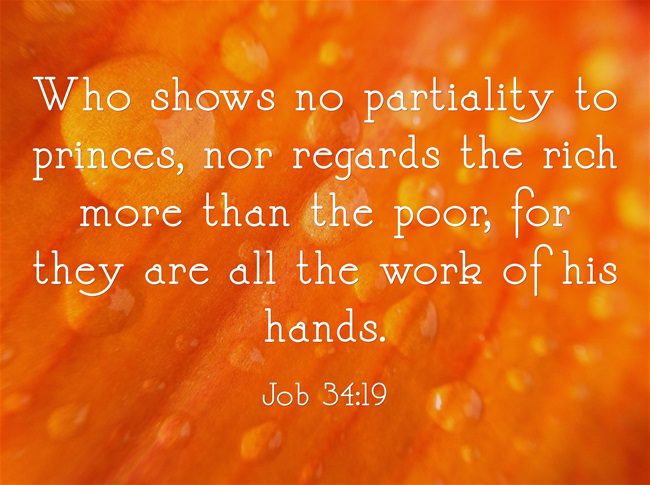
From the beginning to the end the Bible teaches that there is no partiality with God and He “shows no partiality to princes and does not favor the rich over the poor, for they are all the work of his hands” (Job 34:19). Peter said at the council of Jerusalem, after the gospel had been preached to the Gentiles, that God “did not discriminate between us and them, for he purified their hearts by faith” (Acts 15:9) “For God does not show favoritism” (Rom 2:11) and before God, “There is neither Jew nor Greek, there is neither slave nor free, there is no male and female, for you are all one in Christ Jesus” (Gal 3:28). Paul asks a rhetorical question, “Is God the God of Jews only? Is he not the God of Gentiles too? Yes, of Gentiles too” (Rom 3:29). It’s not about race…it’s always about grace. God looks at your heart, not your lineage.
No Partiality in the Church
When Paul was bringing the gospel to the Gentiles he upset a lot of the Jews but he declared “As for those who were held in high esteem–whatever they were makes no difference to me; God does not show favoritism–they added nothing to my message” (Gal 2:6) and since with God “there is no favoritism with him” (Eph 6:9c) neither should there be any with us. James also wrote to the church, “My brothers and sisters, believers in our glorious Lord Jesus Christ must not show favoritism” (James 2:1) because “if you show favoritism, you sin and are convicted by the law as lawbreakers” (James 2:9). Because Israel was such a huge nation, they needed to set up judges in the nation but Moses was careful to warn them “You shall not be partial in judgment. You shall hear the small and the great alike. You shall not be intimidated by anyone, for the judgment is God’s. And the case that is too hard for you, you shall bring to me, and I will hear it” (Duet 1:17) for “For the LORD your God is God of gods and Lord of lords, the great God, mighty and awesome, who shows no partiality and accepts no bribes” (Duet 10:17).
Having Mercy
It is human nature to complain that some will be saved and some will not. Can we judge God? Paul asks, “Has the potter no right over the clay, to make out of the same lump one vessel for honorable use and another for dishonorable use” (Rom 9:21) because “This righteousness is given through faith in Jesus Christ to all who believe. There is no difference between Jew and Gentile” (Rom 3:22). Just as with Israel, God said “Can I not do with you, Israel, as this potter does?” declares the LORD. “Like clay in the hand of the potter, so are you in my hand, Israel” (Jer 18:6) so “who are you, a human being, to talk back to God? “Shall what is formed say to the one who formed it, ‘Why did you make me like this’” (Rom 9:20? He told Moses that it is His right to choose who to save and who not to save, saying “I will have mercy on whom I have mercy, and I will have compassion on whom I have compassion” (Rom 9:15) and so our salvation “does not, therefore, depend on human desire or effort, but on God’s mercy” (Rom 9:16).
Hate verses Love
The passage written by Paul in Romans 9:13 trouble many because it says “Jacob I loved, but Esau I hated.” Why did God hate Esau? It wasn’t really hate as we typically think of the word but it was the contrast between the great love He had for Jacob (Israel) to that of Esau who despised his birthright (Gen 25:34). In other words, Esau had such little regard for his God-given birthright blessings that he sold it to satisfy his hunger and so God loved Jacob more than Esau, which by comparison, it might look like hate. Jesus gave another such apparent discrepancy when He said “If anyone comes to me and does not hate his own father and mother and wife and children and brothers and sisters, yes, and even his own life, he cannot be my disciple” (Luke 14:26). Naturally, this doesn’t mean we should hate our family because we’re commanded to honor our father and our mother (Ex 20:12) but our devotion to Christ will look like hate when the relationships are compared to our relationship with Christ.
Conclusion
The lesson for believers is to “let the fear of the LORD be on you. Judge carefully, for with the LORD our God there is no injustice or partiality or bribery” (2nd Chron 19:7) since God looks at the heart and not the outward man or woman (1st Sam 16:7). Why does He save some and not others? I don’t know but Paul wrote, “In a large house there are articles not only of gold and silver, but also of wood and clay; some are for special purposes and some for common use” (2nd Tim 2:20). God says “Woe to those who quarrel with their Maker, those who are nothing but potsherds among the potsherds on the ground. Does the clay say to the potter, ‘What are you making?’ Does your work say, ‘The potter has no hands’” (Isaiah 45:9)? God is the Potter and we are the clay vessels and so God asks, “But who are you, a human being, to talk back to God? “Shall what is formed say to the one who formed it, ‘Why did you make me like this’” (Rom 9:20)? It’s not amazing that only a few will be saved (Matt 7:21-23; 22:14) but that anyone is saved! God does not play favorites. He will save anyone that repents and believes in Christ.
Article by Jack Wellman
Jack Wellman is Pastor of the Mulvane Brethren church in Mulvane Kansas. Jack is also the Senior Writer at What Christians Want To Know whose mission is to equip, encourage, and energize Christians and to address questions about the believer’s daily walk with God and the Bible. You can follow Jack on Google Plus or check out his book Teaching Children the Gospel available on Amazon.
Previous Post

October 16, 2015
Who Were Some Of The Greatest Leaders In The Bible?
Next Post
October 16, 2015 Does God Really Love Everyone?
Browse Our Archives
Select a Category Bible Answers Bible Definitions Bible Story Bible Study Bible Verses Christian Books Christian Entertainment Christian Fathers Christian Mothers Christian Quotes Devotional Famous Christians Music News Parables Prayers Quotes Sunday School Lesson Uncategorized Youth Sermons
Select a Month October 2019 September 2019 August 2019 July 2019 June 2019 May 2019 April 2019 March 2019 February 2019 January 2019 December 2018 November 2018 October 2018 September 2018 August 2018 July 2018 June 2018 May 2018 April 2018 March 2018 February 2018 January 2018 December 2017 November 2017 October 2017 September 2017 August 2017 July 2017 June 2017 May 2017 April 2017 March 2017 February 2017 January 2017 December 2016 November 2016 October 2016 September 2016 August 2016 July 2016 June 2016 May 2016 March 2016 February 2016 January 2016 December 2015 November 2015 October 2015 September 2015 August 2015 July 2015 June 2015 May 2015 April 2015 March 2015 February 2015 January 2015 December 2014 November 2014 October 2014 September 2014 August 2014 July 2014 June 2014 May 2014 April 2014 March 2014 February 2014 January 2014 December 2013 November 2013 October 2013 September 2013 August 2013 July 2013 June 2013 May 2013 April 2013 March 2013
Follow Us!
TAKE THE
Religious Wisdom Quiz
How long was Israel in Egyptian bondage?
Select your answer to see how you score.
500 years 200 years 400 years 300 years
Related posts from Christian Crier

What Does The Bible Say About Our Thoughts?

Do Colors Have Special Meaning In The Bible?

The Glass – Half Empty Or Half Full?

TRENDING AT PATHEOS Evangelical

The REST of Your Life: A Creative Wrestles...
This week I had a conversation with a good friend from church....

How the author of the world's best hymn...
I've been working with John Newton for a while now. This makes...

Long before this Lectio Divina, Psalm 130 - the song - started...

What About the Trees? Another Living Parable
After I finished writing the last article about falling leaves as a...

Why Classical Education Is a Conversation, Not a...
Come and Read: Joy in Classical Education When I was a little...

Cornell University has received a great deal of negative publicity and intense...
view all Evangelical blogs
Ad-Free & Subscriber Log-In Subscription Support
- About Us
- 2026 Calendar
- Videos
- Podcasts
- Library of World Religions
- Faith In Media Tracker
- Advertise With Us
- Write for Us
- Privacy Policy
- Terms of Service
- Do Not Sell My Data
- Contact Us
- Radiant Digital
- Manage Newsletter Subscriptions
- Unsubscribe From Notifications
- Sitemap
Copyright 2008-2026, Patheos. All rights reserved.
Subscription Support Ad-Free & Subscriber Log-In
Follow Patheos