
BuddhistCatholicContemplativeEvangelicalGeneral ChristianHinduJewishLatter-day SaintMuslimNew VisionsProgressive Christian
Beliefs
- Buddhist
- Catholic
- Contemplative
- Evangelical
- General Christian
- Hindu
- Jewish
- Latter-day Saint
- More Voices
- Muslim
- New Visions
- Pagan
- Progressive Christian
Topics
- Religion News
- Food and Religion
- Sports and Religion
- Religious Art
- Religious Music and Entertainment
- Religious Events
- History and Religion
- Style and Religion
- Politics and Religion
- Women in Religion
- Recreation Outdoors and Religion
- Business Finance and Religion
- Careers Workplace and Religion
- Education and Religion
- Family Parenting and Religion
- Health Fitness and Religion
- Home and Religion
- Relationships and Religion
- Technology and Religion
- Travel and Religion
Columnists
- Buddhist Columnists
- Business Finance and Religion Columnists
- Careers Workplace and Religion Columnists
- Catholic Columnists
- Contemplative Columnists
- Education and Religion Columnists
- Evangelists Columnists
- Family Parenting and Religion Columnists
- General Christian Columnists
- Health Fitness and Religion Columnists
- Hindu Columnists
- History and Religion Columnists
- Home and Religion Columnists
- Jewish Columnists
- More Voices Columnists
- Latter Day Columnists
- Muslim Columnists
- New Visions Columnists
- Nonreligious Columnists
- Pagan Columnists
- Politics and Religion Columnists
- Progressive Columnists
- Recreation Outdoors and Religion Columnists
- Relationships and Religion Columnists
- Religion News Columnists
- Religious Art Columnists
- Religious Events Columnists
- Religious Music and Entertainment Columnists
- Sports and Religion Columnists
- Style and Religion Columnists
- Technology and Religion Columnists
- Travel and Religion Columnists
- Women in Religion Columnists
Resource Library
- 2026 Calendar
- Library of World Religions
- The 100 Most Holy Places on Earth
- Patheos Answers
- Podcasts
- Videos
- Faith Leaders Database
- Anglican Episcopalian
- Bahai
- Baptist
- Buddhism
- Christianity
- Confucianism
- Eastern Orthodoxy
- Hinduism
- Holiness and Pentecostal
- ISKCON
- Islam
- Judaism
- Lutheran
- Methodist
- The Church of Jesus Christ of Latter-day Saints
- New Age
- Paganism
- Presbytarian and Reformed
- Protestantism
- Religion Behind the Scenes
- Roman Catholic
- Scientology
- Shia Islam
- Sikhism
- Sufism
- Sunni Islam
- Taoism
- Zen
- See all religions
Research Tools
 Ad-Free & Subscriber Log-In Subscription Support
Ad-Free & Subscriber Log-In Subscription Support
Follow Patheos 

- Trending:
- Forgiveness
- |
- Marriage
- |
- Consciousness
- |
- Death Penalty
- |
- Election
- |
- Halloween
 Christian Crier
- Home
- Evangelical
- Amos Bible Summary and Study
Amos Bible Summary and Study
Last updated on: September 24, 2015 at 9:01 pm by Jack Wellman
Amos Bible Summary and Study 2015-09-24T21:01:35-05:00 Jack Wellman
Patheos Explore the world's faith through different perspectives on religion and spirituality! Patheos has the views of the prevalent religions and spiritualities of the world.
Here is a summary and Bible study of the Book of Amos.
Who was Amos?
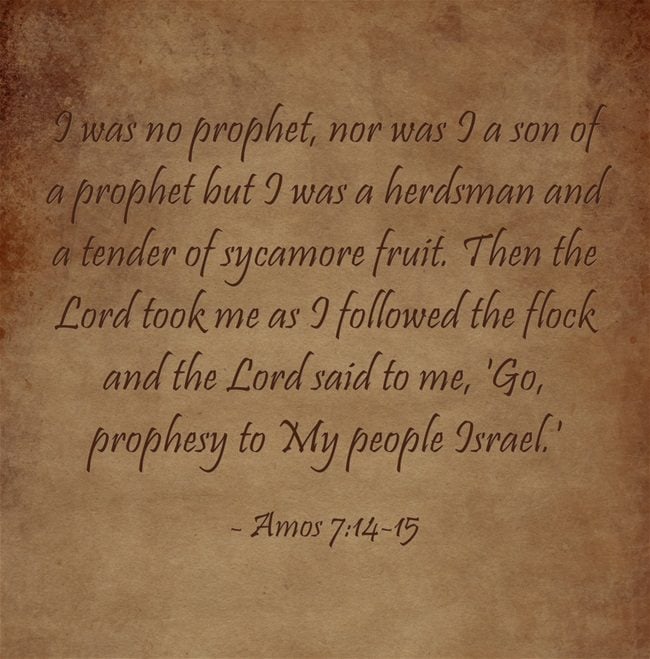
Who was Amos? Where did he come from? What was his background history and family ties? Amos came from Tekoa which was thirteen miles south of Jerusalem but is centered in the wilderness area of Judah and was a very small town. God called him to bring a message to Israel and the wicked King Jeroboam and it would not be a pleasant message either which may explain why Amos’ name means “burden-bearer.” Amos tells us something about himself as he writes, “I was no prophet, nor was I a son of a prophet,” he explains, “but I was a herdsman and a tender of sycamore fruit. Then the Lord took me as I followed the flock and the Lord said to me, ‘Go, prophesy to My people Israel’” (Amos 7:14-15).
Who wrote this Book?
The author doesn’t identify himself but at times it is obvious that Amos is referring to himself. Regardless, critical biblical scholarship holds that Amos is the author. This book would fit into the Jewish historical period of about 762 BC and the author tells of Amos’ mission to prophecy against the House of Israel and King Jeroboam II, who ruled the Northern Kingdom and separate from Judah, which lay to the south. The Book of Amos clearly indicates that these are his words and it even starts out by saying, “The words of Amos, who was among the shepherds of Tekoa, which he saw concerning Israel in the days of Uzziah king of Judah and in the days of Jeroboam the son of Joash, king of Israel, two years before the earthquake” (Amos 1:1).
Why was it Written?
We already know who wrote this book but why was it written? Clearly Amos was sent to prophecy against Israel, the Northern King and her king, King Jeroboam II, however Amos also prophecies against the nations surrounding Israel and Judah but why was the Book of Amos written?
Amos Chapter One and Two
Amos dates the time of his writing (1:1) and immediately prophecies against the nations surrounding Israel and Judah (1:2-2:3) but then turns his attention toward Judah because of their disobedience (2:4-2).
Amos Chapter Three
Amos then turns to Israel and God’s message to them and reminds them that He considers them His family and because of that, He says, “therefore (or because of this) I will punish you for all your iniquities” (Amos 3:2). Just as God is a loving Father, He also disciples all those He loves and are called His children (Heb 12:6) which is why Amos wrote “therefore” or because “of all the families of the earth” (Amos 3:2a) God chose them and He will discipline them if necessary because He loves them. What parent doesn’t discipline their own children?
Amos Chapter Four and Five
God is still speaking to Israel by saying “you cows of Bashan” (Amos 4:1). Bashan was the fertile area of land just below Mount Herman and was located in Samaria, which is where the Northern Kingdom (Israel) was at the time. This is directed specifically toward Israel. Part of their judgment was because they “oppress the poor [and] crush the needy” (Amos 4:1b). Part of God’s discipline to cause them to return to Him (repent) were droughts (Amos 4:7-8) agricultural diseases (Amos 4:9) and even pestilence that brought widespread death (Amos 4:10). Even then, Israel refused to return to God.
Amos Chapter Six and Seven
Next, Amos writes to both Israel and Judah (Amos 6:1) which is why he refers to them as Jacob (6:8). Before Israel split in half and became two separate nations (Israel, the Northern Kingdom and Judah, sometimes called Zion) so when Amos mentions Jacob he may be referring to both Israel and Judah. Amos continues to prophecy Jacob but Amos sees how horrible God’s judgments could be (Amos 7:1-2, 4, 7) that he prays for God’s mercy on them (Amos 7:2, 5).
Amos Chapter Eight and Nine
Some of God’s severest discipline comes upon Jacob (Israel and Judah) for trampling on the poor and the needy and then apparently bringing “the poor of the land to an end” (Amos 8:4) which could well mean that the poorest of the poor are starving to death and dying. All of their joyous feast celebrations will suddenly be times of morning (Amos 8:10). When once there had been plenty, there will come a time of famine (8:11) and it will be a very widespread drought (8:12). Amos reveals in great detail the coming destruction of Israel (Amos 9:1-10) but then the restoration of Jacob as a nation (9:11-15) and at that time, “I will restore the fortunes of my people Israel, and they shall rebuild the ruined cities and inhabit them” (9:14a) and “I will plant them on their land, and they shall never again be uprooted out of the land that I have given them,” says the Lord your God” (9:15).
Conclusion
The Book of Amos gives hope for the Jews and gives us an idea that God is not finished with Israel. Despite the attempts to exterminate the Jews over hundreds of years, they have always managed to survive as a people and now again, as a nation. God has promised that the “days are coming…when the plowman shall overtake the reaper and the treader of grapes him who sows the seed” (Amos 9:13) so even though Israel is nearly surrounded by enemies, she will survive and not only survive, she will thrive!
Article by Jack Wellman
Jack Wellman is Pastor of the Mulvane Brethren church in Mulvane Kansas. Jack is also the Senior Writer at What Christians Want To Know whose mission is to equip, encourage, and energize Christians and to address questions about the believer’s daily walk with God and the Bible. You can follow Jack on Google Plus or check out his book Teaching Children the Gospel available on Amazon.
Previous Post

September 24, 2015
How Did The Bible Become So Popular?
Next Post
September 25, 2015 Are People Born Transgender? A Bible Study
Browse Our Archives
Select a Category Bible Answers Bible Definitions Bible Story Bible Study Bible Verses Christian Books Christian Entertainment Christian Fathers Christian Mothers Christian Quotes Devotional Famous Christians Music News Parables Prayers Quotes Sunday School Lesson Uncategorized Youth Sermons
Select a Month October 2019 September 2019 August 2019 July 2019 June 2019 May 2019 April 2019 March 2019 February 2019 January 2019 December 2018 November 2018 October 2018 September 2018 August 2018 July 2018 June 2018 May 2018 April 2018 March 2018 February 2018 January 2018 December 2017 November 2017 October 2017 September 2017 August 2017 July 2017 June 2017 May 2017 April 2017 March 2017 February 2017 January 2017 December 2016 November 2016 October 2016 September 2016 August 2016 July 2016 June 2016 May 2016 March 2016 February 2016 January 2016 December 2015 November 2015 October 2015 September 2015 August 2015 July 2015 June 2015 May 2015 April 2015 March 2015 February 2015 January 2015 December 2014 November 2014 October 2014 September 2014 August 2014 July 2014 June 2014 May 2014 April 2014 March 2014 February 2014 January 2014 December 2013 November 2013 October 2013 September 2013 August 2013 July 2013 June 2013 May 2013 April 2013 March 2013
Follow Us!
TAKE THE
Religious Wisdom Quiz
What was the primary economic system in Biblical times?
Select your answer to see how you score.
Taxation Barter Gold standard Silver coins
Related posts from Christian Crier

Top 13 Bible Verses About Virtue

The Living, Active, Word Of God
The Exclusivity Of Salvation Through Christ Alone
TRENDING AT PATHEOS Evangelical

The REST of Your Life: A Creative Wrestles...
This week I had a conversation with a good friend from church....

How the author of the world's best hymn...
I've been working with John Newton for a while now. This makes...

Long before this Lectio Divina, Psalm 130 - the song - started...

What About the Trees? Another Living Parable
After I finished writing the last article about falling leaves as a...

Why Classical Education Is a Conversation, Not a...
Come and Read: Joy in Classical Education When I was a little...

Cornell University has received a great deal of negative publicity and intense...
view all Evangelical blogs
Ad-Free & Subscriber Log-In Subscription Support
- About Us
- 2026 Calendar
- Videos
- Podcasts
- Library of World Religions
- Faith In Media Tracker
- Advertise With Us
- Write for Us
- Privacy Policy
- Terms of Service
- Do Not Sell My Data
- Contact Us
- Radiant Digital
- Manage Newsletter Subscriptions
- Unsubscribe From Notifications
- Sitemap
Copyright 2008-2026, Patheos. All rights reserved.
Subscription Support Ad-Free & Subscriber Log-In
Follow Patheos