
BuddhistCatholicContemplativeEvangelicalGeneral ChristianHinduJewishLatter-day SaintMuslimNew VisionsProgressive Christian
Beliefs
- Buddhist
- Catholic
- Contemplative
- Evangelical
- General Christian
- Hindu
- Jewish
- Latter-day Saint
- More Voices
- Muslim
- New Visions
- Pagan
- Progressive Christian
Topics
- Religion News
- Food and Religion
- Sports and Religion
- Religious Art
- Religious Music and Entertainment
- Religious Events
- History and Religion
- Style and Religion
- Politics and Religion
- Women in Religion
- Recreation Outdoors and Religion
- Business Finance and Religion
- Careers Workplace and Religion
- Education and Religion
- Family Parenting and Religion
- Health Fitness and Religion
- Home and Religion
- Relationships and Religion
- Technology and Religion
- Travel and Religion
Columnists
- Buddhist Columnists
- Business Finance and Religion Columnists
- Careers Workplace and Religion Columnists
- Catholic Columnists
- Contemplative Columnists
- Education and Religion Columnists
- Evangelists Columnists
- Family Parenting and Religion Columnists
- General Christian Columnists
- Health Fitness and Religion Columnists
- Hindu Columnists
- History and Religion Columnists
- Home and Religion Columnists
- Jewish Columnists
- More Voices Columnists
- Latter Day Columnists
- Muslim Columnists
- New Visions Columnists
- Nonreligious Columnists
- Pagan Columnists
- Politics and Religion Columnists
- Progressive Columnists
- Recreation Outdoors and Religion Columnists
- Relationships and Religion Columnists
- Religion News Columnists
- Religious Art Columnists
- Religious Events Columnists
- Religious Music and Entertainment Columnists
- Sports and Religion Columnists
- Style and Religion Columnists
- Technology and Religion Columnists
- Travel and Religion Columnists
- Women in Religion Columnists
Resource Library
- 2026 Calendar
- Library of World Religions
- The 100 Most Holy Places on Earth
- Patheos Answers
- Podcasts
- Videos
- Faith Leaders Database
- Anglican Episcopalian
- Bahai
- Baptist
- Buddhism
- Christianity
- Confucianism
- Eastern Orthodoxy
- Hinduism
- Holiness and Pentecostal
- ISKCON
- Islam
- Judaism
- Lutheran
- Methodist
- The Church of Jesus Christ of Latter-day Saints
- New Age
- Paganism
- Presbytarian and Reformed
- Protestantism
- Religion Behind the Scenes
- Roman Catholic
- Scientology
- Shia Islam
- Sikhism
- Sufism
- Sunni Islam
- Taoism
- Zen
- See all religions
Research Tools
 Ad-Free & Subscriber Log-In Subscription Support
Ad-Free & Subscriber Log-In Subscription Support
Follow Patheos 

- Trending:
- Forgiveness
- |
- Marriage
- |
- Consciousness
- |
- Death Penalty
- |
- Election
- |
- Halloween
 Christian Crier
- Home
- Evangelical
- What does Eli Eli Lama Sabachthani Mean?
What does Eli Eli Lama Sabachthani Mean?
Last updated on: September 15, 2015 at 5:45 pm by Jack Wellman
What does Eli Eli Lama Sabachthani Mean? 2015-09-15T17:45:03-05:00 Jack Wellman
Patheos Explore the world's faith through different perspectives on religion and spirituality! Patheos has the views of the prevalent religions and spiritualities of the world.
What did Jesus say when He said while on the cross “Eli Eli Lama Sabachthani?” What does this mean exactly?
Despised and Abandoned
How many of us have felt abandoned in our faith within our family or workplace? Then think about Jesus Who “was despised and rejected by men man of sorrows, and acquainted with grief; and as one from whom men hide their faces he was despised, and we esteemed him not” (Isaiah 53:3) and especially at the cross where “he was pierced for our transgressions; he was crushed for our iniquities upon him was the chastisement that brought us peace, and with his wounds we are healed” (Isaiah 53:5). The word “rejected” literally means “forsaken” Jesus was forsaken by all men. Only “Mary the wife of Clopas, and Mary Magdalene, Jesus’ mother and the Apostle John” were left (John 19:25) so there was Jesus, the Innocent One dying for the guilty ones but all left alone.
Forsaken at Calvary
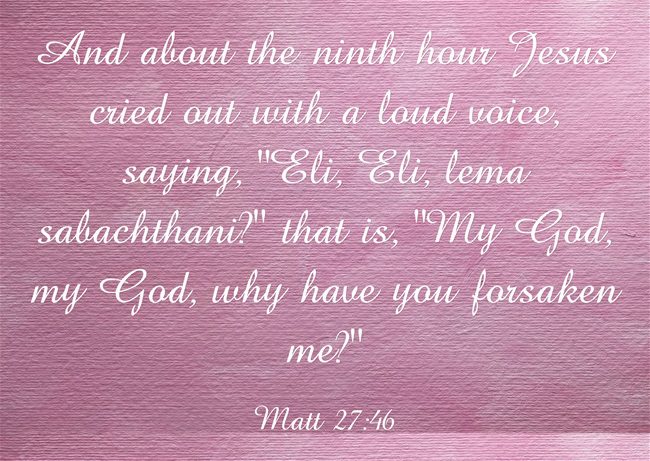
As Calvary approached, Jesus knew it was “the will of the Lord to crush him; he has put him to grief; when his soul makes an offering for guilt.” (Isaiah 53:10). Psalm 22 is where Jesus seems to quote when He “cried out with a loud voice, saying, “Eli, Eli, lema sabachthani?” that is, “My God, my God, why have you forsaken me” (Matt27:46). This is one of the rare occasions when the Scripture was in Aramaic; at least part of it was. We don’t have to guess what it means because it translates it for us; “My God, my God, why have you forsaken me.” Jesus’ quote is from Psalm 22:1. Reading the rest of Psalm 22 you can easily tell that it’s describing the crucifixion; Jesus was “scorned by mankind and despised by the people” (Psalm 22:6), saying “all who see me mock me; they make mouths at me; they wag their heads” (22:7); His soul was “poured out like water, and all my bones are out of joint” and His “heart is like wax; it is melted within my breast” (22:14). For three hours, Jesus’ “strength is dried up like a potsherd, and my tongue sticks to my jaws; you lay me in the dust of death” (22:15) and “a company of evildoers encircles me; they have pierced my hands and feet” (22:16). What you read in Psalm 22 is basically what you see happening at Calvary. He was forsaken or as the Strong’s Concordance suggests, it should read “You have left (forsaken, abandoned) me” (Number #G4518). It has been suggested by scholars that in Jesus’ humanity, as the skies remained black for three hours, Christ felt forsaken or abandoned by the Father. It was dark a full three hours; from about 12 noon until about 3 P.M (Matt 27:45). Jesus didn’t cry out this verse (Matt 27:46) until after the third hour of darkness so He endured three hours of utter darkness like everyone else did. Since God is light and the darkness hung like a damp fog, it might have felt like Jesus was completely forsaken, at least for a time.
Atonement on the Cross
The Day of Atonement looked forward to the day of Calvary as they “serve a copy and shadow of the heavenly things” (Heb 8:5) but “Christ has obtained a ministry that is as much more excellent than the old as the covenant he mediates is better, since it is enacted on better promises” (Heb 8:6) and “speaking of a new covenant, he makes the first one obsolete. And what is becoming obsolete and growing old is ready to vanish away” (Heb 8:13). The so-called scapegoat had all the sins of all of the people laid upon his head and he was led out into the wilderness to separate the sins from the people (Lev 16:21-22). Before we are saved we were separated from God by our sins and no goat could take them away (Isaiah 59:2) and so the spotless Lamb of God had to come and offer Himself to take upon Himself our sins. The righteousness we need is His righteousness, where Paul so beautifully illustrates that it was, “For our sake he made him to be sin who knew no sin, so that in him we might become the righteousness of God” (2nd Cor 5:21). Now we can be “at-one” with God which is what atonement means. It is to be “at one ment” or “at-one” with God. Our sins had prohibited this one-on-one relationship but Christ tore down the wall of separation between man and God just like temple veil that was torn from top to bottom that separated the Holy of Holies from the people. Jesus was our scapegoat but for millions more over the years.
Conclusion
IF you have confessed your sins to God, asked for His forgiveness, repented of your sins, and then put your trust in Christ, you are already “at-one” with God through Jesus Christ. There is no other way to be in the kingdom than through Christ (John 6:44) and this narrow, hard way, has only one Whom we must go through (Acts 4:12). At most, there are two paths to God; one is entering into eternal life in an eternal kingdom and be with the King (Rev 22) and the other is entering into judgment and hears the judgment of the Righteous Judge (Rev 10:12-15; 21:8). He can be your Advocate in the judgment or He can be your Judge and Sentencer.
Article by Jack Wellman
Jack Wellman is Pastor of the Mulvane Brethren church in Mulvane Kansas. Jack is also the Senior Writer at What Christians Want To Know whose mission is to equip, encourage, and energize Christians and to address questions about the believer’s daily walk with God and the Bible. You can follow Jack on Google Plus or check out his book Teaching Children the Gospel available on Amazon.
Previous Post

September 15, 2015
Are There Different Levels Of Heaven?
Next Post
September 15, 2015 What Does The Bible Say About Self Defense?
Browse Our Archives
Select a Category Bible Answers Bible Definitions Bible Story Bible Study Bible Verses Christian Books Christian Entertainment Christian Fathers Christian Mothers Christian Quotes Devotional Famous Christians Music News Parables Prayers Quotes Sunday School Lesson Uncategorized Youth Sermons
Select a Month October 2019 September 2019 August 2019 July 2019 June 2019 May 2019 April 2019 March 2019 February 2019 January 2019 December 2018 November 2018 October 2018 September 2018 August 2018 July 2018 June 2018 May 2018 April 2018 March 2018 February 2018 January 2018 December 2017 November 2017 October 2017 September 2017 August 2017 July 2017 June 2017 May 2017 April 2017 March 2017 February 2017 January 2017 December 2016 November 2016 October 2016 September 2016 August 2016 July 2016 June 2016 May 2016 March 2016 February 2016 January 2016 December 2015 November 2015 October 2015 September 2015 August 2015 July 2015 June 2015 May 2015 April 2015 March 2015 February 2015 January 2015 December 2014 November 2014 October 2014 September 2014 August 2014 July 2014 June 2014 May 2014 April 2014 March 2014 February 2014 January 2014 December 2013 November 2013 October 2013 September 2013 August 2013 July 2013 June 2013 May 2013 April 2013 March 2013
Follow Us!
TAKE THE
Religious Wisdom Quiz
True or False: Hebrews states that without faith it is impossible to please God.
Select your answer to see how you score.
TRUE FALSE
Related posts from Christian Crier

What Does The Bible Say About Our Thoughts?

Do Colors Have Special Meaning In The Bible?

The Glass – Half Empty Or Half Full?

TRENDING AT PATHEOS Evangelical

The REST of Your Life: A Creative Wrestles...
This week I had a conversation with a good friend from church....

How the author of the world's best hymn...
I've been working with John Newton for a while now. This makes...

Long before this Lectio Divina, Psalm 130 - the song - started...

What About the Trees? Another Living Parable
After I finished writing the last article about falling leaves as a...

Why Classical Education Is a Conversation, Not a...
Come and Read: Joy in Classical Education When I was a little...

Cornell University has received a great deal of negative publicity and intense...
view all Evangelical blogs
Ad-Free & Subscriber Log-In Subscription Support
- About Us
- 2026 Calendar
- Videos
- Podcasts
- Library of World Religions
- Faith In Media Tracker
- Advertise With Us
- Write for Us
- Privacy Policy
- Terms of Service
- Do Not Sell My Data
- Contact Us
- Radiant Digital
- Manage Newsletter Subscriptions
- Unsubscribe From Notifications
- Sitemap
Copyright 2008-2026, Patheos. All rights reserved.
Subscription Support Ad-Free & Subscriber Log-In
Follow Patheos