
BuddhistCatholicContemplativeEvangelicalGeneral ChristianHinduJewishLatter-day SaintMuslimNew VisionsProgressive Christian
Beliefs
- Buddhist
- Catholic
- Contemplative
- Evangelical
- General Christian
- Hindu
- Jewish
- Latter-day Saint
- More Voices
- Muslim
- New Visions
- Pagan
- Progressive Christian
Topics
- Religion News
- Food and Religion
- Sports and Religion
- Religious Art
- Religious Music and Entertainment
- Religious Events
- History and Religion
- Style and Religion
- Politics and Religion
- Women in Religion
- Recreation Outdoors and Religion
- Business Finance and Religion
- Careers Workplace and Religion
- Education and Religion
- Family Parenting and Religion
- Health Fitness and Religion
- Home and Religion
- Relationships and Religion
- Technology and Religion
- Travel and Religion
Columnists
- Buddhist Columnists
- Business Finance and Religion Columnists
- Careers Workplace and Religion Columnists
- Catholic Columnists
- Contemplative Columnists
- Education and Religion Columnists
- Evangelists Columnists
- Family Parenting and Religion Columnists
- General Christian Columnists
- Health Fitness and Religion Columnists
- Hindu Columnists
- History and Religion Columnists
- Home and Religion Columnists
- Jewish Columnists
- More Voices Columnists
- Latter Day Columnists
- Muslim Columnists
- New Visions Columnists
- Nonreligious Columnists
- Pagan Columnists
- Politics and Religion Columnists
- Progressive Columnists
- Recreation Outdoors and Religion Columnists
- Relationships and Religion Columnists
- Religion News Columnists
- Religious Art Columnists
- Religious Events Columnists
- Religious Music and Entertainment Columnists
- Sports and Religion Columnists
- Style and Religion Columnists
- Technology and Religion Columnists
- Travel and Religion Columnists
- Women in Religion Columnists
Resource Library
- 2026 Calendar
- Library of World Religions
- The 100 Most Holy Places on Earth
- Patheos Answers
- Podcasts
- Videos
- Faith Leaders Database
- Anglican Episcopalian
- Bahai
- Baptist
- Buddhism
- Christianity
- Confucianism
- Eastern Orthodoxy
- Hinduism
- Holiness and Pentecostal
- ISKCON
- Islam
- Judaism
- Lutheran
- Methodist
- The Church of Jesus Christ of Latter-day Saints
- New Age
- Paganism
- Presbytarian and Reformed
- Protestantism
- Religion Behind the Scenes
- Roman Catholic
- Scientology
- Shia Islam
- Sikhism
- Sufism
- Sunni Islam
- Taoism
- Zen
- See all religions
Research Tools
 Ad-Free & Subscriber Log-In Subscription Support
Ad-Free & Subscriber Log-In Subscription Support
Follow Patheos 

- Trending:
- Forgiveness
- |
- Marriage
- |
- Consciousness
- |
- Death Penalty
- |
- Election
- |
- Halloween
 Christian Crier
- Home
- Evangelical
- What Is The Leviathan In The Bible?
What Is The Leviathan In The Bible?
Last updated on: August 22, 2015 at 7:13 pm by Jack Wellman
What Is The Leviathan In The Bible? 2015-08-22T19:13:37-05:00 Jack Wellman
Patheos Explore the world's faith through different perspectives on religion and spirituality! Patheos has the views of the prevalent religions and spiritualities of the world.
What was the Leviathan in the Bible? What could this creature have been? How does the Hebrew language help us find out?
Self-Righteous Job
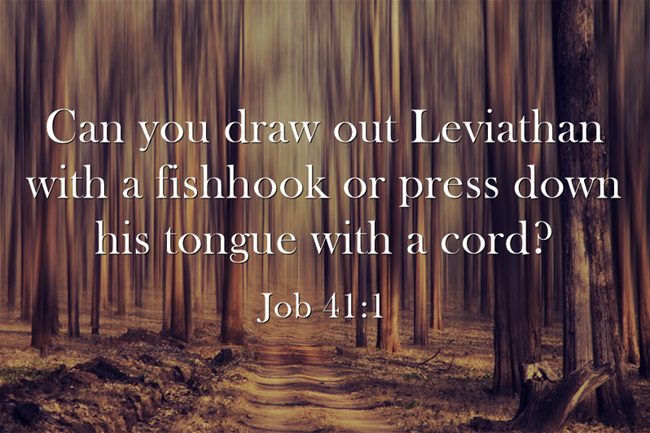
In Job 41:1 God asks Job a rhetorical question, “Can you draw out Leviathan with a fishhook or press down his tongue with a cord?” The obvious answer is no, it can’t be done. God was answering Job who had been questioning God so God came back and asked Job a lot of questions which basically says “Job, who do you think you are? I am the Creator! How could you even question me?” God begins to humble Job by reminding him of the creation and to put himself into the right perspective of the Creator and His creation compared to that which He created (Job).
The Leviathan in the Book of Job
What are the leviathans that are mentioned in the Book of Job and in the psalms as well as the Book of Isaiah? The Hebrew word for leviathan is “livyathan” so it’s not really a translation but a transliteration. To the author, the leviathan (livyathan) is apparently a sea monster or dragon, perhaps the extinct dinosaur, plesiosaurus but the exact meaning is unknown. This “leviathan,” whatever it was, is “so fierce that [who] dares to stir him up” (Job 41:10), who could possibly “fill his skin with harpoons or his head with fishing spears” (Job 41:7), or can “put a rope in his nose or pierce his jaw with a hook” (Job 41:2), and which “counts iron as straw, and bronze as rotten wood” (Job 41:27). This is not a whale or a sea serpent (sea snake) but something much greater. What it is exactly is insignificant next to what and Who God is and that is the whole point of this chapter. God reigns supreme above and over His creation, no matter how formidable it looks.
The Leviathan in the Book of Isaiah
The leviathan is also mentioned in the Book of Isaiah where he writes “In that day the Lord with his hard and great and strong sword will punish Leviathan the fleeing serpent, Leviathan the twisting serpent, and he will slay the dragon that is in the sea” (Isaiah 27:1). The word for “Leviathan” is the same as it is in the Book of Job, “livyathan” and means a sea monster or dragon. The Leviathan is described as “the twisting serpent” like a “dragon.” The Hebrew word for serpent is “nachash” and actually refers to a snake but then there’s the Hebrew word “tanniyn” and this means “sea dragon.” Is his is a physical description of the leviathan or a description of the leviathan’s attributes…or both? The leviathan resembles a twisting serpent but is also like a dragon. In the context of Isaiah 27 this reference may refer to the redemption of Israel as this is what the whole chapter is about. The reference may be about that old serpent, the Devil, which is what he is referred to elsewhere in the Bible (Rev 12:9) and that God will take hold of “the dragon” (Rev 20:2). To state that Isaiah is talking about a physical monster-like creature of the sea might be taking this one verse too far (in Isaiah 27:1).
The Leviathan in the Book of Psalms
In Psalm 74:14 it says “You crushed the heads of Leviathan; you gave him as food for the creatures of the wilderness.” Who is able to crush all resistance to Him? The context of this chapter is about God protecting and avenging Mount Zion. The Leviathan seems to portray the enemy and the “creatures” are actually people or a nation as the Hebrew word for creatures is “`am” meaning a nation or a people. This word (`am) is even embedded within Abraham’s name as He was known as the father of many nations (Gen 17:5). Another psalm also mentioned the leviathan in Psalm 104:26 where it says “There go the ships, and Leviathan, which you formed to play in it” almost seeming to indicate that the psalmist could still observe leviathans at play. The word for “play” is “sachaq” and means “to play, to laugh,” or “to mock” so maybe this represents the Devil mocking God and toying around with His people, Israel (Mount Zion). Either way, these two verses in the Book of Psalms doesn’t seem to specifically be about a creature on the earth but an invisible foe and God’s ability to protect His chosen people
Conclusion
The point of the verses referring to the leviathan is always to make the point that God’s creatures, no matter how big they are to us, is nothing to Him. He should receive all the glory for the created thing has nothing to boast in except its creator and in this case, THE Creator.
Article by Jack Wellman
Jack Wellman is Pastor of the Mulvane Brethren church in Mulvane Kansas. Jack is also the Senior Writer at What Christians Want To Know whose mission is to equip, encourage, and energize Christians and to address questions about the believer’s daily walk with God and the Bible. You can follow Jack on Google Plus or check out his book Blind Chance or Intelligent Design available on Amazon.
Previous Post

August 22, 2015
What Is The Difference Between Joy And Happiness In The Bible?
Next Post
August 22, 2015 What Is The Apocalypse In The Bible?
Browse Our Archives
Select a Category Bible Answers Bible Definitions Bible Story Bible Study Bible Verses Christian Books Christian Entertainment Christian Fathers Christian Mothers Christian Quotes Devotional Famous Christians Music News Parables Prayers Quotes Sunday School Lesson Uncategorized Youth Sermons
Select a Month October 2019 September 2019 August 2019 July 2019 June 2019 May 2019 April 2019 March 2019 February 2019 January 2019 December 2018 November 2018 October 2018 September 2018 August 2018 July 2018 June 2018 May 2018 April 2018 March 2018 February 2018 January 2018 December 2017 November 2017 October 2017 September 2017 August 2017 July 2017 June 2017 May 2017 April 2017 March 2017 February 2017 January 2017 December 2016 November 2016 October 2016 September 2016 August 2016 July 2016 June 2016 May 2016 March 2016 February 2016 January 2016 December 2015 November 2015 October 2015 September 2015 August 2015 July 2015 June 2015 May 2015 April 2015 March 2015 February 2015 January 2015 December 2014 November 2014 October 2014 September 2014 August 2014 July 2014 June 2014 May 2014 April 2014 March 2014 February 2014 January 2014 December 2013 November 2013 October 2013 September 2013 August 2013 July 2013 June 2013 May 2013 April 2013 March 2013
Follow Us!
TAKE THE
Religious Wisdom Quiz
What is the Christian principle about judging by appearances?
Select your answer to see how you score.
Do not judge by outward appearance Copy others' opinions See clothes first Judge quickly
Related posts from Christian Crier

What Does The Bible Say About Our Thoughts?

Do Colors Have Special Meaning In The Bible?

The Glass – Half Empty Or Half Full?

TRENDING AT PATHEOS Evangelical

The REST of Your Life: A Creative Wrestles...
This week I had a conversation with a good friend from church....

How the author of the world's best hymn...
I've been working with John Newton for a while now. This makes...

Long before this Lectio Divina, Psalm 130 - the song - started...

What About the Trees? Another Living Parable
After I finished writing the last article about falling leaves as a...

Why Classical Education Is a Conversation, Not a...
Come and Read: Joy in Classical Education When I was a little...

Cornell University has received a great deal of negative publicity and intense...
view all Evangelical blogs
Ad-Free & Subscriber Log-In Subscription Support
- About Us
- 2026 Calendar
- Videos
- Podcasts
- Library of World Religions
- Faith In Media Tracker
- Advertise With Us
- Write for Us
- Privacy Policy
- Terms of Service
- Do Not Sell My Data
- Contact Us
- Radiant Digital
- Manage Newsletter Subscriptions
- Unsubscribe From Notifications
- Sitemap
Copyright 2008-2026, Patheos. All rights reserved.
Subscription Support Ad-Free & Subscriber Log-In
Follow Patheos